
society
The Church as a Prison: How Pastors Keep Africa Enslaved


The Church as a Prison: How Pastors Keep Africa Enslaved.
By George Omagbemi Sylvester | Published by Sahara Weekly NG
They preach comfort instead of conviction, prosperity instead of truth and mental slavery instead of freedom. “Comfort replaces conviction and governments applaud their betrayal.”
The Betrayal of Christ’s Gospel.
It is no longer a secret that what we see on our pulpits today is far from what Jesus Christ Himself taught over 2,000 years ago. If the same Jesus who overturned the tables of corrupt money changers in the temple were physically present today, many of these so-called “men of God” would not only run for their lives but also face exposure for their deception. Christ preached freedom, truth, justice and boldness against the oppressive powers of His time. In contrast, many modern-day pastors have become cheerleaders of the ruling elite, deliberately reducing the church into an instrument of mental slavery.

Let us speak the truth without fear: if today’s pastors truly preached the radical gospel of Christ (condemning injustice, exposing government wickedness and mobilizing believers towards righteousness in governance) they would be arrested, harassed and prosecuted. Instead, governments across Africa and beyond give them patronage, front seats at state banquets and sometimes political appointments. Why? Because they are not a threat to oppression; they are an extension of it.
The Revolutionary Nature of Christ’s Message.
The ministry of Jesus was not one of political correctness. He was not a motivational speaker promising “BREAKTHROUGHS” and “PROSPERITY.” Instead, He declared in Luke 4:18: “The Spirit of the Lord is upon me, because he has anointed me to preach good news to the poor. He has sent me to proclaim freedom for the prisoners and recovery of sight for the blind, to release the oppressed.”

Christ did not promise private jets; He promised persecution. He did not preach “sow a seed for your miracle”; He demanded repentance and justice. He called the religious leaders of His time “HYPOCRITES,” “BLIND GUIDES,” and “a BROOD of VIPERS” (Matthew 23). If pastors today echoed such thunderous rebuke, they would be on government watchlists not on billboards smiling beside governors.
Mental Slavery Disguised as Religion.
Religion, in its corrupted form, has long been used as a tool of control. The late Kenyan intellectual, Professor John Mbiti, once noted: “Religion in Africa has often been manipulated as an anesthetic, dulling people’s consciousness against the injustices around them.”

Colonialists understood this tactic perfectly. During the transatlantic slave trade, enslaved Africans were forced to embrace a distorted version of Christianity designed to keep them obedient. While verses about obedience to masters were emphasized, the liberating passages about freedom and justice were conveniently ignored. This is what Jamaican revolutionary Marcus Garvey meant when he said: “We are going to emancipate ourselves from mental slavery, because whilst others might free the body, none but ourselves can free the mind.”

Sadly, African pastors today continue this legacy. Rather than empowering the people to resist corrupt governments, they encourage blind submission, promising that “your reward is in heaven” while collaborating with the very politicians that rob the poor.
Government and the Prosperity Gospel Alliance.
It is not accidental that governments tolerate and even endorse these churches. The prosperity gospel (preaching that faith guarantees wealth and comfort) creates docile followers who do not challenge injustice. When poverty is explained as a “spiritual problem” rather than the direct consequence of bad governance, corrupt leaders are shielded from accountability.
Dr. Allan Boesak, South African theologian and anti-apartheid activist, once warned: “Any theology that is indifferent to the suffering of the people is not theology but ideology in service of oppression.” Today’s Nigerian, Ghanaian and South African mega-churches are guilty of exactly this. They preach an ideology of silence, urging members to pray for their leaders rather than demand accountability from them.
That is why the government has no problem when pastors gather millions in crusades, as long as the message is harmless to power. If a pastor dares to echo Christ and thunder against corruption, as Archbishop Oscar Romero did in El Salvador before he was assassinated in 1980, then he becomes a target.
Christ Versus the Modern Pastor. The difference between Christ and modern pastors is as clear as light and darkness:
Jesus preached AGAINST the elite; modern pastors wine and dine with them.
Jesus DEMANDED justice for the poor; modern pastors demand tithes from the poor.
Jesus DECLARED truth without compromise; modern pastors dilute truth with motivational speeches.
Jesus FACED PERSECUTION from the state; modern pastors enjoy state protection.
The late Nigerian literary giant, Chinua Achebe, once remarked: “The trouble with Nigeria is simply and squarely a failure of leadership.” That failure is not limited to political leaders; it extends to spiritual leaders who have abandoned their prophetic responsibility to speak truth to power.
Facts That Cannot Be Denied.
Africa has the fastest-growing Christian population in the world. Pew Research reports that by 2060, 40% of all Christians globally will live in sub-Saharan Africa. Yet, this growth has not translated into reduced corruption or poverty. Why? Because religion has been domesticated into an escape from reality rather than a tool of transformation.
The prosperity gospel enriches pastors not societies. Forbes reports that some Nigerian pastors rank among the richest religious leaders worldwide, with fortunes worth hundreds of millions of dollars. Meanwhile, Nigeria ranks as one of the poorest nations, with over 133 million people living in multidimensional poverty according to the National Bureau of Statistics (2022).
Government complicity is evident. In many African countries, churches are exempted from taxation, even while they collect billions in offerings and donations. Politicians regularly appear at crusades during election seasons, using pulpits as campaign stages.
These are not coincidences; they are strategies.
The Path Forward: Reclaiming the True Gospel.
If Africans are to break free from mental slavery, they must demand a gospel that liberates rather than imprisons. The words of Ghanaian scholar Kwame Nkrumah ring true: “The emancipation of the mind is the greatest task confronting our continent.” This emancipation will not come from pastors selling anointed oil or politicians buying church loyalty; it will come from believers insisting that the gospel must confront, not comfort, oppressive systems.
The church must return to its prophetic roots:
Condemn bad governance with fearless boldness.
Defend the oppressed against exploitation.
Teach financial independence, not blind dependence on “miracle seeds.”
Remind believers that faith without works (without justice, without accountability) is dead.
Final Word.
The gospel of Christ is REVOLUTIONARY, RADICAL and LIBERATING. The gospel of today’s pastors is DOMESTICATED, COMMERCIALIZED and ENSLAVING. Until the church reclaims its true mission, governments will continue to support these mental prison wardens because they help keep the masses silent.
As the great African-American theologian Howard Thurman said: “Don’t ask what the world needs. Ask what makes you come alive and go do it. What the world needs is people who have come alive.”
Africa needs a church that is alive, not one that is asleep in the arms of corrupt power.






Dr. Bernard Shiaunda Eete Mobilizes Loyalists Ahead of Kenya’s General Election
Ahead of Kenya’s 2027 general election, Nyanza ODM aspirant Dr. Bernard Shiaunda Eete, popularly known as Dumex3, has intensified grassroots mobilization by holding a strategic meeting with his loyalists across the region. The gathering was aimed at aligning his team, refining campaign strategies, and positioning the movement for a decisive outcome at the polls.
The meeting provided an important platform for open consultation, idea exchange, and consensus building. Dr. Eete emphasized the need for unity, discipline, and clear communication as the campaign enters a critical phase. According to attendees, the discussions focused on strengthening the political structure on the ground, addressing community concerns, and ensuring that the movement remains responsive to the aspirations of the people.
A key focus was Dr. Eete’s developmental agenda for Nyanza. He outlined his commitments to education, youth empowerment, healthcare access, and infrastructure development, noting that these areas remain central to transforming lives in the region. He urged his loyalists to carry the message to the grassroots, explaining both what has been achieved so far and what the region stands to gain if they rally behind his candidacy.
“This is not just about winning an election. It’s about building a stronger, united political movement that delivers real change for our people,” Dr. Eete told the gathering. He called on his supporters to remain focused, avoid divisive rhetoric, and engage voters with facts about his track record and plans.
The meeting ended with a renewed commitment from the loyalists to expand outreach, coordinate ward-level activities, and mobilize voters ahead of party primaries and the general election. Organizers described the session as productive, noting that it sharpened the team’s resolve and clarified immediate next steps.
As political activity heats up in Nyanza, Dr. Eete’s camp says the strategy is clear: consolidate support, communicate consistently, and deliver a campaign anchored on service and results.


Live update from Kenya by Hon. Babatunde Seidu, Youths Ambassador._
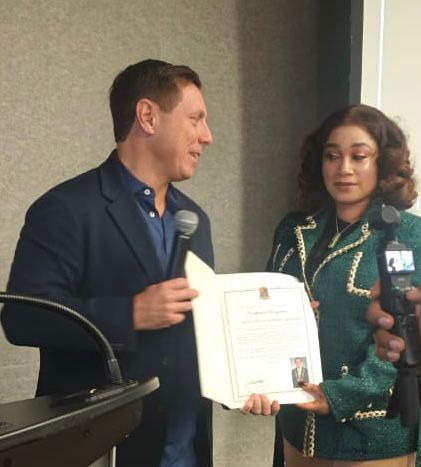
Mayor of Brampton Honours Olajumoke Abegunde For Charitable Works
…Foundation Touches Over 8,000 Women, Widows, and Youth in Ondo State…..
…Collaborates with International Partners for Free Skill Acquisition in Canada…
For Chief Mrs. Olajumoke Abegunde, the act of touching lives positively and contributing meaningfully to societal development is not merely a pastime but a deeply ingrained existential mandate. With unwavering gusto, she has remained faithful to this noble vision, championing the esoteric principle that cheerful giving and advocacy for the downtrodden are responsibilities too sacred to be left exclusively in the hands of the government.
This resolute philosophy has not only engendered transformative impact within her immediate locality but has also catapulted her onto the global stage. Recently, her passionate charitable exertions—executed both within and outside the shores of Nigeria—earned her prestigious international recognition.
A Legacy of Grassroots Transformation
As the visionary founder of the Jummy I Care Foundation, Chief Mrs. Abegunde has systematically dismantled barriers of vulnerability across Ondo State. Through sustained philanthropic gestures, she has disbursed extensive humanitarian relief and social assistance to over 3,000 indigent widows and elderly persons. In parallel, her foundation has galvanized robust support for orphaned and vulnerable children while orchestrating an ambitious women’s empowerment programme. To date, over 5,000 women have benefited from skills acquisition and income-generating activities designed to cultivate self-reliance and entrepreneurial audacity. Many of these beneficiaries have also received start-up seed capital to establish their own enterprises.
A proud alumna of Criminology and Security Studies from the National Open University of Nigeria, Chief Mrs. Abegunde has also distinguished herself as a patron of youth development. She has sponsored numerous essay writing and entrepreneurship competitions across Ondo State, in addition to funding medical outreaches, orphanage interventions, Iftar and Easter entrepreneurship programmes, and sustained feeding initiatives for the less privileged.
Her core philosophy remains immutable: when those who are well-to-do invest strategically in their immediate society, the collective becomes safer, more stable, and poised for greater heights.
International Collaboration and Brampton Honour
In a decisive move to intensify her developmental footprint, the Jummy I Care Foundation recently entered into a strategic tripartite collaboration with the Habeeb Okunola Foundation and the MakeMee Elegant Foundation. Together, they delivered a gratuitous, high-impact skill acquisition training programme to residents of Brampton, Canada.
Participants were immersed in an array of artisan crafts, including the production of resin bags, photo books, picture otters, resin key holders and frame holders, ornamental flower vases, rhinestone embellishment, and the advanced technique of printing images on fabrics.
In a ceremonial recognition of her sustained benevolence, the Mayor of Brampton formally hosted Chief Mrs. Abegunde and her delegation at the mayor’s office. The mayor personally expressed profound gratitude for her unwavering support of community development and entrepreneurship. As a tangible emblem of this appreciation, she was presented with a personally signed certificate of appreciation and commendation.
Unwavering Commitment to the Future
While accepting the honour, Chief Mrs. Olajumoke Abegunde reaffirmed her immutable resolve. She declared that her commitment to touching lives remains absolute and non-negotiable. According to her, she will not relent in ensuring that more lives are touched, more support is channeled to the people, and greater stability is secured for communities. She further emphasized her dedication to cultivating the spirit of entrepreneurship among women and youths as a cornerstone for sustainable development.
With over 8,000 direct beneficiaries in Nigeria alone and an expanding international footprint, Chief Mrs. Abegunde stands as a formidable testament to the profound change one determined philanthropist can effectuate when passion meets purpose.



APM Senatorial Candidate Ajadi Distributes Over 500 Bags of Rice
The Senatorial candidate of Oyo Central Senatorial District under the Allied Peoples Movement (APM), Ambassador Olufemi Ajadi Oguntoyinbo, has distributed over 500 bags of rice to residents, party members, state executives, and key stakeholders across Oyo State ahead of the forthcoming Eid al-Adha celebration.
The gesture, which forms part of his annual humanitarian outreach, was aimed at easing economic hardship and strengthening unity among party executives, party members, and residents within the senatorial district during the festive period.
Ajadi said the distribution was a continuation of his commitment to supporting vulnerable households and fostering community solidarity, especially at a time when many families are facing rising food prices and economic pressure.
He explained that Eid al-Adha is rooted in sacrifice, sharing, and compassion, adding that political leadership must consistently reflect empathy for the people, regardless of political affiliation or election cycles.
According to him, the intervention was extended to party executives, grassroots mobilizers, youth groups, and key stakeholders across the senatorial district to ensure equitable distribution across different segments of the political structure in Oyo State.
Ajadi further noted that the initiative was designed to complement household food needs during the festive season, stressing that small acts of support can significantly ease the burden on families affected by economic challenges.
He urged political leaders at all levels to prioritize welfare-driven initiatives that have direct impact on citizens, emphasizing that leadership should go beyond campaigns to sustained service delivery and humanitarian engagement.
Beneficiaries of the rice distribution expressed appreciation for the gesture, describing it as timely and thoughtful amid rising food costs across the country.
They commended Ajadi for maintaining close contact with grassroots members and consistently demonstrating what they described as people-oriented leadership.
The distribution exercise was carried out across selected locations within Oyo Central Senatorial District and coordinated through local party structures to ensure fairness and orderly sharing.
Political observers in the state noted that such interventions have become a key feature of political engagement in Nigeria, particularly during festive seasons, as politicians seek to connect with constituents beyond electoral promises.
As the Eid al-Adha celebration approaches, Ajadi reaffirmed his commitment to continuing similar initiatives aimed at supporting families and promoting unity among residents of Oyo State.


- Transforming Healthcare and Empowering Women: Dr. Rasha Kelej Recognized Among Africa’s 100 Most Influential Women May 25, 2026
- 2026 BASKETBALL AFRICA LEAGUE SEASON: BY THE NUMBERS May 25, 2026
- Guyana Confirmed to Host Caribbean Energy Week 2027 as Regional Energy Integration Gains Momentum May 25, 2026
- Canon Demonstrates Print’s ‘Power to Move’ with On-Stand Experience and Latest Large Format Technologies at Federation of European Screen Printers Associations (FESPA) Global Print Expo 2026 May 25, 2026
- Africa Doesn't Need to Be Translated; It Needs to Be Heard (By Rania El Rafie) May 25, 2026
- Venezuela Under Rodriguez: Turning Back Toward Stability and Opportunity (By NJ Ayuk) May 25, 2026
- Dubai Chamber of Commerce concludes trade mission in Addis Ababa with series of bilateral business meetings between companies from Dubai and Ethiopia May 25, 2026
- How Congo’s Offshore Legacy Fields Are Powering a New Production Upswing May 25, 2026
- Rugby Africa Appoints Former National Basketball Association (NBA) Africa Executive Aïcha Diop as Chief of Staff to the President May 25, 2026
- Global Africa Business Initiative shifts Digital and Health Action Pathways into higher gear to accelerate continent’s economic transformation May 25, 2026
- Transforming Healthcare and Empowering Women: Dr. Rasha Kelej Recognized Among Africa’s 100 Most Influential Women May 25, 2026
- 2026 BASKETBALL AFRICA LEAGUE SEASON: BY THE NUMBERS May 25, 2026
- Guyana Confirmed to Host Caribbean Energy Week 2027 as Regional Energy Integration Gains Momentum May 25, 2026
- Canon Demonstrates Print’s ‘Power to Move’ with On-Stand Experience and Latest Large Format Technologies at Federation of European Screen Printers Associations (FESPA) Global Print Expo 2026 May 25, 2026
- Africa Doesn't Need to Be Translated; It Needs to Be Heard (By Rania El Rafie) May 25, 2026
- Venezuela Under Rodriguez: Turning Back Toward Stability and Opportunity (By NJ Ayuk) May 25, 2026
- Dubai Chamber of Commerce concludes trade mission in Addis Ababa with series of bilateral business meetings between companies from Dubai and Ethiopia May 25, 2026
-

 news5 months ago
WHO REALLY OWNS MONIEPOINT? The $290 Million Deal That Sold Nigeria’s Top Fintech to Foreign Interests
-

 society3 weeks ago
SOCIAL MEDIA IS NOT A BATTLEFIELD COMMAND – WHY THE NIGERIAN ARMY’S ACTION AGAINST JUSTICE CRACK IS A NATIONAL SECURITY IMPERATIVE
-

 celebrity radar - gossips4 months ago
Dr. Chris Okafor Returns with Power and Fire of the Spirit -Mounts Grace Nation Altar with Fresh Anointing and Restoration Grace on February 1, 2026
-

 celebrity radar - gossips6 months ago
Prophet Kingsley Aitafo Releases 2026 Prophecy: ‘Nigeria Will Rise, but the World Must Prepare for Turbulence’