
Politics
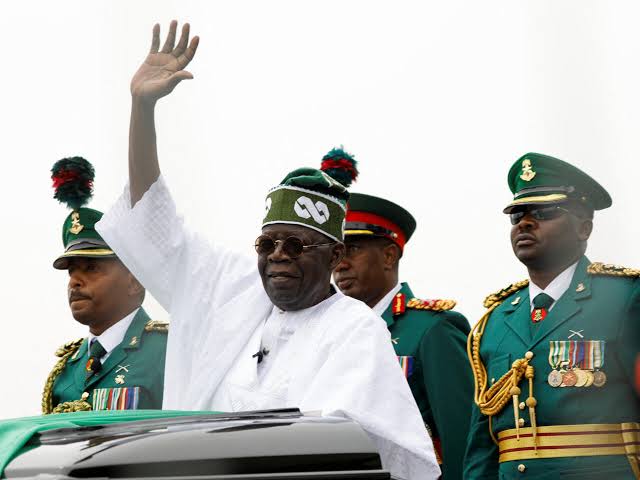
Tinubu’s Presidency In 30 Days

Tinubu’s Presidency In 30 Days
-
Households, and businesses under renewed inflationary pressures
-
Naira depreciation continues
-
Energy crises fester as electricity generation declines
-
Stock market rises 13.5%, investors gain N3.9trn
-
Portfolio investors are returning
-
Credit ratings may rise, says Bank of America
-
Oil sector reform beckons, says Int’l agencies
-
Analysts see rays of hope
The Tinubu Presidency in 30 days is impacting individuals, businesses, and the economy in an inescapable way, driven by double-barreled liberalization policies.

Though Vanguard findings reveal increased hardships as the cost of living rises sharply, many analysts, yesterday indicated that the difficulties would soften in the medium term if the fall-outs are managed properly.
The policies which are the removal of subsidy through petrol pricing to market forces and removal of official controls on the foreign exchange market by floating the Naira exchange rate in the open market, were launched in the first two weeks of Tinubu’s assumption of office.
Consequently, by yesterday, petrol prices at the pump have risen by a minimum of 175 percent to the national average of N600 per litre outside Lagos, though Lagos is selling at an average of N500 per litre, about a 169 percent rise.
The Naira, as at the close of business yesterday, has depreciated by 63 percent to N768.17 per dollar in the official market.
Last week, it was also announced that new taxes are taking effect from today while a 40 percent hike in electricity tariff has been proposed to take effect from today if the President approves the recommendation of the sector regulators and operators.
These additional policies meant to take effect from today are expected to join the petrol and the forex reforms in reshaping Nigeria’s economic environment and ultimately the life of the citizens in huge proportion going forward.
Policy Pronouncements
“….Fuel subsidy is gone………..The Central Bank must work towards a unified exchange rate”, the President said at his inauguration on May 29, 2023.
Thus the President signalled major changes in policy directions in two major sectors of the economy, which was followed by a raft of implementation measures felt in every home and in every facet of the economy, as prices of most food and essential items have now come under severe inflationary pressures.
Prices of Food, essential items
For example, eight out of the 11 food and essential items monitored by Financial Derivatives Company (FDC), a leading Lagos-based economic and financial research company, recorded significant price increases in June.
These are: Beans Oloyin (50kg) rose from N30,000 to N35,000; Tomatoes (50kg) rose from N55,000 to N65,000; Pepper (bag) rose from N20,000 to N33,000; Onions (bag) rose from N28,000 to N37,000; Palm Oil (25liters) rose from N22,500 to N29,000; New Yam (medium size) rose from N2,000 to N3,500; and Sugar (50kg) rose from N35,000 to N42,000.
The prices of Semovita (10kg) and Flour (50kg) remained stable at N6,800 and N28,500 respectively. But the price of Garri (50kg) Yellow fell from N28,000 to N19,000 and Rice (50kg) short grain fell from N35,000 to N33,000.
Naira depreciation
Following the pronouncement of the President, the Central Bank of Nigeria, CBN, on Wednesday, June 14, introduced new operational measures for the foreign exchange market. These include the elimination of multiple exchange rates and the reintroduction of the willing buyer, the willing seller model in the official market, and the Investors & Exporters (I&E) window.
Consequently, the exchange rate in the I&E window rose to N768.17 per dollar on June 27th from N471.67 per dollar on May 20th. This translated to 63 percent depreciation of the naira in the official market. The depreciation in the parallel market was marginal at 0.9 per cent during the same period, rising to N775 per dollar on June 27th from N768 per dollar on May 28th.
Meanwhile, the nation’s external reserves declined by $927 million during the same period.
According to data by CBN, the reserves fell to $34.22 billion on June 26th from $35.147 billion.
Notwithstanding these developments, analysts including the World Bank commended some aspects of the foreign exchange market reform which included the elimination of multiple exchange rates and the removal of other restrictions in the I&E window.
While noting that in the short term, the measures will lead to naira depreciation and inflation, they projected that in the long term, they will enhance investors’ confidence, enhance foreign exchange inflow into the economy, and stability in the forex market, as well as increase revenue for the government.
The World Bank in the June 2023 edition of its Nigeria Development Update, said: “The comprehensive reform initiated in mid-June addresses three critical distortions in the FX market: (i) the absence of a price discovery mechanism; (ii) the existence of multiple FX windows; and (iii) institutional weaknesses, such as a lack of transparency and predictability”.
But according to analysts at FDC, led by a notable economist, Bismarck Rewane, “The foreign exchange market will remain volatile in the short term as market expectations continue to drive the demand & supply dynamics. The naira is likely to trade within the band of N656/$ – N795/$ on the I & E window in the short term to medium term.
“ In the short term, the external reserve is likely to sustain its depletion as oil prices sustain its losses on fears of weak global demand. However, in the medium term, the reduction in forex restrictions and administrative controls will increase foreign investment inflows as lower currency & convertibility risks improve foreign investor confidence. This will lead to reduced depletion of the foreign exchange reserves”
Stock market rises, investors gain N3.9trn
Against the backdrop of a seeming adverse fallout from the new policies, investors in the Nigerian stock market seem to be the immediate beneficiaries. The stock market recorded a significant positive movement in the first 30 days of President Tinubu’s government, rising by 13.5 percent, even as investors gained N3.9 trillion within the period.
The surge is coming on the back of the new administration’s decision to remove the fuel subsidy, unify exchange rates and ensure that foreign investors and businesses are able to repatriate their earnings in dividends and profits.
The market began an upsurge on May 30, 2023, barely 24 hours after the presidential inauguration, and lasted to the end of June.
Specifically, the benchmark All Share Index (ASI), which measures the performance of the market rose to 60,108.86 points at the close of transactions on June 27, 2023, from 52,973.88 points on May 26, 202, days before the inauguration. This represents a 13.5 percent increase.
Similarly, the market capitalization of all listed equities advanced by 13.5 percent or N3.9 trillion to N32.730 trillion from N28.845 trillion.
Foreign portfolio investors have also resumed participation in the equity market in response to the policy changes. Available data from the Nigerian Exchange Limited (NGX) on Domestic and Foreign Portfolio Investors’ Participation in Equity for May 2023 showed that foreign investors raised their stake by 338.72 percent, reflecting the rally that ensued in the last two days in May, following the announcement of the policy changes.
Analysis showed that the FPIs raised their stake to N37.16 billion from N8.47 billion in April, representing an 11.5 percent participation level and a 7.07 percentage point increase compared to their total transaction (4.43%) in April.
Credit rating may rise
As Nigeria undergoes reforms, the bond market has responded positively with Nigeria’s bonds outperforming peer countries, according to the Bank of America report.
The country’s current spread came in tighter than Angola, Egypt, and Kenya for 5yr, 10yr, and 30yr which made the country’s rating reflect B (implied rating), higher than the actual rating of B-.
In November 2022, Fitch downgraded the country’s credit rating to B- due to the continued deterioration of the fiscal and debt position despite the elevated oil prices.
Not quite long after, Moody followed suit by downgrading to Caa1 with a stable outlook.
The Bank of America expects a likely upgrade of the country’s rating considering the performance of the market and the key policy reforms. Analysts affirm the possible upward review of the country’s rating as the recent policy suggests a better fiscal position.
However, the debt position and debt servicing might hinder the desired upgrade as total public debt is expected to climb to around N81trillion as of June 2023 and debt servicing continues to rise.
Analysts comments
Speaking on the developments, David Adonri, Vice Chairman, of Highcap Securities, said that the capital market would receive a great boost if the monetary policy could be normalized by lowering interest rates.
His words: “If monetary policy can be normalized through lowering of interest rate, liberalization of consumer credit including margin credit, unification of exchange rate, which has commenced, and release of trapped foreign investor’s funds, the capital market will receive a great boost. If the interest rate falls to the point where the yield on equities supersedes the yield on debt, the primary market which is the essence of the capital market can start booming again.
“However, some of these are still conjectures because the necessary actions are yet to be taken. Action always speaks louder than words. It may also be premature at this point to anticipate what impact the other proposed fiscal policies will have on the capital market but they are laudable goals if the President will summon the iron determination to actualize them.”
Agreeing with him, Victor Chiazor, Head of Research, and Investment, at FSL Securities, said: “The equities market will continue to react positively to government policies that it perceives as the right and market-friendly policies. So far, the market has been excited about the recent policy statements by the new administration hence the rally being observed in the market which has lifted the market by 13.5% in 30 days.
“The next phase will now be to implement coordinated fiscal and monetary policies that will foster a favourable business environment and a prosperous economy and until the market sees a semblance of these things, the market rally may be short-lived.”
Also speaking, Uche Uwaleke, Professor of Capital Market and President, of Capital Market Academics of Nigeria, said: “Whether the bullish sentiment will be sustained, especially on the part of domestic investors, depends on how the impact of the reforms are managed as well as on the implementation of the policies contained in his economic blueprint aimed at boosting the capital market such as leveraging opportunities in infrastructure financing via Sukuk and promoting commodity exchanges which ought to facilitate growth in agric GDP.”
Oil sector reform beckons
During the Buhari-led administration, policy advice from international development agencies revolved around the removal of the petrol subsidy and the elimination of the multi-tiered exchange rate system.
The implementation of these reforms by the new Tinubu-led administration has been driving the wave of optimism expressed by these agencies about Nigeria’s business environment.
Bank of America’s (BoA) analysis of Nigeria demonstrates this viewpoint. The US-based bank noted that President Bola Tinubu’s political influence has successfully led to the removal of fuel subsidies and the floatation of the naira, without any societal uproar.
The bank predicts that, with the current momentum, Tinubu’s next significant move will be to eliminate oil theft by overhauling the security sector and involving host communities.
According to the bank, if this strategy proves effective, it could raise Nigeria’s crude oil production to 1.6mb/d in 12-18 months from the present 1.2mb/d, barring OPEC limits, and combining this with the operation of the Dangote refinery would indicate a potential structural enhancement in Nigeria’s economic prospects.
But some other analysts are less optimistic as BoA was about the country’s oil and gas sector reforms and prosperity. According to them, the country’s oil infrastructure is limited in capacity as many would require a complete overhaul to operate near the nameplate capacity, which would require more than the projected timeframe.
Also, Nigeria’s oil theft cartel is said to have extended beyond the security architecture and host communities. It has become an organized parallel industry that includes security personnel, oil companies, supply chain partners, and host communities, among others, with sophisticated infrastructure, which could undermine reforms targeted at certain segments.
Moreso, they said years of many challenges, such as the high cost of production and unmet export obligations, may have weakened the prospect of Nigeria’s crude oil in the international market.
Analysts believe a more holistic approach that combines regulatory actions, technology, and institutional reforms should, however, deliver short to medium success.
Meanwhile, analysts reckon that the operation of the Dangote refinery will not significantly bring down petroleum product prices but could provide price cushions as the company will also operate in the global high-cost environment.
Electricity generation drops
Notwithstanding, with the mixed fallouts from the policy statements so far, Nigeria’s electricity sector remained negative.
Average electricity generation dropped month-on-month, MoM, by 3.8 percent to 4,003.4 megawatts, MW in June 2023, from an average of 4,161MW recorded in the preceding month of May 2023.
This was based on data obtained by Vanguard from the Nigeria Electricity System Operator, the semi-autonomous arm of the Transmission Company of Nigeria, TCN.
Checks by Vanguard indicated that less than 4,000MW was transmitted and distributed daily to consumers, including households and organizations, a development that compelled many to generate their independent power at a higher cost.
The high cost of independent power generation by households and organizations was not only because of the high price of diesel currently hovering at over N600 per litre, but also the higher cost of petrol in the past one month.




AMBO and the Osun Governorship Race: Assessing the Man, the Politics and the Vision
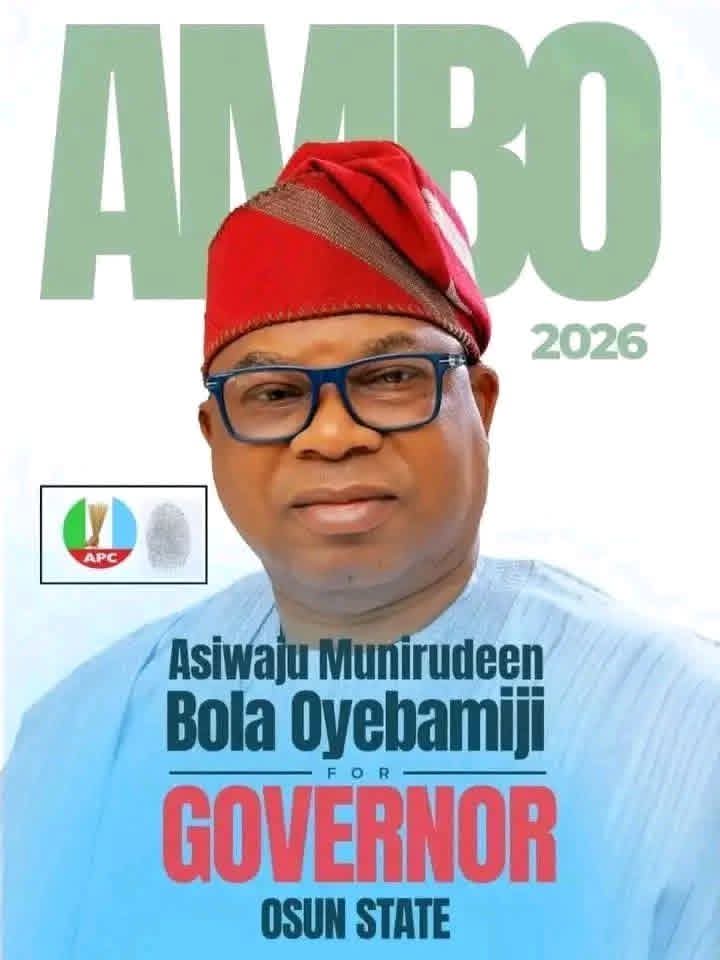
As political activities gather momentum ahead of the 2026 Osun State governorship election, a public affairs commentator, Oluseyi Olonade, has described the emergence of Asiwaju Munirudeen Bola Oyebamiji, popularly known as AMBO, as a significant development in the state’s political landscape.
In an article titled “Oyebamiji: The Man, The Politics and The Aspiration,” Olonade argued that the All Progressives Congress governorship hopeful possesses the character, experience and vision needed to reposition Osun State for sustainable growth.
According to the writer, Oyebamiji’s appeal stems from his extensive background in the banking sector, where he spent nearly three decades working with institutions including Wema Bank, Trans International Bank, Spring Bank and Enterprise Bank.
A native of Ikire in Irewole Local Government Area, Oyebamiji was described as a technocrat whose experience in corporate governance, finance and risk management has shaped his approach to public administration.
The article noted that his public service journey gained prominence in 2012 when he was appointed to oversee the then Osun State Investment Company Limited. Under his leadership, the organisation was reportedly restructured and transformed into Omoluabi Holdings Limited.
The writer further highlighted Oyebamiji’s tenure as Commissioner for Finance under successive APC administrations, where he was credited with managing the state’s finances during challenging economic periods.
Olonade also referenced Oyebamiji’s appointment as Managing Director of the National Inland Waterways Authority, describing it as further evidence of his administrative and leadership capabilities.
The article contrasted Oyebamiji’s governance philosophy with that of the current administration in Osun State, arguing that the APC aspirant favours institutional reforms, economic diversification and fiscal discipline.

According to the writer, Oyebamiji’s proposed agenda includes strengthening transparency in government spending, expanding internally generated revenue, attracting private-sector investments and promoting industrial and agricultural development.
The article also highlighted youth empowerment, entrepreneurship development and digital skills acquisition as key components of his vision for the state.
Olonade concluded that the forthcoming governorship election would present voters with a choice between different approaches to governance, expressing confidence that Oyebamiji’s experience and developmental agenda make him a strong contender in the race.
*Oselu Tiwa nTiwa Endorses Oriyomi Hamzat for Oyo Governorship*
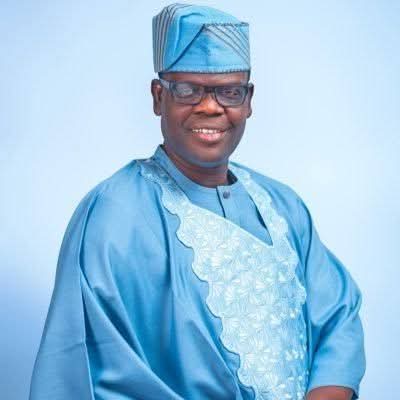
A sociopolitical support group in Oyo State, Oselu Tiwa nTiwa, has declared its support for Alhaji Oriyomi Hamzat as the authentic governorship candidate of the Accord Party ahead of the forthcoming governorship election in the state.
The group made its position known in a statement jointly signed by its President, Mr. Adewale Oluwaseyi and Secretary, Alh. Adebayo Oyewole, on Thursday, describing Hamzat as a grassroots figure with strong connection to the people and a track record of humanitarian interventions across Oyo State.

According to the group, the endorsement followed what it described as careful observation of Hamzat’s leadership qualities, compassion and dedication to the welfare of ordinary citizens.
“Oriyomi Hamzat has consistently demonstrated empathy, courage and selfless commitment to humanity. Through his numerous interventions in the lives of ordinary citizens, he has become a symbol of hope to many families and communities,” the statement read.
Oselu Tiwa nTiwa also appealed to the national leadership of the Accord Party to prioritise the long-term future and electoral growth of the party in its decision-making process.
The group noted that Hamzat’s candidacy presents an opportunity for the party to strengthen its grassroots support base and expand its political relevance across Oyo State.
“We respectfully appeal to the National Leadership of the Accord Party to look beyond immediate political calculations and consider the bigger picture, the future growth, stability and electoral success of the party in Oyo State and beyond,” the statement added.
The group further expressed confidence in the leadership of the party, saying it believes the party’s national officers and stakeholders would take decisions that reflect fairness, inclusiveness and the collective interest of members.
While calling on party loyalists to remain calm and united, Oselu Tiwa nTiwa said continued consultations among stakeholders would help strengthen the Accord Party ahead of the election.
Signed:
Alh. Adebayo Oyewole,
Secretary.
Atiku Set To Clinch ADC Presidential Ticket, Leads Amaechi, Hayatu-Deen In 34 States
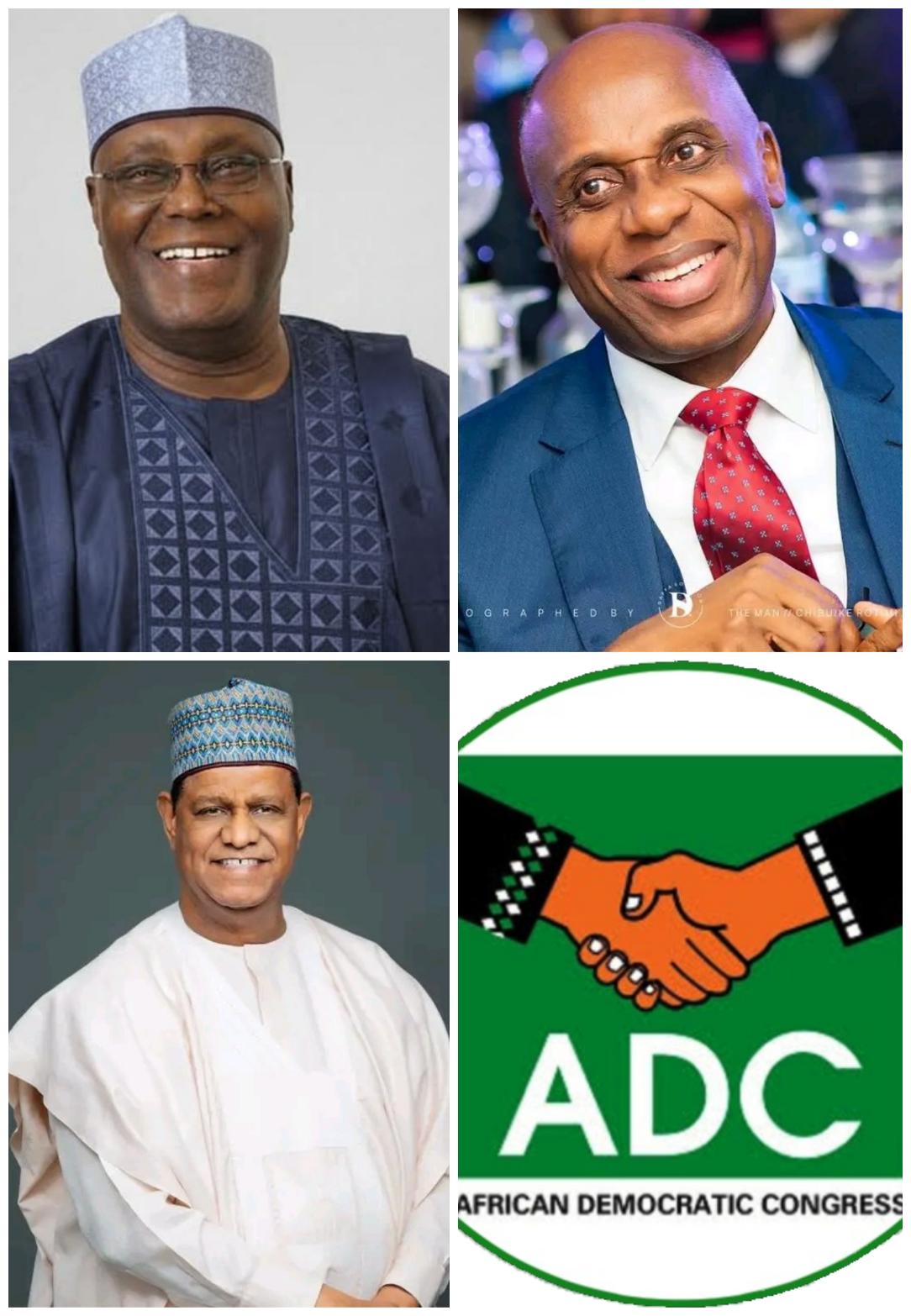
Former Vice President of Nigeria and frontline presidential aspirant of the African Democratic Congress (ADC), Atiku Abubakar, is projected to emerge winner of the party’s presidential primaries, according to impeccable sources in Abuja.
The primaries, conducted across over 8,000 wards in the 36 states of the federation and the Federal Capital Territory, reportedly placed Atiku far ahead of his closest rivals — former Rivers State Governor, Rotimi Amaechi, and former Chairman of the Nigerian Economic Summit Group, Mohammed Hayatu-Deen.

Highly placed party insiders disclosed that Atiku is currently leading in 34 states, including the FCT, after securing dominance across the 19 Northern states, the five South-East states, and the six South-West states, while also maintaining a strong showing in at least three states in the South-South geopolitical zone.
The sources added that the outcome reflects what they described as “an overwhelming nationwide acceptance” of the former vice president within the opposition party ahead of the 2027 general election.
Meanwhile, the ADC leadership has invited members of the press to the official announcement of the final collated results scheduled for 11:00 a.m. on Tuesday, May 26, 2026, in Abuja.
The declaration of results is expected to be broadcast live on ARISE Television and two other major television stations, while also being livestreamed on the party’s official social media platforms on X and Facebook.
Speaking ahead of the announcement, the founding National Chairman of the ADC, Chief Ralph Nwosu, said the decision to televise the exercise live was aimed at promoting transparency and democratic accountability.
“We want millions of Nigerians at home and in the Diaspora to witness democracy in action,” Nwosu said.
He further revealed that the party leadership would encourage all three presidential aspirants to publicly embrace a peace accord and commit themselves to working together in unity for the party’s success.
According to him, the move is necessary to strengthen internal cohesion and position the ADC for victory in the presidential election scheduled for January 16, 2027.
Details later.


- Economic Community of West African States (ECOWAS) Commission and Women in Law and Development (WiLDAF) Train Women Cross-Border Traders in The Gambia June 5, 2026
- Eritrea: Seminar to Nationals in The Hague June 5, 2026
- Eritrea: Training on Photography and Video Production June 5, 2026
- Dr. Rasha Kelej Merck Foundation Chief Executive Officer (CEO) and African First Ladies release “Rays of Hope” Animation Film and Storybook to Raise Awareness About Childhood Cancer June 5, 2026
- Digital transformation journey takes centre stage at ANGOTIC 2026 June 5, 2026
- Junior Achievement (JA) Africa Delivers 1.6 Million Learning Experiences in a Single Year, Marking Twelve-Fold Growth in Five Years June 5, 2026
- United Nations Mission in South Sudan (UNMISS) helps plant hope among youth on World Environment Day June 5, 2026
- Afreximbank Deepens Engagement with Jamaica to Drive Trade, Investment and Industrialisation June 5, 2026
- World Health Organization (WHO) supports reactive yellow fever vaccination campaign and Bundibugyo virus disease (BVD) preparedness in Liberia June 5, 2026
- Uganda: Museveni pushes for wealth creation through development programmes June 5, 2026
- Economic Community of West African States (ECOWAS) Commission and Women in Law and Development (WiLDAF) Train Women Cross-Border Traders in The Gambia June 5, 2026
- Eritrea: Seminar to Nationals in The Hague June 5, 2026
- Eritrea: Training on Photography and Video Production June 5, 2026
- Dr. Rasha Kelej Merck Foundation Chief Executive Officer (CEO) and African First Ladies release “Rays of Hope” Animation Film and Storybook to Raise Awareness About Childhood Cancer June 5, 2026
- Digital transformation journey takes centre stage at ANGOTIC 2026 June 5, 2026
- Junior Achievement (JA) Africa Delivers 1.6 Million Learning Experiences in a Single Year, Marking Twelve-Fold Growth in Five Years June 5, 2026
- United Nations Mission in South Sudan (UNMISS) helps plant hope among youth on World Environment Day June 5, 2026
-

 news6 months ago
WHO REALLY OWNS MONIEPOINT? The $290 Million Deal That Sold Nigeria’s Top Fintech to Foreign Interests
-

 society1 month ago
SOCIAL MEDIA IS NOT A BATTLEFIELD COMMAND – WHY THE NIGERIAN ARMY’S ACTION AGAINST JUSTICE CRACK IS A NATIONAL SECURITY IMPERATIVE
-

 celebrity radar - gossips4 months ago
Dr. Chris Okafor Returns with Power and Fire of the Spirit -Mounts Grace Nation Altar with Fresh Anointing and Restoration Grace on February 1, 2026
-

 celebrity radar - gossips6 months ago
Prophet Kingsley Aitafo Releases 2026 Prophecy: ‘Nigeria Will Rise, but the World Must Prepare for Turbulence’