
celebrity radar - gossips
When Private Love Becomes Public Lesson: What Adaobi Alagwu Must Learn From Regina Daniel’s Exit Strategy


*When Private Love Becomes Public Lesson: What Adaobi Alagwu Must Learn From Regina Daniel’s Exit Strategy*
It is an open secret that disgraced baby mama and embattled mistress to Tunde Ayeni, Adaobi Alagwu, represents a generation brimming with opportunity yet prone to mistaking access for achievement and sponsorship for a life plan. She is what critics describe as the outcome of youth mistaking beauty for currency and believing time will always show indulgence. Nowhere is this lesson clearer than when her story is compared with another national marital drama: the recent spotlight on the Ned Nwoko–Regina Daniels household.
When photographs surfaced of Ned, 65, and his mother visiting his children at their boarding school without Regina in the frame, online speculators declared crisis. Rumors multiplied faster than facts, yet the couple weathered the moment with measured silence. Regina Daniels, 25, was no stranger to scrutiny; visibility has always been part of her career. Having grown in the public eye, she understands the cost of avoidable theatrics. Even when her marriage reached its quiet conclusion, she navigated the transition with maturity beyond her years. She did not crumble. She did not cling. She moved forward.
Unlike 30-year-old Adaobi—still frozen in emotional adolescence, turning Ayeni, 59, into a monthly ATM—Regina rewrote her narrative. She preserved her independence, reclaimed her career, and chose dignity over dependency. Her choices reflect a truth Adaobi has yet to grasp: luxury given is never as empowering as luxury earned. A million-naira allowance can thrill, but it quickly becomes a leash, especially when the giver grows embarrassed by scandal.
That is Adaobi’s reality today. She is tethered to a man who has repeatedly denied her, distanced himself from her, and rejected paternity of her daughter, Omarosa. Despite her age and supposed ambition, Adaobi remains a pitiable figure, deeply dependent on Ayeni’s allowances, rent-free living, and access to properties. Friends describe her as bitter and desperate, clinging to financial lifelines while her peers pursue careers, education, and grounded adult lives.
Her reliance is so entrenched that even after public humiliation—leaked intimate videos, online spats, rejection, and police entanglements—she refuses to detach. Instead, she reportedly manipulates narratives, leverages social media, and works hand-in-hand with her mother to maintain relevance in Ayeni’s world.
Now, she is back on a quest to reclaim her place as Ayeni’s mistress, despite him retrieving her bride price, issuing sworn affidavits severing ties, and insisting the relationship was a grave mistake. In those documents, Ayeni accused her of lacking moral discipline, denied fatherhood of her child, and detailed attempts to malign his name. Add the leaked nudes, WhatsApp rumors, defamation runs, and her arrest, and her predicament becomes a full circus of disgrace.
Yet the spectacle continues. Her engagement to Amadi Etinosa, which came after Ayeni repossessed her bride price, has not halted her determination to return to Ayeni’s orbit. Insiders claim she remains committed to restoring her place as his concubine—while Ayeni himself appears to be softening slightly, much to the frustration of those who hoped the drama had ended.
Adaobi’s dependence on Ayeni is not merely financial but psychological. She seems anchored by the belief that her identity is inseparable from a man who continually rebuffs her. As Ayeni distances himself, she doubles down—arranging visits, maintaining proximity, and fighting to retain privileges she should have long forfeited.
What truly damns her story is the absence of personal agency. Rather than rebuild after adversity, she has settled into the role of a kept woman—reactive, passive, and defined entirely by an older man’s generosity. While her contemporaries build careers and reputations, Adaobi’s entire existence revolves around remaining close to money, turning allowances into her only measure of self-worth. This has created a cycle of dependency, embarrassment, and wasted potential.
Adaobi, still young enough to reinvent herself, does not see the opportunity slipping away. She is fixated on the next half-million or million naira rather than the next certificate, business, or career milestone. Each month brings anxiety over allowances instead of the confidence of personal earnings. She has built no structure—financial, professional, or emotional—that can outlive Ayeni’s mood swings. She has not learned that dependency stunts growth.
Regina, on the other hand, understood this early. She cultivated relevance beyond marriage and built networks not tied to a man’s affection. When the winds shifted, she did not crumble; she adapted. Intentionality became her defining trait. Her story is a roadmap for young women: potential means nothing without direction. Monthly allowances disappear into hair, travel, emergencies, and online shopping. Investments, skills, and businesses last.
Regina used her resources as seeds, not shows. The result is a transformation that even older women respect. She never labored under the illusion that marrying wealth was a career. She embodied the modern woman who can partner with power without losing herself. And when her marital path reached its natural end, she walked forward with purpose.
Thus, the contrast between Regina and Adaobi is not age, beauty, or circumstance—it is substance. Regina always understood she had a future to protect, a name to defend, an identity to maintain. Adaobi has never demonstrated that grounding—in ambition, vision, or discipline.
Youth cannot excuse it. Regina is younger yet far more self-aware.
Ayeni himself is central to this cautionary tale. His narcissism and manipulation fuel a dynamic that survives only because Adaobi remains the perfect victim—directionless, insecure, and prepared to cling to anyone who can give her fleeting relevance. To many observers, she seems trained into dependency. Even Amadi’s unexpected willingness to engage her could not save her, because a woman without identity inevitably gravitates toward chaos.
Ned chose Regina: a woman not easily silenced or reduced. Ayeni chose Adaobi: a woman eager to obey, cling, and collapse. Regina speaks loudly because she has a voice; Adaobi is quiet because she has no center. Regina can walk away because she has her own world; Adaobi stays because she has nothing else.
Regina’s choices are instructive not because she is famous but because she chose self-determination over gossip, pity, and dependency. She designed a future in which she could never become emotionally stranded or financially helpless.
Adaobi, by contrast, is now known not for brilliance or entrepreneurial promise but for waiting on credit alerts. That reputation is bleeding her dry—eroding professional opportunity, social capital, and dignity. She is transitioning from partner to liability.
Ayeni, too, is paying a price. A man of his age and status should not be learning through public humiliation, yet he has allowed personal missteps to contaminate his professional reputation. Old allies no longer invite him to meetings. Business partners avoid association. Respect, once lost, takes longer to rebuild than money.
Even Ned Nwoko learned early that private appetites require discretion. The digital age permits no leniency. Ayeni, unfortunately, let private matters spill into public corridors where reputation is currency.
Regina’s exit from her marriage serves as a lesson. She did not wait to become stained by scandal. She controlled her narrative.
Adaobi should ask herself a simple question: If the alerts stop today, who is she? A woman without direction is a kite tied to someone else’s fist; a woman with purpose is a bird that needs no rope.
Every month that Ayeni funds her survival, he stunts her evolution. She has not asked more of life. Her existence revolves around consumption instead of creation. This is not partnership; it is dependency wrapped in luxury aesthetics.
Ayeni must also realize that men of influence live under scrutiny. Personal indulgence inevitably becomes public record. Many powerful men have watched their empires crumble due to unchecked appetites. Ayeni edges closer to that cliff.
Adaobi, on her part, must eventually understand that womanhood is more than waiting for a bank message. She could practice law, pursue further studies, start a business, build skills, explore trade, or cultivate a personal brand. She could look to Regina not as a rival but as a model. Regina embodies the truth that femininity and ambition are compatible, that youth fades but reputation endures, and that allowances are never equal to a future.
Love is beautiful, youth is beautiful—but neither are life plans. Regina learned this early. Adaobi must learn it soon. And Ayeni must understand that the world is watching, not because love is scandalous, but because reputation is fragile and relevance requires discipline.
Reinvention is still possible for both Adaobi and Ayeni—if they choose the maturity, clarity, and independence that Regina embraced.
The future belongs not to those who wait for allowance alerts, but to those who build something that outlives love itself.




celebrity radar - gossips
Akintunde Ogundare Records Another Feat, Graduates with Distinction from University of Guelph-Humber

Akintunde Ogundare Bags Distinction in Canada, Extends Academic Excellence Streak
A Nigerian scholar, Akintunde Ogundare, has once again demonstrated his commitment to academic excellence by graduating with Distinction from the University of Guelph-Humber, Canada, adding another prestigious qualification to an already impressive educational record.

Ogundare earned a Bachelor of Applied Science (BASc) in Community Social Services with Distinction, a feat that underscores years of dedication, resilience and an unwavering pursuit of knowledge.
The convocation ceremony is slated for June 15, 2026, at the Toronto Congress Centre, North Building, Etobicoke, Ontario, where family members, friends and associates are expected to celebrate the milestone.

The latest achievement extends Ogundare’s remarkable streak of academic success across institutions in Nigeria and Canada.
Before obtaining his latest degree, he graduated with Distinction from George Brown College, Canada, where he earned a Diploma in Social Service Work. He also holds a Bachelor of Science in Business Administration with Second Class Upper Division from Joseph Ayo Babalola University and a Higher National Diploma in Urban and Regional Planning with Upper Credit from Lagos State Polytechnic.
Beyond his academic accomplishments, Ogundare is also known for his commitment to humanitarian service and community development. He serves as Secretary of the Allmen Progressive Association, where he has played an active role in promoting initiatives aimed at improving the welfare of members and supporting community-based causes. Associates describe him as a selfless leader whose passion for humanity and dedication to service have earned him widespread respect.
Colleagues and admirers have described Ogundare as a lifelong learner whose determination to excel has remained consistent despite the challenges of balancing academic pursuits with personal and professional responsibilities.
His achievements have also been hailed as an inspiration to young Nigerians seeking opportunities for academic and professional advancement, proving that discipline, perseverance and continuous self-development can yield exceptional results.
As he joins the graduating Class of 2026, Ogundare’s story stands as a testament to the value of hard work and the transformative power of education, reinforcing the belief that excellence is built through consistency and dedication.
The latest distinction not only adds another feather to his cap but also cements his reputation as a scholar and community leader committed to lifelong learning, humanitarian service and the advancement of society.


celebrity radar - gossips
The Unfinished Conversation: Five Years of Missing T.B. Joshua BY FEMI OYEWALE

The Unfinished Conversation: Five Years of Missing T.B. Joshua BY FEMI OYEWALE
”In life we meet to part, we part to meet, but parting is the sweetest sorrow.”

Five years have vanished like a vapor, yet the echoes of his voice remain as vivid as a morning sunrise. June 5th marks the anniversary of the transition of a man who was not merely a global religious icon, but a father, a mentor, and a beacon of profound simplicity in a complex world. As I pen this, I find myself still navigating the shores of denial. How does one write a tribute to a man whose influence was as vast as the oceans, yet whose heart remained as humble as the desert sands?

The Last Assignment
Time truly flies, but some moments are frozen in the amber of memory. I recall with poignant nostalgia that I was among the final few with whom he spoke before stepping out for his last assignment on the pulpit on June 5,2021. Unknown to many, we shared an uncommon bond—a father-son relationship that stood the test of time.

Just an hour before that glorious, final ministration, my phone rang. We discussed the fulfillment of prophecies and my planned assignment to South Africa, an assignment he promised to single-handedly finance. By God’s grace, I have traveled the globe, and ninety percent of those journeys were bankrolled by him. Before ending the call, he spoke with finality: “Femi, go and watch it.” I never knew it was a parting shot. I never knew those words would be the threshold of eternity. Perhaps that is why, despite being part of his burial media committee, I lacked the courage to write until today.
From Fear to Faith: The Beginning
My journey to the Synagogue Church of All Nations (SCOAN) was written in the stars of fate. Then a reporter for Encomium Weekly, under the tutelage of the legendary Mr. Kunle Bakare, I was recommended to handle media work for a “prominent client.” When the name “T.B. Joshua” was mentioned, my heart sank.
Having cut my journalistic teeth under titans like Mr. Femi Adeshina and Mr. Dele Alake, I had heard the tales, stories of monsters, of shape-shifters, of dark magic. As I drove to Ikotun, I recited every Psalm I could muster and texted my parents my destination, unsure if I would return. I arrived expecting a beast; I was introduced to a brother. I met a man so profoundly simple, so devastatingly ordinary in his humility, that if not for his presence on Emmanuel TV, I would have sworn I was meeting an impostor. That was the day the fear died, and a lifelong relationship began.
The Man Behind the Mantle
I am not here to validate a legend; I am here to honor a human. I have been privileged to stand in his office, his personal room, his private altar, and his prayer house. What did I find? Not a demigod, but a man who lived for others.
A Heart of Forgiveness: Like the father in Luke 15, no matter the depth of the offense, a sincere “I am sorry” was all it took to be welcomed back into his fold.
The Weight of Misunderstanding: I remember the pain of the building collapse. He asked me, with tears that shattered my heart, “Femi, can you believe they said I used these people for rituals?” That was the first time I saw the iron man break.
A Channel of Healing: I recall a man brought to the prayer line who had previously declared, “Even if T.B. Joshua is the devil, if he can take this pain away, I am ready.” The moment those words left his lips, the Prophet walked over, touched him, and the healing was instantaneous.
He was a comedian, a teacher, a preacher, and above all, a man who loved his family and his ministry with every fiber of his being. If most clergy possessed even half the global influence he wielded, they would have long ago become arrogant demigods. T.B. Joshua remained, to his last breath, a servant.

A Legacy Enduring
It has been five years, yet it feels like yesterday. Many of those who cast stones in the shadows often came seeking his light in secret. Today, as we remember him, I see that legacy thriving. Prophetess Evelyn Joshua is truly holding the torch, preserving the foundation with grace and strength.
Good morning, Prophet T.B. Joshua. You live on in the lives you changed, the doors you opened, and the heart of your many disciples who will never forget the man who taught them that true greatness is found in the simplicity of love.
”He was a man globally misunderstood, yet a man whose name alone opened doors globally. He lived for others, and in doing so, he became immortal.”

celebrity radar - gossips
Let’s build a future where access to healthcare is strengthened…….Oba Odugbemi
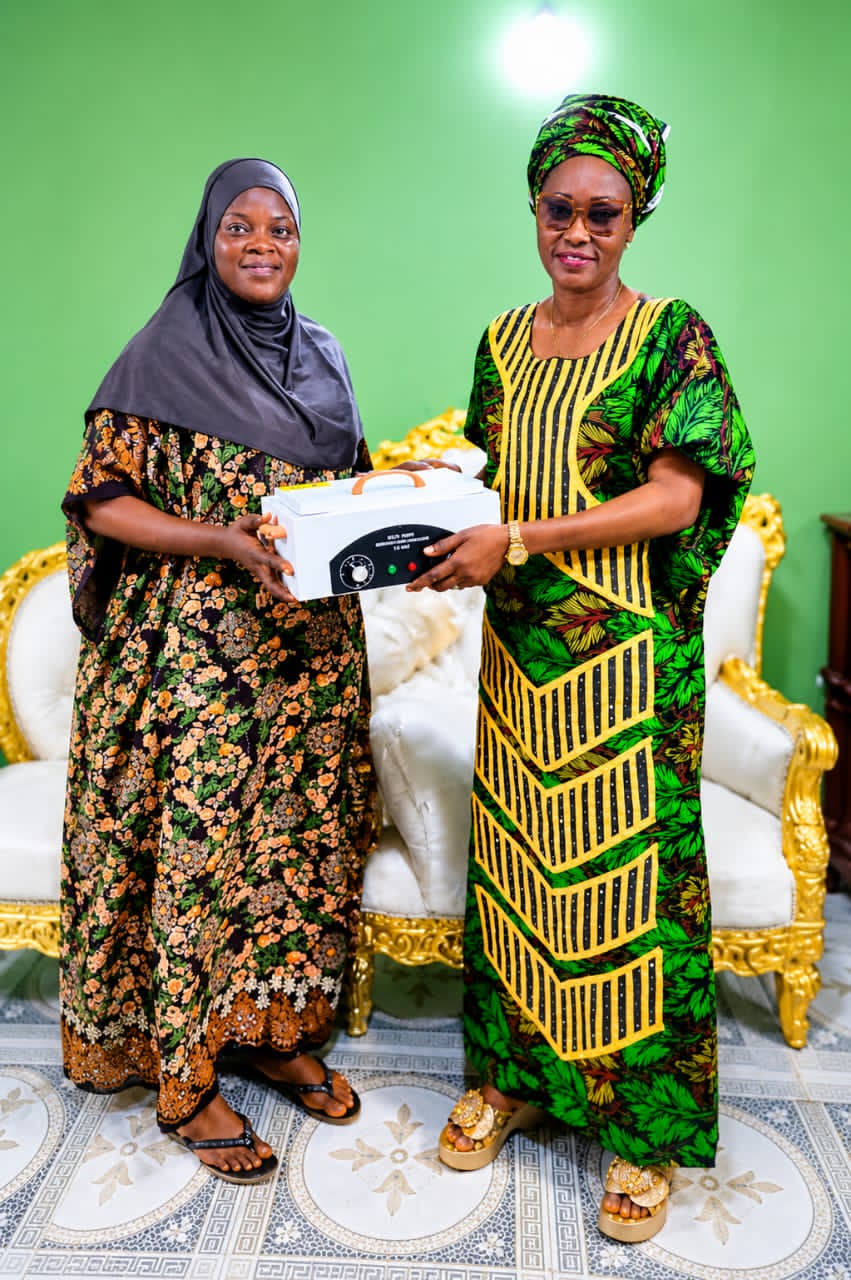
Let’s build a future where access to healthcare is strengthened…….Oba Odugbemi
A call has gone to every stakeholder in the health sector to build a future where access to healthcare is guaranteed and strengthened.
The Onilisa of Lisa Kingdom, Oba Oladele Odugbemi make the call in Lisa while donating a Sanitary Sterilisation Box to the Lisa health centre.
Oba Odugbemi said that the donation became necessary in order to further strengthen the capacity of the health centre for the benefits of the people.
The royal father stressed that his foundation, Oladele Odugbemi foundation would continue to make meaningful impacts in community healthcare aimed at complementing the efforts of government in healthcare delivery system.
He pointed out that the foundation reflects its unwavering commitment to promoting quality healthcare services, enhancing hygiene standards and supporting health institutions with essential tools that contribute to safer and healthier communities.
According to the monarch, all stakeholders in the health sector should work hand-in- hand with government to take healthcare to the doorsteps of the masses as government cannot do it alone, hence health is wealth.
Oba Odugbemi also charged the governments at all levels to declare a state of emergency in the health sector so that every Nigerian can have smooth access to healthcare delivery system in the interest of the country and for the benefits of the masses.
The monarch therefore said that the foundation would continue to care for the people through empowerment by ensuring that masses have good and quality health condition.
The Sanitary Sterilisation Box was presented by the Foundation Director, Hajia Suliat Odugbemi – Tinuosho to the Matron of Lisa Community Health Centre, Mrs Temitope Nofisat Sanni who received it on behalf of the health centre.


- World Cup accredited journalists raise concerns over unfair United States (US) visa restrictions, International Sports Press Association (AIPS) calls on FIFA to intervene June 6, 2026
- Ghana: President Mahama arrives in Belarus, lays wreath at Victory Monument June 6, 2026
- Liberia: President Boakai Advances Clean Energy Agenda; Dedicates 20-Megawatt Solar Power Plant at Mount Coffee June 6, 2026
- African Union (AU) Commission Chairperson mourns Passing of the Former Angola Minister of Foreign Affairs June 6, 2026
- Economic Community of West African States (ECOWAS) Welcomes Students on an Educational Visit to Its Headquarters June 6, 2026
- Seychelles: President Patrick Herminie attended Official Opening of Rise and Shine Day Care Centre at Mont Fleuri June 6, 2026
- Faith, fear and trust: Inside Democratic Republic of the Congo's (DR Congo) fight against Ebola June 6, 2026
- Economic Community of West African States (ECOWAS) Commission and Women in Law and Development (WiLDAF) Train Women Cross-Border Traders in The Gambia June 5, 2026
- Eritrea: Seminar to Nationals in The Hague June 5, 2026
- Eritrea: Training on Photography and Video Production June 5, 2026
- World Cup accredited journalists raise concerns over unfair United States (US) visa restrictions, International Sports Press Association (AIPS) calls on FIFA to intervene June 6, 2026
- Ghana: President Mahama arrives in Belarus, lays wreath at Victory Monument June 6, 2026
- Liberia: President Boakai Advances Clean Energy Agenda; Dedicates 20-Megawatt Solar Power Plant at Mount Coffee June 6, 2026
- African Union (AU) Commission Chairperson mourns Passing of the Former Angola Minister of Foreign Affairs June 6, 2026
- Economic Community of West African States (ECOWAS) Welcomes Students on an Educational Visit to Its Headquarters June 6, 2026
- Seychelles: President Patrick Herminie attended Official Opening of Rise and Shine Day Care Centre at Mont Fleuri June 6, 2026
- Faith, fear and trust: Inside Democratic Republic of the Congo's (DR Congo) fight against Ebola June 6, 2026
-

 news6 months ago
WHO REALLY OWNS MONIEPOINT? The $290 Million Deal That Sold Nigeria’s Top Fintech to Foreign Interests
-

 society1 month ago
SOCIAL MEDIA IS NOT A BATTLEFIELD COMMAND – WHY THE NIGERIAN ARMY’S ACTION AGAINST JUSTICE CRACK IS A NATIONAL SECURITY IMPERATIVE
-

 celebrity radar - gossips4 months ago
Dr. Chris Okafor Returns with Power and Fire of the Spirit -Mounts Grace Nation Altar with Fresh Anointing and Restoration Grace on February 1, 2026
-

 celebrity radar - gossips6 months ago
Prophet Kingsley Aitafo Releases 2026 Prophecy: ‘Nigeria Will Rise, but the World Must Prepare for Turbulence’