
Business
17-Year-Old Entitlement Claim: Ex-Staff Files Motion to Compel MTN To Deposit Judgment Debt and Interest to Court of Appeal


17-Year-Old Entitlement Claim: Ex-Staff Files Motion to Compel MTN To Deposit Judgment Debt and Interest to Court of Appeal
Former expatriate staff of the MTN Group, Mr. Paul Odunewu, has filed a further-reply-affidavit and written address dated December 28, 2023, at the Court of Appeal, Lagos Division, in support of his application praying the Court or an Order to compel the telecommunications giant MTN, to deposit with the Court the judgement debt and accrued interest as ordered by the National Industrial Court Nigeria (NICN), Akure Division.

In a judgement delivered by Honourable Justice Oyejoju Oyewunmi on September 17, 2017, the Court had found that termination of the employment of the former Network Group Operations Manager on February 28, 2006, was wrongful and malicious; and had ordered the company to pay Mr. Odunewu’s entitlements including share options valued at $13,144,512.00.
MTN had faulted the judgement of NICN and straightaway appealed on September 29, 2017, through their external Counsel, Professor G Elias & Co., vide a notice of appeal containing two grounds alleging that the trial Court breached their fundamental right to fair hearing. MTN also filed a Motion for Stay of Execution of the judgement, but Mr. Odunewu’s Counsel, Prof A. B. Kasunmu’s Chambers, opposed the Stay Motion on the ground that the initiating notice of appeal is not competent.
MTN Group Limited, South Africa (MTNG); MTN Nigeria (MTNN) and MTN International, Mauritius (MTNI) is the first, second, and third Appellant respectively, in this six-year-old appeal which had lasted more than 10 years from the Lagos State High Court to the NICN before judgement was delivered in September 2017.
In his application filed on January 8, 2020, with appeal number CA/1346/2017, Mr. Odunewu’s grounds of the motion include assertions that the Notice of Appeal filed by MTN on September 29, 2017, is highly incompetent and does not raise any substantial or recondite issues of law. Also, MTN have been facing huge fines from various Authorities in Nigeria for regulatory and tax infringements and the cumulative impact of these fines raises existential issues for MTN Nigeria and their ability to pay the judgement sum as due at the determination of the case. Furthermore, the Appellants (MTN) have not been prosecuting this appeal diligently and expeditiously.
Mr. Odunewu supported the motion with financial statements and press releases by MTN (among others). In 2019 MTN completed payment of ₦330 billion Nigerian Communication Commission (NCC) fine, and MTN Group had paid $100 million to Lawyers within six months to negotiate the NCC fine. MTN Nigeria reported preferential shares redemption as of December 30, 2019, at a total amount of ₦148.19 billion (or US$399.59 million) in favour of MTN Group. This, consequently, reduced share capital of MTN Nigeria to ₦17.623 billion in 2019 compared to ₦65.145 billion in 2018. On the 24th of December 2018, MTN announced payment of $52.6 Million as a “notional reversal” of $1.0 billion private placement in 2008 based on certificate that did not have final approval and thereby resolved the $8.1 billion dividend repatriation issue with Central Bank of Nigeria (CBN). A Nigeria Senate Committee had investigated MTN for capital flight and had reported that a total capital inflow of $1.24 Billion was injected for MTN operations in Nigeria for the period 2001 – 2016 whereas MTN Nigeria repatriated $13.92 billion from 2006 to 2016 in the guise of dividends/profit, repayment of loans and licenses/management fee. This meant that MTN, as of 2016, were repatriating US$11.00 for every US$1.00 that they injected into their business in Nigeria.
In a Reply-Affidavit dated February 4, 2022, one Temitayo Adeniyi, a Lawyer at Prof A. B. Kasunmu’s Chambers, deposed that MTN “substituted payment of the fines and associated costs with huge debt and are, therefore, running their operations in Nigeria with riskier financial structure than 2014 (before the 2015 NCC fine).” “In the current Nigerian climate of stronger regulatory oversight, MTN Group redeemed its preference shares and thereby reduced their exposure in Nigeria but created significant financial and economic risk to boost shareholder returns with much higher leverage in 2019 than 2018”. Furthermore, MTN “have not prosecuted this appeal expeditiously but instead they have been prevaricating to regularize the initiating Notice of Appeal dated 29th September 2017 thereby causing enormous delay to the determination of this Appeal. “The Appellants have failed or are unable to take advantage of this honourable Court’s ruling on the 17th of October 2018, that the Motion for Stay of Execution shall abide the determination of the appeal, which is adjourned to 27th February 2019.” He further deposed: “the entire appeal is a masterful delay tactic, cleverly designed by the Appellants to deny the Respondent from enjoying the fruit of the Judgement.”
In a Further-Counter-Affidavit by MTN dated 18th February 2022, one Athanasius Akor, a Lawyer at G. Elias & Co, deposed: “the fact that there is an appeal against the judgement and a pending application for stay of execution are an exercise of the constitutional rights of the appellants”. He deposed that MTN “is not dissipating and is not repatriating its assets out of Nigeria”; and that MTN “conducted an offer for sale of its share on the Nigerian Stock Exchange (NGX) which is a testament of its long term believe and its intention to remain as an active participant in the Nigerian economy.” He further deposed that the 2015 fine has been fully paid since May 2019 and that MTN Nigeria has been making profit and declaring dividends. Mr. Akor deposed that share price of MTN Nigeria jumped to ₦199.8 per share on 17th February 2022. He further deposed that Mr. Odunewu based his analyses on the MTN Nigeria 2018 Audited Account and not the latest 2021 Audited Financial Statement in which MTN Nigeria declared a revenue of circa ₦1.7 Trillion and a profit of circa ₦286 billion. Also “the Respondents has no financial issues that will prevent them from meeting their financial obligations or paying the judgement debt and accrued interest in the event that the appeal is determined in favour of the Applicant and against the Respondents”.
In a Further-Reply-Affidavit sworn to on 28th December 2023, one Ejike Mitchel Maduagwu, a Lawyer at Prof A. B. Kasunmu’s Chambers, deposed that MTN Nigeria “is still being investigated for other tax and revenue leakage matters. Meanwhile the Respondents have repatriated out of Nigeria their huge profit and replaced it with huge debt. The huge revenue, profit, and share price in 2021, as reported in the 2021 Audited Account, are unreliable indicators to determine the Respondents’ ability or willingness to pay the judgement debt or withstand future shock to their business, be it regulatory, economic, or political”. MTN Nigeria reported in their 2021 Audited Account that the demand notice for ₦242 Billion and US$1.3 Billion alleged revenue indebtedness is still undergoing review and reconciliation with both Federal Inland Revenue Service (FIRS) and Nigeria Customs Service (NCS). House of Representatives’ (HOR) tax compliance check and alleged US$30 Billion revenue leakage against MTN Nigeria is still undergoing review.
Mr. Odunewu concluded that it is in the interest of justice to grant his application and “direct the Respondents to deposit with this honourable Court the judgement debt and interest accrued till a day of fund transfer; or in the alternative, we pray the Court to direct the Respondents to provide a Bank Guarantee to secure the judgment debt pending the determination of this appeal.”
The Industrial Court had found that MTN Group is the Parent Company and the life wire of both MTNN and MTNI that controls them and thus integral part of the both companies. Also, MTN Nigeria has no power of its own to act under its contractual agreement with Mr. Odunewu except as approved by its Parent Company, MTN Group. In 2017 NICN had ordered that the judgement sums of $13.47 million, ₦2.54 million, and £10 thousand be paid by the second and third defendants (MTNN & MTNI), “except the issue of costs which is to be paid by all the defendants (MTN sic)”. The trial judge had ordered MTN to make the payments within 30 days, failing which the sums would appreciate at 21 percent interest per annum.




*Please be careful, there’s a WhatsApp scam going around
Scammers are currently impersonating Aigboje Aig-Imoukhuede, the Chairman of Access Holdings Plc, to trick people into fake investment schemes.
They’ve created a WhatsApp group called *“Value Focus Club 60”* using this number: *+234 915 708 8290*, and even used his picture to make it look real.
*Important things to know*:
• The Chairman is NOT on WhatsApp running any investment group
• Access Holdings does NOT offer investment advice via WhatsApp
• Any message claiming otherwise is 100% fake
A whistleblower actually spotted this and raised the alarm, so please don’t ignore this.
*What you should do*:
• Don’t join the group or engage them
• Don’t share your personal or banking details
• Block and report the number on WhatsApp
• Let others know so they don’t fall victim
The company is already working to shut it down, but awareness is key.
Please share this with your contacts, someone you know could be targeted.

HOUSE OF BIMPE FIT GAINS ATTENTION WITH TRENDY UNISEX FASHION LINE
LAGOS — A fast-rising fashion brand, House of Bimpe Fit, is making waves in the style scene with its collection of modern, elegant outfits designed for both men and women.
The brand, which showcases a blend of contemporary and classic designs, is quickly attracting attention for its attention to detail and quality finishing. From sharply tailored men’s native wears and suits to chic, figure-flattering outfits for women, House of Bimpe Fit is positioning itself as a go-to destination for fashion lovers seeking both style and comfort.

Speaking on the brand’s vision, the management emphasized its commitment to delivering “quality outfits for both men and women,” ensuring customers step out with confidence and class regardless of the occasion.
Fashion enthusiasts have particularly praised the brand’s versatility, as it caters to a wide range of tastes—from corporate elegance to casual sophistication.

With an active presence on social media, especially on TikTok via @house_of_bimpefit, the brand is leveraging digital platforms to reach a broader audience and showcase its latest collections.
Industry watchers say House of Bimpe Fit is one to watch, as it continues to carve a niche for itself in Nigeria’s competitive fashion industry.
For inquiries, customers can contact the brand via phone at 0802 686 6277.

Business
Jafad College of Nursing Science Showcases Excellence at Matriculation, Capping Ceremony for 158 Nursing Students
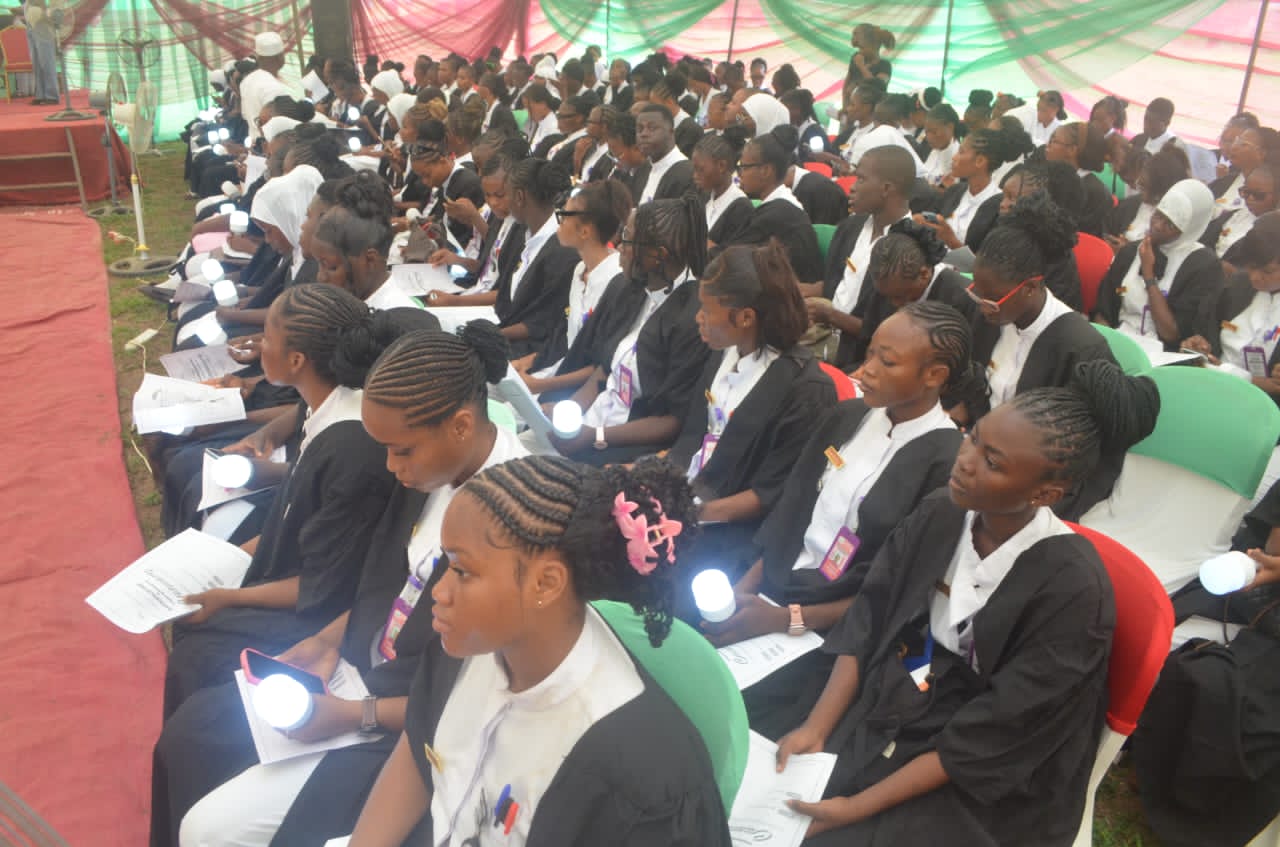
Jafad College of Nursing Science Showcases Excellence at Matriculation, Capping Ceremony for 158 Nursing Students
By Agholor M.O
Jafad College of Nursing Science, Oru Ijebu Ogun State, has once again demonstrated its commitment to excellence in healthcare education as it matriculated and inducted into Nursing Training, 158 students of the N.D 2025/2026 academic session in a well attended and inspiring ceremony which took place on Wednesday, 8th of April 2026 at the College premises, Oru Ijebu, Ogun State

The event began with a colourful academic procession of the matriculating students led by their Class Coordinator Mrs B.O. Okuboyejo, alongside principal officers of the college, including the Student Affairs Officer, Mrs Fijabi; College Accountant, Mrs Funmilayo Victoria Alao; Librarian, Mr Jonathan Olusola Fatokun; Registrar, Mr Mojeed Adewale Lawal; and the Acting Provost, Ms Olufunmilola Akintayo.

In her welcome address, the Acting Provost charged the new students to embrace discipline, dedication, and professionalism, noting that Jafad College provides a strong academic and moral foundation needed to thrive in the ever demanding healthcare sector.

The ceremony attracted dignitaries, including Mr Abdulhameed, JAMB Zonal Coordinator, Abeokuta, Ogun State, further underscoring the institution’s growing reputation.

Delivering the matriculation lecture, Mrs Oyelayo Toyin Adeola, a registered nurse educator from Olabisi Onabanjo University Teaching Hospital, spoke on the theme: *“The Journey of Admission to Graduation: Strategies for a Successful Outcome – Learner and Teacher Perspective.”* She emphasized the importance of goal-setting, effective study habits, time management, and active student teacher collaboration. She also highlighted the need for resilience, ethical conduct, and continuous self-improvement, describing nursing as both a calling and a profession that demands compassion, competence, and lifelong learning.

The ceremony reached a symbolic peak with the capping and stripping of the students by experienced registered nurses from Ogun State Hospital, Ijebu Ode, officially ushering them into the noble nursing professional Training.
Parents and guardians expressed satisfaction with the quality of organization and training standards, while the students beamed with excitement as they began their professional journey.


With its experienced faculty, structured training, and commitment to producing competent and compassionate nurses, Jafad College of Nursing Science continues to stand out as a top choice for aspiring healthcare professionals in Ogun State and beyond.


- Seychelles Backs United Arab Emirates (UAE) Statement, Calls for De-escalation and Respect for International Law April 11, 2026
- TotalEnergies’ Africa Senior Vice President (SVP) Mike Sangster to Spotlight Expanding Project Pipeline at Paris Forum April 11, 2026
- Ascott expands in Nairobi with new Citadines signing, reinforcing the city’s position as a regional hub April 11, 2026
- Century Group Joins African Energy Week (AEW) 2026 as Floating Production Storage and Offloading (FPSO) Partner, Showcasing Regional Offshore Expansion April 10, 2026
- Climate Litigation Surge Reshapes Energy Policy as Africa Seeks Stronger Legal Voice April 10, 2026
- ES-KO Secures Five-Year Catering & Facilities Management Contract Renewal with TotalEnergies EP Congo April 10, 2026
- Beyond the Court: The Kalahari Conference Solidifies its Status as Africa’s Premier Sports & Lifestyle Destination April 10, 2026
- Africa Sports Unified Launches Pan-African Sports Deals Tracker to Improve Market Visibility and Decision-Making April 10, 2026
- Nigeria and Senegal Must Follow Ghana and Mozambique Against Exclusionary Practices April 10, 2026
- Sheraton Nouakchott marks the entry of Marriott International in Mauritania April 10, 2026
- Seychelles Backs United Arab Emirates (UAE) Statement, Calls for De-escalation and Respect for International Law April 11, 2026
- TotalEnergies’ Africa Senior Vice President (SVP) Mike Sangster to Spotlight Expanding Project Pipeline at Paris Forum April 11, 2026
- Ascott expands in Nairobi with new Citadines signing, reinforcing the city’s position as a regional hub April 11, 2026
- Century Group Joins African Energy Week (AEW) 2026 as Floating Production Storage and Offloading (FPSO) Partner, Showcasing Regional Offshore Expansion April 10, 2026
- Climate Litigation Surge Reshapes Energy Policy as Africa Seeks Stronger Legal Voice April 10, 2026
- ES-KO Secures Five-Year Catering & Facilities Management Contract Renewal with TotalEnergies EP Congo April 10, 2026
- Beyond the Court: The Kalahari Conference Solidifies its Status as Africa’s Premier Sports & Lifestyle Destination April 10, 2026
-

 news4 months ago
WHO REALLY OWNS MONIEPOINT? The $290 Million Deal That Sold Nigeria’s Top Fintech to Foreign Interests
-

 celebrity radar - gossips3 months ago
Dr. Chris Okafor Returns with Power and Fire of the Spirit -Mounts Grace Nation Altar with Fresh Anointing and Restoration Grace on February 1, 2026
-

 celebrity radar - gossips4 months ago
Prophet Kingsley Aitafo Releases 2026 Prophecy: ‘Nigeria Will Rise, but the World Must Prepare for Turbulence’
-

 celebrity radar - gossips6 months ago
End of an Era: Nigeria Mourns Evangelist Dr. Uma Ukpai, 80