
Politics
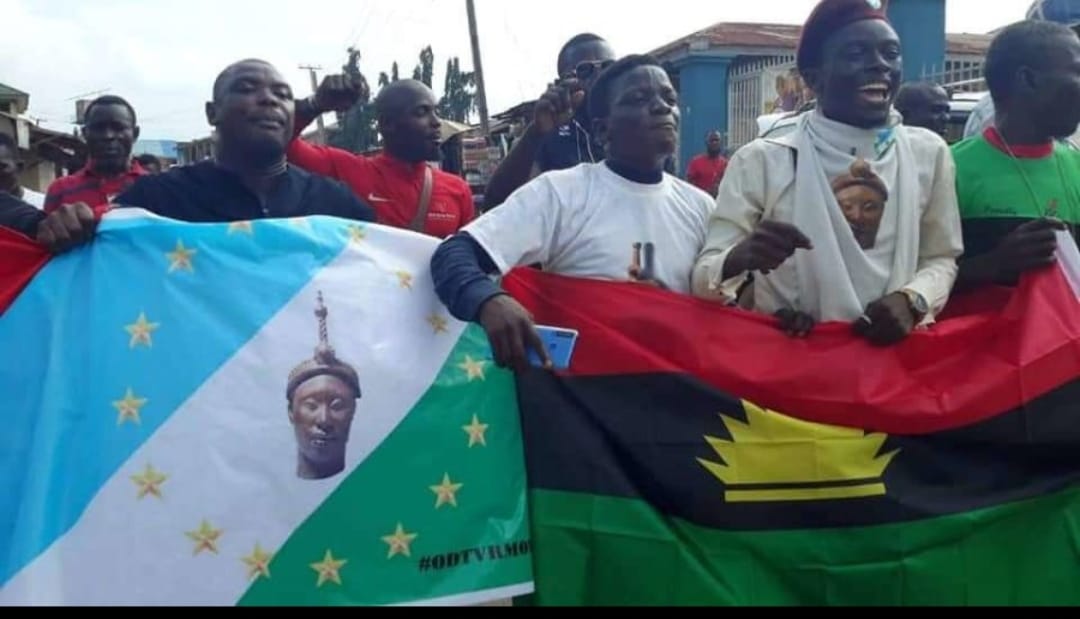
A Case for Peaceful Separation: Rethinking Nigeria’s Forced Unity

A Case for Peaceful Separation: Rethinking Nigeria’s Forced Unity
By George Omagbemi Sylvester
For over a century, Nigeria has struggled to hold together the patchwork quilt of nations stitched into a single entity by British colonial interests. Despite decades of independence, national identity remains elusive. Ethnic rivalries, regional marginalization, and economic imbalances continue to tear at the fragile fabric of this artificial federation. While many still advocate unity as a moral imperative, a growing number of Nigerians—both at home and in the diaspora—are beginning to explore an alternative path: peaceful separation.
Contrary to widespread fear-mongering, separation is not synonymous with war. History is replete with examples of nations that have dissolved their unions with dignity and peace. The United States split from Britain in 1776; Belgium separated from the Netherlands in 1830; Singapore parted ways with Malaysia in 1965 over ethnic and religious tensions; and in 1993, Czechoslovakia executed the “Velvet Divorce,” birthing the Czech Republic and Slovakia without a single drop of blood.

On the African continent, Eritrea gained independence from Ethiopia in 1993, and South Sudan emerged from Sudan in 2011. Though not all secessions have been peaceful—Yugoslavia and parts of the former Soviet Union being cautionary tales—the possibility of a negotiated and dignified exit remains viable, especially for countries like Nigeria whose internal contradictions are too numerous and too persistent to ignore.

A Forced Union in Crisis
At the heart of Nigeria’s problem is the failure to evolve from a colonial configuration into a truly federal state. The so-called ethnic groups in Nigeria—Hausa-Fulani, Yoruba, Igbo, Ijaw, Tiv, and others—are not mere “tribes,” as often mislabeled, but full-fledged nations in their own right. In Europe, these groups would be called what they are: distinct nations with different languages, cultures, worldviews, and aspirations.
What unites Nigeria today is not a shared vision but a centralized constitution imposed through military fiat and maintained by successive governments for political expediency. The result is an overburdened federal system where one region’s dominance is perceived—rightly or wrongly—as a source of systemic injustice. The cry for restructuring has been loud and long, but it is now giving way to a more definitive demand: peaceful separation.

Learning from the World
Across the globe, countries have restructured or separated in response to ethnic and economic realities. Norway and Sweden amicably separated in 1905. Iceland left Denmark in 1944. The Soviet Union disintegrated into multiple nations—Ukraine, Georgia, Kazakhstan, Lithuania, and others—based on ethnic lines. Even in modern-day Canada, Quebec retains a high level of autonomy with French as its official language, reflecting its cultural uniqueness.
Switzerland, often cited as a model multi-ethnic state, rotates its presidency annually among representatives of four major linguistic groups: German, French, Italian, and Romansh. Its federation is composed of cantons, each retaining significant autonomy. Nigeria, by contrast, continues to centralize power in a federal government that is neither representative nor responsive.
The Nigerian Paradox
Some still argue that all Nigeria needs is good leadership. But that ignores the structural imbalances hardwired into the country’s political architecture. Even the most competent leader will struggle under a system that rewards ethnic hegemony and punishes regional innovation.
Take the Southeast, for example. The five states—Anambra, Imo, Abia, Ebonyi, and Enugu—have a combined landmass of just 29,525 km², less than that of Kogi State alone (29,833 km²). Niger State, the largest in Nigeria, is bigger than the entire Southwest minus Lagos. Yet policy frameworks continue to treat all regions as though they are equally endowed and equally represented.
The same structural flaw affects economic planning. The so-called cattle colony debate reveals how absurd Nigeria’s policymaking has become. Despite not ranking among the top 20 global cattle producers, Nigeria insists on clinging to archaic methods like open grazing—resulting in violent clashes between farmers and herders. Meanwhile, countries like India, Brazil, and Australia—world leaders in cattle and beef exports—have long adopted modern ranching techniques.
According to global data:
India has over 300 million cattle.
Brazil follows with 226 million.
The USA and EU are also in the top five, with mechanized systems that prioritize productivity and safety.
Yet, in Nigeria, the cattle business has become not just a source of conflict, but a symbol of how far behind the nation is in adopting global best practices.
Separation as Development Catalyst
Separation, if well negotiated, can usher in a new era of healthy competition among Nigeria’s regions. Singapore, after its split from Malaysia, transformed itself into one of the world’s leading economies. Bangladesh, which broke away from Pakistan in 1971, has surpassed its former counterpart in several human development indicators.
What holds Nigeria back is not a lack of human or natural resources, but the illusion of unity under a flawed structure. The political elite preach unity not out of conviction but convenience. They benefit from a system that concentrates wealth and power in the center while denying states the autonomy to thrive or fail on their own merits.
A peaceful separation could enable each region to pursue its developmental vision without interference. The North, with its vast landmass, could become a hub for ranching and renewable energy. The South could focus on industrialization and technology. The East could pursue its vision of commerce and manufacturing. Rather than clashing over a failing center, each region could chart its own path.
The Path Forward
Nigeria must confront its truths. The forced amalgamation of 1914 was never about nation-building—it was about administrative convenience for the British Empire. That colonial logic no longer serves the aspirations of the people.
What is needed now is a national conversation—not driven by fear, but by courage. A conference where all ethnic nationalities, civil society groups, youth representatives, and diaspora voices can negotiate new terms of coexistence. Whether that leads to a restructured federation or an amicable separation, the goal should be justice, peace, and prosperity.
It is not enough to quote slogans like “One Nigeria.” Unity, like marriage, must be consensual. It must be renewed with shared values, mutual respect, and equitable governance. Otherwise, it becomes a prison rather than a partnership.
As the world evolves, Nigeria must evolve too. And if evolution means reconfiguration, then so be it. Let us give peace a chance—not just by tolerating each other under duress, but by honoring each other’s right to self-determination.




Amupitan: Why the ADC is Chasing Shadows
Sanya Oni
It is no surprise that the African Democratic Congress is insistent on the immediate resignation of the chairman of the Independent National Electoral Commission, Prof. Joash Amupitan. First, was for the ‘high crime’ of seeking to play safe over a judgment of the court which demanded that ADC’s feuding parties and INEC under the leadership of Amupitan in particular take no further step to present the court with a fait accompli over a matter before it. Not sufficient to play the judge and jury in its own cause, it also insists on treating the appearance of any position deemed contrary to its own as treasonable.
Now, they want the head of the electoral body served on the platter over an alleged pro-President Bola Tinubu tweet in 2023. And so determined to press its case, the ADC, in a statement by its rambunctious National Publicity Secretary, Bolaji Abdullahi, would on Saturday, lob yet another charge at the INEC boss for what it claimed were attempts (by who?) to erase the digital trail of the offending tweet – which it also says amounted to a dangerous cover-up that undermined the credibility and neutrality of Nigeria’s electoral system.
Talk of an unproven tweet suddenly becoming an issue over which the chief electoral umpire’s integrity is not only being called into question but constituting the grounds for demanding for his head!
Of course, save for the party’s army of salesmen with their all-familiar talking points on prime time television, few Nigerians would be surprised by such antics which border on desperation. Before now, the party had, much earlier, raised the alarm over what it described as a calculated plot to impose a one-party state ahead of the 2027 general elections, accusing the ruling All Progressives Congress (APC) of using INEC to weaken opposition parties.
Let’s take a look at the tragedy of a party which seeks to pride itself as a leading opposition but has done practically nothing to earn its stripes. It started with a horde of angry, internally displaced politicians overrunning the organs of a once-marginal party, the ADC in a spectacular act of a hostile take-over. Unfortunately, if the image presented by the party from the outside at the time was one of cohesion, it certainly did not help that the invaders neither possessed the patience nor the discipline to undertake the required due diligence! Now that it turns out that what they thought they had bought with pride was in every sense, a damaged good, Nigerians as a whole are being blackmailed, accused of being an accessory to their grand act of dereliction.
Yet, as the presidential candidate of the party in the 2023, general election, Dumebi Kachikwu, would care to remind, the takeover bid, being a flawed process is akin to erecting a castle on shifting sand. The tenure of the so-called chairman of the party, Ralph Nwosu, with whom the invaders negotiated, had long been rendered invalid by the effluxion of time. Not only that, the constitution of the party also made clear that those seeking the leadership of the party must have spent no less than two years in the party! These are supposed to be the issues before the courts!
Across the states, it is the same story of a party riven with crises from top to bottom. Yet, convinced that their good – as illegitimate as could be – was already theirs for keeps, the caretakers-turned undertakers plodded on, choosing to ignore the feelings of a section of the party hierarchs that needed to be placated. With just enough crude blackmail, impunity, cash and more cash in their armoury to waltz through, the conquistadors actually assumed they were unstoppable.
Of course, they pretended that the court processes are merely a side-show. The Federal High Court ruling which required the invaders to show cause why the prayers of the aggrieved ADC members should not be granted was thought of as a joke; the same way the judgment of the appellate court which directed the parties to return to status quo ante bellum was deemed by the ADC invaders a non-binding opinion hence their plans to proceed with a convention fraught with potential legal jeopardy.
To the invaders – Mark, Rauf Aregbesola et al, their interpretation, as against that of INEC with its tilt on neutrality – was sacrosanct.
While these drag on, trust the lawyers with their boring whining about how Section 83 of the Electoral Act, 2026 ousts the jurisdiction of the courts. Yes, it provides that “No court in Nigeria shall entertain jurisdiction over any suit or matter pertaining the internal affairs of a political party” as if that effectively translates to shutting the doors of mediation to aggrieved party men even on issues bordering on their rights or non-observance of party constitutions. In like manner, it is like the express provisions of Section 6(6)(b) which also provides that: “The judicial powers vested in accordance with the foregoing provisions of this section – shall extend to all matters between persons, or between government or authority and to any persons in Nigeria, and to all actions and proceedings relating thereto, for the determination of any question as to the civil rights and obligations of that person” has suddenly become superfluous in the current electoral cycle!
To return to the Amupitan matter: Should anyone be fooled by the orchestrated blackmail by those whose record private and public can’t hold a candle to Amupitan’s? Certainly not with what I had earlier described as a programmed de-legitimisation of the 2027 elections by overrated political actors being already an open book. Sure enough, the matter, in the coming days, would not be whether or not the gentleman from Kogi can take the heat, but how far those in the business of concocting lies would go to undermine the process simply because the odds are not going their way. While they are at it, they have still not told Nigerians how the lone individual – out of 37 odd Resident Electoral Commissioners (RECs) and 12 National Commissioners, with two representing each of the six geopolitical zones, has suddenly become the ultimate decider of how things will go in 2027.
Reminds of the bad workman perennially blaming his tools.
First published in The Nation on April 14, 2026
*Ogun’s Future at Risk, Says MAO, Faults ‘Anointed’ Consensus Candidate Yayi*
“In a land starved of vision, even the barely capable are crowned as kings.”
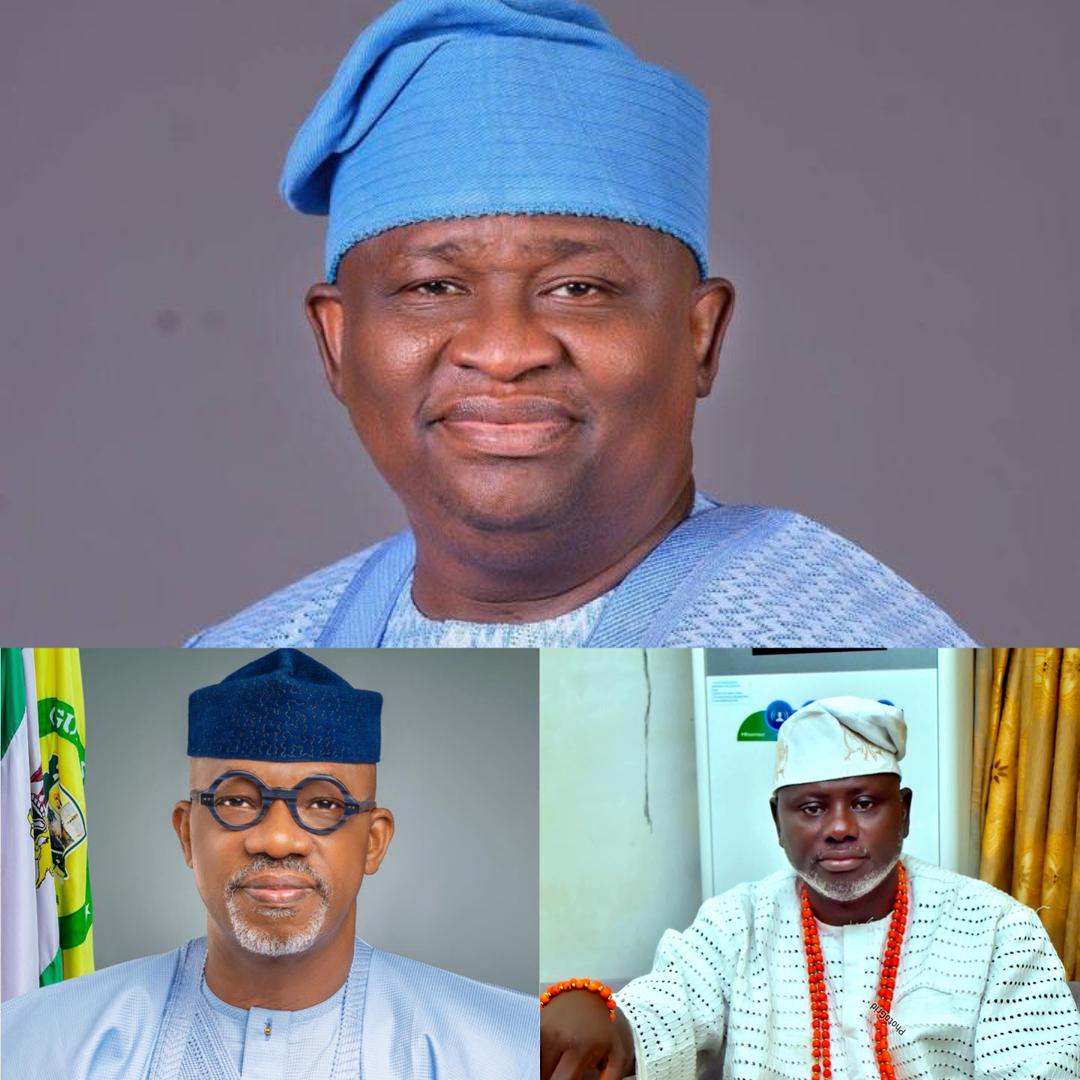
With this striking illustration, Chairman of the Egba Agenda Forum, High Chief Mustapha Abdulakeem Owolabi (MAO), has condemned the emergence of Senator Solomon Olamilekan Adeola, popularly known as Yayi, as the consensus governorship candidate of the All Progressives Congress (APC) in Ogun State.
In a strongly worded statement issued on Tuesday, Owolabi described the development as a “quiet and almost shameful orchestration,” insisting that the process reflects calculated imposition rather than the genuine will of the people.
According to him, while Yayi may have found political footing in Ogun about six years ago through Yewa, his elevation as a statewide consensus candidate without what he termed “a true test of popular mandate” raises fundamental concerns about the state of democracy in Ogun.
“This is not democracy; it is orchestration,” Owolabi declared.
The Egba Agenda Forum chairman further alleged that the move represents a stepping stone in a broader political design, suggesting that Ogun State risks becoming an extension of entrenched political influence beyond its borders.
He argued that the ambition behind the arrangement is “structured, patient and deliberate,” warning that such consolidation threatens the independence of the state’s political space.
Owolabi blamed past administrations for laying the groundwork for what he described as the recycling of failure. He accused previous leaders of governing “without building,” entrenching poverty, weakening institutions and replacing sustainable development with dependency.
“The next generation has learned the system too well,” he said. “They understand that you don’t need to fix the people; you only need to manage them.”
He criticized what is often presented as empowerment programmes, describing them as tools of control rather than genuine development initiatives. According to him, with education weakened, healthcare struggling, infrastructure decaying and debt mounting, citizens are left vulnerable to “small relief packages and symbolic gestures” that replace accountability with gratitude.
“This is not progress. It is recycling failure,” the statement read.
The Forum also expressed concern over what it called the systematic weakening of opposition parties, alleging that fractured and destabilized opposition voices leave citizens with “no real alternative only the illusion of choice.”
“True democracy thrives on vibrant, credible opposition. It demands competition, accountability and the constant testing of ideas,” Owolabi stated. “What we are witnessing is a slow drift toward political monopoly disguised as consensus.”
He further criticized former aspirants and political actors who, according to him, have abandoned principles in a bid to secure appointments and remain in the good graces of the “anointed.”
“Principles abandoned, convictions traded, ambition preserved at all costs. Shameful is an understatement,” he said.
Owolabi warned that the situation sends the wrong message to emerging political leaders, who he fears are being trained to perfect the same political playbook rather than inspired to chart a new course.
“A nation cannot rise on manipulation. A people cannot thrive on crumbs,” he added.
Concluding his statement, the Egba Agenda Forum chairman called on Nigerians to reflect deeply on the direction of the country’s democracy.
“‘Nigeria, we hail thee’ but surely, this cannot be the nation our forefathers envisioned, nor the system they hoped to build. If this cycle is not broken, then the future is already compromised. May Nigeria find the courage to demand more.”
APC Picks Adeola Yayi as Consensus Candidate, Declares ‘New Ogun State Is Born’
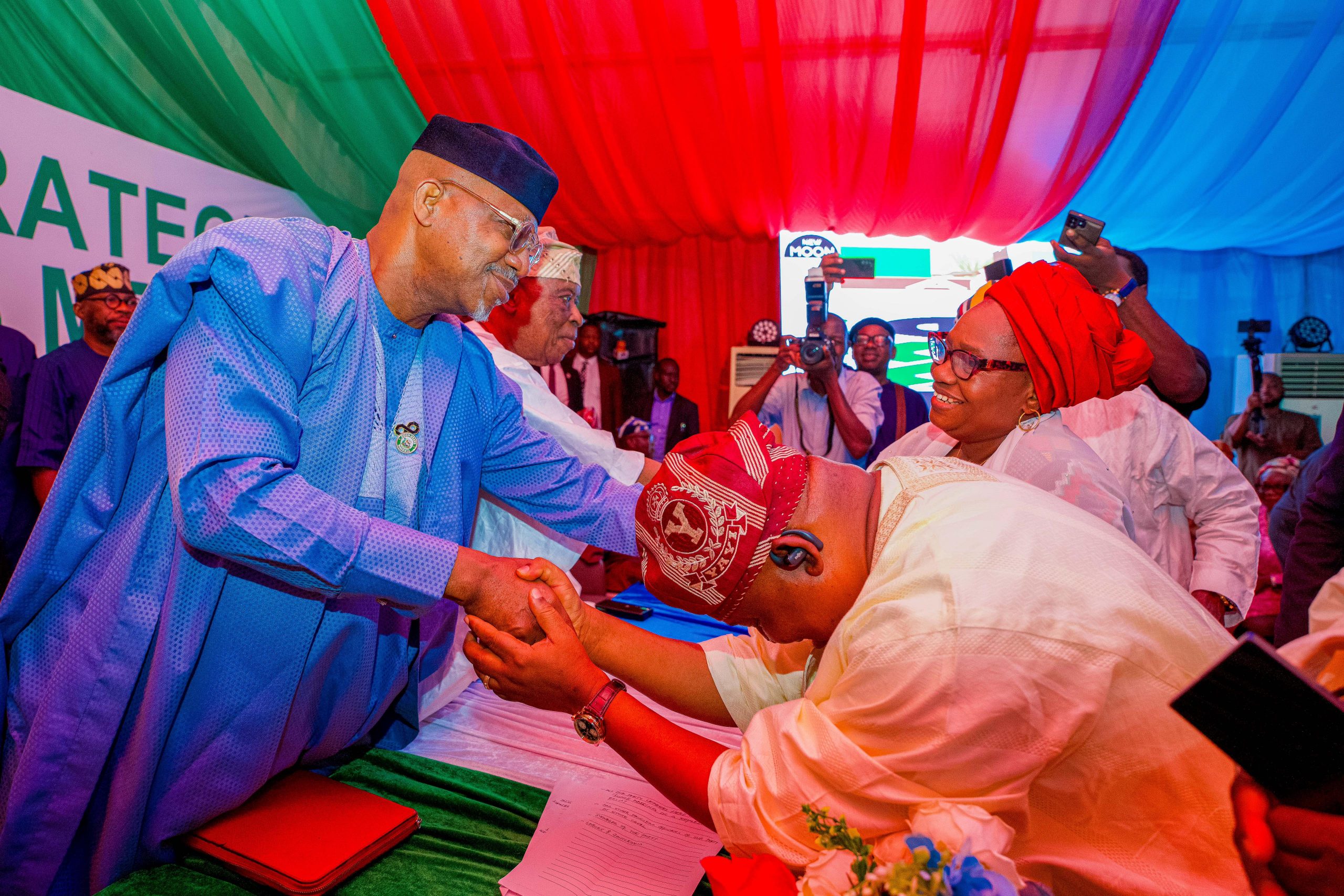
ABEOKUTA, OGUN STATE — The Ogun State chapter of the All Progressives Congress (APC) has adopted Solomon Olamilekan Adeola, popularly known as Yayi, as its consensus governorship candidate ahead of the 2027 election.
The decision was announced on Monday, April 13, 2026, during a high-level party congress held in Abeokuta, drawing party leaders and stakeholders from across the state.
Governor Dapo Abiodun, who presided over the gathering, said the consensus arrangement was a strategic move to promote equity and inclusiveness, particularly by addressing what he described as a decades-long marginalisation of Ogun West Senatorial District in the state’s leadership structure.
He noted that the decision reflects a deliberate effort by the party to rotate power fairly among the state’s senatorial zones.
“Nothing will give me more joy than to fulfill the dreams of my predecessors — especially ensuring that Ogun West produces the next governor,” Abiodun said.
“I look forward to a time when I will sit proudly with my successor and my fellow former governors at the swearing-in of a new APC governor.”
Amid applause from party faithful, the governor formally unveiled Adeola as the party’s flagbearer, describing him as the most suitable candidate to lead the state into its next phase of development.
The announcement triggered jubilant reactions, with chants of “Yayi” echoing across the venue.
In his acceptance speech, Adeola expressed gratitude to party leaders and members, describing his emergence as a product of unity, sacrifice, and collective vision.
“I believe in oneness and the unity of our dear state and Ogun West by extension,” he said, pledging to justify the confidence reposed in him.
Adeola highlighted Ogun State’s growing economic relevance, noting its status as one of Nigeria’s most industrialised states. He promised to consolidate existing gains while advancing policies that would further drive development and prosperity.
“I will not let you down. I promise to keep the flag flying and maintain the unity, peace, and progress achieved in Ogun State,” he added.
Using a nautical metaphor, the senator assured party members of steady leadership, saying, “The ship I’m about to take over, I will make sure that it does not derail.”
He also emphasized inclusiveness, pledging to unite all factions within the party and across the state, regardless of political differences.
“By the grace of God, I will do my utmost best to keep every member of our great party together and ensure that we remain one indivisible family,” he said.
Declaring a new chapter for the state, Adeola proclaimed, “A new Ogun State is born,” promising a renewed focus on unity, development, and shared prosperity.
The endorsement, which took place during the APC Strategic Caucus Meeting, is widely seen as a defining moment in Ogun State politics, setting the stage for the 2027 governorship race and signaling strong internal cohesion within the ruling party.


- Uganda Development Corporation (UDC) to take 82% of Trade ministry budget April 16, 2026
- Merck Foundation marks ‘World Art Day’ through their Film, Song, Media and Fashion Awards 2026 in partnership with Africa’s First Ladies to raise awareness about social & health issues April 15, 2026
- Gabon’s Offshore Comeback: International Oil Companies (IOCs) Return as Exploration Heats Up Ahead of Paris Forum April 15, 2026
- Shell’s Eugene Okpere to Speak at Angola Oil & Gas (AOG) 2026 Amid $1B Angolan Deepwater Drive April 15, 2026
- Oando Joins African Energy Week (AEW) 2026 as Emerald Sponsor as Firm Reports 10% Profit Rise April 15, 2026
- Africa Finance Corporation (AFC) Invests in Dhamana Guarantee Company to Catalyse Local Currency Infrastructure Financing in East Africa April 15, 2026
- WESGRO and Enlit Africa 2026 unite to spotlight the Western Cape’s energy investment opportunity April 15, 2026
- Gianni Merlo re-elected as International Sports Press Association (AIPS) President for sixth and final term in landslide victory April 15, 2026
- African Development Fund approves 1.7 billion CFA francs to boost private sector competitiveness across West African Economic and Monetary Union (WAEMU) countries April 15, 2026
- Knowledge Katti: The Architect Behind Namibia’s Energy Breakthrough April 15, 2026
- Uganda Development Corporation (UDC) to take 82% of Trade ministry budget April 16, 2026
- Merck Foundation marks ‘World Art Day’ through their Film, Song, Media and Fashion Awards 2026 in partnership with Africa’s First Ladies to raise awareness about social & health issues April 15, 2026
- Gabon’s Offshore Comeback: International Oil Companies (IOCs) Return as Exploration Heats Up Ahead of Paris Forum April 15, 2026
- Shell’s Eugene Okpere to Speak at Angola Oil & Gas (AOG) 2026 Amid $1B Angolan Deepwater Drive April 15, 2026
- Oando Joins African Energy Week (AEW) 2026 as Emerald Sponsor as Firm Reports 10% Profit Rise April 15, 2026
- Africa Finance Corporation (AFC) Invests in Dhamana Guarantee Company to Catalyse Local Currency Infrastructure Financing in East Africa April 15, 2026
- WESGRO and Enlit Africa 2026 unite to spotlight the Western Cape’s energy investment opportunity April 15, 2026
-

 news4 months ago
WHO REALLY OWNS MONIEPOINT? The $290 Million Deal That Sold Nigeria’s Top Fintech to Foreign Interests
-

 celebrity radar - gossips3 months ago
Dr. Chris Okafor Returns with Power and Fire of the Spirit -Mounts Grace Nation Altar with Fresh Anointing and Restoration Grace on February 1, 2026
-

 celebrity radar - gossips4 months ago
Prophet Kingsley Aitafo Releases 2026 Prophecy: ‘Nigeria Will Rise, but the World Must Prepare for Turbulence’
-

 celebrity radar - gossips6 months ago
End of an Era: Nigeria Mourns Evangelist Dr. Uma Ukpai, 80