
society
MMIA Renovation Bruhaha—What Do Nigerians Really Want?


MMIA Renovation Bruhaha—What Do Nigerians Really Want?
By Tunde Moshood
When the news broke that the Federal Executive Council had approved N712 billion for the complete renovation of the Murtala Muhammed International Airport (MMIA) Terminal 1 in Lagos, the backlash came swiftly and loudly, mostly from the comfort zones of social media. Suddenly, everyone became an infrastructure economist, a seasoned aviation planner, or worse, a self-styled corruption watchdog. But in all of this noise, one crucial question has been ignored:
What do Nigerians really want?
Is it a modern, world-class international airport that can stand toe-to-toe with global benchmarks—or another patchwork job that barely scratches the surface of over four decades of infrastructural decay?
Let’s face the facts. MMIA Terminal 1 was commissioned in 1979, designed to handle fewer than a million passengers annually. Today, it receives over 8 million passengers, often forcing travelers through a moribund, smelly, and visibly dilapidated terminal. The air conditioning system barely works, the conveyor belts are prone to breakdowns, and the aesthetics resemble a government office stuck in the 1980s.
Yet, when the Federal Government, under President Bola Ahmed Tinubu, finally approved a comprehensive overhaul of the terminal—the very project Nigerians have clamored for—scepticism erupted, not from a place of genuine concern, but from a reflexive culture of politicized criticism.
The Cost of Modernity
Let’s talk numbers and you can Google-search this. Ethiopia’s Bole International Airport expansion cost over $345 million. Angola’s new Luanda International Airport is projected to cost $3 billion. Kigali International Airport in Rwanda is being rebuilt for $1.3 billion. The new Abidjan airport terminal cost over $300 million—and that’s in far smaller economies with less traffic than Nigeria.
So, when you consider that N712 billion, at today’s exchange rate of roughly N1500 to $1, equals approximately $475 million, the figures begin to make sense. The planned renovation is not just cosmetic—it’s a complete structural overhaul with the passengers’ processing hub in focus. That includes new baggage handling systems, smart security infrastructure, modern terminals, ICT upgrades, aerobridges, lounges, vertical circulation systems, a modern fire-fighting unit, energy-efficient systems, and integration with multimodal transport systems. In global aviation terms, this is not extravagant—this is standard.
The Keyamo Factor
It is baffling that some critics are willing to ignore the impressive leadership of the current Minister of Aviation and Aerospace Development, Festus Keyamo SAN, just to make another social media point. Since assuming office, Keyamo has taken aviation reform head-on—from resolving longstanding Bilateral Air Services Agreement (BASA) bottlenecks to improving Nigeria’s ICAO safety rating from 49% to 75.5%, and even leading Nigeria to comply with Cape Town Convention protocols, opening the door for local airlines to lease aircraft from global lessors under fairer conditions.
Keyamo’s legal background has turned out to be a strategic asset. Instead of outsourcing complex aviation legal documentation to foreign consultants, he’s taken charge, ensured clarity, and driven agreements with efficiency that industry insiders now praise.
Yet, because he’s not a pilot or a technical engineer, some feel justified in questioning his every move. But isn’t leadership about vision, coordination, and strategic thinking?
The “Cafeteria Expert” Syndrome
One of the curious traits of the Nigerian commentary space is how everyone becomes an expert overnight. From politics to medicine to aviation, the voices are the loudest, not from those who’ve built terminals or operated airliners, but from those whose closest association with aviation might be running a kiosk near the tarmac. And yet, these “aviation experts” are the ones quick to dismiss a project simply because the figures sound “too big”. We must stop conflating uninformed criticism with activism.
Time for Constructive Criticism, Not Cynicism
No one is saying government projects should not be scrutinized. On the contrary, robust criticism is the engine of democracy. But criticism must be informed, balanced, and constructive. Not every initiative is a scam. Not every official is a thief. The belief that everyone in government is out to loot only breeds cynicism, not solutions.
Instead of politicizing this landmark renovation, how about we call for a public forum on the project? How about we invite engineers, architects, procurement experts, and regulators to explain the breakdown of the budget to the public? That’s how mature democracies operate—not by dismissing every project as fraudulent from day one.
The MMIA Project Is More Than a Building. Let’s not forget: The Murtala Muhammed International Airport, Lagos, is Nigeria’s economic and diplomatic gateway. It is the first impression visitors, investors, and diplomats get of our country. A poor first impression leads to a poor perception of the country. The new terminal must reflect the ambition of a nation seeking to compete in the 21st-century economy.
If we truly want a Nigeria that works, then we must begin to support visionary projects—especially when they’re backed by proven leadership, transparent processes, and a clear need. The N712 billion project is not just about renovating an old building—it’s about rewriting the Nigerian aviation story.
So, Nigerians, What Do You Really Want?
Do you want another cycle of mediocrity, where we spend little and get even less? Or do you want infrastructure that reflects our population, economic potential, and national pride?
The choice is ours.
Tunde Moshood is the Special Adviser on Media and Communications to the Honourable Minister of Aviation and Aerospace Development


Ajadi Hails Oyo Speaker Ogundoyin at 39, Describes Him as Beacon of Purposeful Leadership
A leading governorship aspirant of the Peoples Democratic Party (PDP) in Oyo State, Ambassador Olufemi Ajadi Oguntoyinbo, has congratulated the Speaker of the Oyo State House of Assembly, Rt. Hon. Adebo Edward Ogundoyin, on the occasion of his 39th birthday, describing him as “a symbol of resilience, maturity and purposeful leadership in Nigeria’s democratic journey.”
In a congratulatory message made available to journalists on Tuesday, Ajadi praised Ogundoyin’s steady rise in public service, noting that his emergence as Speaker at a relatively young age reflects the possibilities of responsible youth leadership when combined with discipline, vision and service.
“Rt. Hon. Ogundoyin’s leadership has shown that age is not a barrier to excellence,” Ajadi said. “At 39, he stands tall as one of the most impactful Speakers in Oyo State’s history—calm, inclusive and deeply committed to democratic ideals.”
Ogundoyin, who represents Ibarapa East State Constituency under the Peoples Democratic Party, has served as Speaker since 2019 and was re-elected to lead the 10th Assembly in June 2023. His tenure has been marked by legislative stability, improved executive–legislative relations and youth-inclusive governance.
Ajadi commended the Speaker for fostering unity within the Assembly and prioritising laws that strengthen grassroots development across Oyo State. “His humility, accessibility and focus on people-oriented legislation have earned him respect beyond party lines,” he said. “He exemplifies the kind of leadership Oyo State needs—one anchored on service, accountability and progress.”
The governorship aspirant further described Ogundoyin as a rallying point for young Nigerians aspiring to public office. “In a country searching for credible leaders, Ogundoyin’s story offers hope,” Ajadi added. “He has shown that when young leaders are trusted with responsibility, they can deliver stability and results.”
Ajadi wished the Speaker many more years of good health, wisdom and greater service to Oyo State and Nigeria at large, praying that his leadership journey continues to inspire a new generation of public servants.
Ogundoyin, one of the youngest Speakers in Nigeria, has continued to attract goodwill messages from political leaders, civil society actors and constituents, as Oyo State marks another year in the life of a lawmaker widely regarded as a steady hand in the state’s legislative affairs.
society
GEN CHRISTOPHER GWABIN MUSA SUPPORT INITIATIVE JOINS MUSLIM UMMAH IN RAMADAN GREETINGS, CALLS FOR PRAYERS FOR NATIONAL PROGRESS
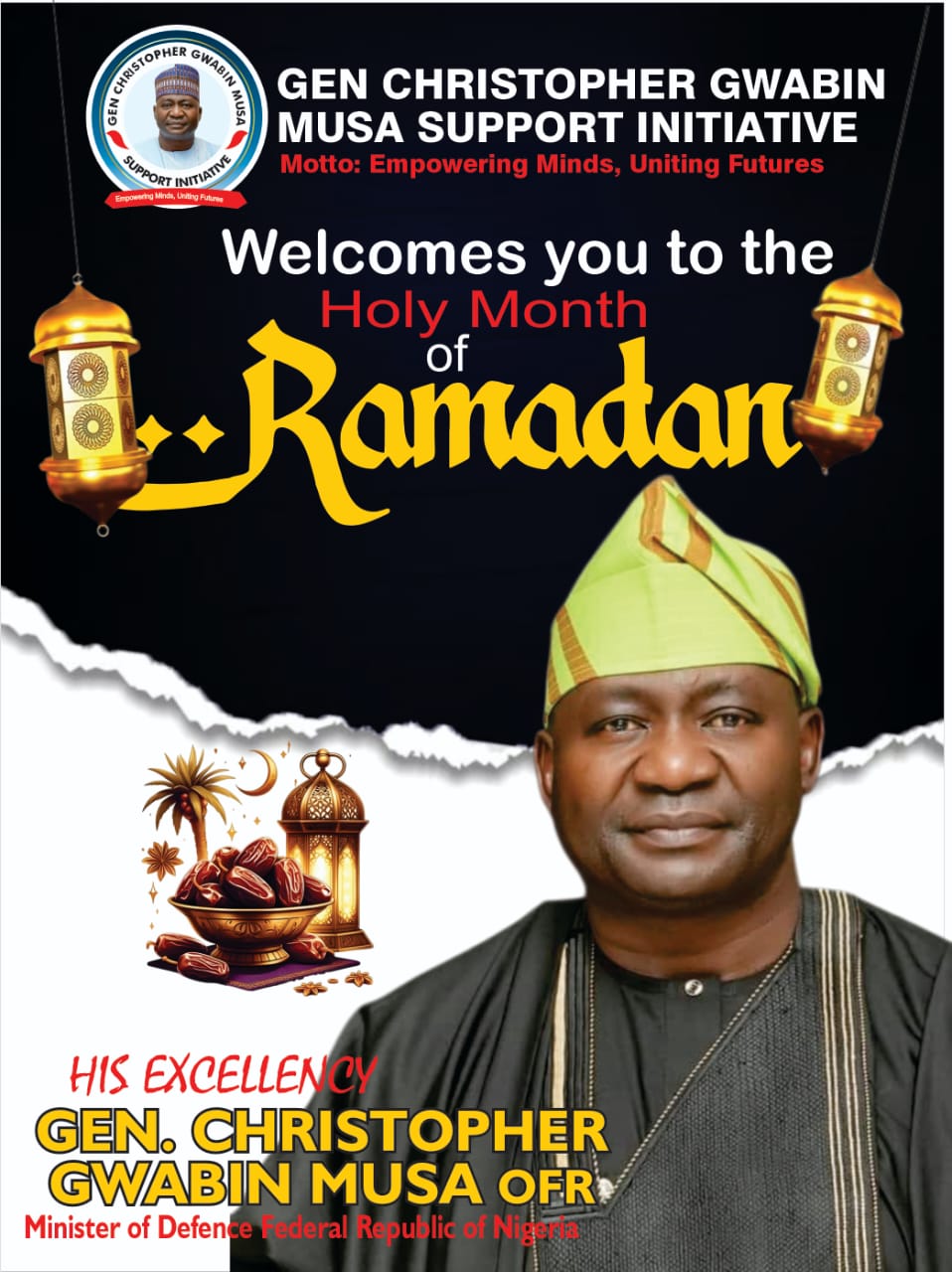
*GEN CHRISTOPHER GWABIN MUSA SUPPORT INITIATIVE JOINS MUSLIM UMMAH IN RAMADAN GREETINGS, CALLS FOR PRAYERS FOR NATIONAL PROGRESS*
The Gen Christopher Gwabin Musa Support Initiative (GCGMSI) has extended heartfelt wishes of Ramadan Mubarak to the Muslim Ummah across Nigeria, while earnestly urging prayers for the success and development of the administration of President Bola Ahmed Tinubu.
This message was conveyed in an official statement signed by the Initiative’s Convener, Ibrahim Dahiru Danfulani, the Sadaukin Garkuwan Keffi/Betara of Biu, and released to the press.
The statement highlighted a powerful exhortation from the Initiative’s Grand Patron, His Excellency General Christopher Gwabin Musa, OFR, the Minister of Defence. General Musa called on the Muslim faithful to deeply reflect upon and embody the profound teachings of the Prophet Muhammad (Peace Be Upon Him) throughout the sacred month of Ramadan and in their daily lives beyond. He emphasized the core Islamic values of piety, charity, tolerance, and unity as essential pillars for personal and national well-being.
The GCGMSI, a foremost advocacy group renowned for its unwavering commitment to national cohesion, reiterated its foundational mission of uniting Nigerians across all ethnic, religious, and social divides. The Initiative remains at the forefront of fostering dialogue, understanding, and a shared sense of patriotism. A key pillar of this mission is its dedicated focus on youth enlightenment, empowering the younger generation with values of civic responsibility, peace, and constructive engagement for a brighter national future.
The statement further underscored the steadfast commitment of its Grand Patron, General Christopher Gwabin Musa, to the ideal of “One Nigeria.” As Minister of Defence and a respected national figure, General Musa continues to champion policies and actions aimed at securing the nation and promoting inclusive development that leaves no citizen behind. His leadership, both within the GCGMSI and in his official capacity, is firmly anchored in the belief that Nigeria’s strength lies in its unity and collective purpose.
The Gen Christopher Gwabin Musa Support Initiative seizes this holy period to reaffirm its dedication to supporting initiatives that promote peace, security, and the overall socio-economic agenda of the Federal Government, praying for divine guidance for the nation’s leaders.
Ondo Poly Staff Protest Exclusion from ₦73,000 Minimum Wage
By George Omagbemi Sylvester | Published by SaharaWeeklyNG
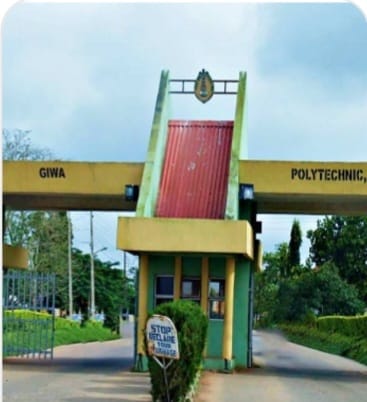
Academic and non‑academic staff of Rufus Giwa Polytechnic, Owo, Ondo State, brought the institution to a standstill on Monday as they protested against the alleged non‑implementation of the new national minimum wage. The demonstration highlighted growing tensions between the workforce and the state government over wage policy and fairness.
The protest involved staff under the Senior Staff Association of Nigeria Polytechnics (SSANIP) and the Academic Staff Union of Polytechnics (ASUP). Workers barricaded the main gate, displayed placards, and chanted solidarity slogans, demanding inclusion in the ₦73,000 minimum wage already being paid to other state employees since late 2024.
Union leaders argue that the state’s decision to exclude polytechnic staff from the new wage structure is discriminatory and legally unsupportable. SSANIP Chairman Comrade Saka Olokungboye Nurudeen described the situation as economically unsustainable, pointing out that many staff struggle to meet rising living costs and family responsibilities.
ASUP Chairman Comrade Ade Arikawe called on Gov. Lucky Aiyedatiwa to intervene and enforce the minimum wage across all state institutions. “The minimum wage is backed by law and should not be treated as a privilege,” he said, emphasizing that selective application undermines morale and productivity.
The rector of the polytechnic, Prof. Igbekele Ajibefun, acknowledged the workers’ grievances, confirming that discussions with union leaders were ongoing and that their concerns would be escalated to the state government for urgent consideration.
This protest is not unprecedented. In 2025, workers at the polytechnic staged an indefinite strike over unpaid salary arrears and the previous failure to implement the national minimum wage, warning that continued neglect could trigger institutional decline.
Labour experts argue that such disputes expose broader structural weaknesses in public‑sector wage administration. Renowned economist Joseph Stiglitz has observed, “When wages fail to keep pace with living costs, the result is not just hardship, but systemic inefficiency and social instability.” Similarly, labour scholar Guy Standing warns that inconsistent wage policies create a “precariat” class; workers trapped in economic insecurity despite formal employment.
In the context of Ondo State, where some civil servants reportedly receive the new minimum wage while polytechnic staff remain on obsolete pay scales, these warnings resonate sharply. Workers contend that the minimum wage, once enacted, should serve as a universal baseline not a selective benefit. Non‑implementation risks legal challenges, labour unrest and disruption to public education.
For the protesting staff, the issue goes beyond salary figures. It is about equitable treatment, dignity, and adherence to the rule of law. The peaceful protest, though disruptive to campus activities, reflects a determined insistence that the law apply uniformly to all state employees.
The unions have signalled that their action will continue until the state government addresses their demands. Whether the Ondo State authorities respond swiftly or allow the dispute to escalate will likely determine not only the academic calendar at Rufus Giwa Polytechnic but also the broader stability of labour relations across the state’s tertiary education sector.


-
 celebrity radar - gossips6 months ago
Why Babangida’s Hilltop Home Became Nigeria’s Political “Mecca”
-

 society6 months ago
Power is a Loan, Not a Possession: The Sacred Duty of Planting People
-
 news6 months ago
THE APPOINTMENT OF WASIU AYINDE BY THE FEDERAL GOVERNMENT AS AN AMBASSADOR SOUNDS EMBARRASSING
-

 Business6 months ago
Batsumi Travel CEO Lisa Sebogodi Wins Prestigious Africa Travel 100 Women Award