
society
OIL, ETHNICITY AND BETRAYAL: WARRI’S STORY

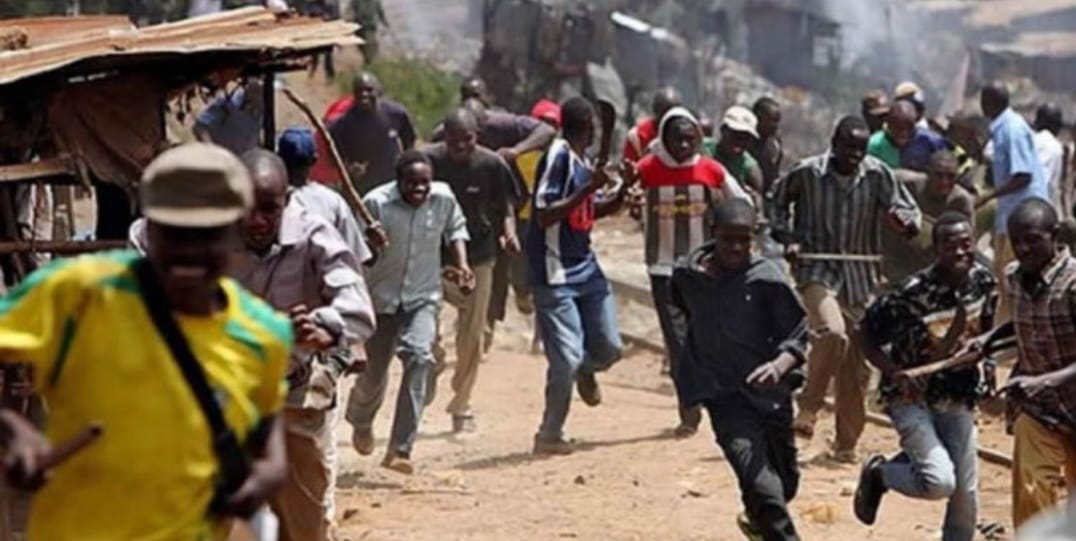
OIL, ETHNICITY AND BETRAYAL: WARRI’S STORY.
By George Omagbemi Sylvester | Published by saharaweeklyng.com
“An authoritative chronicle of how greed, ethnic politics and failed leadership turned a booming economic hub into a battleground of poverty, bloodshed and broken promises.”
Warri (once billed as one of Nigeria’s great oil cities, home to refineries, petrochemical plants and a deep-water river port) has repeatedly been pushed to the brink. What should have been a modern hub of industry and prosperity instead became the theatre of chronic violence, displacement and economic sabotage. The Warri crisis is not an isolated outburst of tribal spite; it is the predictable, preventable implosion of governance in an oil-rich zone where the rules were rigged, revenues were coveted and local communities were left to fight for scraps.
The immediate flashpoint that detonated the late-1990s conflict was deceptively mundane: the relocation of a local government headquarters. In 1997 the federal government created new local government areas and moved the Warri South-West LGA headquarters from the Ijaw town of Ogbe-Ijoh to the Itsekiri community of Ogidigben. That decision (administrative on its face) was interpreted as a grab for oil rents and political access to state resources. The result was a low-intensity war that escalated quickly into pitched battles, revenge killings and the occupation of oil installations. The violence that followed underscored a simple truth: in the Niger Delta, control over territory is control over oil money.
This was not merely an ethnic feud. Human Rights Watch, after on-the-ground investigation, concluded the violence was “essentially a fight over the oil money” a concise but damning diagnosis. When institutions fail to distribute wealth transparently, social identities harden into combat brigades and youth militias. In Warri the principal actors included Itsekiri and Ijaw militias, with Urhobo groups drawn in at times; the conflict’s web of grievances ranged across land claims, political representation, community boundary disputes and the spoils of petroleum production.
The human toll was devastating. Reports from credible observers describe hundreds killed, thousands injured and mass displacement. Between the broader waves of violence across Delta State and the concentrated fighting in Warri, hundreds of thousands of people were driven from their homes. The Red Cross and humanitarian organizations documented scenes of shattered families, pillaged homes and a spiralling humanitarian crisis. For oil companies and the national economy the costs were also steep: pipelines were blown up, storage facilities seized and production slashed and losses that reverberated through export revenues and local livelihoods.
The economic dimension cannot be overstated. Warri was and remains, strategically vital: it hosts major refinery and storage infrastructure, petrochemical facilities and one of the region’s key ports. Disruptions there were not local problems, but they were national emergencies. During peak episodes of unrest companies such as Chevron and Shell reported dramatic drops in output as installations were attacked or abandoned, underlining how fragile Nigeria’s oil-dependent economy is when social cohesion unravels. The Warri disturbances therefore had direct macroeconomic consequences and exposed how local grievances can become national security risks.
Why did the crisis persist for so long? A combination of structural failure and opportunism. Colonial-era administrative boundaries and the later reorganization of native authorities created unequal access to power and resources; these historical distortions metastasized into contemporary grievance. Successive state and federal governments frequently reacted with ad hoc force rather than durable political solutions. Peace deals were negotiated, only to fray when accountability, resource sharing and local governance were not meaningfully addressed. International analysts warned time and again that quick fixes would not suffice and the violence demanded institutional reforms, investment in transparent revenue sharing and meaningful local empowerment.
There is an additional corrosive element: the rise of armed youth networks and criminal entrepreneurs who profited from pipeline vandalism, oil theft and the chaos itself. Where legitimate opportunity is absent, illegitimate economies thrive. The emergence of groups later associated with the Movement for the Emancipation of the Niger Delta (MEND) and other militias was partly a product of state neglect but also of cynical manipulation by political actors and shadowy economic interests. The result was a multi-layered conflict in which ethnicity, economics and criminality fed each other in a cycle of violence and impoverishment.
The consequences for ordinary people were predictable and brutal. Beyond deaths and displacements, the social fabric of communities frayed: schools closed, health services collapsed and markets ceased to function. Children lost years of schooling; breadwinners lost access to fishing and farming grounds as insecurity spread. The dream of Warri (a bustling oil city that would lift Delta State’s “Big Heart” into prosperity) was substituted with a daily scramble for survival, where the loudest voices were often those armed and paid by others agendas.
So what must be done to rebuild and reclaim Warri’s future? First, truth and accountability: the history of decisions that stoked the conflict (from dubious boundary changes to corrupt contracts) must be laid out honestly and remedied where possible. Second, transparent revenue-sharing mechanisms must be instituted and enforced so that oil wealth funds local development rather than patronage. Third, durable reconciliation processes are needed that go beyond ceasefires: land boundary disputes require independent adjudication, local governments must be empowered and traditional leaders and civil society should be central to peacebuilding. Lastly, economic regeneration must prioritize jobs, education and infrastructure so that youth have real alternatives to militia life. These are not fanciful prescriptions; they are pragmatic, evidence-based steps recommended by conflict analysts and development agencies.
There is an uncomfortable political truth: Warri’s collapse is a mirror reflecting national governance failures. When central and state authorities outsource order to security crackdowns without fixing underlying political grievances, each temporary “PEACE” simply stores up a deeper eruption. Nigeria cannot afford to treat its oil cities as policing problems alone; they are the seams where the nation’s social contract will either be reforged or finally tear. As one human rights observer summed up bluntly: when oil money becomes the axis of local power, democracy degrades into a rent-seeking scramble.
Warri can be rebuilt; but only if politics change. The Big Heart state of Delta must reclaim the narrative of its capital: investment, inclusion and the rule of law over guns, patronage and impunity. That means politicians need to accept uncomfortable compromises, companies must be accountable to communities rather than complicit in silence and civil society must be empowered to monitor and participate. The alternative is perpetual decline: an oil city that extracts wealth while exporting misery. That is a national scandal we can and must prevent.





NAWOJ: SEKINAT, CHARITY GETS VOTE OF CONFIDENCE
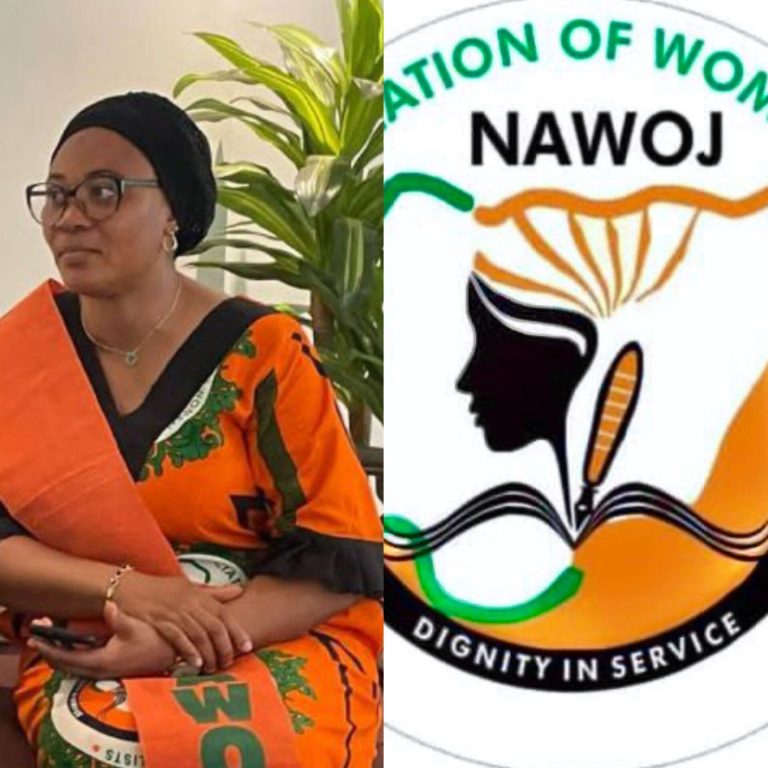
The Nigeria Association of Women Journalists,(NAWOJ), Ogun State Chapter Executives has unanimously passed a vote of confidence on Chairman NAWOJ SEKINAT Salam and the Financial Secretary, Charity James, saying that, their leadership reflect the ideal and objectives of NAWOJ.
This was revealed in a communique issued at an Emergency meeting of the Executive held at the NUJ State Council, Iwe-Iroyin in Abeokuta.
The vote of confidence on the Leadership of NAWOJ was unanimously signed by all the five executive members that attended the meeting with the vice chairperson taking apology for official engagement outside the state capital.
According to the communique ” Consequently, NAWOJ Ogun State Chapter, reaffirms it’s unwavering support and confidence in the Chairperson and the Financial Secretary, Sekinat Salam and Charity James respectively, Urge them to continue in their commitment to purposeful leadership in the best interest of the association and the society at large”.
Speaking briefly with Journalists after the emergency Executive meeting, the Chairperson, Nigeria Association of Woman Journalists (NAWOJ), Com. Sekinat Salam, said the meeting was necessary as the news of her suspension was laughable and insulting because it is like a pot calling a kettle black in this case, saying that the Leadership of the State Council, Com. Wale Olanrewaju has no local standing to suspend her or any executive member, even he cannot be a judge in his own case.
According to her” The Leadership of the Nigeria Union of Journalists, Ogun State led by Wale Olanrewaju has always been misusing power without recourse to the constitution of this noble Union, hence has no local standing to suspend me or any executive member “.
She said only the Central Working Committee (CWC) has the constitutional rights to sanction or suspend any members found wanting after due process has been followed.
While calling on members to stay calm, Com. Sekinat Salam assured members of positive representation of NAWOJ at both the State and National level, adding the success recorded under her administration cannot be overemphasized.
She therefore called on the National leadership of NUJ to critically look into the matter, either by setting up independent committee to investigate the issues and resolve the matter as quickly as possible.
Adron Homes Chairman Congratulates Oyo State on 50 Years of Progress
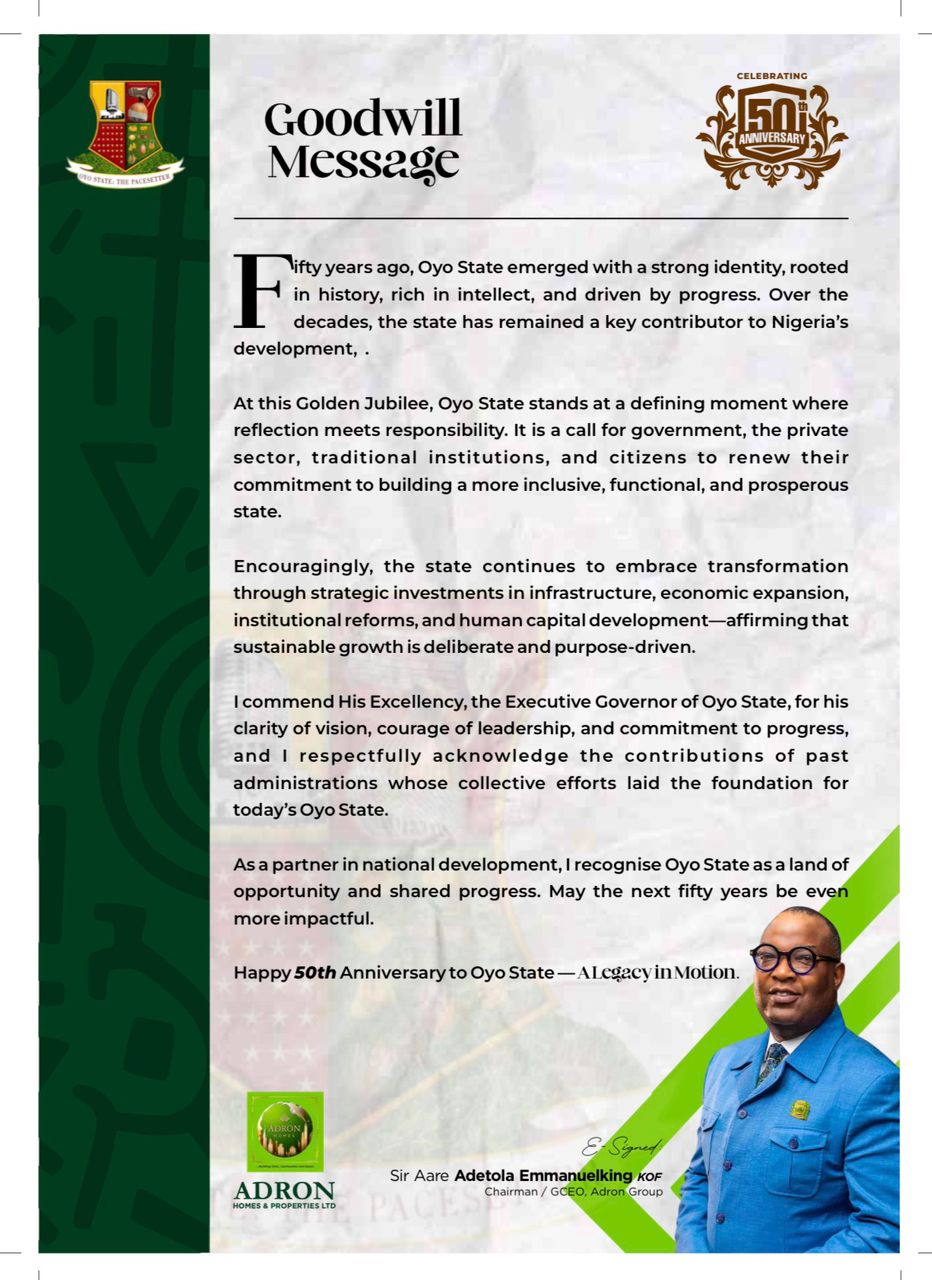
The Chairman and Chief Executive Officer of Adron Homes and Properties Limited, Aare Adetola Emmanuelking, has congratulated the Government and people of Oyo State as the state marks its 50th anniversary, describing the occasion as a celebration of resilience, cultural pride, and sustained progress.
He noted that since its creation, Oyo State has remained a strong contributor to Nigeria’s socio-economic and cultural development, emerging as a hub of commerce, education, and innovation.
According to him, the Golden Jubilee offers a moment for reflection and renewed commitment by government, private sector players, traditional institutions, and citizens toward building a more inclusive and prosperous state.
Aare Emmanuelking commended the state’s ongoing transformation through investments in infrastructure, economic expansion, and human capital development, adding that sustainable growth is deliberate and must remain purpose-driven.
He also praised the leadership of the current administration while acknowledging the contributions of past leaders whose efforts laid the foundation for today’s Oyo State.
Reaffirming Adron Homes’ commitment to national development, he described Oyo State as a land of opportunity. He wished the state continued peace and prosperity, expressing confidence that the next fifty years will bring even greater achievements for the Pace Setter State and its people.
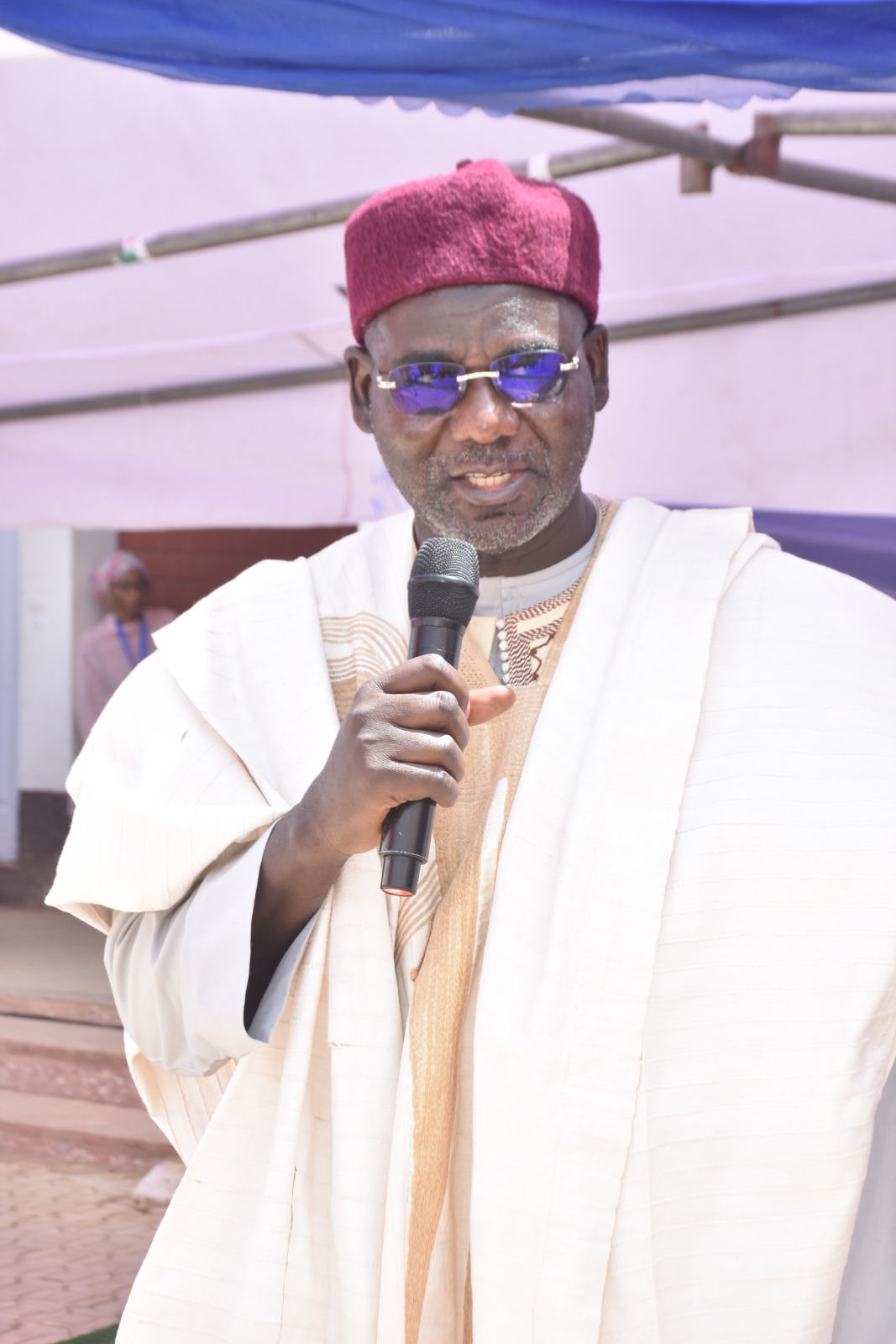
TY BURATAI HUMANITY CARE FOUNDATION CONDOLES WITH BIU EMIRATE OVER TRAGIC ATTACK
In a profound expression of sorrow, the TY Buratai Humanity Care Foundation has extended its heartfelt condolences to the families of the victims and the entire people of Biu Emirate, Borno State, following the recent tragic attack attributed to Boko Haram. This devastating assault, which occurred at a work site in northeastern Nigeria, claimed the lives of dozens, including brave soldiers committed to protecting the nation.
In a statement released to the press and signed by the Chairman of the foundation, Ibrahim Dahiru Danfulani Sadaukin Garkuwan Keffi/Betara Biu, the Grand Patron of the Foundation, His Excellency Amb. Lt. Gen. Tukur Yusufu Buratai CFR (Rtd), former Chief of Army Staff, described the incident as “one too many senseless, barbaric, and ruthless displays of inhumanity.” His Excellency emphasized the heartbreaking impact of such attacks on innocent, hardworking citizens striving to make a positive difference in their communities.
The Grand Patron praised the swift and decisive response of military personnel during this critical time, underscoring their brave commitment to safeguarding the nation. He called upon them to maintain this momentum, commending their courage and sacrifice in the face of adversity. “May Almighty Allah forgive their souls and grant them Aljannah Firdouse,” he remarked, encouraging the nation to honor their spirit of sacrifice as they rally together to rebuild and restore hope across the region.
In his statement, Gen. Buratai highlighted the importance of collective action in overcoming the challenges posed by insecurity, urging concerned citizens to increase their efforts in fostering a virile community that future generations can cherish. “Together, we can surmount these troubles,” he asserted, calling on all patriotic leaders and citizens to unite in the fight against violence and insecurity.
The TY Buratai Humanity Care Foundation remains committed to supporting initiatives that promote peace, security, unity, and prosperity. As the foundation extends its condolences to the bereaved, it also calls upon all segments of society to collaborate in creating a better and safer future. May Allah guide and protect the nation and lead it toward enduring peace. Amen.


-

 celebrity radar - gossips6 months ago
Why Babangida’s Hilltop Home Became Nigeria’s Political “Mecca”
-

 society6 months ago
Power is a Loan, Not a Possession: The Sacred Duty of Planting People
-

 Business6 months ago
Batsumi Travel CEO Lisa Sebogodi Wins Prestigious Africa Travel 100 Women Award
-

 news6 months ago
THE APPOINTMENT OF WASIU AYINDE BY THE FEDERAL GOVERNMENT AS AN AMBASSADOR SOUNDS EMBARRASSING