
society
BLOOD, OIL AND BETRAYAL: The Untold History of the Warri Crisis

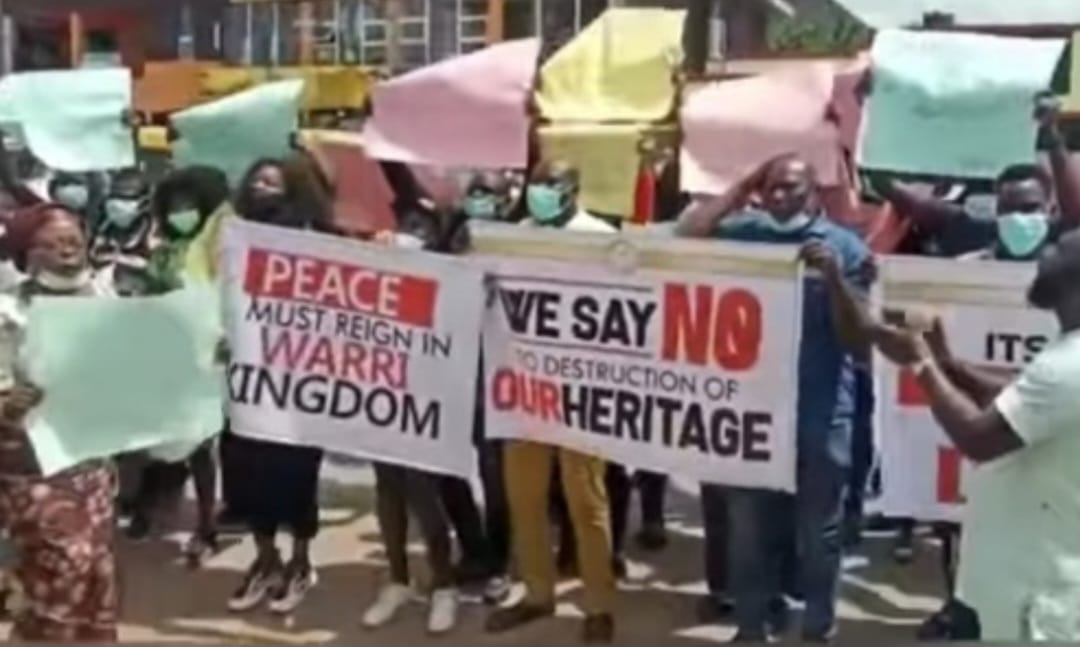
BLOOD, OIL AND BETRAYAL: The Untold History of the Warri Crisis.
By George Omagbemi Sylvester | Published by saharaweeklyng.com
“A deep dive into the political distortions, boundary disputes and violent power struggles that fuelled one of Nigeria’s most devastating oil-region conflicts.”
INTRODUCTION: WHEN OIL BECOMES A CURSE.
Warri was not designed to bleed. It was designed to thrive; a booming oil city, a melting pot of Itsekiri, Ijaw and Urhobo civilisation and one of the most economically strategic territories in the entire Niger Delta. Though the same abundance that should have made Warri Nigeria’s industrial crown jewel became the poison that fractured it.
The Warri crisis is a brutal testament to what happens when greed overwhelms governance, when political manipulation replaces justice, and when the oxygen of a people’s survival (land, identity and resource control) is weaponised. The city became a theatre of unending conflict because institutions failed, leaders betrayed trust and the federal structure amplified rather than resolved grievances. As the renowned political theorist John L. Esposito once wrote, “Where the state refuses fairness, society becomes a battleground of competing wounds.” Warri embodies that warning to the letter.
THE ROOT OF THE FIRE: A CITY BUILT ON COMPETING HISTORIES.
The foundation of Warri’s crisis lies in the overlapping historical claims of three ethnic groups: the ITSEKIRI, IJAW and URHOBO. Each group holds deep cultural and ancestral attachments to the land and its waterways. Colonial administrators worsened tensions by redrawing boundaries in ways that ignored indigenous histories. The British-era Native Authorities, provincial boundaries and later Local Government reforms all created structural imbalances. Communities who felt sidelined by these political designs carried those grievances into the post-colonial era. The embers were already hot and it only needed a spark.
Professor Eghosa Osaghae, a leading scholar of federalism, once warned:
“When administrative boundaries do not reflect social reality, conflict becomes a permanent resident.” WARRI is the NIGERIAN example of that truth.
THE FLASHPOINT OF 1997: WHEN A “PEN STROKE” IGNITED A WAR.
In March 1997, the Nigerian military government created new LGAs and relocated the Warri South-West Local Government Headquarters from the predominantly Ijaw community of Ogbe Ijoh to the Itsekiri community of Ogidigben.
That decision was not administrative; it was explosive. For the Ijaw, it meant political disenfranchisement, loss of control over revenue allocations and weakened access to land rights. For the Itsekiri, it was a long-overdue correction of historic marginalisation. For the Urhobo, it added another layer of complexity to already tense communal relations.
The consequence was war.
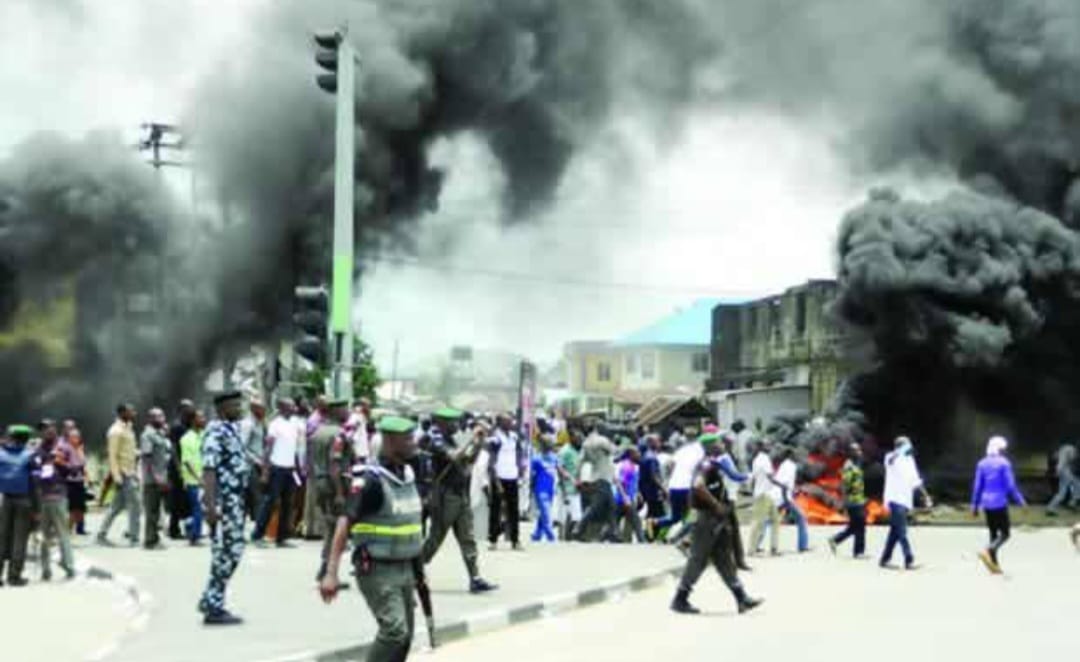
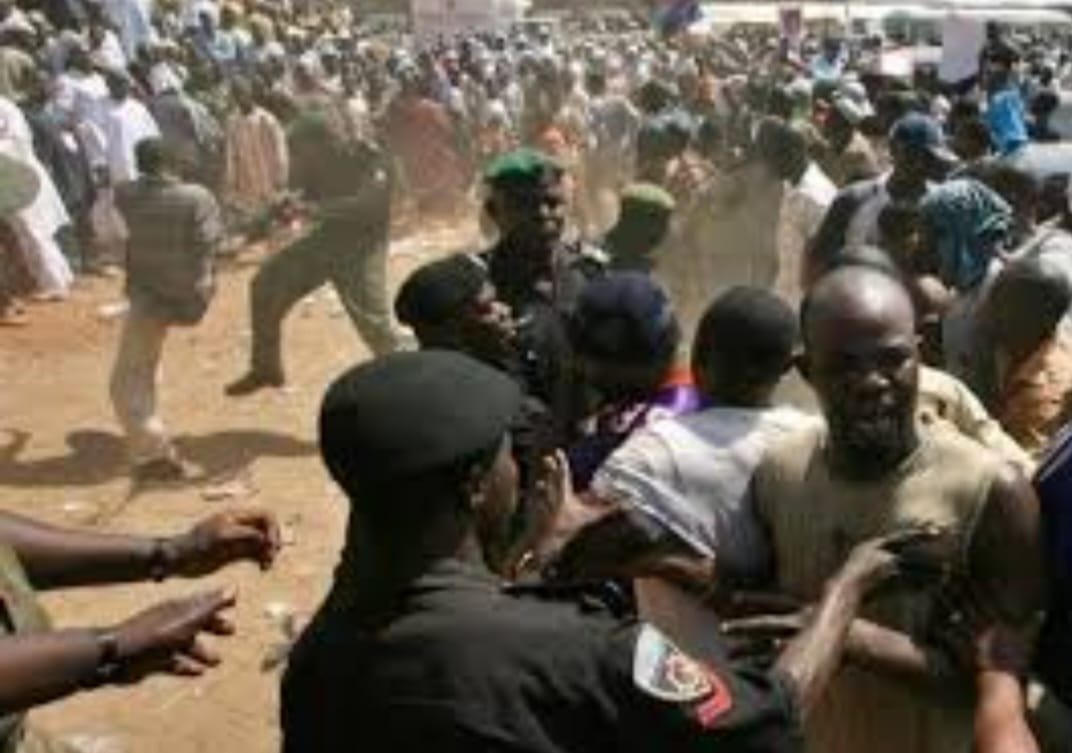
Militias formed overnight. Villages were razed. Lives ended brutally. Communities that had lived in uneasy peace for decades turned into bitter enemies. The conflict spread quickly across Warri, Escravos, Koko, Gbaramatu, Ugborodo and other key oil belts.
Human rights groups recorded hundreds of deaths, mass displacement and widespread destruction. Chevron, Shell and NNPC facilities became targets and Nigeria’s oil production nose-dived.
Warri (a city built to be a symbol of prosperity) was now synonymous with bloodshed.
OIL: THE FUEL THAT FED THE FLAMES.
To understand the Warri crisis, one must understand the politics of oil. The struggle was never merely about ethnicity. It was about control — of flow stations, pipelines, royalties, political access, oil company patronage and federal allocations. The late economist Claude Ake captured it perfectly:
“In Nigeria, oil is not a resource. It is the politics itself.”
In Warri, this reality was unmasked violently.
Oil companies often hid behind a façade of neutrality, yet their operational maps influenced who had power. Communities fought bitterly to be recognised as “HOST COMMUNITIES” because that meant contracts, employment, compensation and political access.
The 1997 LGA headquarters relocation was simply the match that lit decades of tinder.
THE DEEPER BETRAYAL: HOW GOVERNMENT FAILED WARRI.
The Warri crisis persisted because the state repeatedly failed in three major ways:
1. Failure of Fair Governance.
Decisions were made without consultation. Communities were treated as afterthoughts. Leaders played ethnic politics to secure FEDERAL ATTENTION and OIL COMPANY FAVOUR.
2. Failure of Security and Justice.
Instead of impartial conflict resolution, authorities often responded with force. Allegations of arbitrary raids, mass arrests and selective protection became common. As the conflict analyst Dr. Cyril Obi wrote, “When security forces become perceived as ethnic tools, the state’s legitimacy collapses.”
3. Failure of Development.
Despite producing billions in oil wealth, Warri’s communities remained underdeveloped. Roads collapsed. Schools shut. Health centres decayed. Youth unemployment worsened. A generation grew up seeing violence as the only language the government understands.
Warri became a paradox: an oil giant with the LIVING CONDITIONS of an ABANDONED VILLAGE.
THE RISE OF MILITIAS: WHEN YOUTH BECAME THE ARBITERS OF POWER.
With no jobs, no justice system to trust and no political empowerment, young people turned to the only available economy, which is the militant economy.
Pipeline vandalism, oil theft and territorial control became alternative livelihoods.
This era birthed the militant networks that later evolved into groups connected to the Movement for the Emancipation of the Niger Delta (MEND).
These groups defended their ethnic interests but also tapped into the lucrative black economy of illegal oil bunkering. As the Niger Delta historian Ibaba I. Samuel puts it:
“A neglected youth is a weapon waiting for the highest bidder.”
Warri’s youth became exactly that; weapons in the hands of political actors, warlords and economic saboteurs.
THE HUMAN COST: WHEN A CITY’S HEART STOPPED BEATING.
The Warri crisis unleashed human suffering on a massive scale:
Entire communities were erased.
Children dropped out of school.
Women became widows in hours.
Markets and businesses collapsed.
Inter-marriages dissolved as families fled.
Thousands were internally displaced.
Traditional institutions lost authority.
Fear became the city’s official language.
Warri moved from being a city of industry to a city of trauma.
THE ECONOMIC RUIN: WHEN AN OIL CAPITAL BECAME A WARZONE.
The Warri crisis dealt Nigeria one of its largest economic blows in the Fourth Republic:
Oil companies shut down operations.
Production dropped significantly during peak violence.
Billions of dollars were lost in output.
Critical infrastructure was vandalised continuously.
Investors fled.
Port activity declined.
The ONCE-BUSTLING Warri refinery became symbolic of national decay.
Nigeria (a nation addicted to oil revenue) bled alongside Warri.
PATH TO REDEMPTION: WHAT MUST BE DONE.
Warri can rise again, but not through EMPTY POLITICAL speeches. It needs STRUCTURAL REFORM anchored on fairness.
1. Clear, just, community-backed boundary demarcation.
No more ambiguous maps drawn by bureaucrats who have never visited the creeks.
2. Power-sharing and political inclusion for all ethnic groups.
No group must feel like a tenant in its own land.
3. Transparent oil revenue allocation.
Host communities must feel the impact and not through crumbs but genuine development.
4. Community-based peace mechanisms.
DIALOGUE, not FORCE, creates permanent peace.
5. Youth empowerment and economic diversification.
A city that leaves its youth jobless manufactures its own destroyers.
6. Oil companies must be held accountable.
CSR must become law-backed obligation, not public relations charity.
FINAL NOTE: REBUILDING A CITY BETRAYED BY ITS GUARDIANS.
Warri’s crisis is not just a story of conflict, but a story of betrayal.
Betrayal by leaders who weaponised ethnicity.
Betrayal by governments that ignored early warnings.
Betrayal by oil companies that benefited from division.
Betrayal by a system that treated human lives as expendable.
YET WARRI HAS NOT DIED.
Its people remain RESILIENT, PROUD and EAGER for PEACE.
Its creeks still carry the ECHOES of a FUTURE WAITING to be REBUILT.
Its youth still POSSESS BRILLIANCE WAITING to be UNLOCKED.
Though only TRUTH, JUSTICE and INCLUSIVE GOVERNANCE can restore what was lost.
As Chinua Achebe warned:
“A man who does not know where the rain began to beat him cannot say where he dried his body.”
Warri must confront where the rain began. Only then can the Big Heart State (Delta) beat strongly again.






NAWOJ: SEKINAT, CHARITY GETS VOTE OF CONFIDENCE
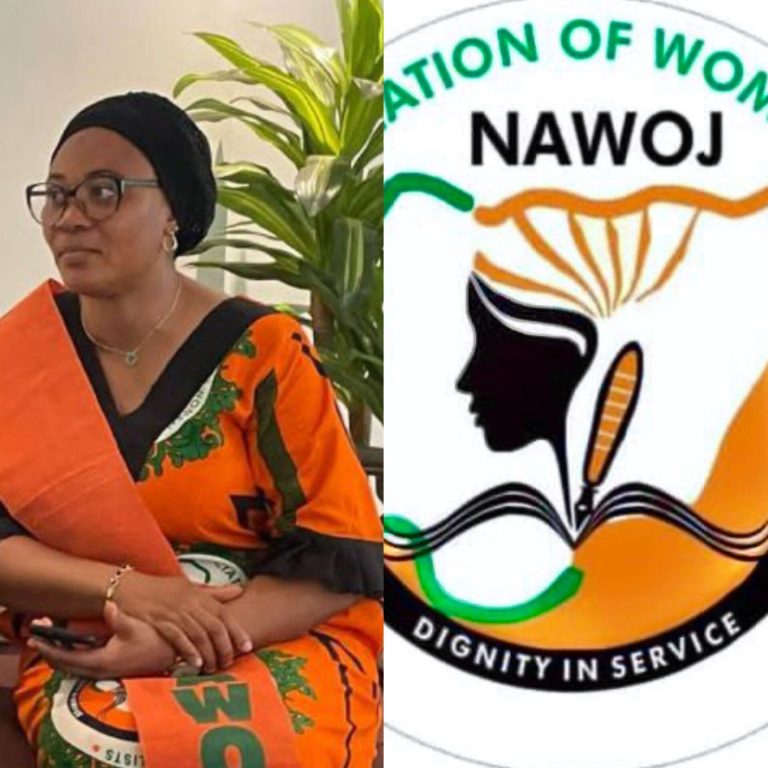
The Nigeria Association of Women Journalists,(NAWOJ), Ogun State Chapter Executives has unanimously passed a vote of confidence on Chairman NAWOJ SEKINAT Salam and the Financial Secretary, Charity James, saying that, their leadership reflect the ideal and objectives of NAWOJ.
This was revealed in a communique issued at an Emergency meeting of the Executive held at the NUJ State Council, Iwe-Iroyin in Abeokuta.
The vote of confidence on the Leadership of NAWOJ was unanimously signed by all the five executive members that attended the meeting with the vice chairperson taking apology for official engagement outside the state capital.
According to the communique ” Consequently, NAWOJ Ogun State Chapter, reaffirms it’s unwavering support and confidence in the Chairperson and the Financial Secretary, Sekinat Salam and Charity James respectively, Urge them to continue in their commitment to purposeful leadership in the best interest of the association and the society at large”.
Speaking briefly with Journalists after the emergency Executive meeting, the Chairperson, Nigeria Association of Woman Journalists (NAWOJ), Com. Sekinat Salam, said the meeting was necessary as the news of her suspension was laughable and insulting because it is like a pot calling a kettle black in this case, saying that the Leadership of the State Council, Com. Wale Olanrewaju has no local standing to suspend her or any executive member, even he cannot be a judge in his own case.
According to her” The Leadership of the Nigeria Union of Journalists, Ogun State led by Wale Olanrewaju has always been misusing power without recourse to the constitution of this noble Union, hence has no local standing to suspend me or any executive member “.
She said only the Central Working Committee (CWC) has the constitutional rights to sanction or suspend any members found wanting after due process has been followed.
While calling on members to stay calm, Com. Sekinat Salam assured members of positive representation of NAWOJ at both the State and National level, adding the success recorded under her administration cannot be overemphasized.
She therefore called on the National leadership of NUJ to critically look into the matter, either by setting up independent committee to investigate the issues and resolve the matter as quickly as possible.
Adron Homes Chairman Congratulates Oyo State on 50 Years of Progress
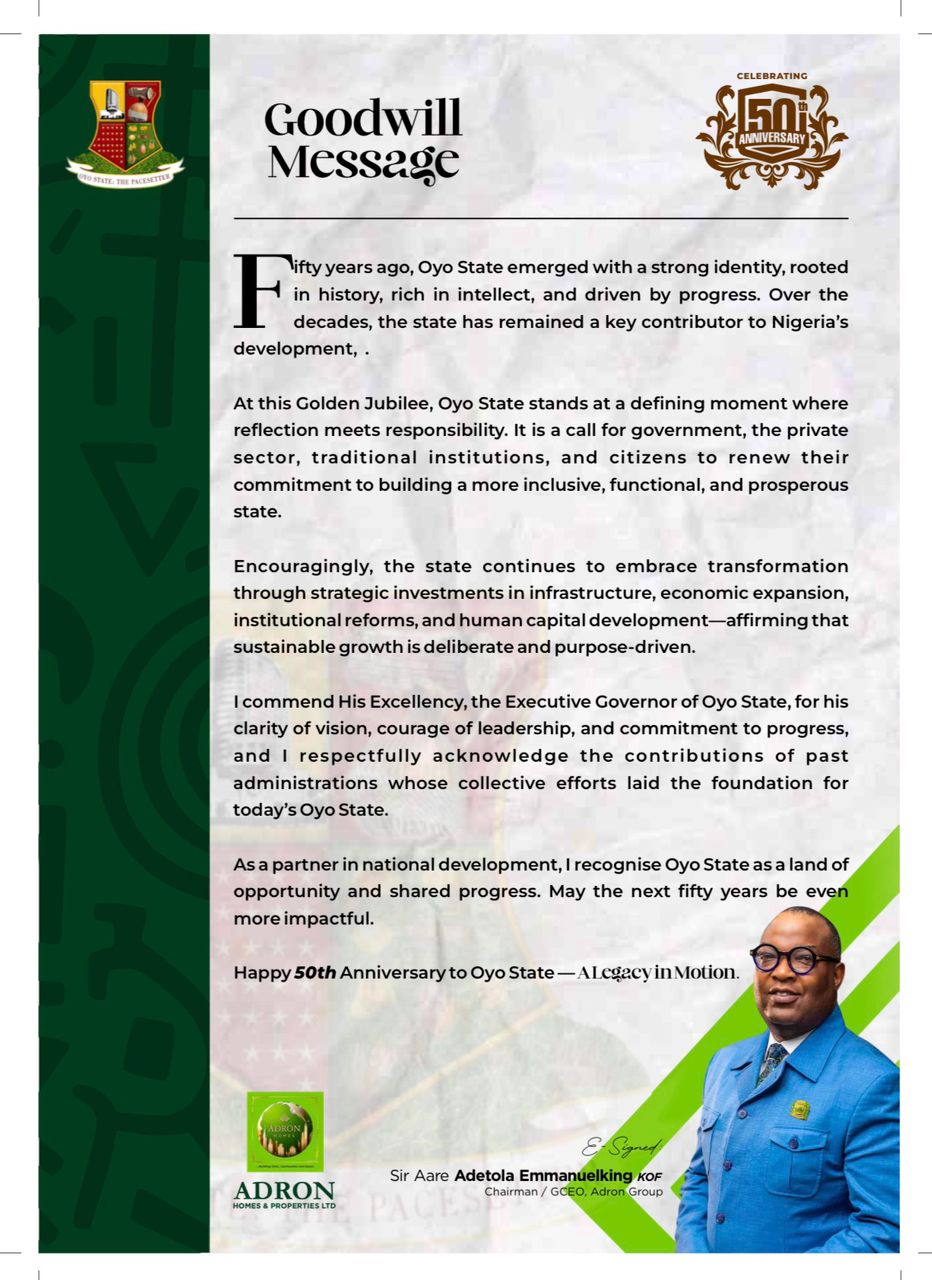
The Chairman and Chief Executive Officer of Adron Homes and Properties Limited, Aare Adetola Emmanuelking, has congratulated the Government and people of Oyo State as the state marks its 50th anniversary, describing the occasion as a celebration of resilience, cultural pride, and sustained progress.
He noted that since its creation, Oyo State has remained a strong contributor to Nigeria’s socio-economic and cultural development, emerging as a hub of commerce, education, and innovation.
According to him, the Golden Jubilee offers a moment for reflection and renewed commitment by government, private sector players, traditional institutions, and citizens toward building a more inclusive and prosperous state.
Aare Emmanuelking commended the state’s ongoing transformation through investments in infrastructure, economic expansion, and human capital development, adding that sustainable growth is deliberate and must remain purpose-driven.
He also praised the leadership of the current administration while acknowledging the contributions of past leaders whose efforts laid the foundation for today’s Oyo State.
Reaffirming Adron Homes’ commitment to national development, he described Oyo State as a land of opportunity. He wished the state continued peace and prosperity, expressing confidence that the next fifty years will bring even greater achievements for the Pace Setter State and its people.
TY BURATAI HUMANITY CARE FOUNDATION CONDOLES WITH BIU EMIRATE OVER TRAGIC ATTACK
In a profound expression of sorrow, the TY Buratai Humanity Care Foundation has extended its heartfelt condolences to the families of the victims and the entire people of Biu Emirate, Borno State, following the recent tragic attack attributed to Boko Haram. This devastating assault, which occurred at a work site in northeastern Nigeria, claimed the lives of dozens, including brave soldiers committed to protecting the nation.
In a statement released to the press and signed by the Chairman of the foundation, Ibrahim Dahiru Danfulani Sadaukin Garkuwan Keffi/Betara Biu, the Grand Patron of the Foundation, His Excellency Amb. Lt. Gen. Tukur Yusufu Buratai CFR (Rtd), former Chief of Army Staff, described the incident as “one too many senseless, barbaric, and ruthless displays of inhumanity.” His Excellency emphasized the heartbreaking impact of such attacks on innocent, hardworking citizens striving to make a positive difference in their communities.
The Grand Patron praised the swift and decisive response of military personnel during this critical time, underscoring their brave commitment to safeguarding the nation. He called upon them to maintain this momentum, commending their courage and sacrifice in the face of adversity. “May Almighty Allah forgive their souls and grant them Aljannah Firdouse,” he remarked, encouraging the nation to honor their spirit of sacrifice as they rally together to rebuild and restore hope across the region.
In his statement, Gen. Buratai highlighted the importance of collective action in overcoming the challenges posed by insecurity, urging concerned citizens to increase their efforts in fostering a virile community that future generations can cherish. “Together, we can surmount these troubles,” he asserted, calling on all patriotic leaders and citizens to unite in the fight against violence and insecurity.
The TY Buratai Humanity Care Foundation remains committed to supporting initiatives that promote peace, security, unity, and prosperity. As the foundation extends its condolences to the bereaved, it also calls upon all segments of society to collaborate in creating a better and safer future. May Allah guide and protect the nation and lead it toward enduring peace. Amen.


-

 celebrity radar - gossips6 months ago
Why Babangida’s Hilltop Home Became Nigeria’s Political “Mecca”
-

 society6 months ago
Power is a Loan, Not a Possession: The Sacred Duty of Planting People
-

 Business6 months ago
Batsumi Travel CEO Lisa Sebogodi Wins Prestigious Africa Travel 100 Women Award
-

 news6 months ago
THE APPOINTMENT OF WASIU AYINDE BY THE FEDERAL GOVERNMENT AS AN AMBASSADOR SOUNDS EMBARRASSING