
society
A Nation on Alert: Is FIRS’ Xpress Payments Move Consolidating a Revenue Cartel?

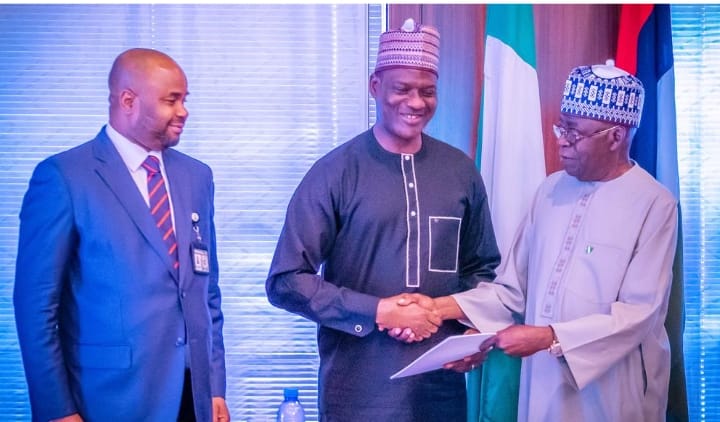
A Nation on Alert: Is FIRS’ Xpress Payments Move Consolidating a Revenue Cartel?
BY BLAISE UDUNZE
Nigeria’s national mood is tense. The country is facing economic hardship, insecurity, public distrust in institutions, and an increasingly widening gap between citizens and their government. Yet, in the midst of this fragility, a quiet administrative action by the Federal Inland Revenue Service (FIRS) has sparked a storm of public concern, political accusations, and renewed debate over who truly controls Nigeria’s revenue system.
The controversy began when the FIRS quietly announced the appointment of Xpress Payment Solutions Limited, a fast-rising Nigerian fintech company, as a Treasury Single Account (TSA) collecting agent, effectively giving the company authority to process federal government tax payments through the TaxPro Max platform. With this appointment, taxpayers can now remit Company Income Tax, Value Added Tax, Withholding Tax, and other federal payments using XpressPay or the company’s in-branch e-Cashier platform.
At first glance, the move appears technical and harmless, perhaps even a necessary step to modernize Nigeria’s digital tax infrastructure. But almost immediately, outrage erupted across political, civil society, and economic circles. And within hours, the debate had escalated into what is now being framed as a national question: Is Nigeria witnessing the quiet re-emergence of a revenue cartel, this time on a federal scale?
A Tax Gatekeeper Emerges Silently
Xpress Payments is not an unfamiliar name in Nigeria’s fintech landscape. Incorporated in 2016, the company has grown steadily, offering secure payment gateways, switching services, and enterprise financial solutions. Its Acting Managing Director, Wale Olayisade, expressed delight at the appointment, describing it as a major milestone, “We are honoured to be selected by FIRS. Our systems are built to ensure ease, speed, and security for every transaction.”
He insisted that taxpayers would enjoy a seamless, transparent, and reliable experience.
Ordinarily, such remarks should settle nerves. But the public response was anything but calm. Citizens and political stakeholders immediately raised a torrent of questions:
– Why was this appointment announced quietly, without public consultation?
– What new value does Xpress Payments add that existing TSA channels, such as Remita, do not already provide?
– Were there competitive bids?
– What are the contract terms, and who benefits financially?
– Why concentrate such a sensitive national function in private hands at a time when transparency is already strained?
The silence from government circles only deepened the suspicion. In governance, especially around revenue, silence is not neutrality; it is oxygen for mistrust.
Atiku Abubakar Explodes: “This Is Lagos-Style State Capture”
The loudest reaction came from former Vice President Atiku Abubakar, who issued one of his most forceful statements in recent years. Atiku accused the Federal Government of attempting to replicate the same at a national scale. The controversial Lagos revenue model was dominated for years by Alpha Beta, a private firm accused of enjoying a monopoly over the state’s revenue pipeline.
In his words, “This is the resurrection of the Alpha Beta revenue cartel. What we are witnessing now is an attempt to nationalise that template.”
Atiku warned that the move could concentrate power around politically connected private actors, enabling them to sit at the centre of federal revenue flows. He questioned the timing, calling it insensitive given the nationwide grief over insecurity, “When a nation is mourning, leadership should show empathy, not expand private revenue pipelines.”
He issued five demands:
1. Immediate suspension of the Xpress Payments appointment
2. Full disclosure of contract terms and beneficiaries
3. A comprehensive audit of TSA operations
4. A legal framework preventing private proxies from controlling public revenue
5. A shift in national priorities toward security and transparent governance
His final warning was blunt, “Nigeria’s revenues are not political spoils. They are the lifeblood of our national survival.”
The Ghost of Alphabeta: Why Nigerians Are Worried
For many Nigerians, this controversy triggers painful memories of earlier private-sector dominance over public revenue. The “Alphabeta era” in Lagos is widely remembered, fairly or unfairly, as a time when a single private company appeared to dominate the state’s tax collection landscape, shrouded in secrecy and controversy.
Nigeria’s fear is simple:
– If revenue collection becomes controlled by one or two private companies, transparency dies, and corruption flourishes.
– Allowing private entities to sit between taxpayers and government can create:
· Monopoly power
· Inflated service fees
· Data privacy concerns
· Political weaponization of revenue information
· Institutional dependency
· Centralization of sensitive national data
Each of these risks has real consequences for economic stability.
FIRS’ Defence: “It Is Only an Additional Option”
To be fair, the FIRS insists that Xpress Payments is only one of several available channels, not the exclusive gatekeeper. Remita and other payment service providers remain operational.
According to FIRS, the move is part of a broader effort to modernize and expand taxpayer options within the TSA. In a functional environment, this would be welcomed as healthy competition. But Nigerians are not reacting to the announcement; they are reacting to the pattern:
– Sudden appointments
– Lack of transparency
– Political undertones
– Private-sector centralization of public revenue
– Timing that coincides with widespread economic strain
The concern is not the company itself; it is the impenetrability surrounding how such decisions are made.
The Big Tax Picture: Major Reforms Coming in January 2026
While the Xpress Payments controversy rages, Nigeria is simultaneously preparing for the most ambitious tax reform in decades, one that may change how individuals and businesses perceive taxation entirely.
The reforms, spearheaded by the Presidential Fiscal Policy and Tax Reforms Committee, chaired by Mr. Taiwo Oyedele, will take effect in January 2026, and they promise sweeping changes.
1. Drastic Reduction of Tax Burden on 98 percent of Nigerians
Oyedele has repeatedly emphasized, “You will pay less or no tax if you are in the bottom 98 percent of income earners.” Under the new regime:
– Workers earning below N800,000 annually pay zero personal income tax.
– Basic food, healthcare, education, and public transport become VAT-exempt, lowering living costs.
– Small companies (turnover ≤ N100m) will pay zero corporate tax, zero capital gains tax, and be exempt from the new 4 percent development levy.
2. Consolidation of Multiple Tax Laws
The reform merges numerous existing laws, CITA, PITA, VAT Act, CGT Act, into a unified tax code. This eliminates duplication, confusion, and overlapping mandates that have plagued Nigeria for decades.
3. Increased CGT for Companies, Fairer Rates for Individuals
– Companies now pay 30 percent CGT.
– Individuals pay CGT based on their income band.
4. Tax on Digital and Virtual Asset Profits
The reforms modernize the tax base to include digital transactions and virtual assets.
5. Export Incentives
Profits from goods exported will now be income tax-free, provided proceeds are repatriated legally.
6. Stronger Tax Institutions
A new Nigeria Revenue Service (NRS) will become the sole federal tax collector, while the Tax Ombudsman will resolve disputes.
7. President Tinubu Sets Up an Implementation Committee
To ensure smooth rollout, President Tinubu has approved the National Tax Policy Implementation Committee (NTPIC) chaired by Joseph Tegbe and supervised by Minister of Finance, Wale Edun.
The goal:
Improve compliance, reduce leakages, and reinforce fiscal sustainability.
So, Why Are Nigerians Still Worried?
Because reform alone does not guarantee trust. Nigerians welcome the promise of lower taxes, simpler laws, and less harassment. But they fear that while the tax burden may be reduced, the control over tax collection may be quietly shifting into private hands.
The unsettling question persists:
– How can a nation modernize its tax system while simultaneously outsourcing its revenue gateways?
– What Exactly Is the Risk?
1. Over-Centralization of Revenue Gateways
Even if Xpress Payments is “an option,” such appointments can slowly evolve into de facto monopolies, especially in Nigeria, where political influence often determines market dominance.
2. Data Privacy and National Security
Tax data is deeply sensitive. It reveals income patterns, business operations, sectoral flows, and strategic economic information. Consolidating such data under private firms raises major cybersecurity concerns.
3. Potential for Political Capture
The fear is not that Xpress Payments lacks capacity; the company is reputable, but that future actors may exploit such arrangements for political financing or influence.
4. Risk of Middlemen Profiting from Public Revenue
If service fees or transaction charges apply, taxpayers may indirectly fund private intermediaries for basic access to government services.
5. Erosion of Public Trust
A tax system must be trusted to function. When people sense secrecy, they resist compliance.
What Nigeria Needs Now: Full Transparency, Not Silence
To rebuild confidence, the federal government must take immediate steps:
1. Publish All Contract Details
Service fees, revenue-sharing models, data access permissions, contracts’ duration, and ownership disclosures must be made public.
2. Conduct an Independent Audit of TSA Payment Providers
This should include Remita, Xpress Payments, and all other agents.
3. Prevent Monopolies in Revenue Collection
No single company should control more than 30 percent of federal tax traffic.
4. Strengthen FIRS Capacity
Modern digital tax administration should rely primarily on state capacity, not outsourcing.
5. Establish a Legal Framework for Digital Tax Contractors
To regulate:
– Data usage
– Infrastructure standards
– Profit margins
– Conflict-of-interest rules
Without such laws, Nigeria remains vulnerable.
A Nation at a Revenue Intersection
Nigeria stands at a defining moment. The 2026 tax reforms promise hope: lower taxes, simpler rules, better compliance, and reduced harassment. They present an opportunity to reset the social contract around taxation.
But that promise is threatened by the unsettling perception that tax collection is quietly being privatized, again. The public narrative is now locked in a dangerous contradiction; the government promises tax relief, while citizens fear revenue capture.
Until transparency is restored, the controversy surrounding Xpress Payments will not disappear. It has grown beyond a payment gateway issue. It has become a test of Nigeria’s commitment to:
– Accountability
– Institutional integrity
– Democratic oversight
– And the protection of national revenue
A country cannot modernize its tax system while leaving its revenue gateways in the shadows. Nigerians want answers. They want openness. And they want assurance that the era of revenue cartels, real or perceived, will never return. Anything short of full disclosure leaves the nation with a painful question: Who is truly controlling Nigeria’s money?
Blaise, a journalist and PR professional, writes from Lagos, can be reached via: [email protected]








Life Patron Gen. Buratai Congratulates Newly Elected Lady Captain of TYBGRCC
ABUJA – The Tukur Yusufu Buratai Golf Resort and Country Club (TYBGRCC) has ushered in a new era of leadership with the election of Ms. Jumai Hajara Adamu as its Lady Captain.
The club’s Life Patron, Lt Gen Tukur Yusufu Buratai (Rtd) CFR, former Chief of Army Staff, has extended his warm congratulations and full endorsement. “As the Life Patron, I am immensely proud to see a leader of your calibre step forward,” he stated. “Please be assured of my full and unwavering support throughout your tenure. I have every confidence that your leadership will be marked by significant achievements.”
The election, conducted by the club’s Board of Trustees and membership, highlights a unanimous confidence in Ms. Adamu’s vision and dedication to the sport and the club’s community.
In her acceptance address, the newly elected Lady Captain outlined a forward-looking agenda anchored on three key pillars: Unity, Development, and Inclusiveness. “I believe that golf is not just a sport but a powerful platform for friendship, discipline, mentorship, and community,” she stated, pledging to strengthen member bonds, encourage greater participation among ladies and youth, and enhance the club’s facilities.
Ms. Jumai Hajara Adamu, a respected member known for her active participation and organizational acumen, succeeds a line of distinguished past Lady Captains. She has pledged to build upon their legacy with transparency, teamwork, and accountability, ensuring every member feels heard and represented.
This appointment is seen as a significant step for the TYBGRCC, reinforcing its commitment to excellence, growth, and fostering a vibrant sporting community in the heart of the nation’s capital. The club anticipates a dynamic and prosperous term under her guidance.
About Tukur Yusufu Buratai Golf Resort and Country Club (TYBGRCC):
Located in Abuja, TYBGRCC is a premier golfing destination dedicated to promoting the sport of golf, fostering camaraderie, and encouraging a healthy lifestyle among its members and guests. It stands as a testament to world-class sporting and recreational facilities.
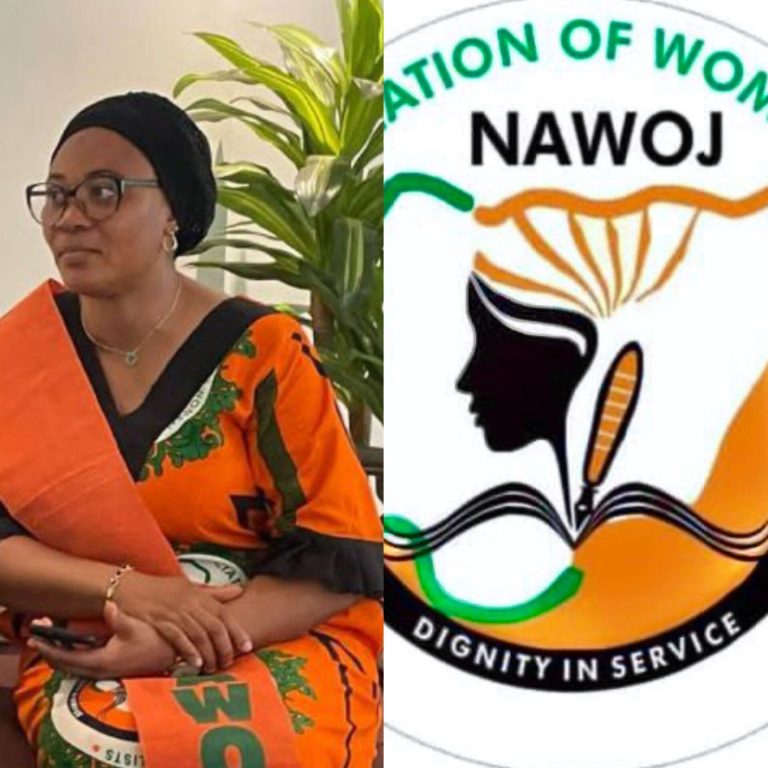
NAWOJ: SEKINAT, CHARITY GETS VOTE OF CONFIDENCE
The Nigeria Association of Women Journalists,(NAWOJ), Ogun State Chapter Executives has unanimously passed a vote of confidence on Chairman NAWOJ SEKINAT Salam and the Financial Secretary, Charity James, saying that, their leadership reflect the ideal and objectives of NAWOJ.
This was revealed in a communique issued at an Emergency meeting of the Executive held at the NUJ State Council, Iwe-Iroyin in Abeokuta.
The vote of confidence on the Leadership of NAWOJ was unanimously signed by all the five executive members that attended the meeting with the vice chairperson taking apology for official engagement outside the state capital.
According to the communique ” Consequently, NAWOJ Ogun State Chapter, reaffirms it’s unwavering support and confidence in the Chairperson and the Financial Secretary, Sekinat Salam and Charity James respectively, Urge them to continue in their commitment to purposeful leadership in the best interest of the association and the society at large”.
Speaking briefly with Journalists after the emergency Executive meeting, the Chairperson, Nigeria Association of Woman Journalists (NAWOJ), Com. Sekinat Salam, said the meeting was necessary as the news of her suspension was laughable and insulting because it is like a pot calling a kettle black in this case, saying that the Leadership of the State Council, Com. Wale Olanrewaju has no local standing to suspend her or any executive member, even he cannot be a judge in his own case.
According to her” The Leadership of the Nigeria Union of Journalists, Ogun State led by Wale Olanrewaju has always been misusing power without recourse to the constitution of this noble Union, hence has no local standing to suspend me or any executive member “.
She said only the Central Working Committee (CWC) has the constitutional rights to sanction or suspend any members found wanting after due process has been followed.
While calling on members to stay calm, Com. Sekinat Salam assured members of positive representation of NAWOJ at both the State and National level, adding the success recorded under her administration cannot be overemphasized.
She therefore called on the National leadership of NUJ to critically look into the matter, either by setting up independent committee to investigate the issues and resolve the matter as quickly as possible.
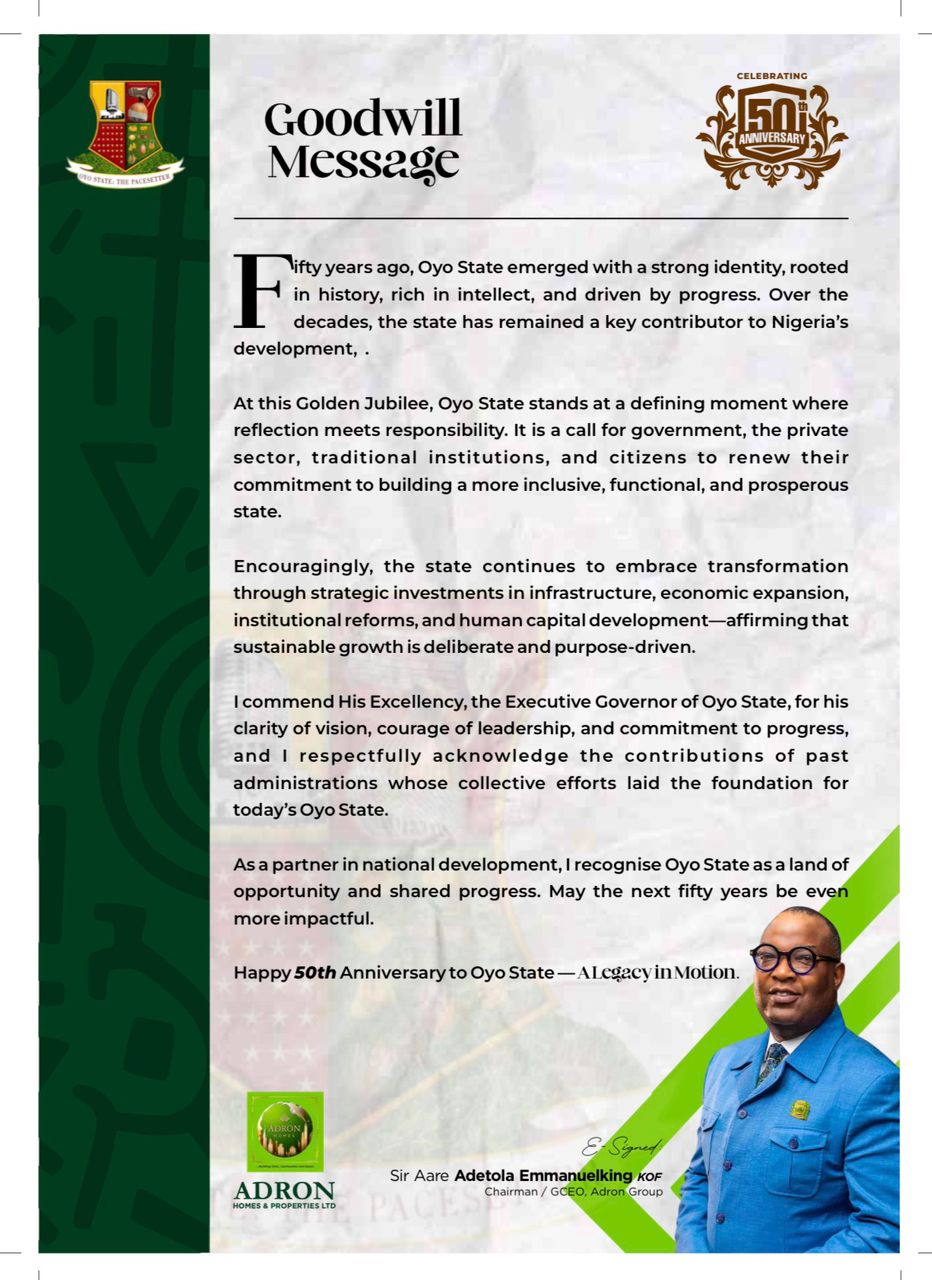
Adron Homes Chairman Congratulates Oyo State on 50 Years of Progress
The Chairman and Chief Executive Officer of Adron Homes and Properties Limited, Aare Adetola Emmanuelking, has congratulated the Government and people of Oyo State as the state marks its 50th anniversary, describing the occasion as a celebration of resilience, cultural pride, and sustained progress.
He noted that since its creation, Oyo State has remained a strong contributor to Nigeria’s socio-economic and cultural development, emerging as a hub of commerce, education, and innovation.
According to him, the Golden Jubilee offers a moment for reflection and renewed commitment by government, private sector players, traditional institutions, and citizens toward building a more inclusive and prosperous state.
Aare Emmanuelking commended the state’s ongoing transformation through investments in infrastructure, economic expansion, and human capital development, adding that sustainable growth is deliberate and must remain purpose-driven.
He also praised the leadership of the current administration while acknowledging the contributions of past leaders whose efforts laid the foundation for today’s Oyo State.
Reaffirming Adron Homes’ commitment to national development, he described Oyo State as a land of opportunity. He wished the state continued peace and prosperity, expressing confidence that the next fifty years will bring even greater achievements for the Pace Setter State and its people.


-

 celebrity radar - gossips6 months ago
Why Babangida’s Hilltop Home Became Nigeria’s Political “Mecca”
-

 society6 months ago
Power is a Loan, Not a Possession: The Sacred Duty of Planting People
-

 Business6 months ago
Batsumi Travel CEO Lisa Sebogodi Wins Prestigious Africa Travel 100 Women Award
-

 news6 months ago
THE APPOINTMENT OF WASIU AYINDE BY THE FEDERAL GOVERNMENT AS AN AMBASSADOR SOUNDS EMBARRASSING