
society
Opinion: Dear General Elijah Ayodele, Where Is the Next Coup Taking Place?* By Sammy Godson

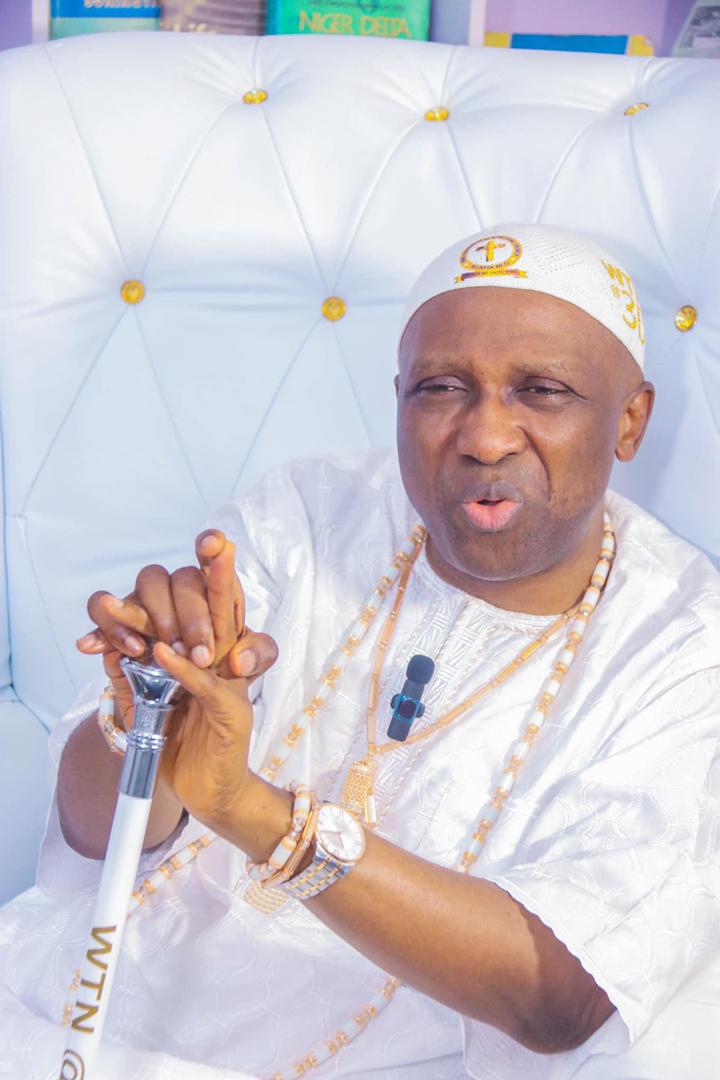
*Opinion: Dear General Elijah Ayodele, Where Is the Next Coup Taking Place?*
By Sammy Godson
Seeing the title General attached to Elijah Ayodele may surprise many because everyone knows he is not a member of the army, nor has he ever been publicly addressed as such. But permit me to rechristen him, because at this point, his revelations on security matters go far beyond what an army general’s intelligence can cover.
General Elijah Ayodele is a prophet and the leader of the INRI Evangelical Spiritual Church in Lagos, yet one wonders how he has accurately foretold coup-related events across Africa—events that have been happening exactly as he mentioned.
There is a huge difference between vaguely predicting that coups will occur in a continent and specifically naming the exact countries where they will take place—and seeing them happen precisely that way. Even the world’s most powerful army general cannot achieve such accuracy, no matter the intelligence available. It is absolutely impossible.
An army general is limited to the affairs of his own country. A Nigerian general cannot know of a coup being planned in Benin Republic, and vice versa. Yet General Elijah Ayodele will sit in Lagos and speak of dangerous events such as military coups in distant countries, and they happen exactly as though he wrote the script.
This simply shows that General Elijah Ayodele is firmly connected to the throne of heaven, from where all things are revealed. As the Bible says, God does nothing without revealing it to His prophets. His prophets are His generals, and in Nigeria, we can boldly say that General Elijah Ayodele is not just a member of God’s troops but a commander—no one else comes close.
Starting with the latest coup attempt in Africa, which occurred in Benin Republic: on Sunday morning, a group of soldiers seized the national television station to announce that they had taken over the country and removed President Talon from power. They declared the suspension of all political activities and the constitution. It was a tense situation before the soldiers were repelled, resulting in the ultimate failure of the coup.
This did not happen without General Elijah Ayodele mentioning it days earlier. He had spoken about it at least three times, with the last warning given on Friday—just two days before the incident. He said some countries would experience revolutions through coups or elections, and Benin Republic was among them. He warned these nations to prepare, and within two days, it happened.
His exact words were:
“The following nations will face revolution in the coming year, either by coup or any other way. There will be disorderliness in the following countries: Cameroon, Chad, Niger, Mali, Tanzania, Benin Republic, Ethiopia, South Sudan, and Uganda. Let them prepare for the challenges ahead.”
Recently, a coup also occurred in Guinea-Bissau after the presidential election. The army announced that they had taken over the country, suspended all electoral activities, and removed the president from power.
This, too, did not occur without General Elijah Ayodele’s warning earlier in November. He called on the president to be careful during the election and not tamper with the process, warning that a coup could occur if he attempted it. In videos and news publications, he advised the president to step down if he lost, so as not to be removed unconstitutionally.
He said:
“In Guinea-Bissau, there is going to be an election, but if there is a coalition and the president tries to rig the election, the country will turn to fire. There will be anarchy, and the impossible coup can be possible. To the president: if you lose this election, just leave. Don’t force yourself because you will fail.”
Additionally, during a live service on November 11, General Ayodele said that Guinea-Bissau would experience military action. He specifically warned that the president would lose relevance and would need to take urgent steps to stabilize the country.
His words were:
“Guinea-Bissau: The country isn’t yet settled; there is still a crisis. They will be fighting seriously. The president will not be reckoned with, and the military will carry out another action. The president must be ready to do anything to stabilize the country because I see a crisis in Guinea.”
Let us also not forget the reported attempt to unseat President Bola Ahmed Tinubu months ago, which allegedly led to the removal of some service chiefs. Weeks before the incident, General Ayodele specifically mentioned that soldiers were angry with the president and that powerful Nigerians were planning to use the military against him.
He warned:
“There will be an attempt to unseat Tinubu unconstitutionally; the NSA, DSS, and Chief of Army Staff must be careful. There are gangs planning between November and January to unseat him.”
“Even the Navy and Air Force will be part of it, including the Nigerian Army. President Tinubu must be ready for anything and fortify himself. He needs to change his security strategy because these personalities will be unbelievable names.”
In July 2025, he had also said that Tinubu must strengthen his security system because he foresaw an attempt to carry out a coup against his government.
“I see an attempt to take power from him (Tinubu) in an unconstitutional manner. God warns him to take his personal safety seriously. What I saw was coup-like, with tension everywhere.”
Going back further, in 2019—before the 2020 coup in Mali—General Ayodele warned in his prophecy for 2020 (released in December 2019) that there would be a gang-up against the president. Just months into the new year, it came to pass.
He had said:
“There will be a gang-up against the Malian president. The country should pray against protests and disorderliness.”
In Gabon, before Ali Bongo was ousted, General Ayodele stood in his church on October 7, 2022, during a live service and advised Bongo to resign because the military would remove him. This was long before the election that ultimately ended in a coup.
He told Bongo:
“Gabonese president, your time is up. I am seeing a crisis, if not a coup d’état. Because of your health, why not resign? Why do you want to die on this seat? I am telling you what the Lord has said. Your staying on the throne is killing you. You are incapacitated, but no one is telling you the truth. I am advising you to humble yourself, resign, and hand over to someone who can do better so you won’t cause a crisis in your country.”
Other coups—including those in Niger and Burkina Faso—were also foretold by General Ayodele. Even though some governments did nothing until events swept them away, one thing is certain: none of them can ever say the prophet did not warn them.
However, for the sake of the good citizens of the nations concerned, I would like to ask the General:
Where is the next coup taking place?
Thank you.








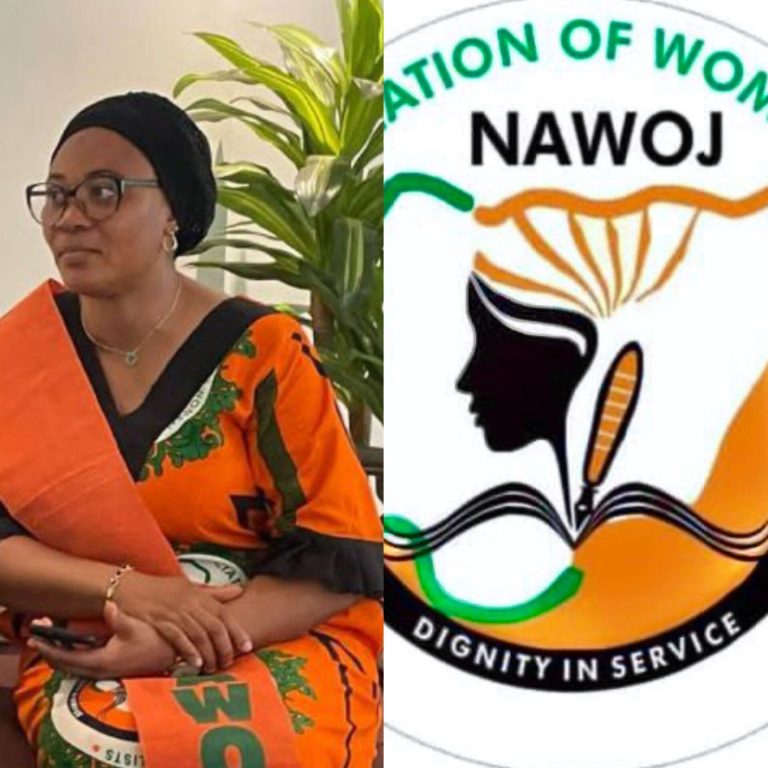
NAWOJ: SEKINAT, CHARITY GETS VOTE OF CONFIDENCE
The Nigeria Association of Women Journalists,(NAWOJ), Ogun State Chapter Executives has unanimously passed a vote of confidence on Chairman NAWOJ SEKINAT Salam and the Financial Secretary, Charity James, saying that, their leadership reflect the ideal and objectives of NAWOJ.
This was revealed in a communique issued at an Emergency meeting of the Executive held at the NUJ State Council, Iwe-Iroyin in Abeokuta.
The vote of confidence on the Leadership of NAWOJ was unanimously signed by all the five executive members that attended the meeting with the vice chairperson taking apology for official engagement outside the state capital.
According to the communique ” Consequently, NAWOJ Ogun State Chapter, reaffirms it’s unwavering support and confidence in the Chairperson and the Financial Secretary, Sekinat Salam and Charity James respectively, Urge them to continue in their commitment to purposeful leadership in the best interest of the association and the society at large”.
Speaking briefly with Journalists after the emergency Executive meeting, the Chairperson, Nigeria Association of Woman Journalists (NAWOJ), Com. Sekinat Salam, said the meeting was necessary as the news of her suspension was laughable and insulting because it is like a pot calling a kettle black in this case, saying that the Leadership of the State Council, Com. Wale Olanrewaju has no local standing to suspend her or any executive member, even he cannot be a judge in his own case.
According to her” The Leadership of the Nigeria Union of Journalists, Ogun State led by Wale Olanrewaju has always been misusing power without recourse to the constitution of this noble Union, hence has no local standing to suspend me or any executive member “.
She said only the Central Working Committee (CWC) has the constitutional rights to sanction or suspend any members found wanting after due process has been followed.
While calling on members to stay calm, Com. Sekinat Salam assured members of positive representation of NAWOJ at both the State and National level, adding the success recorded under her administration cannot be overemphasized.
She therefore called on the National leadership of NUJ to critically look into the matter, either by setting up independent committee to investigate the issues and resolve the matter as quickly as possible.
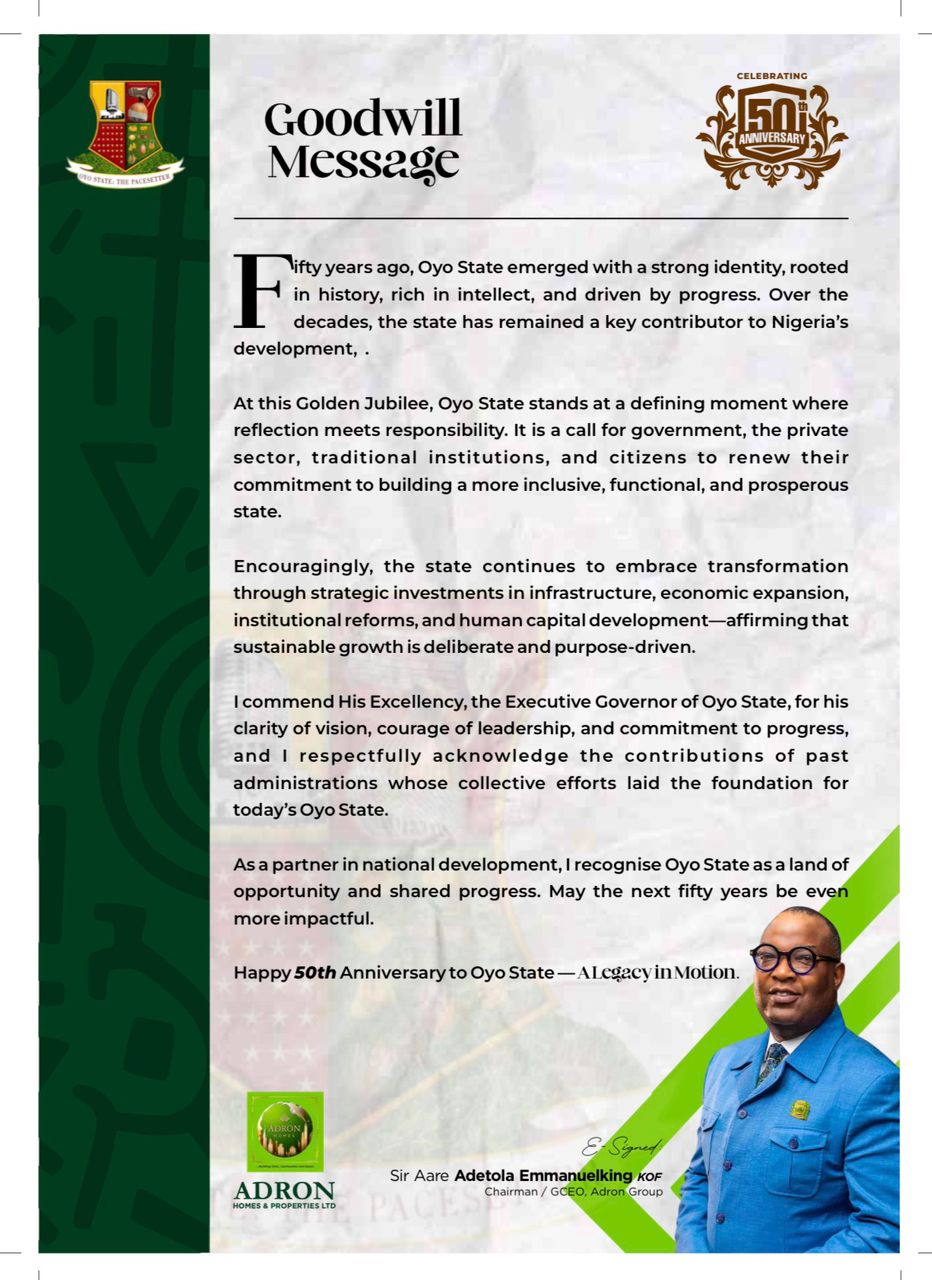
Adron Homes Chairman Congratulates Oyo State on 50 Years of Progress
The Chairman and Chief Executive Officer of Adron Homes and Properties Limited, Aare Adetola Emmanuelking, has congratulated the Government and people of Oyo State as the state marks its 50th anniversary, describing the occasion as a celebration of resilience, cultural pride, and sustained progress.
He noted that since its creation, Oyo State has remained a strong contributor to Nigeria’s socio-economic and cultural development, emerging as a hub of commerce, education, and innovation.
According to him, the Golden Jubilee offers a moment for reflection and renewed commitment by government, private sector players, traditional institutions, and citizens toward building a more inclusive and prosperous state.
Aare Emmanuelking commended the state’s ongoing transformation through investments in infrastructure, economic expansion, and human capital development, adding that sustainable growth is deliberate and must remain purpose-driven.
He also praised the leadership of the current administration while acknowledging the contributions of past leaders whose efforts laid the foundation for today’s Oyo State.
Reaffirming Adron Homes’ commitment to national development, he described Oyo State as a land of opportunity. He wished the state continued peace and prosperity, expressing confidence that the next fifty years will bring even greater achievements for the Pace Setter State and its people.
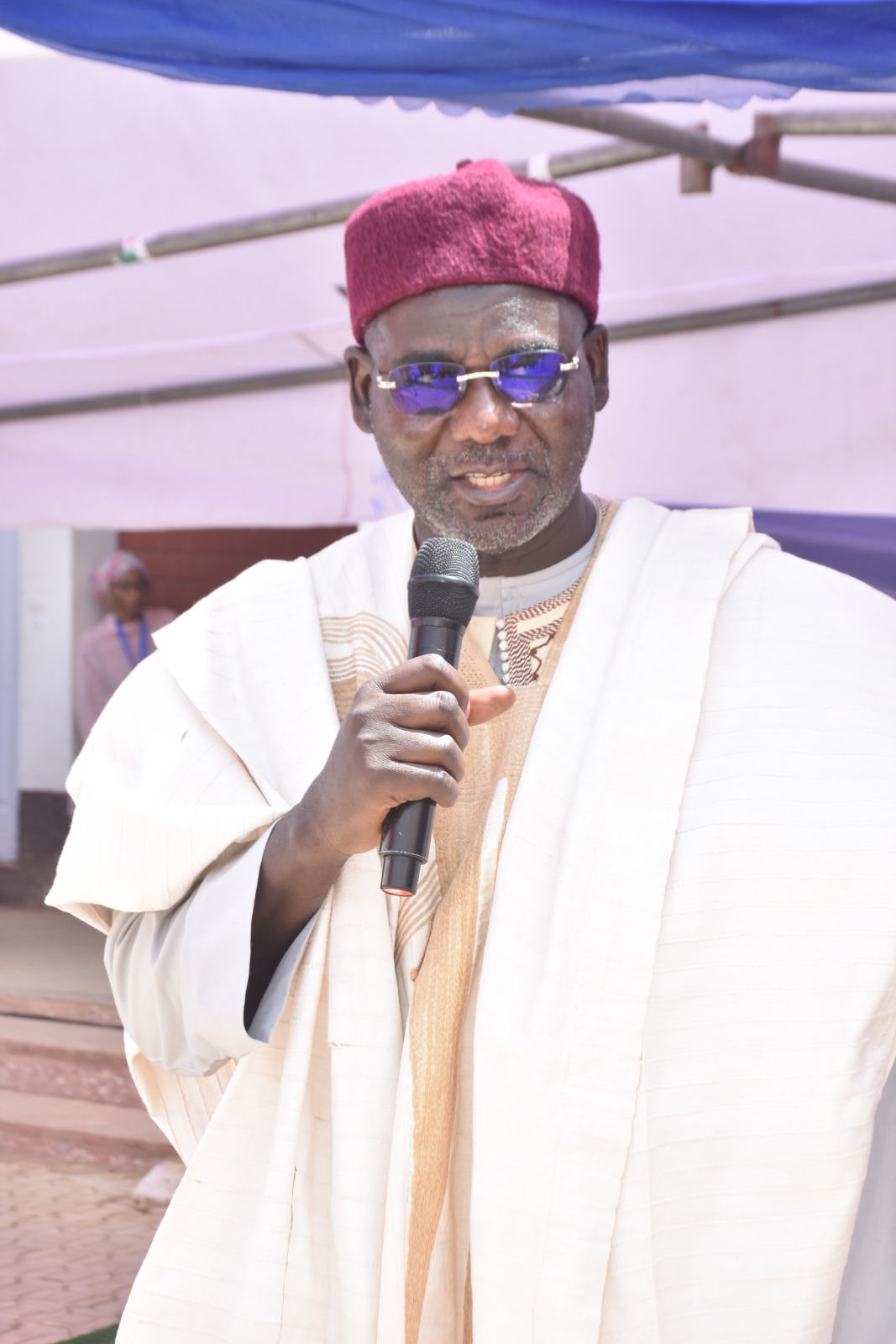
TY BURATAI HUMANITY CARE FOUNDATION CONDOLES WITH BIU EMIRATE OVER TRAGIC ATTACK
In a profound expression of sorrow, the TY Buratai Humanity Care Foundation has extended its heartfelt condolences to the families of the victims and the entire people of Biu Emirate, Borno State, following the recent tragic attack attributed to Boko Haram. This devastating assault, which occurred at a work site in northeastern Nigeria, claimed the lives of dozens, including brave soldiers committed to protecting the nation.
In a statement released to the press and signed by the Chairman of the foundation, Ibrahim Dahiru Danfulani Sadaukin Garkuwan Keffi/Betara Biu, the Grand Patron of the Foundation, His Excellency Amb. Lt. Gen. Tukur Yusufu Buratai CFR (Rtd), former Chief of Army Staff, described the incident as “one too many senseless, barbaric, and ruthless displays of inhumanity.” His Excellency emphasized the heartbreaking impact of such attacks on innocent, hardworking citizens striving to make a positive difference in their communities.
The Grand Patron praised the swift and decisive response of military personnel during this critical time, underscoring their brave commitment to safeguarding the nation. He called upon them to maintain this momentum, commending their courage and sacrifice in the face of adversity. “May Almighty Allah forgive their souls and grant them Aljannah Firdouse,” he remarked, encouraging the nation to honor their spirit of sacrifice as they rally together to rebuild and restore hope across the region.
In his statement, Gen. Buratai highlighted the importance of collective action in overcoming the challenges posed by insecurity, urging concerned citizens to increase their efforts in fostering a virile community that future generations can cherish. “Together, we can surmount these troubles,” he asserted, calling on all patriotic leaders and citizens to unite in the fight against violence and insecurity.

The TY Buratai Humanity Care Foundation remains committed to supporting initiatives that promote peace, security, unity, and prosperity. As the foundation extends its condolences to the bereaved, it also calls upon all segments of society to collaborate in creating a better and safer future. May Allah guide and protect the nation and lead it toward enduring peace. Amen.


-

 celebrity radar - gossips6 months ago
Why Babangida’s Hilltop Home Became Nigeria’s Political “Mecca”
-

 society6 months ago
Power is a Loan, Not a Possession: The Sacred Duty of Planting People
-

 Business6 months ago
Batsumi Travel CEO Lisa Sebogodi Wins Prestigious Africa Travel 100 Women Award
-

 news6 months ago
THE APPOINTMENT OF WASIU AYINDE BY THE FEDERAL GOVERNMENT AS AN AMBASSADOR SOUNDS EMBARRASSING