
Sports
Champions of a Continent: The Definitive History of AFCON Winners

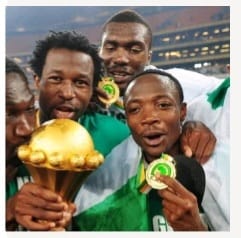
Champions of a Continent: The Definitive History of AFCON Winners.
By George Omagbemi Sylvester | Published by saharaweeklyng.com
“How the Africa Cup of Nations Forged Footballing Giants and United a Diverse Continent Through Sport.”
The Africa Cup of Nations (AFCON) is far more than a biennial football tournament; it is Africa’s premier sporting crucible — where history is shaped, legends are born, and national pride is affirmed. Since its inception in 1957, this tournament has woven itself into the social, political, and cultural fabric of the continent. From the dusty pitches of early competitions to packed modern stadiums echoing with tens of thousands of passionate supporters, AFCON encapsulates both the struggle and the triumph inherent in African identity.
In attempting to fully understand the legacy of AFCON champions, one must appreciate not only who won but why these victories mattered which is culturally, geopolitically and emotionally for entire nations. As celebrated African football historian Dr. Mamadou Diouf of Cheikh Anta Diop University once observed, “In Africa, football is more than a game; it is narrative and identity articulated on grass.” This perspective is critical when chronicling the elite list of nations that have lifted the famed CAF trophy.
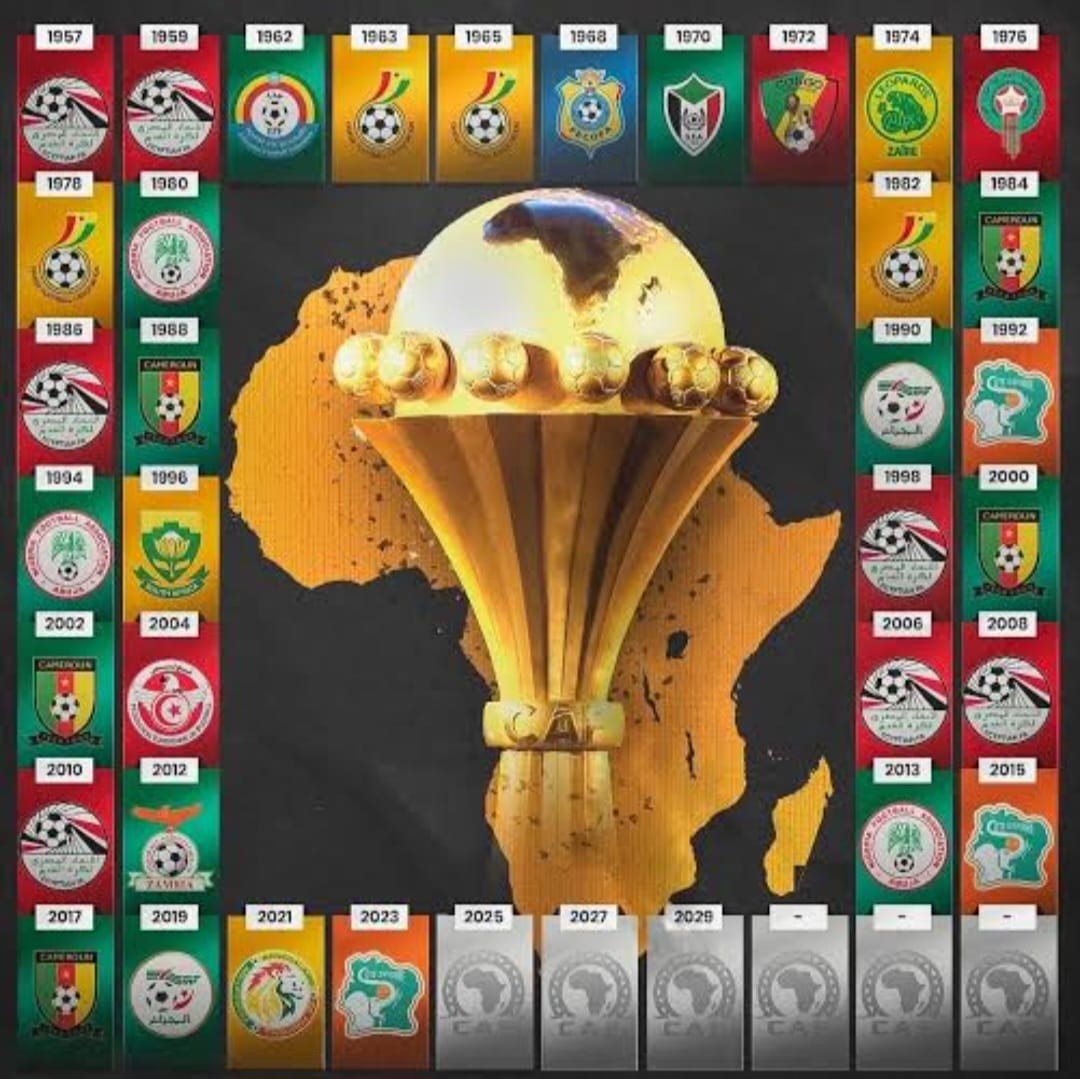
AFCON: A Legacy of Champions. From its inaugural tournament in 1957, when Egypt defeated Ethiopia 4–0 to claim the first crown, AFCON has showcased a remarkable blend of continuity and change in African football.
Encyclopedia Britannica
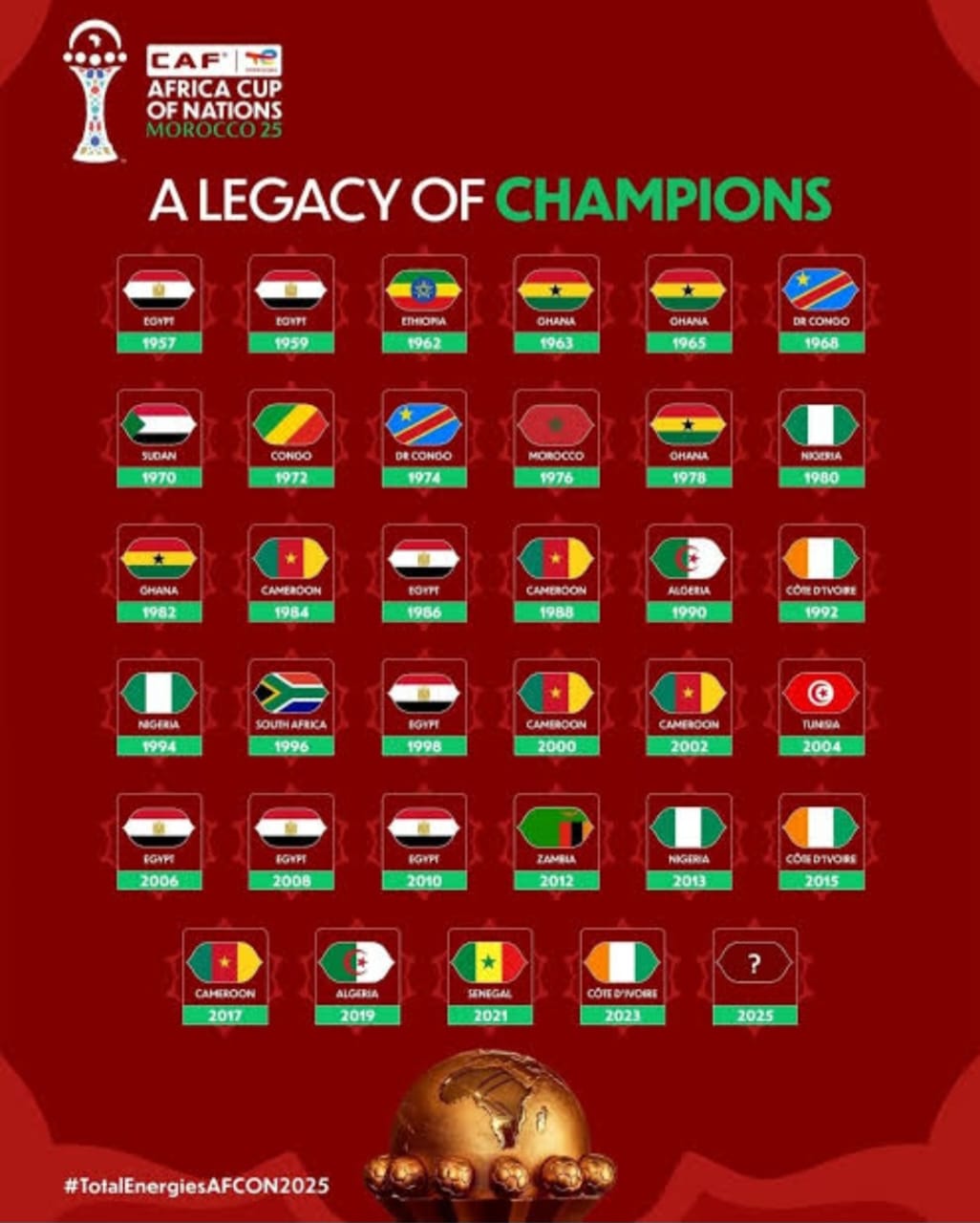
What follows is a chronologically accurate and fully verified inventory of AFCON winners and each a chapter in the tournament’s storied history:
1957 – Egypt (4–0 vs. Ethiopia)
1959 – Egypt (2–1 vs. Sudan)
1962 – Ethiopia (4–2 vs. Egypt)
1963 – Ghana (3–0 vs. Sudan)
1965 – Ghana (3–2 vs. Tunisia)
1968 – DR Congo (1–0 vs. Ghana)
1970 – Sudan (3–2 vs. Ghana)
1972 – Congo (3–2 vs. Mali)
1974 – Zaire (2–0 vs. Zambia)
1976 – Morocco (Champion)
1978 – Ghana (2–0 vs. Uganda)
1980 – Nigeria (3–0 vs. Algeria)
1982 – Ghana (on penalties vs. Libya)
1984 – Cameroon (3–1 vs. Nigeria)
1986 – Egypt (on penalties vs. Cameroon)
1988 – Cameroon (1–0 vs. Nigeria)
1990 – Algeria (1–0 vs. Nigeria)
1992 – Ivory Coast (on penalties vs. Ghana)
1994 – Nigeria (vs. Zambia)
1996 – South Africa (2–0 vs. Tunisia)
1998 – Egypt (2–0 vs. South Africa)
2000 – Cameroon (won on penalties vs. Nigeria)
2002 – Cameroon (on penalties vs. Senegal)
2004 – Tunisia (2–1 vs. Morocco)
2006 – Egypt
2008 – Egypt
2010 – Egypt
2012 – Zambia
2013 – Nigeria
2015 – Ivory Coast
2017 – Cameroon
2019 – Algeria
2021 – Senegal
2023 – Ivory Coast
This list, verified across multiple authoritative sports histories, shows Egypt standing atop the roll of honour with seven AFCON titles, a remarkable feat spanning six decades of competition.
Powerhouses of the Continent. The AFCON champions list reads like a Who’s Who of African football excellence:
Egypt — The Pharaohs boast a record seven championships (1957, 1959, 1986, 1998, 2006, 2008, 2010), leading the continent in titles and consistency. Their early dominance set the template for African footballing success.
Cameroon — With five titles, the Indomitable Lions established themselves as a juggernaut, particularly during the late 20th and early 21st centuries.
Ghana — Their four triumphs reflect a deep-rooted football culture, though recent decades have seen the Black Stars struggle to reclaim past glories.
Nigeria and Ivory Coast, both nations share three championships each, highlighting West Africa’s historical strength on the continental stage.
Algeria, DR Congo, Zambia, Tunisia, Senegal, Sudan, Morocco, South Africa. A diverse set of champions that demonstrates the truly pan-African nature of the competition.
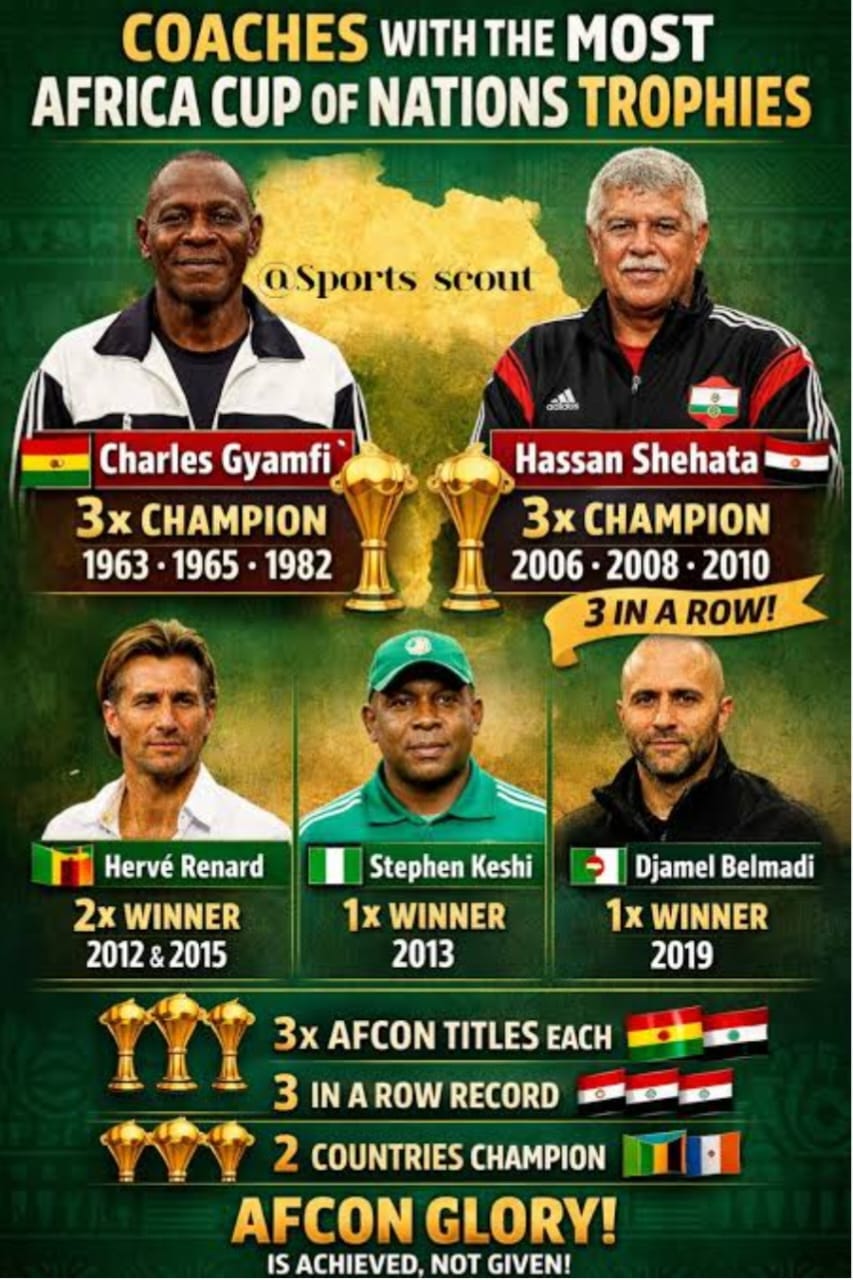
This broad distribution of champions speaks to AFCON’s competitive balance, a tournament where footballing pedigree, tactical evolution, and sheer national will collide. As noted by CAF technical director Salim Ahmed, “AFCON is the purest expression of African football; it doesn’t reward tradition alone, but heart, innovation, and resilience.”
Moments that Shaped the Tournament. Egypt’s Triple Crown (2006–2010): Few national teams have dominated like Egypt did with three consecutive titles which is a testament to tactical discipline and unyielding confidence. Legends such as Mohamed Aboutrika and captain Ahmed Hassan became synonymous with this golden era.
Nigeria’s 1980 Home Glory & 2013 Revival: Winning AFCON on home soil in 1980 marked Nigeria’s emergence as a continental powerhouse. A generation later, the 2013 triumph under Stephen Keshi symbolised African footballing ingenuity and a local coach guiding his team to glory against all odds.
South Africa’s 1996 Breakthrough: Fresh from the end of apartheid, South Africa’s 1996 win signified more than a football title and it was a moment of profound national healing and global recognition.
Zambia’s 2012 Triumph: Zambia’s win stands as one of AFCON’s most emotional victories, occurring near the site of the 1993 air disaster that claimed the national team’s lives. Journalist Dominic Chanda aptly described it as “a victory not just for sport, but for collective memory and perseverance.”
Senegal’s Recent Ascendance: Senegal’s 2021 title, anchored by stars like Sadio Mané, reflects West Africa’s consistent push toward footballing excellence on the global stage.
AFCON’s Broader Impact. The significance of AFCON transcends statistics. Sporting sociologist Professor Aisha Bello rightly asserts, “Football in Africa is a lingua franca; AFCON is its grand symposium where nations articulate hope, contest identity, and assert presence on the global stage.” AFCON champions are not just victors of a tournament and they are carriers of continental aspiration.
Unity Through Competition:
In a continent often scrutinised through the lens of its challenges, AFCON provides a narrative of resilience and unity. Millions watch not merely to see goals but to witness nations affirm their dignity.
Economic and Developmental Impact:
Championship runs boost tourism, stimulate youth engagement in sport, and open diplomatic opportunities. Nations invest in infrastructure, from stadia to training academies, hoping that future champions will emerge from underprivileged neighborhoods.
Role Models and Youth Inspiration: Figures like Didier Drogba, Yaya Touré, Asamoah Gyan, and Mohamed Salah inspire millions of young Africans. Their journeys from local pitches to global arenas underscore sport’s transformative potential.
Looking Ahead. The next AFCON cycle promises to broaden this legacy. As the tournament expands and evolves, new contenders will arise, and historical giants will strive to reaffirm their prestige. The co-hosted 2027 AFCON (set for Kenya, Uganda, and Tanzania) signals CAF’s ambition to lift the tournament’s reach even further.
For scholars, fans, and nations alike, AFCON remains more than a championship; it is living history, written every two years in the sweat of players and the roars of supporters. As respected football analyst Jonathan Wilson noted, “Champions are remembered not solely for their trophies, but for how they changed the game, inspired their people, and expanded the realm of possibility.”
In that regard, every AFCON winner (from Egypt’s early dynasty to Ivory Coast’s latest triumph) is a testament to the enduring power of football in forging both excellence and identity.




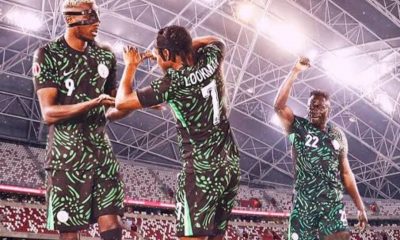



Sports
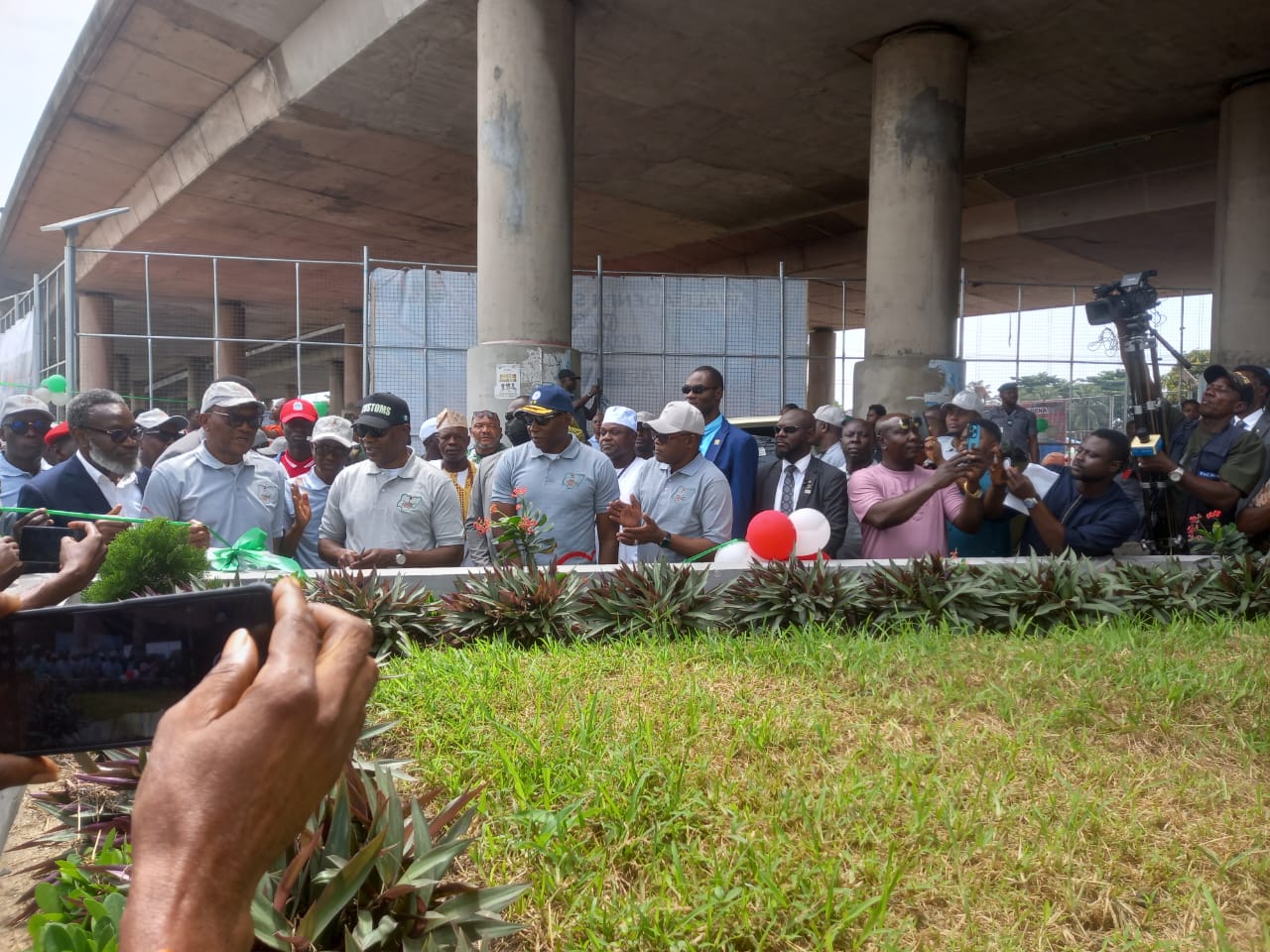
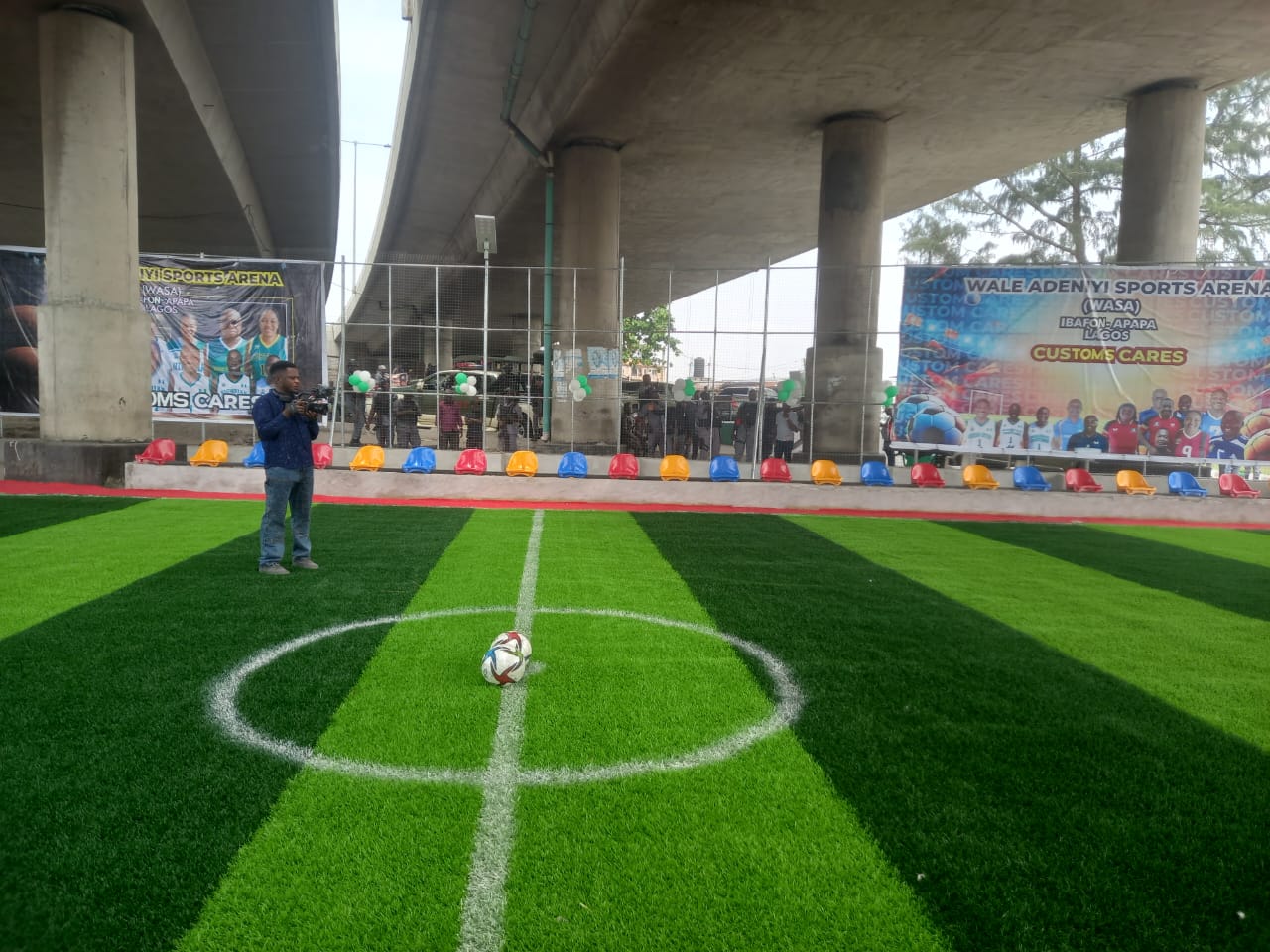
Adeniyi Urges Customs Officers to Stay Fit, Commissions Sports Arena at Western Marine Command
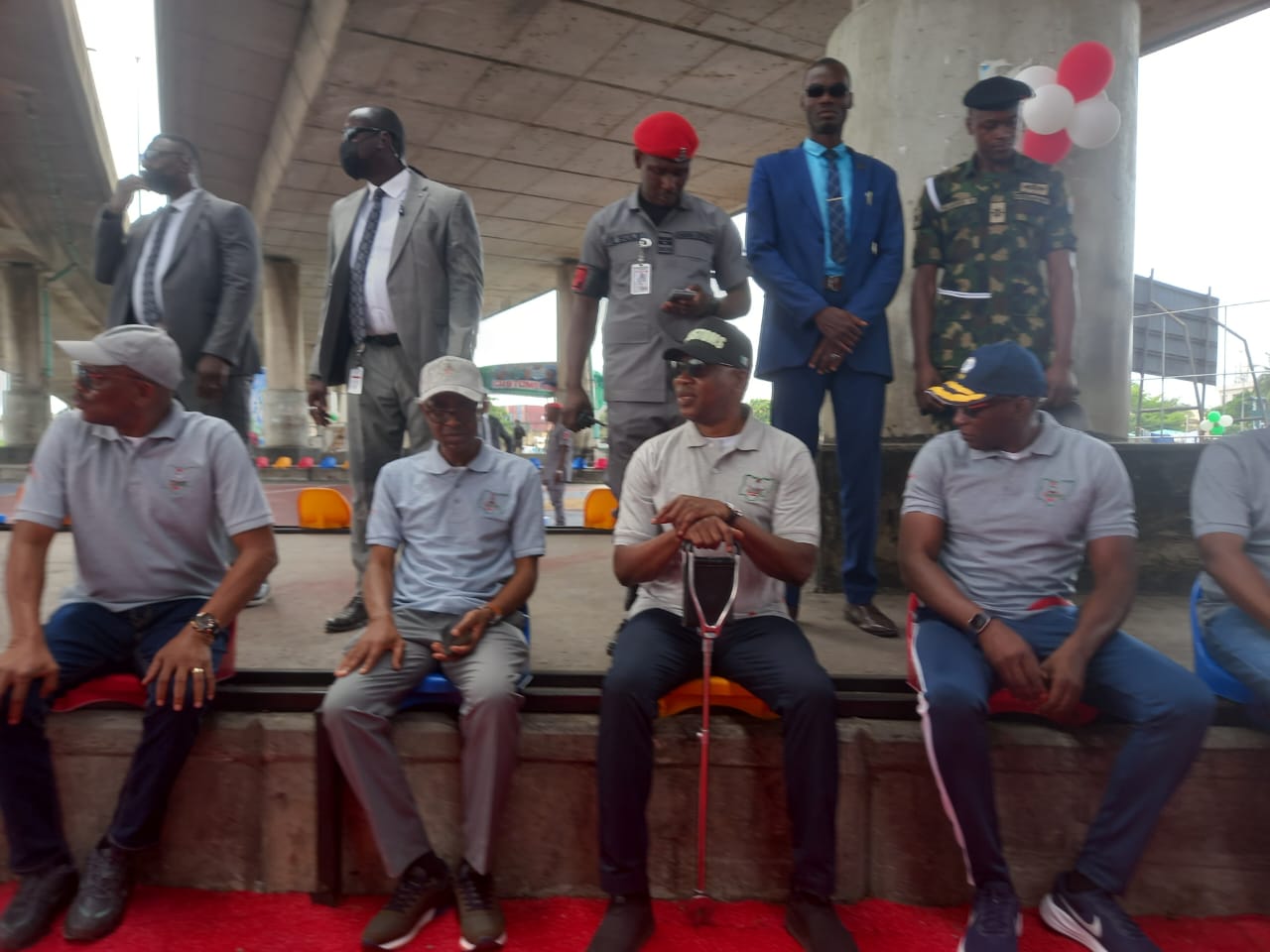
Adeniyi Urges Customs Officers to Stay Fit, Commissions Sports Arena at Western Marine Command
By Ifeoma Ikem
Sports
Fans Mock Pinnick’s ‘Morocco-Level’ Pitch Claim as Credibility Debate Returns to Nigerian Football

Fans Mock Pinnick’s ‘Morocco-Level’ Pitch Claim as Credibility Debate Returns to Nigerian Football
By George Omagbemi Sylvester | Published by SaharaWeeklyNG
“Former NFF boss promises five world-class surfaces in 18 months, but supporters question record and reality.”
A fresh controversy has erupted in Nigerian football after former Nigeria Football Federation (NFF) president and FIFA Council member Amaju Melvin Pinnick declared that Nigeria would soon have football pitches comparable to those used at major tournaments in Morocco. The statement, intended to signal a new phase of infrastructure upgrades, instead triggered widespread skepticism among fans.
The backlash followed Pinnick’s remarks in early February 2026, when he said Nigeria would have at least five pitches matching Moroccan standards within 18 months. According to him, the team responsible for Morocco’s acclaimed stadium surfaces had already arrived in Nigeria to begin the upgrades. He identified the targeted venues as Warri City Stadium, two stadiums in Bayelsa State, Teslim Balogun Stadium in Lagos, and the Moshood Abiola National Stadium in Abuja.
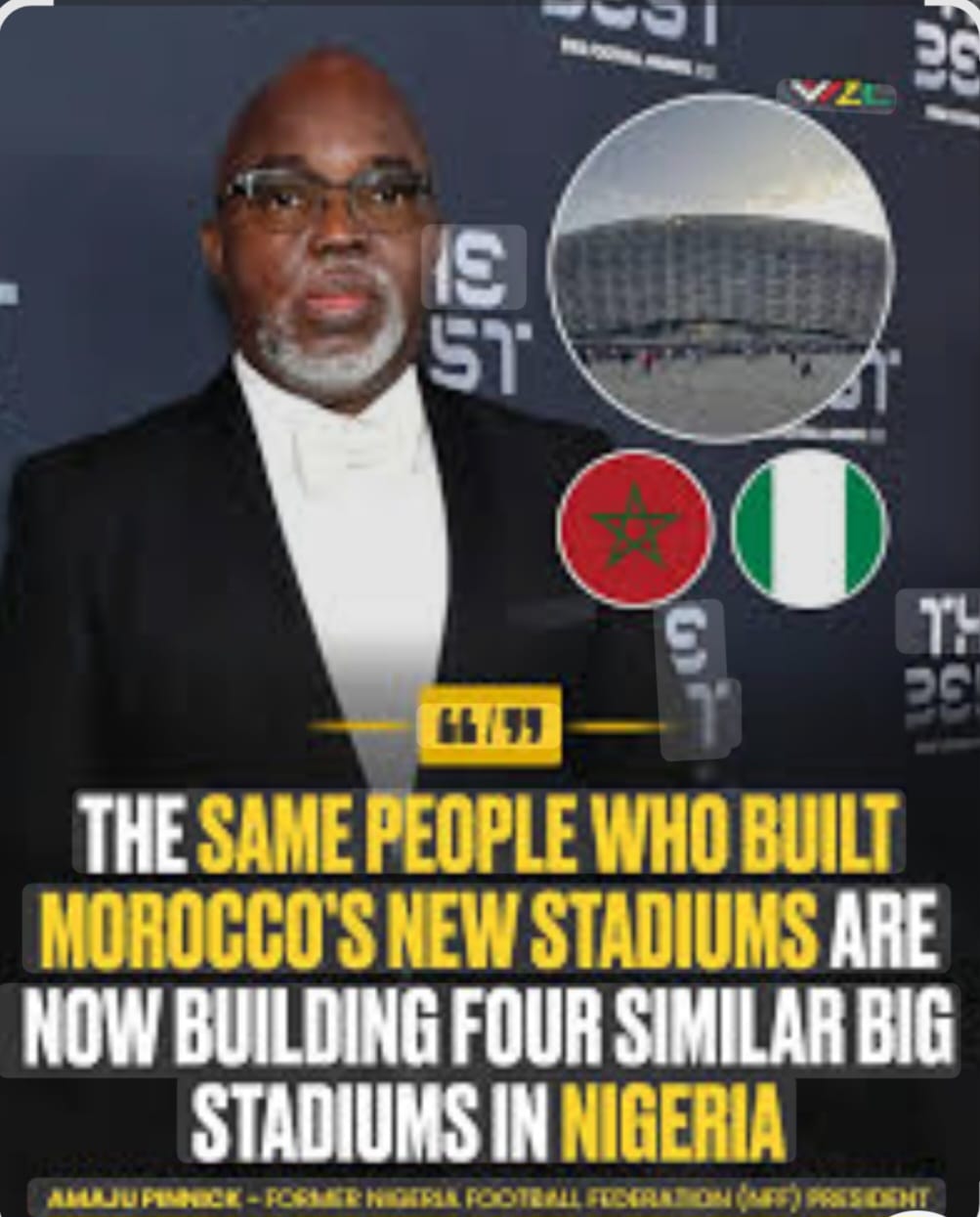
Rather than inspiring confidence, the announcement was met with sarcasm and disbelief across social media. Many supporters dismissed the claim as unrealistic, pointing to the current state of numerous Nigerian pitches, several of which have failed to meet international standards in recent years. Some fans described the promise as something to “believe at your own risk,” reflecting deep mistrust toward football administrators.
The reaction comes against the backdrop of long-standing infrastructure problems in Nigerian football. For years, the country has struggled to maintain stadiums to the standards required by FIFA and the Confederation of African Football (CAF). On multiple occasions, national-team matches have been moved or played in alternative venues because approved facilities were unavailable.
Pinnick himself has previously acknowledged the depth of the problem. In earlier interviews, he admitted that many Nigerian stadiums lack basic amenities and cannot meet international requirements, noting that the country is currently unable to host major FIFA competitions because of substandard facilities. He also contrasted Nigeria’s situation with Morocco’s, describing the North African country as having a “plug-and-play” football infrastructure capable of hosting major tournaments at short notice.
Morocco’s progress has been widely praised by football authorities. The country has invested heavily in modern stadiums, training facilities, and pitch technology, positioning itself as one of Africa’s leading hosts for international competitions. Its infrastructure upgrades have played a major role in securing hosting rights for major tournaments, including the Africa Cup of Nations.
Nigeria’s situation has followed a different trajectory. Many stadiums built or renovated at significant cost have deteriorated within a few years, often due to poor maintenance, irregular funding, and administrative disputes. Sports policy experts argue that the core problem is not simply the construction of facilities but the absence of sustainable management structures.
Global sports business scholar Professor Simon Chadwick has argued that infrastructure projects must be backed by sound governance. “Facilities are only as effective as the systems that sustain them,” he notes. “Without management discipline, even the best stadiums deteriorate quickly.”
Economist Andrew Zimbalist, a leading authority on sports infrastructure, has also warned that stadium promises often fail without transparent planning and long-term operational strategies. His research shows that politically driven projects frequently fall short of expectations when maintenance and funding models are unclear.
These broader concerns help explain the intensity of the reaction to Pinnick’s latest claim. Many supporters remember his eight-year tenure as NFF president from 2014 to 2022, a period that produced mixed results. While the national team qualified for major tournaments and maintained administrative stability, the infrastructure question remained largely unresolved.
Beyond public debate, the issue carries practical consequences. Stadium quality directly affects Nigeria’s ability to host international matches. When facilities fail to meet required standards, national teams are forced to play “home” fixtures in foreign countries, increasing costs and weakening home advantage.
The impact is also felt at the grassroots level. Without quality pitches, young players are forced to train in poor conditions that do not match international standards, creating long-term developmental disadvantages.
Supporters of Pinnick argue that the new plan could mark a genuine effort to address these long-standing problems. They note that the proposal involves collaboration with international pitch experts and focuses on specific stadiums rather than vague nationwide promises.
Critics, however, insist that credibility will depend entirely on execution. They argue that Nigerian football has heard similar assurances for decades, with little to show in terms of sustained improvement.
For now, the 18-month timeline has set a clear benchmark. If the promised upgrades materialize and the selected stadiums meet international standards, the initiative could help restore public confidence. Though if the deadline passes without visible results, the skepticism surrounding the announcement is likely to deepen.

In a football-obsessed nation, infrastructure promises are no longer judged by speeches or press statements. They are judged by results and by the condition of the pitch on match day.
Sports
Super Eagles Soar: Nigeria Storms AFCON 2025 Semifinals in a Showcase of Resilience and Continental Football Supremacy
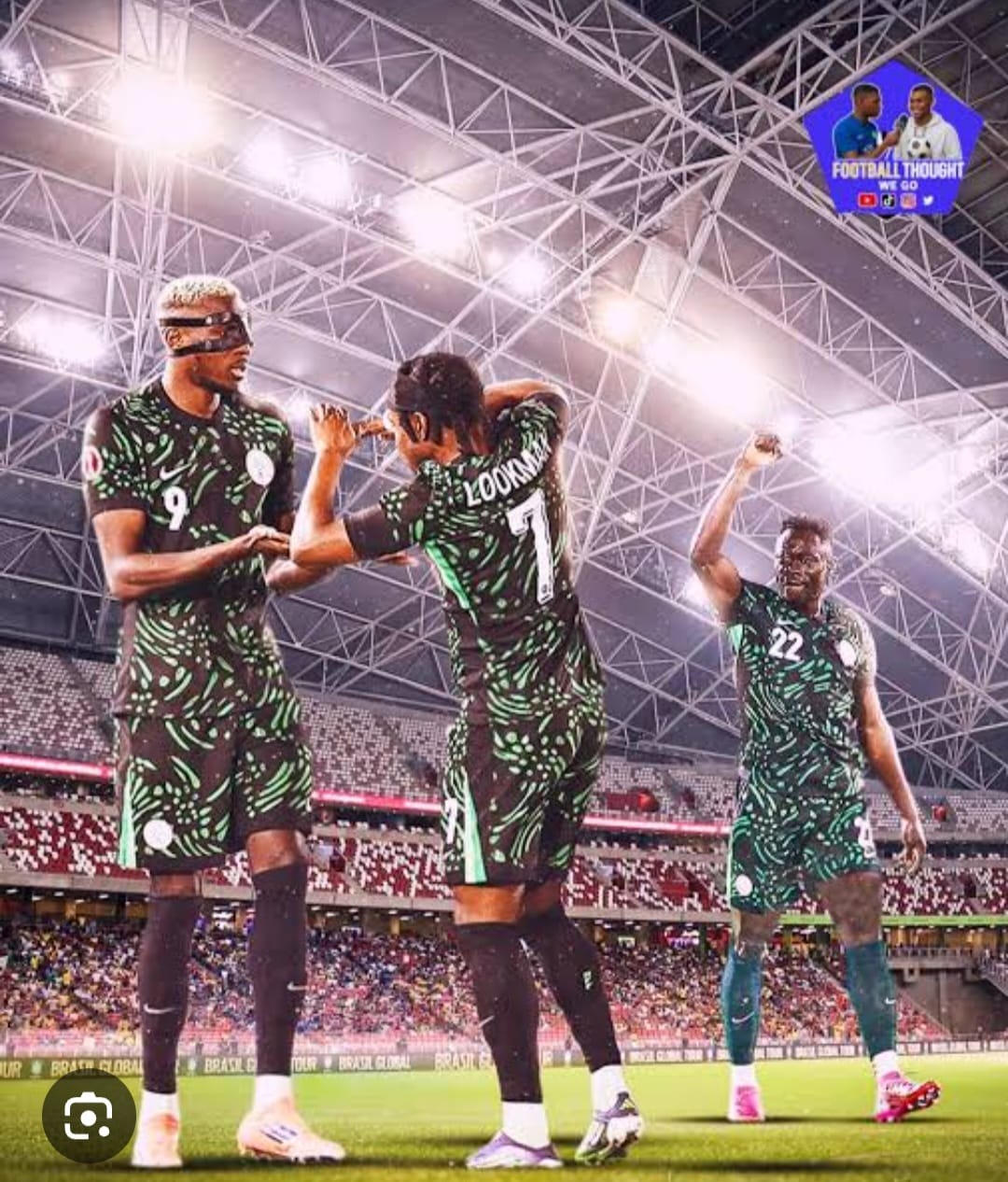
Super Eagles Soar: Nigeria Storms AFCON 2025 Semifinals in a Showcase of Resilience and Continental Football Supremacy.
By George Omagbemi Sylvester
saharaweeklyng.com
“After a commanding 2-0 win over Algeria and quarter-final upsets across the board, Nigeria sets up a blockbuster semi-final against hosts Morocco as Egypt and Senegal also advance in the Africa Cup of Nations.”
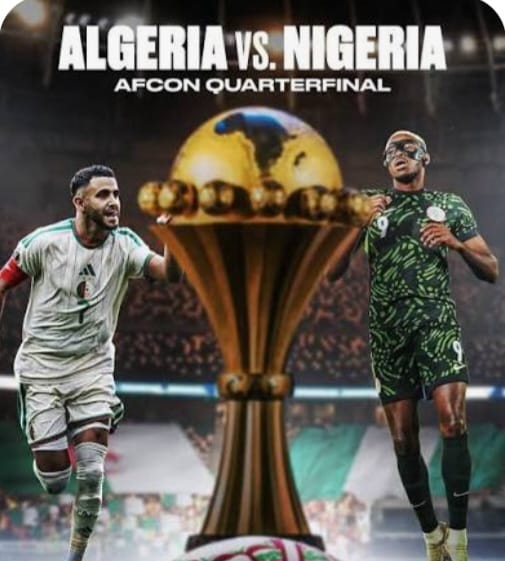
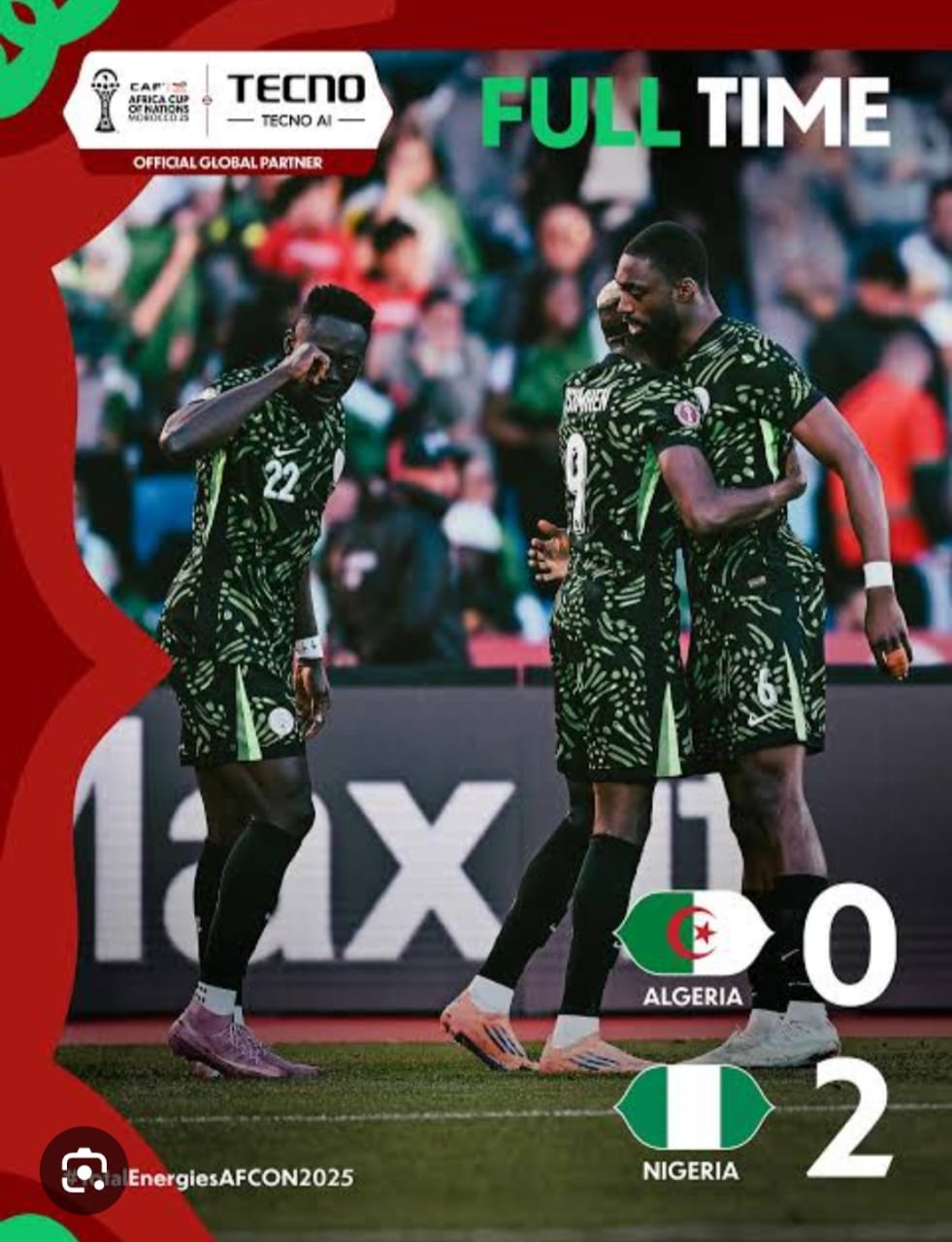
When the whistle blew in Marrakech’s Grand Stade on January 10, 2026, history was reaffirmed: Nigeria’s Super Eagles, Africa’s perennial powerhouse, soared into the AFCON 2025 semifinals with a convincing 2-0 triumph over Algeria in the quarter-finals. Driven by tactical intelligence, physical dominance and individual brilliance, the Nigerian side not only dispatched a formidable North African foe but did so with the authority and poise expected of a team with genuine title ambitions.
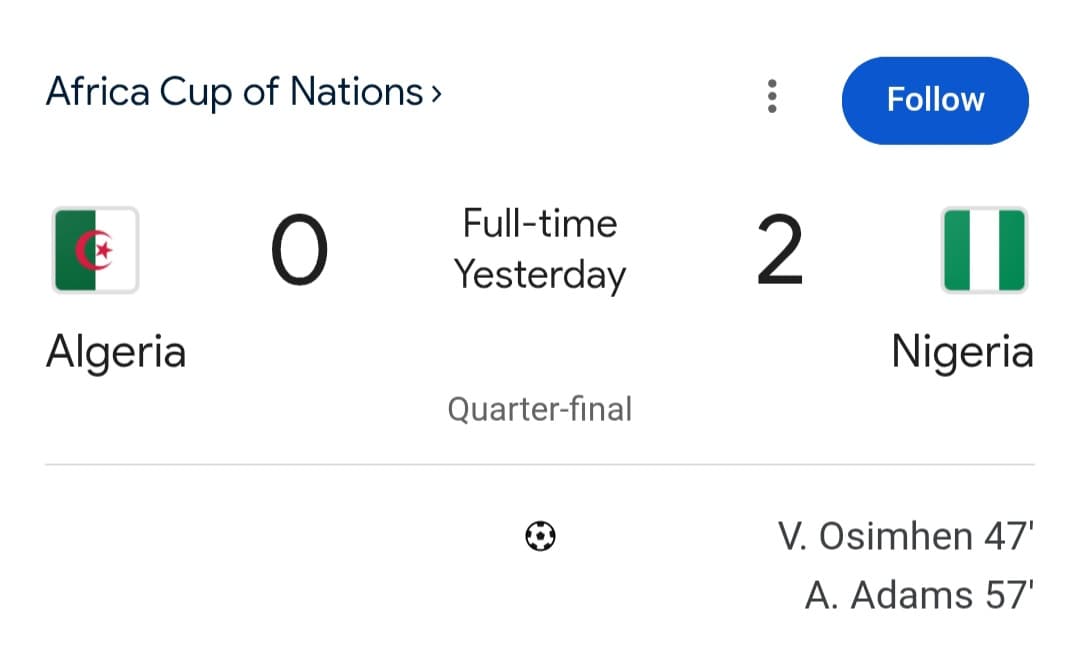
It was a performance that combined discipline and flair, a perfect example of why Nigeria has become regular visitors to football’s final four. Led by stars like Victor Osimhen (the 2023 African Player of the Year) and Akor Adams, the Super Eagles delivered a masterclass under pressure.
Nigeria vs. Algeria: Tactical Supremacy and Clinical Execution.
From the first whistle, Nigeria wrested control of the tempo. Dominant possession, coordinated pressing, and superior fitness allowed them to dictate play against an Algeria side that had previously relied on experience and technical skill. Despite a bright early threat from Algeria (who came into the game after a taxing extra-time victory in the round of 16) the Super Eagles held the balance of play throughout.
The breakthrough came immediately after halftime and a moment that in elite football often decides destiny. In the 47th minute, Nigeria’s attacking interplay culminated in a Victor Osimhen header from a precise Bruno Onyemaechi delivery, piercing Algeria’s resistance and igniting Nigerian belief.
Ten minutes later, Osimhen turned provider with an unselfishly feeding Akor Adams, who calmly rounded Algeria’s goalkeeper Luka Zidane and slotted home Nigeria’s second goal.
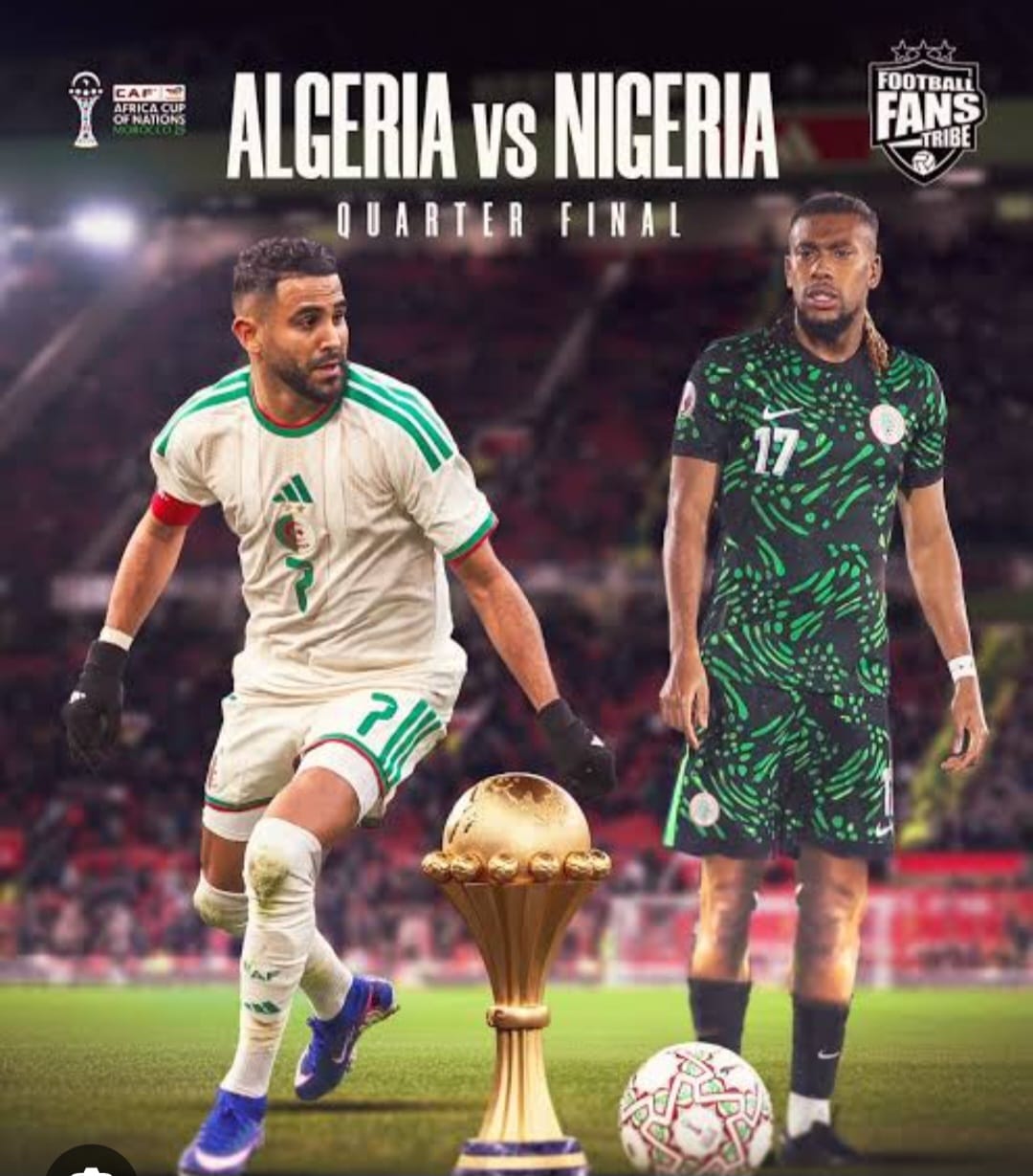
Both goals were TEXTBOOK EXAMPLES of Nigeria’s attacking versatility. Where the first came from intelligent aerial play, the second was built on patient build-up and incisive final third creativity.
For renowned football analyst Dr. Abdulazeez Hassan, such performances reflect the psychological maturity of current Nigerian squads:
“Modern African football demands not only technical ability but mental resilience. Nigeria’s ability to control both possession and tempo against Algeria demonstrated an evolution in tactical discipline seldom seen in earlier Super Eagles sides.” says Dr. Abdulazeez Hassan, African Football Analyst.
The Broader AFCON 2025 Landscape.
Nigeria’s victory unfolded amidst waves of dramatic results across the tournament’s other quarterfinal matches, each with far-reaching implications for the continent’s football hierarchy.
Morocco’s Historic Progress.
Co-hosts Morocco continued their impressive campaign by defeating Cameroon 2-0 to reach the semifinals for the first time since 2004. With a brilliant display in Rabat, the Atlas Lions⚽ confirmed their intent to secure the first AFCON title in half a century. Morocco’s progress carries weight beyond sport. Football historian Khalid El Idrissi explains:
“Football in Morocco has become a symbol of national unity and ambition. This run speaks to more than talent—it is a reflection of strategic development, investment, and a generation determined to leave its mark.” says Khalid El Idrissi, Football Historian.
Worth noting is the tournament’s structural significance: Morocco also plays co-host to the 2030 FIFA World Cup and a testament to Africa’s rising stature in global football.
Egypt and Senegal Forge Onward.
The quarterfinal stage delivered drama in North Africa too. Egypt, led by talisman Mohamed Salah, edged past Ivory Coast 3-2 in a clash that will live long in the memories of African football fans. Salah’s performance, featuring a record-equalling scoring tally, embodied Egypt’s blend of veteran skill and domestic league grit.
Meanwhile, Senegal (arguably one of the tournament’s most complete sides) secured a semifinal berth with a win over Mali, setting up an electrifying encounter with Egypt. Their journey has showcased tactical adaptability and unyielding defensive shape, attributes lauded by coaches and pundits alike.
For sports strategist Dr. Farouk Conteh, Senegal’s rise is emblematic:
“Senegal is not just winning games; they are defining a new model of African success—balance between defense and attack, and a psychological fortitude earned through continental competitions.” says Dr. Farouk Conteh, Sports Strategist.
Setting the Semifinal Stage: What’s at Stake.
With the stage now set for two electrifying semifinals (Morocco vs. Nigeria and Senegal vs. Egypt) the drama of AFCON 2025 has never been richer.
Morocco vs. Nigeria: A Clash of Titans.
The Nigeria-Morocco matchup epitomizes the essence of African football: flair versus experience, speed versus structure and underdog resolve against home-support fervor.
For Nigeria, this game is more than tactical; it is symbolic. After missing out on the FIFA World Cup qualification, the Super Eagles have channeled national disappointment into continental determination. Their performance against Algeria was evidence not of mere resilience but of a collective hunger to restore Nigerian excellence on Africa’s grandest stage.
Veteran coach Emmanuel Okoye captures the sentiment succinctly:
“Nigeria’s football identity must always reflect passion, pace and boldness. In Morocco, they have found themselves again in an assertive, cohesive and lethal when the moment demands.” says Emmanuel Okoye, Veteran Football Coach.
For Morocco, buoyed by home support and a fervent quest for victory, the semifinal in Rabat will be no less than a national festival. Their defensive solidity and midfield creativity will test Nigeria’s counterattacking dynamism.
Egypt vs. Senegal: Tradition vs. Tenacity.
The other semifinal pits history against speed. Egypt, the record seven-time AFCON champions, carry a legacy of brilliance. But Senegal’s physicality and depth (fast becoming one of Africa’s most feared teams) promise a tactical chess match that could redefine continental power structures.
Football journalist Sophie Adesina notes:
“Egypt’s experience versus Senegal’s modern athleticism is a narrative rich with contrast. Either side could change the storyline of African football for years to come.” says Sophie Adesina, Football Journalist.
Final Thoughts: The Contest for Continental Supremacy.
As AFCON 2025 edges toward its climax, the narrative is clear: this tournament has reintroduced Africa to its footballing soul (passionate, unpredictable, and unbounded by stereotype. Nigeria’s journey to the semifinals is not merely a statistical achievement; it is a reaffirmation of African football’s dynamism) where talent, strategy and heart converge in spectacular fashion.
The Super Eagles’ triumph over Algeria was not only a win, bit it was also a message.
A message that says Nigeria remains a continent marked not by past struggles but by future potential; that in football (as in life) resilience and unity can subdue adversity.
And in Morocco’s Rabat, when these two clubs of African myth meet, the beautiful game will once again affirm why it is Africa’s greatest shared passion.
Published by saharaweeklyng.com – Your trusted source for African sports journalism.


-

 society6 months ago
Religion: Africa’s Oldest Weapon of Enslavement and the Forgotten Truth
-

 news3 months ago
WHO REALLY OWNS MONIEPOINT? The $290 Million Deal That Sold Nigeria’s Top Fintech to Foreign Interests
-

 Business6 months ago
GTCO increases GTBank’s Paid-Up Capital to ₦504 Billion
-

 society6 months ago
“You Are Never Without Help” – Pastor Gebhardt Berndt Inspires Hope Through Empower Church (Video)