
Politics
RIVERS STATE IN THE EYE OF THE STORM: POLITICS, IMPEACHMENT & NATIONAL IMPLICATIONS

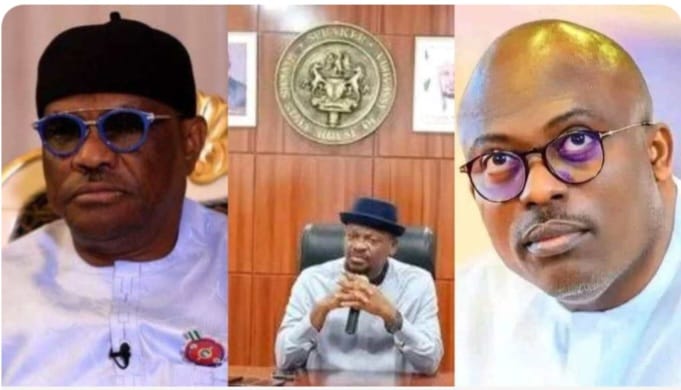
RIVERS STATE IN THE EYE OF THE STORM: POLITICS, IMPEACHMENT & NATIONAL IMPLICATIONS.
By George Omagbemi Sylvester | Published by SaharaWeeklyNG.com
“From Paris to Port Harcourt. A Constitutional Clash, Power Play and the Future of Nigerian Democratic Governance.”
In what can only be described as one of the most explosive and consequential political sagas in Nigeria’s recent history, Rivers State has once again plunged into a constitutional and political crisis that transcends mere state politics in which reverberating across the Nigerian federation and challenging the very essence of democratic governance. At the heart of this unfolding drama is Governor Siminalayi Fubara, his relationship with political heavyweights and the ongoing impeachment proceedings launched against him and his deputy, Professor Ngozi Odu.
This crisis is not a sudden spark but a culmination of prolonged political rivalry, deep factional divisions and contestations over constitutional authority. This write-up does not seek to merely narrate events; it is to contextualise, dissect and scrutinise the interplay of constitutional law, political strategy and democratic principles shaping the crisis in Rivers State whereby leaving no stone unturned in understanding its implications.
A Governor Under Siege: The Genesis of the Crisis.
Siminalayi Fubara (a seasoned accountant turned politician) officially assumed office as the Governor of Rivers State in May 2023 following a decisive electoral victory in what was then a Peoples Democratic Party (PDP) stronghold. However, this ascent was not without internal turmoil. His relationship with his political godfather and predecessor, Minister of the Federal Capital Territory (FCT), Nyesom Wike, deteriorated rapidly, setting the stage for prolonged political strife.
Political observers often quote Alexis de Tocqueville: “A democracy cannot exist without a certain measure of mutual toleration and respect for the rule of law” but yet, in Rivers State, what is unfolding can only be described as a breakdown of mutual political respect, with factional interests dominating constitutional norms.
The House of Assembly (predominantly aligned with Wike’s political camp) has, for the third time, initiated impeachment proceedings against Fubara and his deputy. The motion cites allegations of gross misconduct, including refusal to present the budget, extra-budgetary spending, obstruction of legislative oversight, demolition of the Assembly complex and alleged disregard for judicial directives pertaining to the financial autonomy of the legislature.
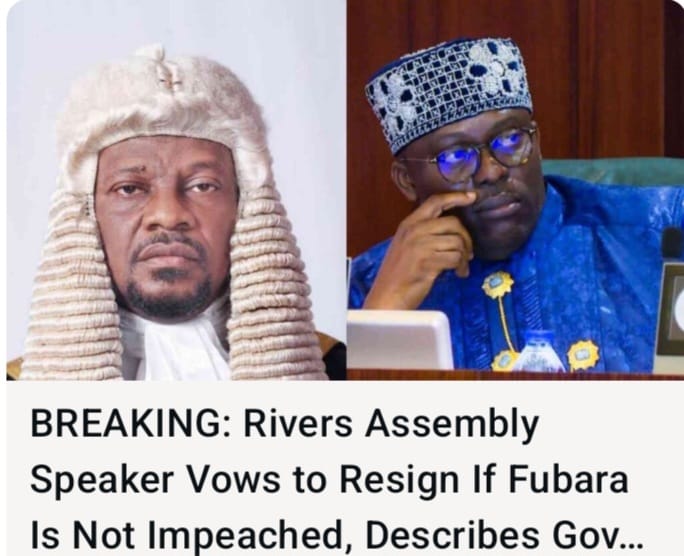
Speaker Martins Amaewhule declared that the legislature would pursue due process to its conclusion, even vowing to resign rather than abdicate what he described as constitutional responsibility. Critics, however, argue that this rhetoric masks political theatre rather than due process.
Impeachment vs. Political Sabotage: The APC’s Rejection.
The Rivers State chapter of the All Progressives Congress (APC); the ruling party at the national level has forcefully rejected the impeachment move, describing it as “DESTABILIZING, UNNECESSARY and POLITICALLY MOTIVATED.” In an official statement, the party’s spokesperson, Darlington Nwauju, held that while the legislature enjoys constitutional independence, resorting to impeachment against its own governor and deputy “AMOUNTS TO DESTABILIZATION ” and risks undermining governance in an APC-led administration.
The APC emphasized fiscal and constitutional safeguards: the ₦1.485 trillion budget approved during emergency rule in 2025 remains valid until August 2026, and the Nigerian Constitution permits governors to continue spending for six months into a new fiscal year without presenting a supplementary budget therefore nullifying claims that Fubara failed in fiscal duties.
The APC’s stance is not merely partisan defence; it reflects constitutional reasoning. Impeachment under Section 188 of the 1999 Constitution (which defines the grounds and process) must be anchored in clear and demonstrable gross misconduct, grave violations of the law, or misappropriation of public funds. Citing budget timing and procedural disagreements alone does not constitute such breaches.
Renowned constitutional scholar, Professor Itse Sagay, once asserted: “The impeachment power is created by our Constitution as a last resort and not as a weapon of political vendetta.” Without airtight evidentiary grounding, impeachment becomes a tool for factional politics rather than constitutional accountability.
Fubara’s Strategic Diplomacy: The Paris Intervention.
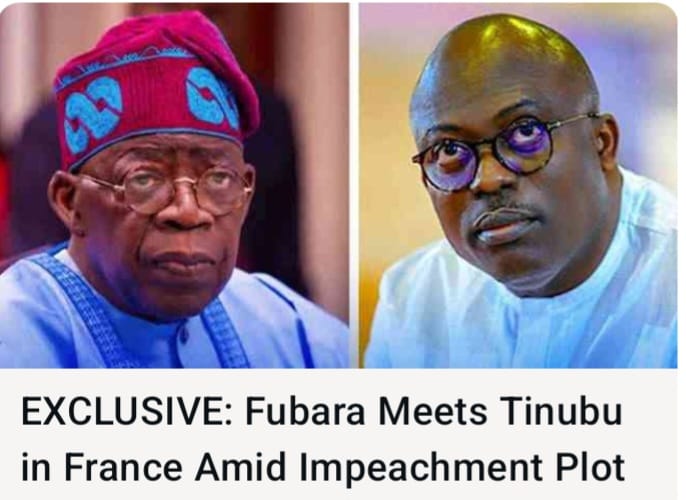
In a remarkable turn of events, Governor Fubara reportedly traveled to Paris, France, to meet President Bola Ahmed Tinubu ahead of the impeachment session, seeking presidential intervention amid mounting pressure from lawmakers aligned with Wike.
This strategic move underscores the governor’s recognition that the crisis extends beyond state legislature corridors, reaching the national political summit. No democracy can survive if its constitutional actors operate in isolation from constitutional anchors at the federal level. Fubara’s decision to brief the president highlights an attempt to balance regional dynamics with national political order.
Tinubu, arguably Nigeria’s most influential political actor, brokered a ceasefire in 2025 when he declared a six-month state of emergency in Rivers State after earlier impeachment attempts destabilised governance. This intervention elevated the conflict from local politics to federal constitutional negotiations.
Civil Society and Legal Advocacy: Critique of the Impeachment Move.
The impeachment threat in Rivers State has drawn widespread condemnation from civil society groups and legal watchdogs. The Human Rights Writers Association of Nigeria (HURIWA) described the impeachment plot as “reckless, unconstitutional, and a grave danger to democratic stability.” HURIWA accused lawmakers of acting at the behest of political interests rather than genuine constitutional oversight, urging President Tinubu to rein in the situation and uphold democratic norms.
The APC Progressive Mandate Group also criticised the proceedings as “constitutionally flawed and politically motivated,” framing it as an affront to the peace accord personally brokered by Tinubu.
These criticisms align with principles articulated by constitutional scholars: impeachment must remain a last-resort accountability mechanism, not a substitute for political dissatisfaction or factional rivalry.
Wider Political Implications: National Stability & Federalism.
The Rivers State crisis is not an isolated event; it strikes at the heart of Nigerian federalism and democratic sustainability. If a governor can be impeached (or threatened with impeachment) predominantly on political alignments rather than incontrovertible legal evidence, then the doctrine of separation of powers is imperiled.
Political scientist Leo Strauss once warned: “When law becomes subject to politics, democracy is no longer a government of law but of persons.” This insight resonates deeply in the current crisis. The Legislature’s actions risk converting constitutional mechanisms into political instruments, weakening democratic checks and balances.
Moreover, the expanded involvement of national party actors and speculation about the roles of influential figures like Tinubu and Wike, suggest that Rivers State’s political storm has strategic implications for national political alignments and the 2027 elections.
The Road Ahead: Constitutional Order, Political Integrity and the Future of Rivers.
The impeachment crisis in Rivers State represents multiple layers of conflict and constitutional interpretation versus political strategy, executive oversight versus legislative assertiveness, and local factionalism versus national political calculus.
At stake is not merely the political survival of Governor Fubara but the integrity of Nigeria’s democratic institutions. As respected democracy scholar Larry Diamond asserts: “Democracy is more than elections; it is about predictable, transparent governance under the rule of law.”
For Rivers State, the crisis is a stern test of constitutional resilience, political maturity and democratic fortitude. If constitutional processes are subverted for factional ends, the state (and indeed the nation) risks eroding public trust in democratic governance.
As events continue to unfold, Nigerians must watch closely: not just for who wins the political battle in Rivers State, but for whether constitutional order, judicial independence and the rule of law prevail in the face of political turbulence.
Published by SaharaWeeklyNG.com







Obasa Appointed to CPA African Executive Committee
The Speaker of the Lagos State House of Assembly, Rt. Hon. (Dr.) Mudashiru Ajayi Obasa, has been appointed as a Sub-National Representative to the Commonwealth Parliamentary Association (CPA) African Executive Committee.
The announcement was formally conveyed through a letter from the CPA Africa Region, which was read on the floor of the Assembly by the Clerk, Mr. Olalekan Onafeko, on Tuesday, March 10. The appointment confirms Speaker Obasa’s three-year tenure, spanning 2026 to 2029.
Lawmakers took turns to congratulate Speaker Obasa, praising his devotion to parliamentary service and his consistent efforts to strengthen legislative practice. They described his appointment as a recognition of his hard work and a reflection of Lagos State’s growing influence within the Commonwealth. Members noted that his achievements continue to bring pride not only to Lagos but to Nigeria as a whole.
In his remarks, Speaker Obasa expressed gratitude to his colleagues for their support, urging them to remain steadfast in prioritizing the progress of the Assembly and to continue working collectively to advance the legislature. He further directed the Clerk to send a formal letter of appreciation to the CPA African Region for the honour bestowed upon him. “Let us always put the House of Assembly first and never relent in our efforts to move the legislature forward, ” Obasa concluded.
The CPA African Region plays a pivotal role in advancing the interests of African parliaments within the Commonwealth. It is widely recognized for promoting gender equality, women’s empowerment, respect for human rights, democracy, and good governance across member nations.
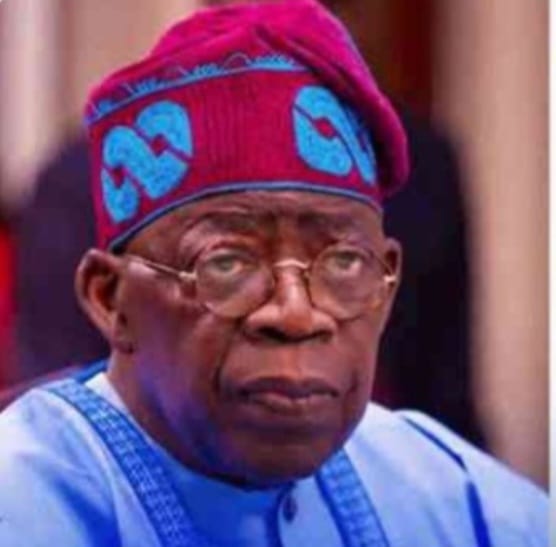
TINUBU RENEWS TENURE OF THREE PERMANENT SECRETARIES
President Bola Ahmed Tinubu has approved the renewal of tenure for three Permanent Secretaries in the Federal Civil Service, in line with existing public service regulations.
The approval was disclosed in a statement issued by the Office of the Head of the Civil Service of the Federation, indicating that the renewed appointments will take effect from April 27, 2026.
The affected officials include Kachallom Shangti Daju, Permanent Secretary in the Federal Ministry of Health and Social Welfare; Beatrice Jedy‑Agba, Solicitor-General of the Federation and Permanent Secretary in the Federal Ministry of Justice; and Mary Ada Ogbe, Permanent Secretary in the Federal Ministry of Regional Development.
According to the statement, the renewal represents a second and final four-year tenure for the officials, in accordance with the provisions of Public Service Rule 020909, which allows Permanent Secretaries an initial four-year term with the possibility of a second term based on satisfactory performance.
The Head of the Civil Service of the Federation, Didi Esther Walson‑Jack, congratulated the Permanent Secretaries on their reappointment and urged them to see the renewed mandate as a call to greater dedication and excellence in service delivery.
She further encouraged them to deploy their experience and professional expertise toward strengthening governance and advancing national development.
The statement was signed by Eno Olotu, Director of Press and Public Relations in the Office of the Head of the Civil Service of the Federation, and dated March 6, 2026.
Politics
Governor Dauda Lawal’s Prompt Action Against Insecurity in Zamfara State Yielding Positive Result’ – GDL Media Force Fires Back at Critics
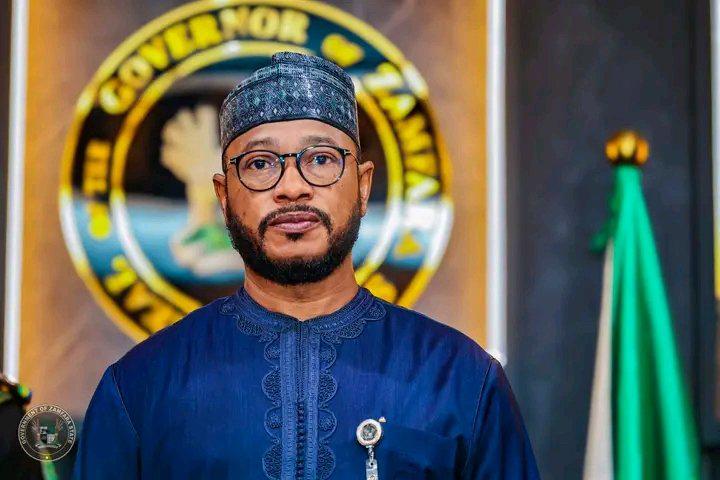
‘Governor Dauda Lawal’s Prompt Action Against Insecurity in Zamfara State Yielding Positive Result’ – GDL Media Force Fires Back at Critics
The attention of GDL Media Force and other well-meaning supporters of the Dauda Lawal-led administration has been drawn to a recent statement syndicated on social media by influencers from a group calling itself the Zamfara Good Governance Forum, which ludicrously attempted to portray the Governor’s security efforts as a “total failure.” This characterisation is not only divorced from reality. Still, it represents a desperate attempt by political opponents to rewrite history and undermine a Governor whose growing influence and performance clearly terrify them. It should be on record that in the whole of the North West region, Governor Dauda Lawal has tackled insecurity head-on with verifiable evidence that even those in the opposition have commended him for his huge investment in equipment that will further give security and armed forces an edge over those fueling insecurity in the country.
Since his assumption as Governor of Zamfara State, Dr Lawal has vowed that as the Chief Security Officer of the state, as well as the chief rescuer, an unprecedented commitment to tackling the security challenges that have plagued Zamfara for over a decade is his top priority and he is engaging it with much gusto. Unlike previous administrations, that engaged in shadowy deals with non-state actors, this Governor has chosen the path of transparency, capacity building, and decisive action. He was one of the Governors who openly declared that His administration would not negotiate with bandit rather his administration with fight them to a standstill and ensure they are cleared out.
In a bid to address the issues of insecurity with a well-planned arrival plan, he procured heavy Security Assets that even the Federal Government commended, him for. The recently procured and unveiled 25 units of Armoured Personnel Carriers (APCs) and an 80-meter endurance surveillance drone capable of covering 50 kilometres and operating continuously for eight hours. This represents the single largest state-government investment in security hardware in the history of Zamfara State.
The Defence Minister, during the inauguration ceremony, praised what he described as a clear demonstration of the Governor’s commitment to protecting lives and property, making the striking projection that “if we continue like this in the second term, Zamfara will look like Dubai”. This is not praise from a partisan source it is professional acknowledgement from the highest level of Nigeria’s defence establishment that Governor Lawal is doing something right.
Beyond heavy military hardware, the Governor has operationalised the Community Protection Guards in accordance with the law, providing them with 60 brand-new, well-equipped Hilux operational vehicles and specialised motorcycles to ensure swift response and effective first-responder services in difficult terrains. This is complemented by the distribution of 150 Hilux vehicles to mainstream security agencies including the Nigeria Police, DSS, and NSCDC, plus 20 Toyota Buffalo vehicles (both armoured and soft-body).
Perhaps most significantly, Governor Lawal established the Zamfara State Security Trust Fund, which provides a predictable, structured framework for logistical support to security forces. This moves the state away from the era of fragmented, reactive responses to a professional, sustainable security architecture.
When recent attacks occurred including the unfortunate February 19 incident in Anka LGA, Governor Lawal did not go into hiding or issue condolence statements from his office in Gusau. He immediately convened and personally presided over an emergency security meeting with all heads of security agencies at the Government House in Gusau, tasking them to urgently review the current security framework and implement coordinated countermeasures.
The Governor charged security chiefs to maintain “heightened vigilance, strengthened intelligence, and immediate, coordinated countermeasures” to ensure that criminal elements do not gain further ground. He also commiserated with affected communities and assured them of his administration’s full support both logistical and institutional. This is not the behaviour of a detached leader. This is the conduct of a Governor who understands that his primary constitutional responsibility is the protection of lives and property.
The public needs to understand the pedigree of those behind these allegations. The so-called “Zamfara Good Governance Forum” has a well-documented history of partisan attacks against Governor Lawal. A simple review of their previous statements reveals a pattern they have consistently attacked the Governor while remaining conspicuously silent during the administrations that presided over the worst years of banditry in the state. Interestingly, these attacks often coincide with political manoeuvres by the immediate past governor, Bello Matawalle, now Minister of State for Defence. The Zamfara State Government has previously accused Matawalle of using federal security apparatus to intimidate opposition figures in the state. The current criticism fits a familiar pattern, when you cannot defeat a Governor politically or at the ballot box, you attempt to undermine him through sponsored propaganda spreading sheer falsehood to ensure the public turns their back on a performing Governor who is rebuilding the rot the Matawale-led administration caused.
These same critics who now demand a “security roadmap” conveniently ignore that Governor Lawal inherited a state that was virtually a failed entity where farmers could not access their lands, where markets were paralysed, and where government had lost all credibility through failed negotiations and ransom payments to bandits.
Critics also conveniently ignore a fundamental reality Governor Lawal is the only opposition governor in the entire North-West geopolitical zone. Since taking office in 2023, his administration has received no federal intervention funds beyond statutory allocations no special palliatives, and no enhanced security support that flows to states with ruling-party governors. Yet despite this political isolation, he has managed to fund security without resorting to new borrowing, while monthly servicing N1.2 billion in inherited debts from the Bello Matawalle-led administration. This is governance under siege fiscally constrained, politically isolated, yet still delivering.
Governor Dauda Lawal has never claimed that the battle against banditry is easy or that success will come overnight. What he has demonstrated is sincerity of purpose, strategic vision, and relentless commitment. From the Security Trust Fund to community protection guards, from armoured personnel carriers to surveillance drones, these are not the actions of a leader who has failed. The growing influence of Governor Lawal across the North-West clearly frightens those who benefited from the old order of insecurity. When banditry thrives, politicians who negotiate with criminals remain relevant. But when peace is restored through genuine security architecture, such elements become obsolete.
Zamfara State is on the path to lasting peace. The detractors may continue their campaign of falsehood, but the facts on the ground speak louder than their sponsored propaganda. Governor Dauda Lawal remains focused, undeterred, and absolutely committed to restoring full normalcy to every inch of Zamfara State. The people of Zamfara see the progress. The Federal Government acknowledges the investment. And history will remember who truly fought for the state’s liberation.
Signed: GDL Media Force Support Group
March 4, 2026
Abuja, Nigeria


-
 society6 months ago
Religion: Africa’s Oldest Weapon of Enslavement and the Forgotten Truth
-

 news3 months ago
WHO REALLY OWNS MONIEPOINT? The $290 Million Deal That Sold Nigeria’s Top Fintech to Foreign Interests
-

 society6 months ago
“You Are Never Without Help” – Pastor Gebhardt Berndt Inspires Hope Through Empower Church (Video)
-

 Business7 months ago
GTCO increases GTBank’s Paid-Up Capital to ₦504 Billion