
society
Nigeria’s $9 Million Image-Laundering Debacle: Misplaced Priorities, Diplomatic Failure and the Cost of Reputation Over Security

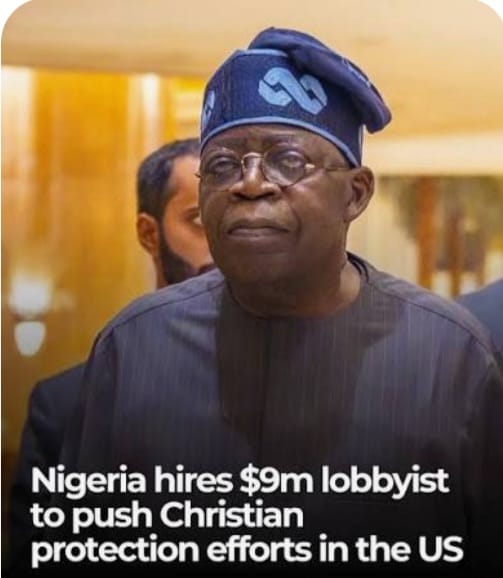
Nigeria’s $9 Million Image-Laundering Debacle: Misplaced Priorities, Diplomatic Failure and the Cost of Reputation Over Security.
By George Omagbemi Sylvester
“Why Abuja’s Decision to Spend Millions on U.S. Lobbying Amid Deepening Insecurity and Economic Hardship Is a National Embarrassment.”
In a decision that has sparked domestic outrage and intensified global scrutiny, the Federal Government of Nigeria has entered into a $9 million (about ₦13.5 billion) lobbying contract with a Washington-based public affairs firm in a bid to shape the narrative over alleged “GENOCIDE” claims against Christians in the country. The contract, which was executed on December 17, 2025, was signed on behalf of the Nigerian government by Aster Legal, a Kaduna-based law firm and DCI Group, an American lobbying and public affairs company. The agreement mandates that DCI Group help communicate Nigeria’s actions to protect Christian communities and sustain U.S. support for counter-terrorism efforts.

Yet, this costly engagement abroad has provoked resounding condemnation from political parties, civil society organizations and policy analysts who argue that such an expenditure (at a time of worsening insecurity and economic hardship) reflects a distorted sense of national priority and diplomatic failure.
A $9 Million Contract Amid Crises at Home. Under the terms of the contract, Nigeria paid an upfront $4.5 million on December 12, 2025, covering the first six months of the lobbying engagement. The remaining amount is structured as a monthly retainer of $750,000, bringing the total value to $9 million over one year, with the initial period running until June 30, 2026, and subject to automatic renewal unless terminated by either party with a 60-day notice.
The ostensible objective, officials say, is to “assist the Nigerian government in communicating its actions to protect Nigerian Christian communities and maintaining U.S. support in countering West African jihadist groups and other destabilizing elements.”
On its face, this may seem like a legitimate diplomatic engagement. However, critics argue it is reductive, counterproductive and a glaring misallocation of public funds at a time when Nigerians are confronted with everyday threats and from rampant banditry and terrorism to crippling inflation and infrastructure decay.

Misplaced Priorities, According to Critics. Commentators and civil society leaders have condemned the contract as scandalous, indefensible and morally blind. The African Democratic Congress (ADC), for instance, described the expenditure as “OBSCENE,” saying no amount of paid lobbying would hide the government’s failure to protect lives and property at home. The party’s National Publicity Secretary said: “While the ADC recognizes the importance of representing Nigeria’s interests internationally, spending $9 million on image management at a time when millions of Nigerians cannot afford food, fuel, or basic healthcare is a clear case of misplaced priorities and moral blindness.”
Similarly, the Peoples Democratic Party (PDP) labeled the public relations contract “DEFECTIVE and DECEPTIVE,” questioning why a government with vacant ambassadorial positions would outsource core diplomatic functions to a private law firm and yet fail to articulate its record effectively through its own diplomatic corps.
Human Rights Writers Association of Nigeria (HURIWA) also weighed in, calling the move a “senseless waste of public funds” when those resources could have been deployed to address security gaps that have cost thousands of lives and displaced millions.
Diplomacy by Proxy: A Sign of Institutional Weakness?

The Nigerian government’s turn to paid lobbying in Washington exposes a deeper institutional weakness in Nigeria’s diplomatic architecture. Diplomats and foreign service professionals are meant to champion Nigeria’s interests abroad. Yet, the reliance on external firms suggests that the government views international image management as a technical exercise to be contracted rather than a fundamental part of statecraft to be pursued through capable, accountable institutions.
An experienced former foreign service officer, speaking anonymously, noted: “A government that has left key ambassadorial positions vacant now seeks to outsource diplomacy to lobbyists, further weakening Nigeria’s institutional credibility and reducing foreign policy to transactional propaganda.” This view echoes widespread concern that international perception cannot be effectively rebranded without genuine improvement in security and governance on the ground.
The Genocide Narrative and Its Complexity. The backdrop to this lobbying contract is a contentious narrative surrounding alleged violence against Christian communities in Nigeria. In 2025, influential U.S. political figures, including former President Donald Trump, characterized the violence as “GENOCIDE,” a designation the Nigerian government has firmly rejected. Nigerian authorities insist that insecurity affects all communities irrespective of religion, attributing violence to terrorism, banditry and criminality rather than systematic religious persecution.
Yet the issue has gained traction among foreign policymakers, think tanks and diaspora advocates who argue that ethno-religious violence in Nigeria is intensifying and requires urgent international attention. This has created a competitive narrative environment in Washington, with various lobbyists, including groups linked to pro-Biafra activism, vying to influence U.S. policy and perceptions. According to recent reporting, Nigeria may well be outspending these lobbyists in an effort to shape the narrative in its favour.
While the debate is complex and multifaceted, the government’s heavy investment in narrative management abroad raises a fundamental question: Why spend millions on perception management when realities on the ground cry out for sound governance and security solutions?
A Government Under Pressure. Nigeria’s diplomatic outreach comes at a time when its international standing is under pressure. Aside from allegations of targeted violence, the country grapples with allegations of human rights violations in various regions and concern over the effectiveness of its counter-terrorism strategies. Meanwhile, within Nigeria, citizens face deteriorating economic conditions, skyrocketing inflation and daily insecurity.
A respected international relations scholar, Professor Amina Yusuf, summed up the dilemma: “Reputation is a by-product of reality, not a substitute for it. A government cannot buy legitimacy abroad while legitimacy at home collapses.”
This insight is particularly poignant in a nation where tertiary education experts and economists have repeatedly argued that security and economic stability are prerequisites for a positive global image and not the other way around. Investing in robust public institutions and ensuring citizens’ safety should logically precede investment in public relations abroad.
Toward an Authentic National Narrative. If Nigeria is to defend its global image effectively, the starting point must be substantive improvements at home. International audiences (policymakers, investors and civil society) look beyond glossy talking points to concrete developments: declining rates of violence, improved access to justice, respect for human rights and economic progress.
A veteran diplomatic analyst, Ambassador (ret.) Chukwuemeka Okafor, stresses this point: “Diplomacy without results is propaganda, and propaganda without results is hypocrisy. Our ambassadors must be empowered to tell our story, grounded in progress, not spin.”
The current approach (outsourcing narrative management while core domestic issues fester) runs the risk of projecting desperation rather than confidence. It is akin to repainting a crumbling wall instead of repairing the foundation.
Summative Perspective: Rebuilding Trust Through Action. Nigeria’s $9 million image management deal with a U.S. lobbying firm lays bare a deeper crisis of governance. It exemplifies a decisions-over-delivery mindset, prioritizing perception over performance. At a time when millions of Nigerians face insecurity, economic hardship and eroding trust in state institutions, this contract underscores a leadership disconnected from the immediate needs of its people.
A government that truly cares about its global reputation must first ensure security, accountability and prosperity at home. Only then can international narratives shift, but not through paid lobbyists but through undeniable progress. As Professor Yusuf aptly concludes: “A nation’s reputation is earned in the field, not bought in the boardroom.”
This report was compiled with reference to multiple sources including Nigeria’s recent $9 million lobbying engagement to counter alleged genocide claims and critical analyses of the broader political responses.





STILL ON DELE MOMODU by Chief Femi Fani-Kayode
I saw Dele Momodu’s response to my article on him & was amused.
I tried to be polite & restrained in that write up & I didn’t realise that it would hurt him so deeply. Yet for that I offer no apology.
I said he sounded tired & worne in his interview with Seun Okinbaloye but from his response today it is clear that he is now completely unhinged.
He has blown his gasket & his reaction is rooted more in emotion than it is in logic.

Frankly I feel sorry for him because it is clear that he is fighting a lost cause, he is badly diminished & he is now a shadow of his former self.
For Bobby Dee the glory days are certainly over & I suspect that by 2027 when Tinubu emerges victorious he will crawl back into the hole that he originally came from.
Perhaps at that time he will go back to taking pictures of former Governor Nyesom Wike, the Adeleke’s & other prominent figures for a living & shining their shoes.
Playing clips of things that I said about President Tinubu 11 years ago when I was in the then opposition & when I led the media section of President Jonathan’s presidential campaign organisation will not help him to get rid of the stench of faeces that he has immersed himself in today & neither does it derogate from the fact that he was speaking rubbish when he said Tinubu is a dictator.
Unlike others I will never deny what I have said in the past about Tinubu or anyone else but at least I had the decency & courage to admit that I was wrong & ever since I left the then opposition and joined the APC in 2021 I have not looked back.
Not only did I fight for Tinubu in 2023 during the presidential campaign but I have remained loyal & committed to him & his cause since then and I have no apology for that either.
Unlike Dele I did not benefit from him for close to 40 years, eat from his plate, collect handouts from him, stay in his house, claim to be his brother and yet refuse to support him in achieving his dream of becoming President.
Bobby Dee’s nose is so far up the posterior of those he is now slaving for that he forgot to mention the fact that every single one of them, at some point or the other in their sorry lives & career, have not only changed political parties several times over but have also opposed Tinubu bitterly & even more vehemently than I ever did only to go back & later re-align with him.
I do not begrudge them or blame them for that because that is the nature of politics all over the world.
There are no permanent friends or enemies but only permanent interests and in my view it is in the interest of Nigeria that Tinubu continues the reforms that he started in 2023 after he was elected President.
It is also my view that Nigeria must never fall into the hands of the conglomeration of court jesters, sorry clowns & motely crew of insufferable jokers that Dele is now speaking, slaving & fronting for.
I will still be gentle with my old friend because I have a soft spot for him but if he ever crosses the line with me again I will stop being so restrained.
He does not have the stomach for a real fight because he is vain and thin-skinned. He also has an over- inflated opinion of himself and a huge ego.
These are weaknesses in this game and not strengths and as we get closer to the presidential campaign he will learn this the hard way.
Meanwhile he should stay in his lane otherwise I will give him plenty to write about.
For him to compare Tinubu to Abacha was wrong and if he was anything like the dictator that Dele claims he is both Dele and those he speaks for today would either be dead or in jail.
He should count himself lucky that our President is a democrat and not a monster.
Dele’s lies, duplicity & shameless perfidy have finally been exposed & are as obvious & glaring as his very large stomach.
I advise him to do some press ups & go jogging because unlike before I will no longer remain silent as he & his friends throw mud at our President.
Game on!
(FFK)
society
OWUTU FM 2026 Ramadan Lecture: Sheikh Jamiu Asanbe Urges Muslims to Avoid Showboating in Worship

OWUTU FM 2026 Ramadan Lecture: Sheikh Jamiu Asanbe Urges Muslims to Avoid Showboating in Worship.
The Chief Imam of Agelete Central Mosque, Ikoyi Lagos, Alhaji Jamiu Asanbe, has urged Muslims to remain sincere in their acts of worship and avoid the temptation of seeking public praise for good deeds.
The respected Islamic scholar gave this admonition while delivering a lecture at the OWUTU FM 2026 Ramadan Lecture, held on Saturday, February 28, 2026, in Lagos.
Speaking on the importance of sincerity in Islam, Sheikh Asanbe cautioned Muslim faithful against what he described as “showboating” — the practice of performing charitable acts or religious duties merely to gain recognition or admiration from others.
According to him, every act of worship in Islam must be done purely for the sake of Almighty Allah.
He explained that while acts such as prayer, fasting, and charity are fundamental pillars of faith, their true value lies in the intention behind them.
The cleric therefore encouraged Muslims to remain genuine in their devotion and avoid mixing their faith with the desire for worldly praise or attention.
Sheikh Asanbe also reminded the faithful that the holy month of Ramadan presents a unique opportunity for spiritual renewal. He urged believers to increase acts of generosity, particularly by supporting the needy, vulnerable members of society, and orphans.
Earlier in her remarks, the Convener of the Ramadan Lecture and CEO of OWUTU FM, Hajia Adejoke Muyibat Balogun, encouraged attendees to use the sacred month as a time for reflection, self-improvement, and community development.
She described the lecture theme as carefully selected to promote spirituality, strengthen faith, and encourage peaceful coexistence within the community.
Balogun expressed appreciation to the numerous guests and supporters who attended the event, noting that their presence reflected the strong bond within the community.
She further reaffirmed OWUTU FM’s commitment to sustaining the annual Ramadan Lecture, praying for Allah’s continued guidance and mercy in the years ahead.
The 2026 edition of the Ramadan Lecture attracted dignitaries and representatives from various organisations including Uzamot Communications, Okutex Fabrics, and the Yeye Asiwaju of Ojota Kingdom.
The event also featured engaging activities such as a quiz competition, where winners were presented with gifts. In the spirit of Ramadan, iftar meals were shared with guests, reinforcing the values of unity, generosity, and compassion that define the holy month.
Through initiatives like this, OWUTU FM continues to play a vital role in promoting faith-based dialogue, community engagement, and social harmony.
Tinubu Abroad, Nigeria in Chaos: The Spectacle of Elite Excess
By George Omagbemi Sylvester
“Government officials queue to bid him farewell as he departs, only to rush ahead and line up again to welcome him at his destination; a stark display of misaligned priorities in Nigerian leadership.”
Wednesday, March18, 2026
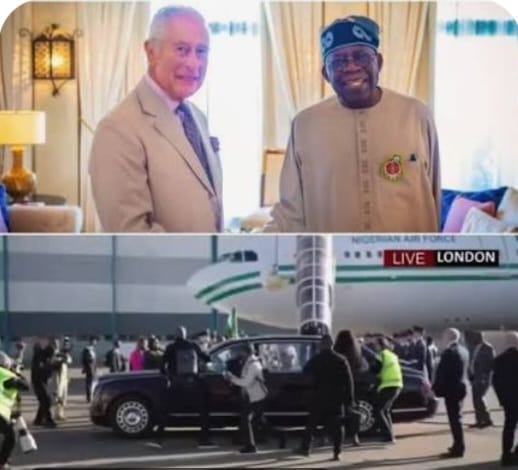
In a spectacle that has plunged Nigeria’s political class into fresh ignominy, a long line of federal ministers, governors, senators and political hangers‑on queued outside a London hotel this week to welcome President Bola Ahmed Tinubu, GCFR upon his arrival in the United Kingdom for a two‑day state visit.
Not only did these government officials send off Mr. Tinubu as he departed Nigeria (a ritual in itself excessive given the scale of pressing national crises) they rushed ahead to London to line the halls of his hotel, applauding and greeting him like conquering heroes arriving on foreign shores. This is how Nigeria’s elites now comport themselves while millions of citizens endure ever‑deepening hardship.
A Travesty of Priorities
Tinubu’s visit to the UK, hosted by King Charles III and Queen Camilla, is officially billed as an effort to deepen trade relations, attract investment and strengthen bilateral cooperation between Britain and Africa’s most populous nation. While those diplomatic objectives in theory could benefit Nigeria, the optics of an entire political class fawning over a president abroad are unbearably grim against the backdrop of domestic suffering.
According to recent economic analysis, despite macroeconomic adjustments such as ending fuel subsidies and floating the naira, more than 60% of Nigerians still live in poverty and daily hardships are rampant. Security remains a grave concern with violence and banditry destabilising large swathes of the country. Instead of addressing these crises with urgency, Nigeria’s leadership appears fascinated with photo‑ops overseas.
“A System of Self‑Centred Elites”
Critics within Nigeria have not minced words. Political observers describe the spectacle as a display of self‑centred politics divorced from the realities facing ordinary citizens. One observer on social platforms summed up the broader sentiment: “Tinubu represents a system of self‑centred elites (elite consensus over popular will) and this is exactly the performative politics that lines like these embody.”
Dr. Godfrey Mwakikagile, a respected African scholar on post‑colonial governance, has long warned that bad leadership and lack of accountability are Africa’s greatest challenges. “Power in many African states is too centralised and concentrated in the hands of elites who use it to perpetuate themselves at the expense of the public good,” Mwakikagile recently argued; a critique that resonates all the more when ministers fly abroad not to pursue tangible policy but to line up like admirers.
The Cost of Foreign Pageantry
This isn’t the first time Tinubu’s foreign engagements have attracted scrutiny. His administration’s frequent travels (often with large entourages) have drawn criticism for prioritising optics over outcomes, especially when Nigeria’s economy contracts and its people struggle with food inflation and insecurity.
Former presidential candidate Peter Obi has been among the most vocal domestic critics of these priorities, noting that Tinubu’s extensive foreign travel (including to the UK) distracts from urgent national needs and has become a “matter of grave concern.” Obi insists that such actions reveal a leadership more interested in global visibility than domestic wellbeing.
Nigeria Jagajaga!
The phrase “Nigeria jagajaga” (loosely translated as Nigeria being in disarray) has never felt more apt. A nation where ministers greet presidents in plush foreign suites while citizens queue for food and services is a country deeply out of balance.
Instead of being welcomed like dignitaries abroad, ministers and governors should be at home addressing the root causes of Nigeria’s struggles: insecurity that displaces communities and kills livelihoods, an economy that leaves the majority impoverished despite reforms, and the persistent failings of governance that erode public trust.
What Nigerians Deserve
President Tinubu and his entourage should be judged not by the number of ministers who lined up to greet him in London, but by the lives changed back in Nigeria.
As scholars like Mwakikagile and critics like Obi remind us, political leadership must be accountable and grounded in service, not spectacle. Nigeria’s leaders owe the people more than applause at international hotels; they owe them safety, economic opportunity, and genuine progress.
If this nation is ever to break free from the cycle of “jagajaga,” then those in power must demonstrate sincerity, not pageantry; action, not admiration. The lines outside a London hotel are not a testament to leadership; they are a testament to where Nigeria’s priorities have tragically come to rest.


-

 society6 months ago
Religion: Africa’s Oldest Weapon of Enslavement and the Forgotten Truth
-

 news3 months ago
WHO REALLY OWNS MONIEPOINT? The $290 Million Deal That Sold Nigeria’s Top Fintech to Foreign Interests
-

 society6 months ago
“You Are Never Without Help” – Pastor Gebhardt Berndt Inspires Hope Through Empower Church (Video)
-

 society7 months ago
Who is Chief Kestin Pondi? Niger Delta’s “People’s Chief” Winning Hearts With Hundreds of Millions in Generosity