
news
Kalabari Kingdom Witnesses Historic Rite as King Dokubo- Asari Installs Son as Chief, rolls out a Boat Regatta

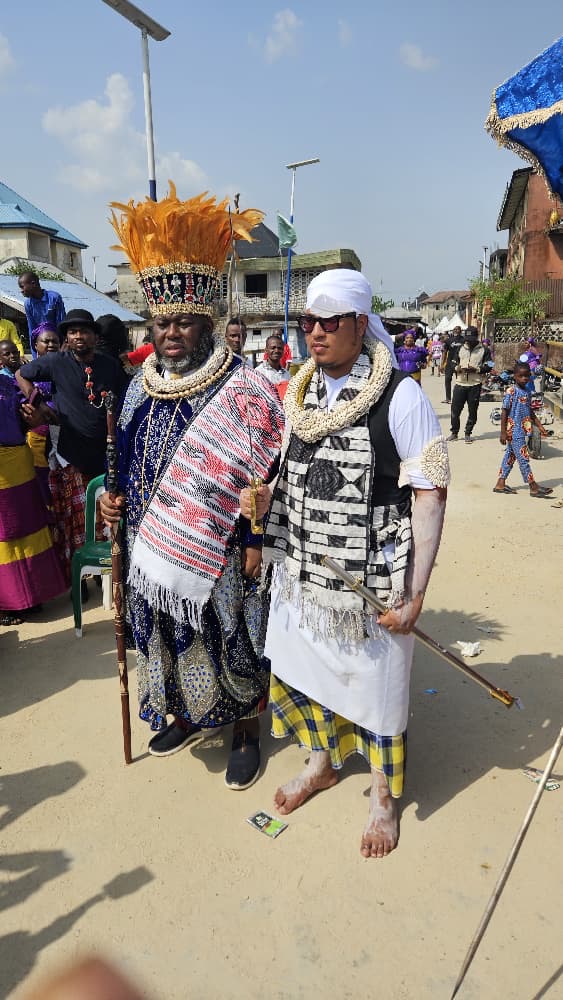
Kalabari Kingdom Witnesses Historic Rite as King Dokubo- Asari Installs Son as Chief, rolls out a Boat Regatta
By; Al Humphrey Onyanabo
The rich customs and time-honoured traditions of the ancient Kalabari kingdom came alive in Buguma, Rivers State today, February 28, 2026 as Da Amakiri Tubo, Alhaji Mujahid Abubakar Dokubo-Asari, Dabaye Amakiri 1, Amanyanabo of Elem Kalabari ( The Source) formally presented his son, Briebibo Dienyefa, to the Kalabari nation as a chief.
The ceremony marked the culmination of over two months of meticulous traditional processes — a demanding journey rooted in ancestry, honour and communal validation. In Kalabari land, chieftaincy is neither symbolic nor automatic. It is earned through a rigorous rite of passage that requires the candidate to be presented before chiefs of various houses and families with which he has paternal affiliation.
At each stage, Briebibo Dienyefa was introduced,scrutinised and affirmed. The chiefs examined not only his lineage but also his character, reputation and conduct. In keeping with tradition, he had to be accepted as worthy and without blemish — fit to lead, represent and uphold the dignity of his people.
With the traditional requirements satisfied, he was formally put forward by his father, the Amanyanabo of Elem Kalabari, to sit on his personal stool as Dokubo-Asari II — a title that carries both heritage and responsibility.
The presentation ceremony drew traditional rulers, chiefs, elders and well-wishers from across Kalabari land, underscoring the cultural weight of the moment. It was not merely a family milestone but a reaffirmation of Kalabari’s enduring governance structure — one that blends ancestry, moral authority and communal consensus.
The chieftaincy journey of Alabo Briebibo Dienyefa Dokubo-Asari began on January 17, 2026, with a colourful outing in Buguma.(He is taking over the personal chieftaincy stool initiated by his father since 2004).
On that day, he was formally presented to the Edi Polo family at the Edi Polo Memorial Hall, marking the first step in a process deeply rooted in Kalabari custom.
A week later, on January 24, 2026, the second stage — Polo Diye, the traditional compound presentation — took place at the Omubo Birinaomoni Memorial Hall. Close to one hundred chiefs were in attendance, underscoring the seriousness of the rite and the weight of communal endorsement required for the path he had chosen.
On Saturday, February 27, 2026, he advanced further in consolidating his chieftaincy as he was presented at the Kariboye-Abi Princewill Memorial Hall, Buguma. The day carried historic significance. His father, the Amanyanabo of Elem Kalabari, was also presented to the Abi Royal Family in fulfilment of custom ahead of his coronation — a reminder that in Kalabari land, even a king must submit to ancestral protocol.
Early morning showers that Friday were interpreted by many as a sign of divine alignment with the solemnity of the moment.
This weekend stands as a defining chapter for Da Amakiri Tubo, The Amanyanabo of Elem Kalabari. Father and son move through tradition side by side — one affirming his kingship rites, the other stepping fully into chieftaincy responsibility.
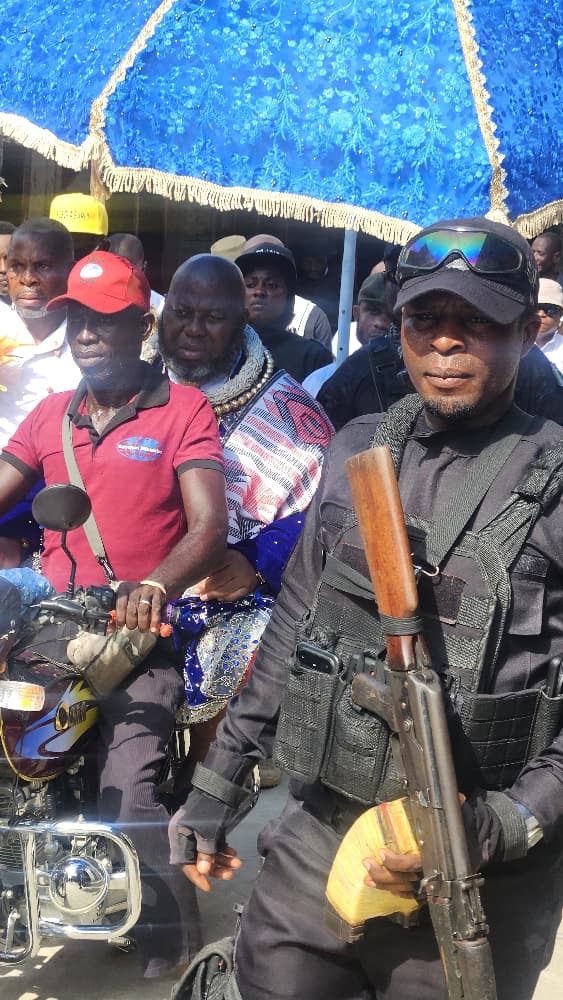
The royal convoy reflected the stature of the occasion. The Amanyanabo rode in a cream Rolls-Royce, followed by a 2025 Toyota Land Cruiser VXR and a Mercedes-Benz Brabus 800. The Amama Soldiers maintained tight security throughout the proceedings.
Today, at the King Kariboye-Abu Princewill Amachree Memorial Hall in Buguma, both father and son are being formally presented to the Abi Family chiefs, as tradition demands. The Abi Royal Family — custodians of ancestral legitimacy — play a central role in affirming both the king and the chief.
Proceedings are being overseen by the Regent of the Kalabari Kingdom, Chief Charles Numbere.
In keeping with Kalabari tradition, no coronation as Amanyanabo is complete without this presentation to the Abi Royal Family. It is a reaffirmation that authority flows not merely from title, but from lineage, acceptance and adherence to sacred custom.
After the opening speech of the Regent, The Amanyanabo’s hand was raised by Chief Basoene Abiyesuku raised the hand of the monarch and presented him to the Regent of the Kalabari Kingdom.
Thereafter it was the turn of King Dokubo-Asari to present his son Breibibo Dienboye formally to his kinsmen of the Kariboye Abi Royal family. That accomplished, step out into the afternoon sun,
The crowd accompanying us had ballooned. We move to the King Amachree town hall where a massive crowd waited at about 12 noon.
The Presentation ceremony is simple. The Regent of the Kalabari Kingdom, Chief Charles Numbere is running the show. There is a quiz to test the fidelity of the new chief. First he is asked to identify two items, a canoon ball and a tuber of yam on the table in front of the Regent and to choose one between both, afterwards he is asked what action he will take if he learns of an insurgency against the king.
Thereafter, A family chief raises his hand and presents him to the Regent. After the successful presentation of any chief, Cannon balls are fired.
There were about ten chiefs who came to show themselves today like the son of Amanyanabo of the Source but beyond doubt, the King stood out. Musical Entertainment outside was provided by the Ogele cultural troupe of the Amanyanabo and the members of the Alhaji Mujahid Abubarkr Dokubo-Asari Cultural Centre. Each tried to outdo each other. They sang and danced in the scorching son for other two hours non stop in honour of their patron. Today was payback day.
Today, Saturday February 28 is the grand finale, King Dokubo-Asari is championing the Se Diye( Presentation to the Kalabari nation) of his son, Alabo Briebibo Dienboye Dokubo-Asari.
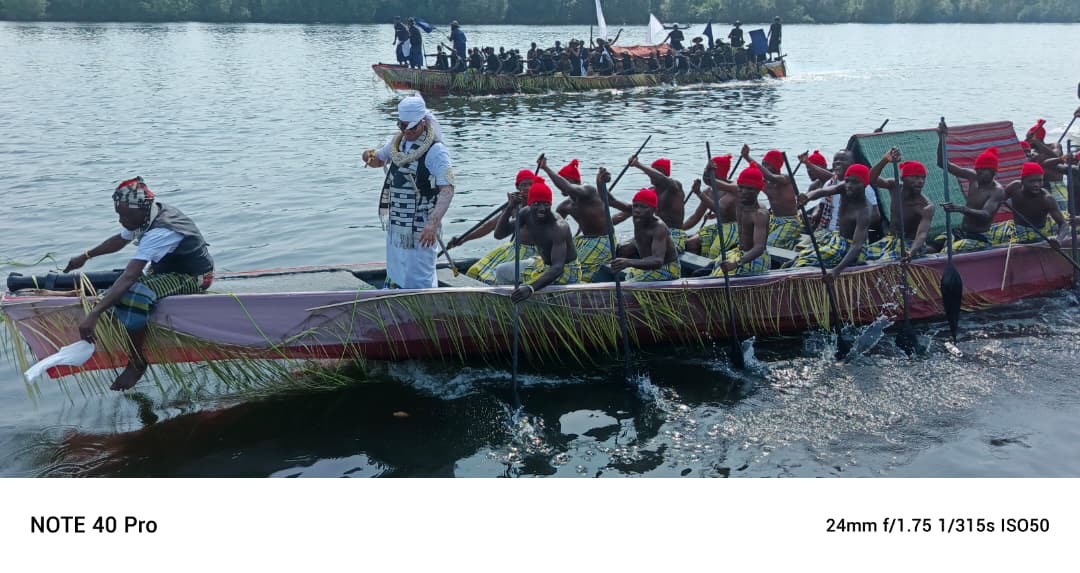
To commemorate the installation, the kingdom staged a colourful boat regatta — a vibrant maritime display deeply woven into Kalabari cultural identity. The spectacle of decorated boats gliding across the waters, accompanied by music, chants and traditional pageantry, symbolised continuity, celebration and the living spirit of a riverine people.
For the Kalabari nation, the event stood as both a preservation of heritage and a declaration of succession — ensuring that the traditions of leadership remain intact, respected and passed from one generation to the next.
This afternoon, King Amachree Memorial Hall in Buguma is filled to capacity.
Influential chiefs and figures from every stratum of the Kalabari Kingdom — including members of the diaspora and invited friends — are present for the historic gathering.
Inside and around the hall, traditional drums thunder without pause. Dancers move in tight formations, voices rise in rhythmic chants, and the tempo of celebration has reached a fevered intensity.
The atmosphere is electric, and the crowd’s exuberance leaves no doubt that this is a moment of collective pride and cultural. Today, five chiefs from the Edi Compound — also headed by King Asari-Dokubo have advanced to the final and most prestigious stage of their chieftaincy journey: the Se Diye.
Those being presented
are: Alabo West Oburulele,
Alabo Seliman of Sama,
Alabo Dr Ebi Robinson Braide, Alabo Obiobra Pankin Braide, Alabo Briebibo Dienyefa Dokubo-Asari,
and Alabo Tubidikiba Braide.
The Se Diye — the formal presentation to the Kalabari nation — represents the highest level of chieftaincy installation in the Kalabari Kingdom. It comes only after a chief has successfully passed through the preceding stages of scrutiny and family endorsements.
By the time a candidate reaches this point, he has already been examined by his compound and lineage.
The Se Diye extends that validation to the entire Kalabari nation.
It is an undertaking of immense cultural and financial weight. The cost is substantial, but more importantly, the responsibility it confers is profound. The Se Diye is similar to the Ama Diye but to a wider audience.
At this stage, the chief (known in Kalabari as Alabo) publicly presents himself before fellow chiefs from across Kalabari land — men who have themselves undergone the same rites. It is both introduction and affirmation: a declaration that he stands as a full Kalabari chief, recognised by tradition and accepted by his peers.
For the Kalabari people, the Se Diye is not a mere ceremony; it is institutional continuity. It ensures that leadership remains rooted in ancestry, accountability and communal consent.
With its completion, Alabo Briebibo Dienyefa Dokubo-Asari steps fully into the privileges and symbolism of his office. He may now wear the Don attire — the distinctive regalia of Kalabari chiefs — anywhere in the kingdom. The walking stick with added swagger, is no longer ornamental. It signifies authority earned through process and endurance.
And truth be told, he has earned it. Today, he stands affirmed.
Congratulations, Alabo Briebibo Dienyefa Dokubo-Asari, (Dokubo-Asari 11). Continue to soar.
By: Al Humphrey Onyanabo,
The Storyteller,


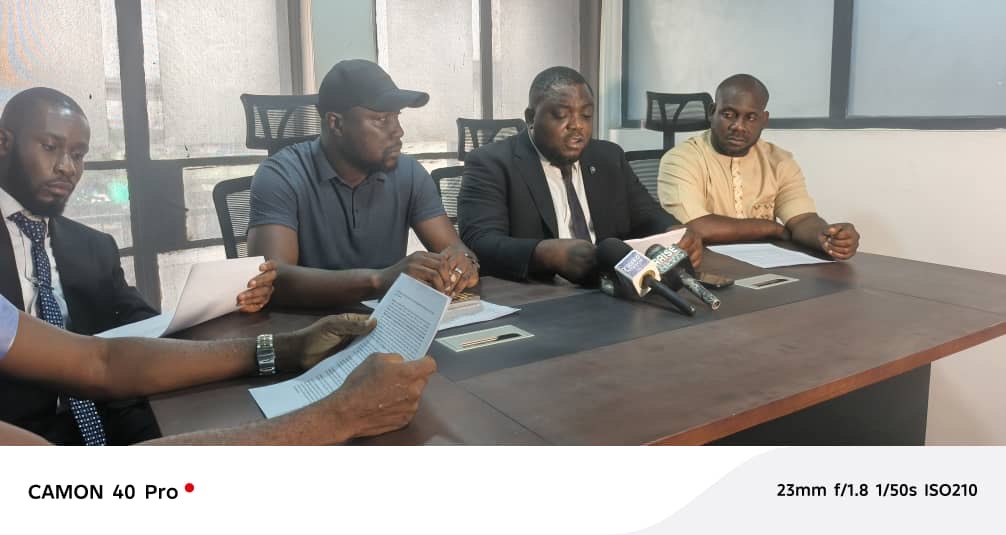
The Youth Forum of Ojomu Royal Family of Ajiran Town in Eti-Osa Local Government Area of Lagos State, has written a petition against the Commissioner of Police in the state, Moshood Jimoh, over the accusations levelled against Hammed Tajudeen.
Speaking at a press briefing in Lagos, the counsel to the Forum, (Adedotun Ajulo, Esq.), said the Lagos State Police Command cannot embark on a media trial in an alleged murder case.
The Forum said the police accused Tajudeen of sponsoring multiple murders without investigation. It stated that at no time was Tajudeen invited by the police for questioning.
It said: “At no time did he refuse or fail to honour any police invitation. At no time was any warrant of arrest issued against him by a court of competent jurisdiction.
“At no time was any judicial authorisation or order obtained to declare him wanted. Despite these concerns, on 20 February 2026, the Commissioner of Police, Lagos State Command, convened a press briefing during which the full image of Alhaji Hammed Tajudeen was displayed and he was publicly accused of sponsoring multiple murders.
“This unilateral and sensational declaration exposed him to public odium, ridicule, and severe reputational harm, all without the benefit of due process or the basic courtesy of an invitation for questioning.
“In the aftermath of the press briefing, hoodlums allegedly sponsored by the opposing parties seized upon the heightened tension to vandalize and destroy properties and assets belonging to Alhaji Hammed Tajudeen, as well as those of other identifiable members of the youth wing who are perceived to be aligned with him.
“These coordinated attacks further underscore the dangerous consequences of deploying the machinery of law enforcement in a manner that inflames communal hostilities rather than preserving public order.
“Subsequently, there has been an overwhelming and intimidating presence of both military personnel and policemen within the community, a development that has served only to further harass, threaten, and denigrate our Clients.
“Meanwhile, the opposing parties continue to enjoy open protection, enabling them to persist in the unchecked dissipation of the community’s common patrimony without resistance or accountability.
“The law is settled. The Administration of Criminal Justice Act, 2015, particularly Section 41, regulates the circumstances under which a citizen may be declared wanted.
“These conditions were not met in this case. Furthermore, the courts have held that the publication of a wanted notice without lawful authority is unconstitutional, illegal, and liable to be set aside.
“We emphasise that our clients are not opposed to lawful investigation. They have consistently cooperated with law enforcement agencies in the past and were previously exonerated after investigations.
“What they strongly oppose is indictment without investigation, trial by media, intimidation, and the use of police machinery to settle private disputes or advance personal interests.
“The issues concerning the Ojomu Royal Family long predate the tenure of the current Commissioner of Police, and it is noteworthy that his predecessors never conducted themselves in a manner suggestive of bias, compromise, or improper influence arising from any promise of advantage or lucre, whether direct or implied.
“Consequently, a formal petition has been submitted against the Lagos State Commissioner of Police and the Lagos State Police Command.
“Among the reliefs sought are the constitution of a special, neutral, and professionally competent investigative team to review the allegations; the prosecution of any persons found to have made false, malicious, or fabricated claims; and a public retraction of the unlawful declaration portraying Alhaji Hammed Tajudeen as a murderer.
“Our Client reiterates his readiness to make himself available for investigation, provided such inquiry is conducted without bias, compromise, or the procedural irregularities presently characterizing the handling of this matter and definitely not by Lagos State Commissioner of Police.
“We trust that the appropriate authorities will urgently intervene to restore confidence in due process, uphold the rule of law, and ensure that policing in Lagos State remains professional, impartial, and accountable.
“More troubling is the fact that such a pronouncement was made in the absence of any invitation, interrogation, or opportunity afforded to Tajudeen to respond to the allegations an omission that gravely offends the tenets of fairness, due process, and responsible policing.
“Furthermore, the conduct of the Commissioner raises serious questions as to whether the machinery of the state is being deployed to settle personal or communal scores rather than to uphold law and order.
“In a democratic society governed by the rule of law, no public officer is permitted to wield statutory powers in a manner that constitutes a media trial or exposes citizens to unwarranted public opprobrium.
“It is against this backdrop that we consider it imperative to address the public and set the records straight, ensuring that the rights and dignity of all parties are preserved while lawful processes are allowed to run their full and proper course.”
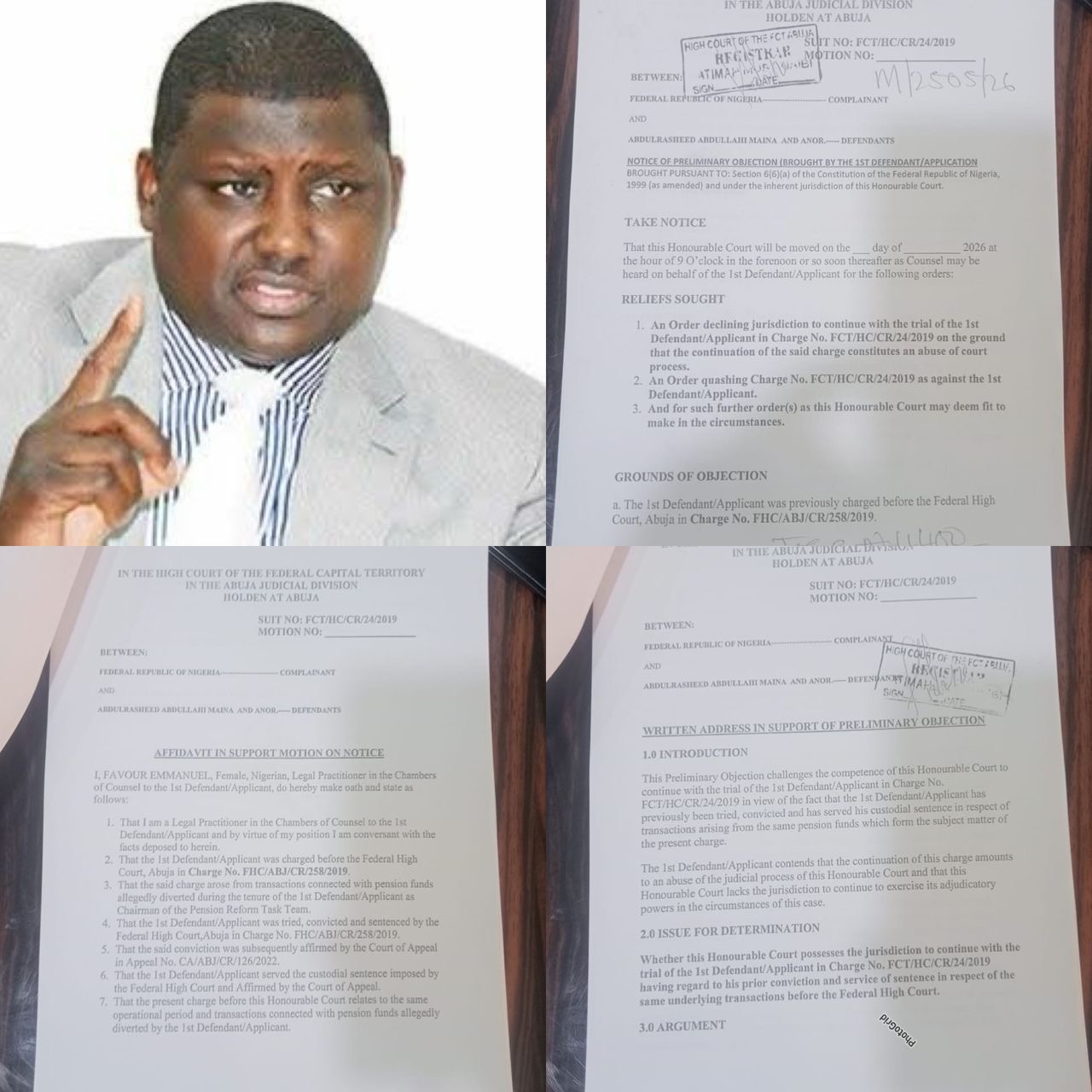
The Defence team representing the former Chairman of the Pension Reform Task Team (PRTT), Dr. Abdulrasheed Abdullahi Maina, has challenged the jurisdiction of the High Court of the Federal Capital Territory (FCT), Abuja, to continue proceedings in Charge No. FCT/HC/CR/24/2019, describing the ongoing prosecution as an abuse of court process.
This follows the filing of a Notice of Preliminary Objection by Counsel to the 1st Defendant, Mr. Emmanuel Umahi Ekwe, supported by an Affidavit and Written Address, urging the Court to decline jurisdiction and quash the charge against the 1st Defendant.
According to the processes filed before the Court, the Defence contends that the present charge arises from the same operational period and transactions relating to pension funds for which the 1st Defendant had previously been tried, convicted, and has served his custodial sentence pursuant to Charge No. FHC/ABJ/CR/258/2019 before the Federal High Court, Abuja.
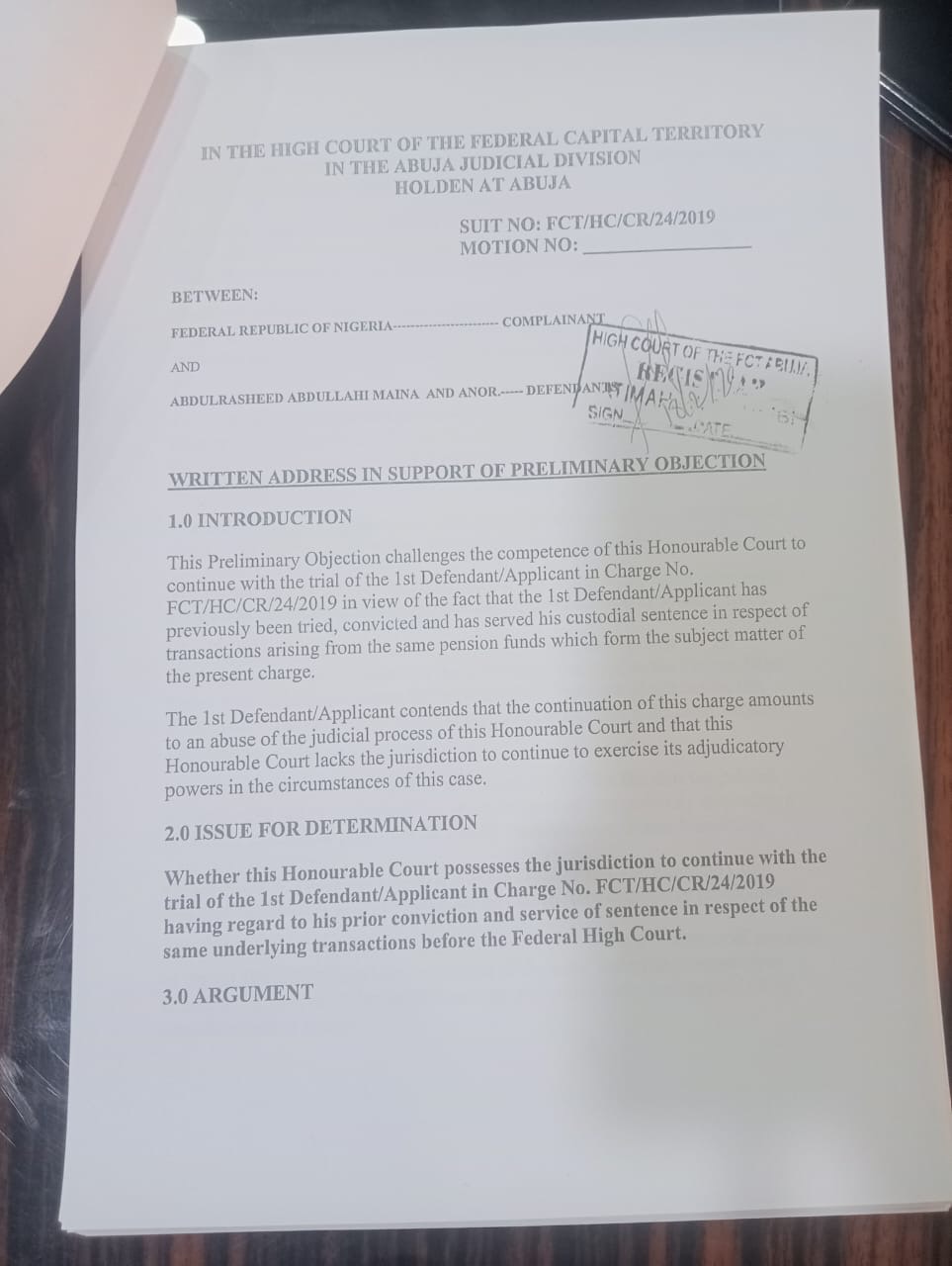
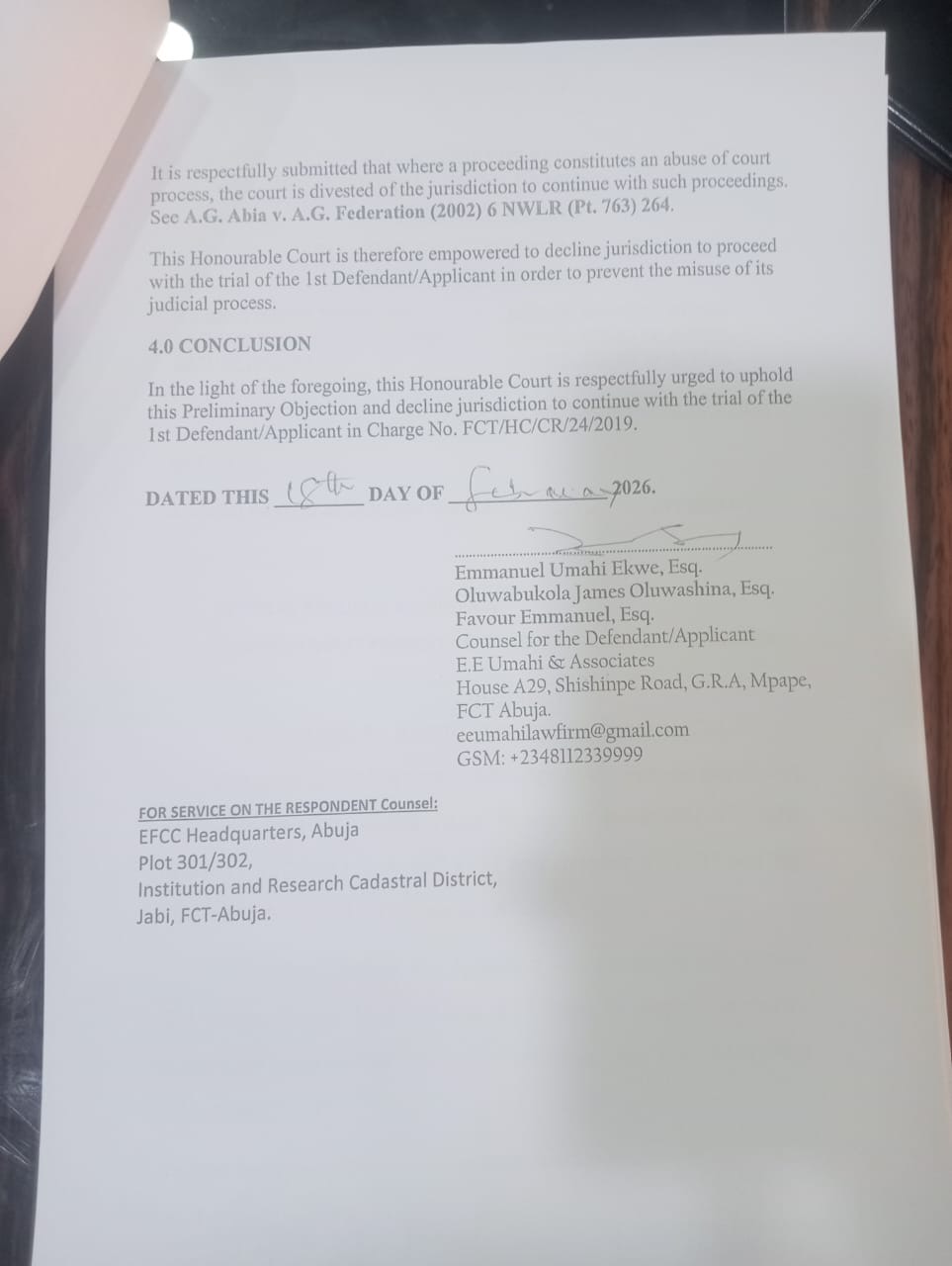
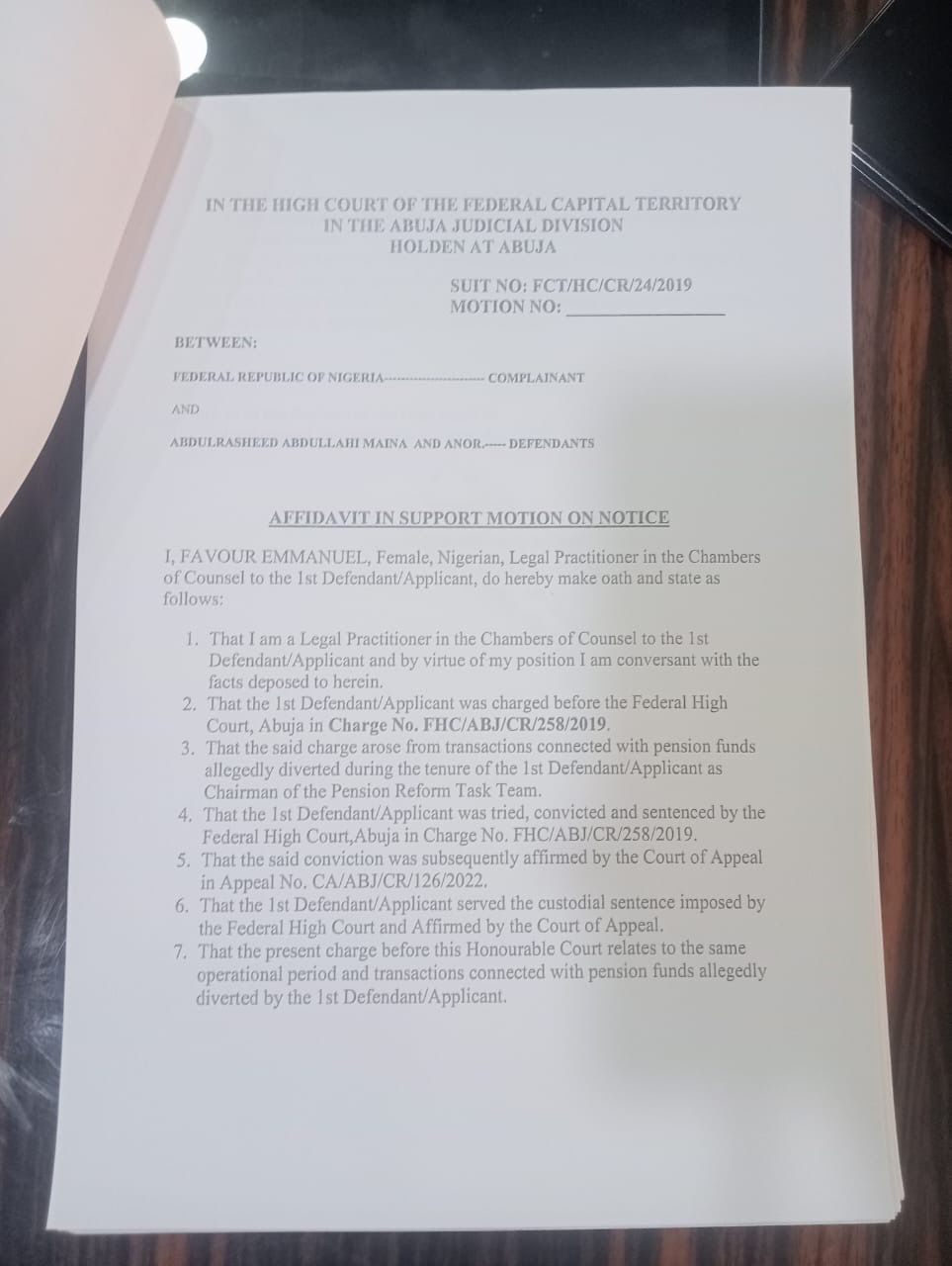
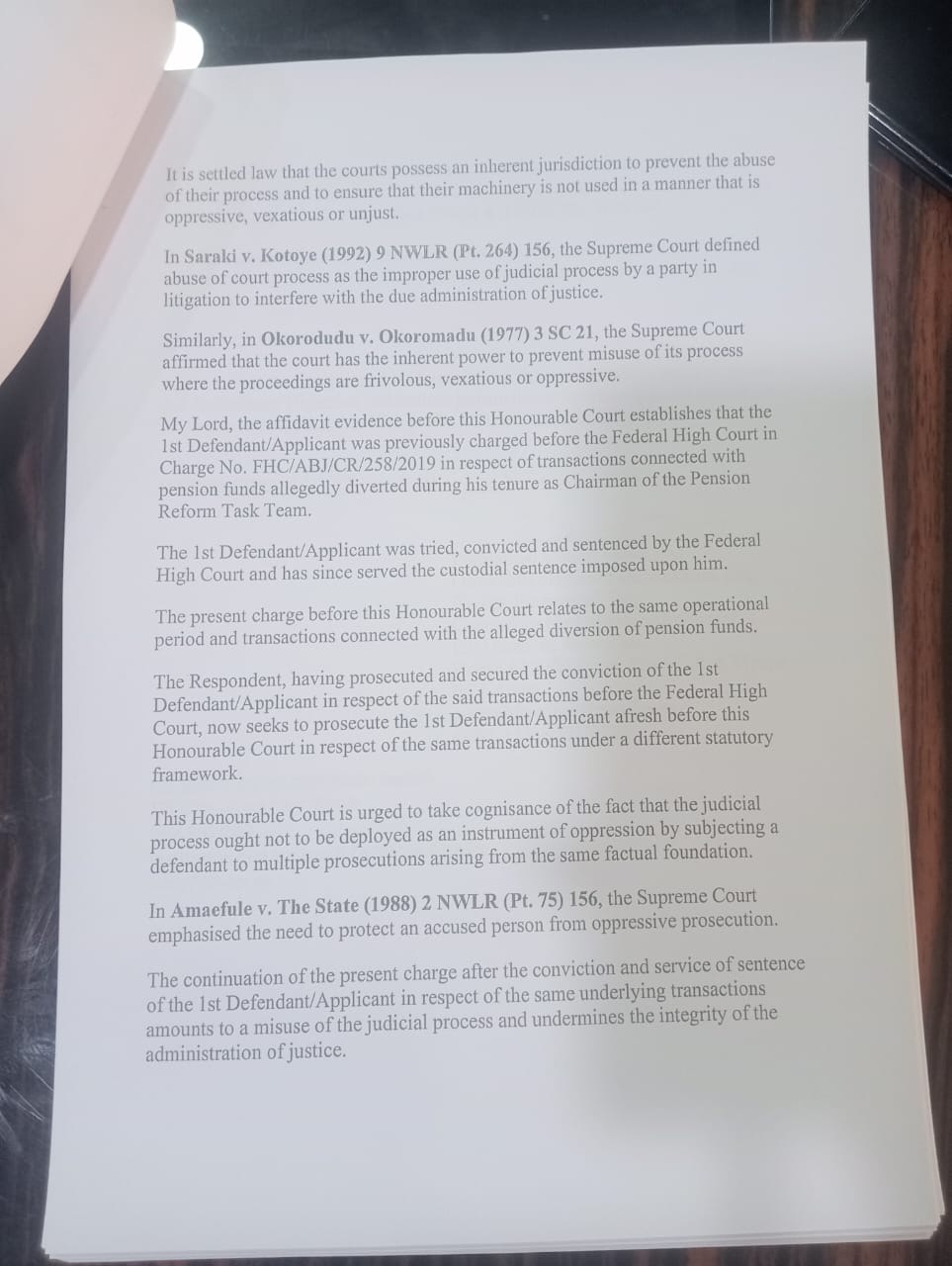
The Defence maintains that the continuation of the present proceedings after prior conviction and service of sentence in respect of the same underlying transactions amounts to multiple prosecutions arising from the same factual foundation and constitutes an abuse of court process.
In the Written Address filed in support of the objection, Counsel argued that where a proceeding constitutes an abuse of court process, the Court is divested of the jurisdiction to continue with such proceedings, and that the present charge ought to be quashed in its entirety.
The Defence further submitted that the Preliminary Objection raises a fundamental threshold issue as to the competence of the charge before the Court and urged the Court to determine same before taking any further steps in the proceedings so as to avoid subjecting the Defendant to multiple trials in respect of the same underlying transactions.
The Preliminary Objection filed by Counsel to the 1st Defendant reads in part: “An Order of this Honourable Court quashing Charge No. FCT/HC/CR/24/2019 for want of jurisdiction, the same constituting an abuse of court process having arisen from the same set of facts and transactions in respect of which the 1st Defendant had previously been tried, convicted and has served his custodial sentence.”
It further states that: “The continuation of the present charge against the 1st Defendant after prior conviction and service of sentence in respect of the same underlying transactions amounts to multiple prosecutions arising from the same factual foundation and renders the present proceedings incompetent.”
Reacting to recent media reports alleging that the 1st Defendant was evading court proceedings, Counsel to the 1st Defendant and Senior Special Assistant on Media and Protocols to Dr. Maina, Barr. Emmanuel Umahi Ekwe, described the publications as misleading and malicious, insisting that the matter currently being circulated in the media is the same case originally filed in 2019 which had already been heard and disposed of.
He further stated that the recent filing by another prosecuting counsel amounts to a duplication of a matter already adjudicated upon, which constitutes double jeopardy and an abuse of court process.
Barr. Ekwe also maintained that there was no refusal on the part of the 1st Defendant to attend court proceedings, stating that Dr. Maina is presently hospitalised — a fact known to the court — and for which medical documentation had been duly presented.
He added that the renewed proceedings coincided with recent public demands for accountability in respect of approximately ₦1.3 trillion in cash and about 227 properties allegedly recovered during pension reform recovery operations carried out during Dr. Maina’s tenure, and called on the Federal Government and relevant oversight institutions to conduct an independent forensic audit of all assets and funds recovered under the pension reform investigations.
The case has been adjourned to 26th February 2026 for continuation of trial-within-trial.

Journalists for Good Governance Shines Searchlight on Local Government Administration
…Calls for Accountability in Nigeria’s Grassroots Governance
LAGOS, Nigeria — A civil society coalition known as Journalists for Good Governance(JGG) has intensified public debate on transparency and accountability within Nigeria’s local government system, urging media professionals, civil society actors, and citizens to hold grassroots leaders accountable.
Speaking an event in Lagos recently, the acting chairman of the society, Comrade Bunmi Obarotimi said that despite reforms such as the Supreme Court’s 2024 ruling granting financial autonomy to all 774 Local Government Areas (LGAs), systemic challenges continues to hinder effective service delivery and responsible stewardship of public funds.
“Local governments are the closest tier of government to the people — yet too often they remain the least transparent. Without civic oversight and vibrant media, promises of autonomy ring hollow.” the acting chairman said.
The Journalist for Good Governance emphasised crucial roles that journalists can play in uncovering discrepancies in council spending, flagging poor service delivery, and educating citizens on their rights. Their call comes amid wider efforts by media and civic organisations to bridge accountability gaps. The civil society initiatives had previously launched monitoring campaigns to track local government expenditures and have been quietly advocating for transparency in how public money is deployed.
The leaders of the Journalists for Good Governance (JGG) highlighted the importance of physical assessment and citizens engagement on projects to boost people’s confidence, urging local councils to adopt open data platforms and proactive information dissemination in compliance with the Freedom of Information Act. Experts say the majority of LGAs currently lack operational websites or digital portals, further limiting public scrutiny.
The Journalists for Good Governance initiative aligns with sustained advocacy by civil society groups and governance experts calling for a collective approach to strengthening democratic accountability, and has decided to engage in critical and holistic assessments of how Local Governments is being run and the impact and quality of projects they embark-on and to address deficits in transparency and public trust.
Meanwhile, some state governments have signalled support for improved community engagement. In Lagos State, authorities reiterated a commitment to enhancing community media platforms as vehicles for civic participation and accountability at the grassroots level.
The renewed spotlight on local government administration has reignited public debate over fiscal responsibility and priorities. Controversies such as the widely criticised Adamawa council chairmen’s wives trip to Istanbul — which drew public outrage for perceived misuse of public funds — underscore why watchdog groups say stronger oversight mechanisms are urgently needed at the grassroots.
Citizens and activists have welcomed the journalists’ initiative, calling for sustained media engagement that goes beyond headlines to influence policy and accountability reform.
The civic rights advocates note that real change will require robust legal frameworks, a free press, and empowered communities equipped to demand transparency at every level of governance.
As Journalists for Good Governance mobilises its members, the coming months are likely to see heightened media attention on grassroots administration — from council budgets and service delivery to the enforcement of public information laws and digital transparency initiatives.


-

 celebrity radar - gossips7 months ago
Why Babangida’s Hilltop Home Became Nigeria’s Political “Mecca”
-
 society5 months ago
Religion: Africa’s Oldest Weapon of Enslavement and the Forgotten Truth
-

 society6 months ago
Power is a Loan, Not a Possession: The Sacred Duty of Planting People
-

 news7 months ago
THE APPOINTMENT OF WASIU AYINDE BY THE FEDERAL GOVERNMENT AS AN AMBASSADOR SOUNDS EMBARRASSING