
Business
‘Nobody died of Cerebro Spinal Meningitis disease in Lagos’ – Government debunks rumours

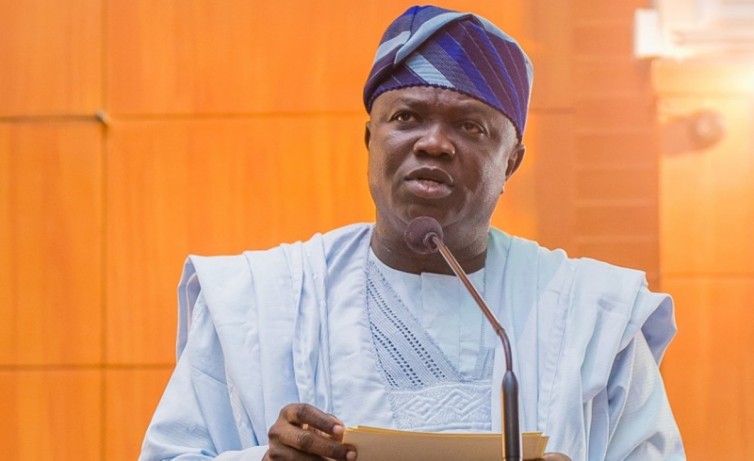

The Lagos state government has denied reports that two persons were recently killed by the epidemic Cerebro Spinal Meningitis disease that has claimed over 400 lives. The Nigeria Centre for Diseases Control (NCDC) on Friday released a statement claiming that three residents of the state had contacted the disease and that two of such persons have died from complications from the disease
The Lagos state Ministry of Health has however refuted this claim, stating that there is no truth to it. In a statement released by the Ministry’s director, public affairs, Adeola Salako, the state Commissioner of Health, Jide Idris says the report was false and capable of causing undue panic. According to Idris, the cases of Meningitis recorded in the state are the non-epidemic ones which is different from the strain of the disease that has killed over 400 persons in some states.
“The report is untrue and does not represent the reality of the situation in Lagos state as at today. For the avoidance of doubt, there are two main types of meningitis. The epidemic prone meningitis, which is referred to as cerebrospinal meningitis (CSM), is caused by a bacteria called neisseria meningitides. Its occurrence is seasonal or cyclical, depending on the level of herd immunity and climatic conditions. The second type of meningitis is non-epidemic meningitis, which is usually caused by a virus or other bacteria, but not by neisseria meningitides. The non-epidemic meningitis occurs without any seasonal pattern or periodicity.”
According to Idris, a disease surveillance notification officer in the Lagos Island local government, reported nine suspected cases of meningitis from Massey Street Children Hospital with two deaths in March this year. He said, however, that none of these was confirmed as due to CSM.
“Although, all the nine cases presented with clinical features of meningitis at that hospital, laboratory tests proved that they were either due to Haemophilus influenza or Streptococcus pneumoniae and not Neisseria meningitides. The ministry was also notified last week of a three-year-old boy, presenting clinically as meningitis at a registered private facility in Lagos, but the laboratory investigations did not confirm CSM. The blood culture yielded no growth but the urine culture yielded Klebsiella and not meningococcus; the patient is already responding to treatment. None of these cases, presented with a history of recent travel to any area with an outbreak of meningitis and neither were visits from such areas recorded with the aforementioned cases.’’
The commissioner urged all residents of the state to maintain a high level of hygiene during this period of the outbreak. According to him, such hygiene measures should include washing of hands with soap and water frequently and thoroughly.
“Also, avoid direct contact with the discharges from an infected person and covering of mouth and nose when coughing and sneezing. It is strongly advised that people should avoid overcrowding in living quarters, provide cross ventilation in sleeping and work-rooms and other places where many people come together. People should get vaccinated with CSM vaccine when they travel to areas where meningitis outbreaks have been reported’’ he said









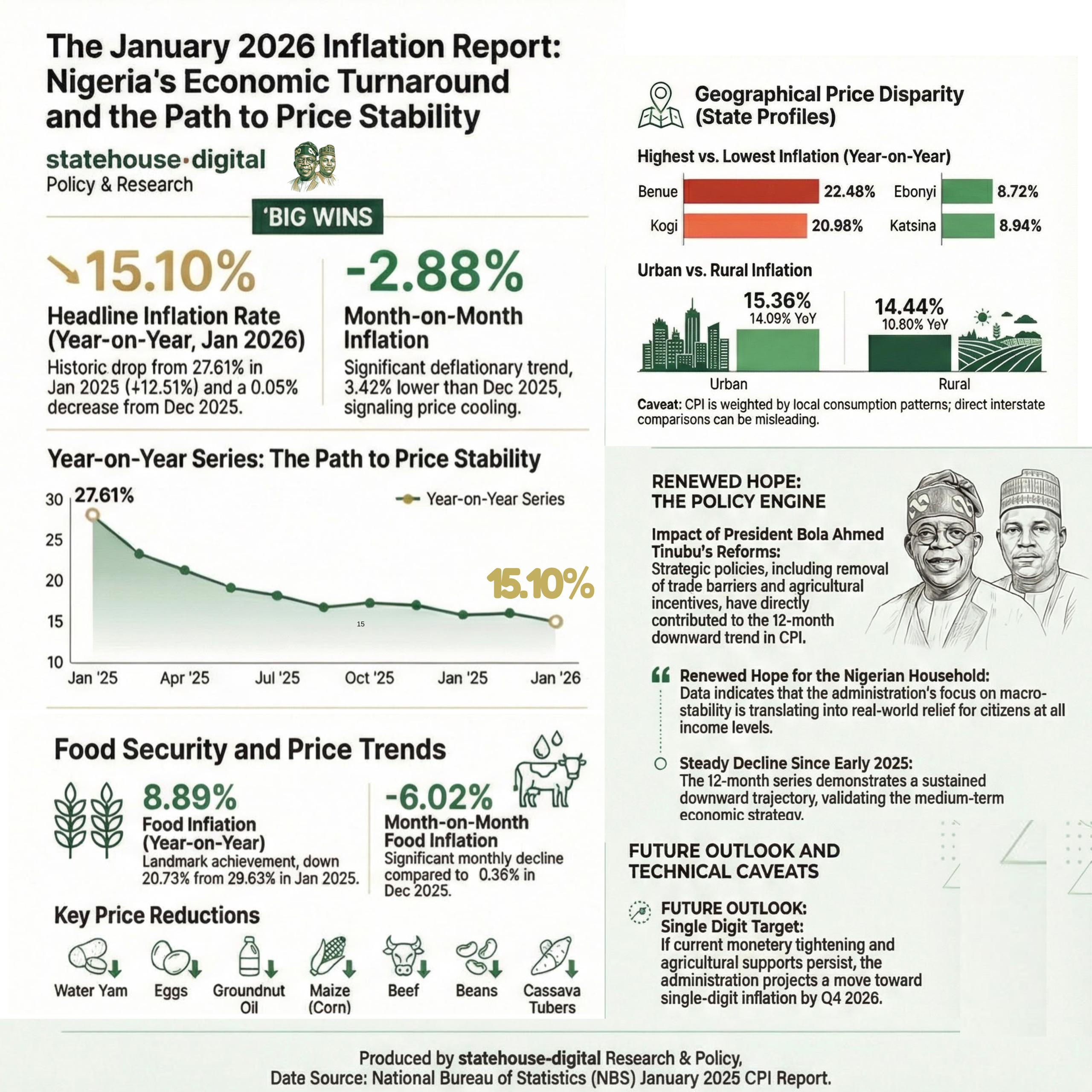
Nigeria’s headline inflation rate declined to 15.10 per cent in January 2026, marking a significant drop from 27.61 per cent recorded in January 2025, according to the latest Consumer Price Index (CPI) report released by the National Bureau of Statistics.
The report also showed that month-on-month inflation recorded a deflationary trend of –2.88 per cent, representing a 3.42 percentage-point decrease compared to December 2025. Analysts say the development signals easing price pressures across key sectors of the economy.
Food inflation stood at 8.89 per cent year-on-year, down from 29.63 per cent in January 2025. On a month-on-month basis, food prices declined by 6.02 per cent, reflecting lower costs in several staple commodities.
The data suggests a sustained downward trajectory in inflation over the past 12 months, pointing to improving macroeconomic stability.
The administration of President Bola Ahmed Tinubu has consistently attributed recent economic adjustments to ongoing fiscal and monetary reforms aimed at stabilising prices, boosting agricultural output, and strengthening domestic supply chains.
Economic analysts note that while the latest figures indicate progress, sustaining the downward trend will depend on continued policy discipline, exchange rate stability, and improvements in food production and distribution.
The January report provides one of the clearest indications yet that inflationary pressures, which surged in early 2025, may be moderating.

Alpha Morgan to Host 19th Economic Review Webinar
In an economy shaped by constant shifts, the edge often belongs to those with the right information.
On Wednesday, February 25, 2026, Alpha Morgan Bank will host the 19th edition of its Economic Review Webinar, a high-level thought leadership session designed to equip businesses, investors, and individuals with timely financial and economic insight.
The session, which will hold live on Zoom at 10:00am WAT and will feature economist Bismarck Rewane, who will examine the key signals influencing Nigeria’s economic direction in 2026, including policy trends, market movements, and global developments shaping the local landscape.
With a consistent track record of delivering clarity in uncertain times, the Alpha Morgan Economic Review continues to provide practical context for decision-making in a dynamic environment.
Registration for the 19th Alpha Morgan Economic Review is free and can be completed via https://bit.ly/registeramerseries19
It is a bi-monthly platform that is open to the public and is held virtually.
Visit www.alphamorganbank to know more.
GTBank Launches Quick Airtime Loan at 2.95%
Guaranty Trust Bank Ltd (GTBank), the flagship banking franchise of GTCO Plc, Africa’s leading financial services group, today announced the launch of Quick Airtime Loan, an innovative digital solution that gives customers instant access to airtime when they run out of call credit and have limited funds in their bank accounts, ensuring customers can stay connected when it matters most.
In today’s always-on world, running out of airtime is more than a minor inconvenience. It can mean missed opportunities, disrupted plans, and lost connections, often at the very moment when funds are tight, and options are limited. Quick Airtime Loan was created to solve this problem, offering customers instant access to airtime on credit, directly from their bank. With Quick Airtime Loan, eligible GTBank customers can access from ₦100 and up to ₦10,000 by dialing *737*90#. Available across all major mobile networks in Nigeria, the service will soon expand to include data loans, further strengthening its proposition as a reliable on-demand platform.
For years, the airtime credit market has been dominated by Telcos, where charges for this service are at 15%. GTBank is now changing the narrative by offering a customer-centric, bank-led digital alternative priced at 2.95%. Built on transparency, convenience and affordability, Quick Airtime Loan has the potential to broaden access to airtime, deliver meaningful cost savings for millions of Nigerians, and redefine how financial services show up in everyday life, not just in banking moments.
Commenting on the product launch, Miriam Olusanya, Managing Director of Guaranty Trust Bank Ltd, said: “Quick Airtime Loan reflects GTBank’s continued focus on delivering digital solutions that are relevant, accessible, and built around real customer needs. The solution underscores the power of a connected financial ecosystem, combining GTBank’s digital reach and lending expertise with the capabilities of HabariPay to deliver a smooth, end-to-end experience. By leveraging unique strengths across the Group, we are able to accelerate innovation, strengthen execution, and deliver a more integrated customer experience across all our service channels.”
Importantly, Quick Airtime Loan highlights GTCO’s evolution as a fully diversified financial services group. Leveraging HabariPay’s Squad, the solution reinforces the Group’s ecosystem proposition by bringing together banking, payment technology, and digital channels to deliver intuitive, one-stop experiences for customers.
With this new product launch, Guaranty Trust Bank is extending its legacy of pioneering digital-first solutions that have redefined customer access to financial services across the industry, building on the proven strength of its widely adopted QuickCredit offering and the convenience of the Bank’s iconic *737# USSD Banking platform.
About Guaranty Trust Bank
Guaranty Trust Bank (GTBank) is the flagship banking franchise of GTCO Plc, a leading financial services group with a strong presence across Africa and the United Kingdom. The Bank is widely recognized for its leadership in digital banking, customer experience, and innovative financial solutions that deliver value to individuals, businesses, and communities.
About HabariPay
HabariPay is the payments fintech subsidiary of GTCO Plc, focused on enabling fast, secure, and accessible digital payments for individuals and businesses. By integrating payments and digital technology, HabariPay supports innovative services that make everyday financial interactions simpler and more seamless.
Enquiries:
GTCO
Group Corporate Communication
[email protected]
+234-1-2715227
www.gtcoplc.com


-

 celebrity radar - gossips6 months ago
Why Babangida’s Hilltop Home Became Nigeria’s Political “Mecca”
-

 society6 months ago
Power is a Loan, Not a Possession: The Sacred Duty of Planting People
-

 society5 months ago
Religion: Africa’s Oldest Weapon of Enslavement and the Forgotten Truth
-

 news6 months ago
THE APPOINTMENT OF WASIU AYINDE BY THE FEDERAL GOVERNMENT AS AN AMBASSADOR SOUNDS EMBARRASSING
You must be logged in to post a comment Login