
Business
University Dons Proffer Solutions to Africa’s Economic Prosperity at the UBA Professorial Lecture

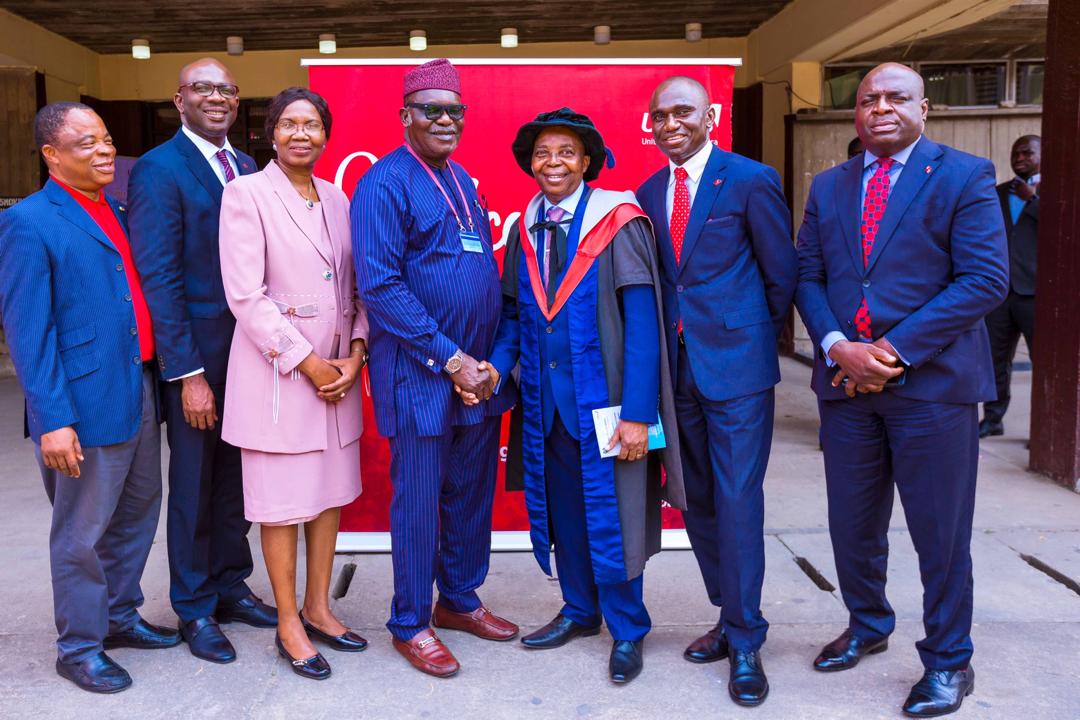
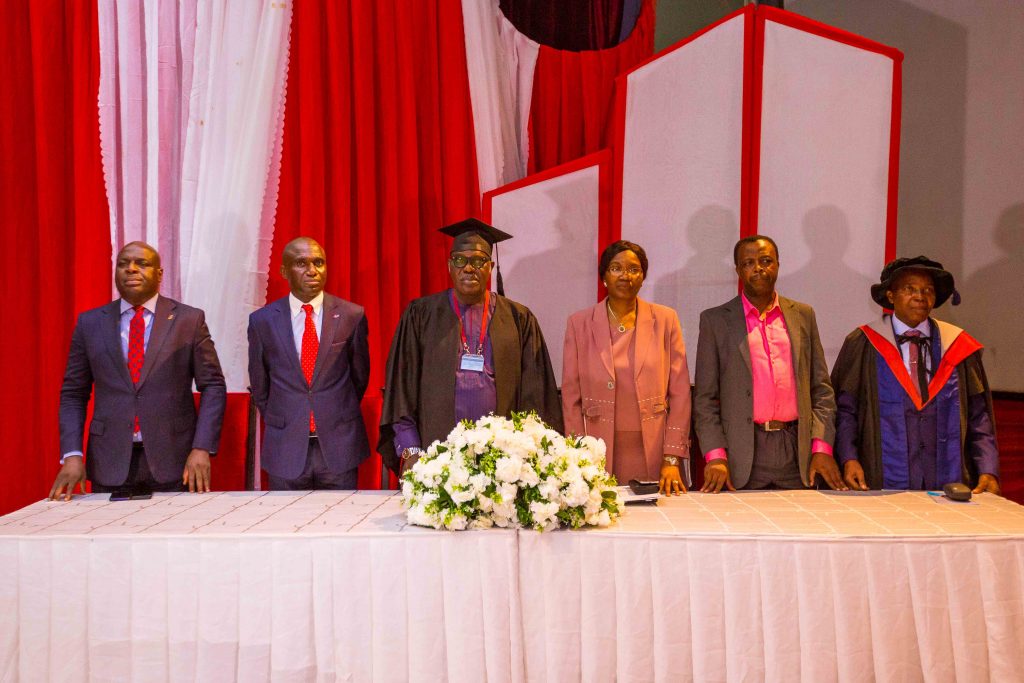
Intellectuals and leading minds across Africa have suggested the adoption by governments, of strategic policy actions which are expected to ultimately lead to the economic prosperity of the continent.
The Academics who spoke during the first Lecture Series of the UBA Professorial Chair in Finance at the University of Lagos (UNILAG) on Tuesday, listed a number of policy measures and strategies that can bring about far reaching results. These include instituting stable macro-economic policies, the adoption of supply-side strategies, capital market development, enhancement of banking and financial system, liberalisation of the economy, privatisation and reduced government dominance of economic management, democracy and good governance, human capital development, policy co-ordination and enabling the multilateral environment.
These polices are capable of creating a sustainable path towards the socio-cultural, economic and political development of the continent.
The Professor of Finance and Chairman, UBA Professorial Chair, University of Lagos( UNILAG) Prof John Ezike was joined by the Head of Department, Economics, UNILAG, Professor Risikat Dauda and Senior Lecturer, Finance Department UNILAG, Dr Olalekan Obademi as they took turns in making contributions on the theme ‘The Dynamic Structure of World Economy from Globalisation To Slowbalisation; The African Dilemma’.
Ezike who led the discourse, explained that the global economy is currently witnessing the fourth wave of revolution in civilisation, which is the movement towards de-globalisation or Slobalisation, adding that countries that have not benefitted from globalisation are those that fail to implement sound macroeconomic measures to maintain financial and exchange stability.
He said, “It behoves countries in sub Saharan –Africa, therefore, to strive to adopt policies that are in consonance with the realities of the rapid integration of world economies. The world must seek for answers in a new ideology which will allow globalisation to prosper faster, but prevents the rise of elitism. In point of fact, some world leaders are already of this view as they have condemned the trickledown theory of capitalism.”
Supporting his point, Professor Ezike shed light on how the mentioned policies can take the continent to a new high. On Stable Macroeconomic Policies, he explained that Globalisation increases the cost of macroeconomic distortions while enhancing the reward for sound policies. “As a result, it is important that sound macroeconomic, sectorial and structural policies are applied to improve internal balance, ensure external sector viability and increase the overall rate of economic growth”. Stable macroeconomic policies also ensure that the domestic economy is insulated from disruptive short term capital flows as investment savings decisions would be predicated on domestic economic fundamentals rather than market sentiments that may be unrelated to developments in the economy.
While explaining Capital Market Development, he explained that the capital market should be developed before opening it to international competition. He further noted that the gradual opening up of the capital market would help to reduce the influx of destabilising short term capital flows which in some cases may result in economic overheating. To avoid unintended developments, the capital market should be opened up gradually after adequate safeguards have been put in place and productive sectors have been strengthened.
Enhancing of the Banking and Financial System: In this case, he said the banking and financial systems needs to be strengthened through adequate supervisory and prudential regulations to ensure that internationalisation does not disrupt the financial sectors, precipitate macroeconomic instability and weaken the productive sectors of the economy.
For Democracy and good governance, Ezike noted that good governance is invaluable for a prosperous economy and that the rule of law, transparency and accountability, the bedrock of public administration prevails. He added that, it is worthy to note that excessive government intervention in economic management creates a fertile ground for corruption and rent seeking agencies. “A well-focused administration geared towards reducing bottlenecks on the path of the private sector, would generate adequate impetus for the acceleration of economic growth, he concluded, saying rule of law reduces the incentives for corruption and ultimately creates an enabling environment for the efficient allocation of resources through the free interplay of market forces”.
According to him, history has shown that it is difficult or near impossible to sufficiently gain sustain growth in an economy like Nigeria which is highly multi-ethnic, has diverse parts, but is highly dependent on a mono-product export resource.
“At this juncture, it is safe to say Nigeria and other countries in its league, must out of necessity enthrone true federalism, in its governance and diversify its economic and export base in order to reposition the economy so as to reap the attendant benefits of dynamic world globalisation/slobalisation”, she noted
On his part, the Deputy Vice Chancellor, and Chairman UBA Board of Trustees, Mr. Ben Oghojafor, appreciated UBA for resuscitating the UBA Professorial Chair of Finance and the laudable support it continues to give the institution.
UBA had in 2015 resuscitated the UBA Professorial Chair of Finance at the UNILAG with an endowment sum of the N52.9 million with the aim of bridging the huge gap in the funding of educational system in the country.
Oghojafor said, “It is to the credit of UBA, that the seed they planted through the first endowment has grown and is now bearing fruit. It is on record that the first endowment in 1972 facilitated the establishment of the department of finance in 1973, the first of such department in Finance in any University in Nigeria and has helped train a great number of finance graduates who have gone on to make great impacts in the country”.
“We appreciate the generosity of UBA in helping to make this colloquium a reality today and are hopeful that the bank will sustain this noble initiative for a long time to come”, Oghojafor said.
In his response, Group Managing Director, Kennedy Uzoka, United Bank for Africa, represented by Head, Micro-small, Small and Medium Enterprises (MSMEs),Mr Babatunde Ajayi said: “UBA is very proud to be associated with the endowment of professorial chair of finance in University of Lagos and it is our plan to continue to endow that chair”. He also noted that it is the banks passion to improve the quality of education across the continent, particularly in the 20 African countries that the bank is present.
“It is also our way of giving back to the society, as we will continue to sustain the initiative and many more that concern education, because it is very important to UBA and we are more than committed to providing the necessary support for the youths in Nigeria and across the African continent,” Ajayi said








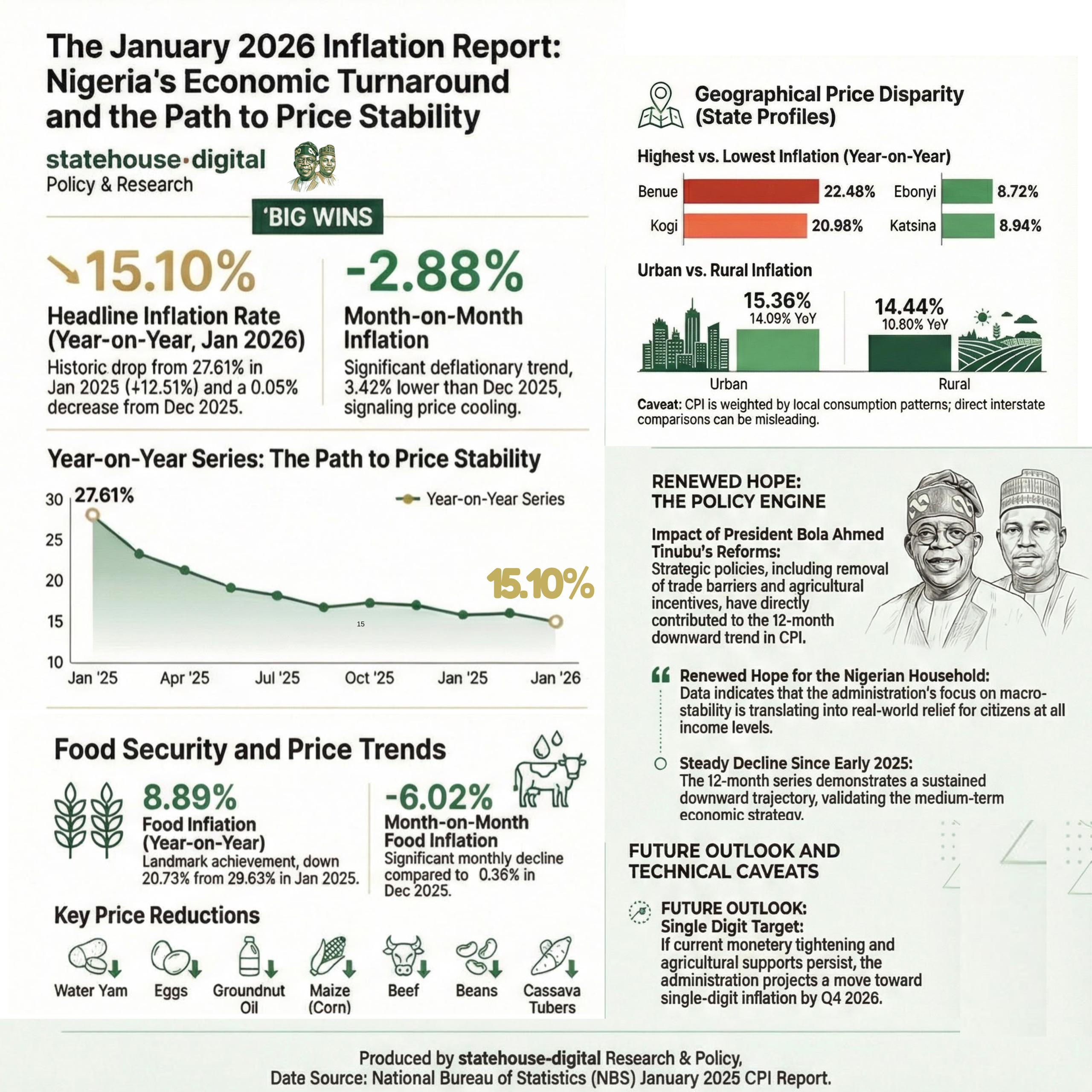
Nigeria’s headline inflation rate declined to 15.10 per cent in January 2026, marking a significant drop from 27.61 per cent recorded in January 2025, according to the latest Consumer Price Index (CPI) report released by the National Bureau of Statistics.
The report also showed that month-on-month inflation recorded a deflationary trend of –2.88 per cent, representing a 3.42 percentage-point decrease compared to December 2025. Analysts say the development signals easing price pressures across key sectors of the economy.
Food inflation stood at 8.89 per cent year-on-year, down from 29.63 per cent in January 2025. On a month-on-month basis, food prices declined by 6.02 per cent, reflecting lower costs in several staple commodities.
The data suggests a sustained downward trajectory in inflation over the past 12 months, pointing to improving macroeconomic stability.
The administration of President Bola Ahmed Tinubu has consistently attributed recent economic adjustments to ongoing fiscal and monetary reforms aimed at stabilising prices, boosting agricultural output, and strengthening domestic supply chains.
Economic analysts note that while the latest figures indicate progress, sustaining the downward trend will depend on continued policy discipline, exchange rate stability, and improvements in food production and distribution.
The January report provides one of the clearest indications yet that inflationary pressures, which surged in early 2025, may be moderating.
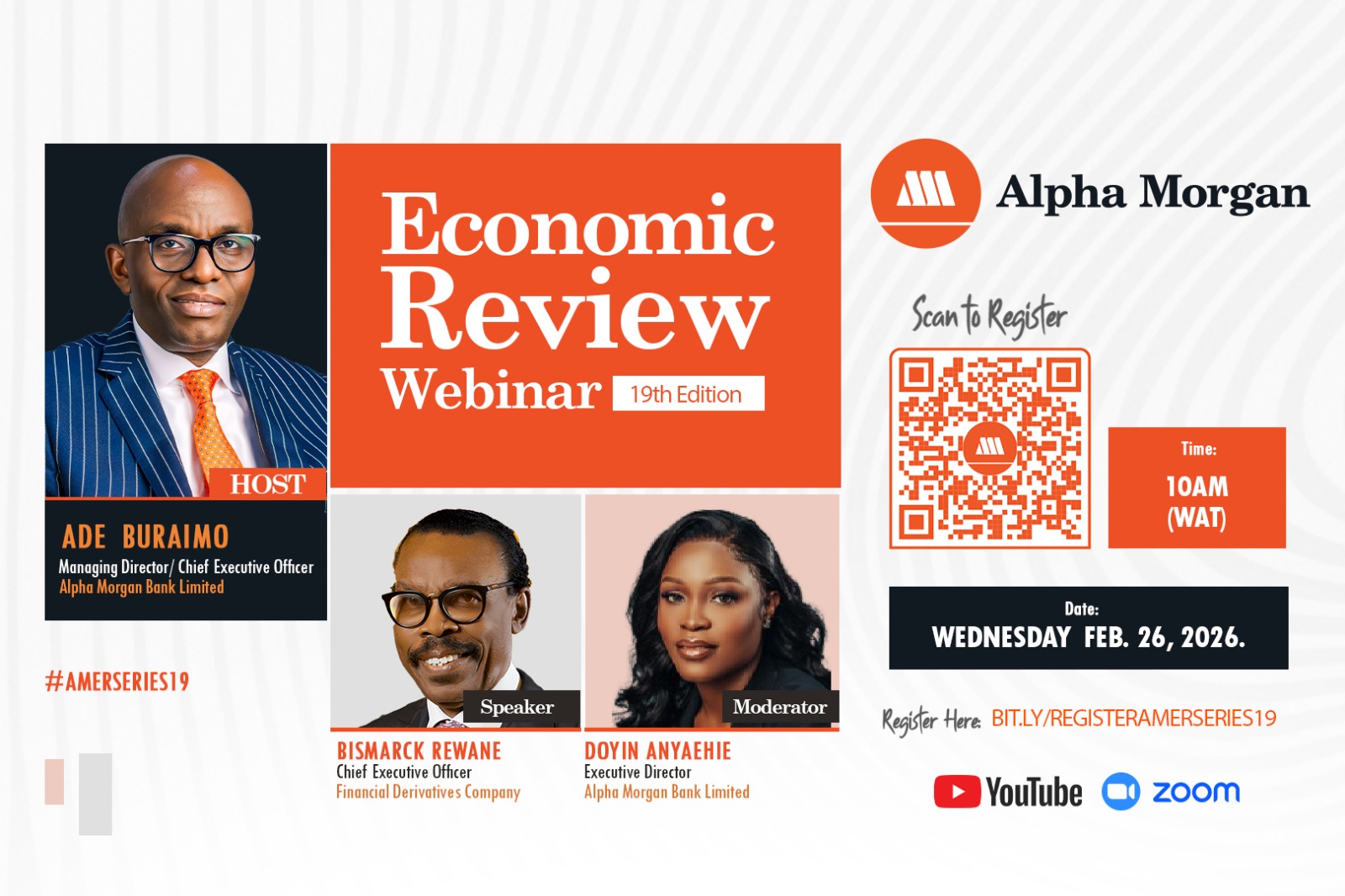
Alpha Morgan to Host 19th Economic Review Webinar
In an economy shaped by constant shifts, the edge often belongs to those with the right information.
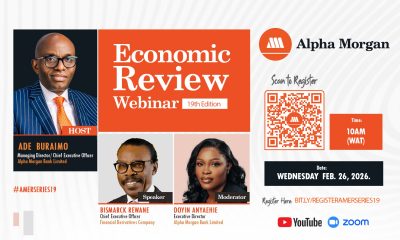
On Wednesday, February 25, 2026, Alpha Morgan Bank will host the 19th edition of its Economic Review Webinar, a high-level thought leadership session designed to equip businesses, investors, and individuals with timely financial and economic insight.
The session, which will hold live on Zoom at 10:00am WAT and will feature economist Bismarck Rewane, who will examine the key signals influencing Nigeria’s economic direction in 2026, including policy trends, market movements, and global developments shaping the local landscape.
With a consistent track record of delivering clarity in uncertain times, the Alpha Morgan Economic Review continues to provide practical context for decision-making in a dynamic environment.
Registration for the 19th Alpha Morgan Economic Review is free and can be completed via https://bit.ly/registeramerseries19
It is a bi-monthly platform that is open to the public and is held virtually.
Visit www.alphamorganbank to know more.
GTBank Launches Quick Airtime Loan at 2.95%
Guaranty Trust Bank Ltd (GTBank), the flagship banking franchise of GTCO Plc, Africa’s leading financial services group, today announced the launch of Quick Airtime Loan, an innovative digital solution that gives customers instant access to airtime when they run out of call credit and have limited funds in their bank accounts, ensuring customers can stay connected when it matters most.
In today’s always-on world, running out of airtime is more than a minor inconvenience. It can mean missed opportunities, disrupted plans, and lost connections, often at the very moment when funds are tight, and options are limited. Quick Airtime Loan was created to solve this problem, offering customers instant access to airtime on credit, directly from their bank. With Quick Airtime Loan, eligible GTBank customers can access from ₦100 and up to ₦10,000 by dialing *737*90#. Available across all major mobile networks in Nigeria, the service will soon expand to include data loans, further strengthening its proposition as a reliable on-demand platform.
For years, the airtime credit market has been dominated by Telcos, where charges for this service are at 15%. GTBank is now changing the narrative by offering a customer-centric, bank-led digital alternative priced at 2.95%. Built on transparency, convenience and affordability, Quick Airtime Loan has the potential to broaden access to airtime, deliver meaningful cost savings for millions of Nigerians, and redefine how financial services show up in everyday life, not just in banking moments.
Commenting on the product launch, Miriam Olusanya, Managing Director of Guaranty Trust Bank Ltd, said: “Quick Airtime Loan reflects GTBank’s continued focus on delivering digital solutions that are relevant, accessible, and built around real customer needs. The solution underscores the power of a connected financial ecosystem, combining GTBank’s digital reach and lending expertise with the capabilities of HabariPay to deliver a smooth, end-to-end experience. By leveraging unique strengths across the Group, we are able to accelerate innovation, strengthen execution, and deliver a more integrated customer experience across all our service channels.”
Importantly, Quick Airtime Loan highlights GTCO’s evolution as a fully diversified financial services group. Leveraging HabariPay’s Squad, the solution reinforces the Group’s ecosystem proposition by bringing together banking, payment technology, and digital channels to deliver intuitive, one-stop experiences for customers.
With this new product launch, Guaranty Trust Bank is extending its legacy of pioneering digital-first solutions that have redefined customer access to financial services across the industry, building on the proven strength of its widely adopted QuickCredit offering and the convenience of the Bank’s iconic *737# USSD Banking platform.
About Guaranty Trust Bank
Guaranty Trust Bank (GTBank) is the flagship banking franchise of GTCO Plc, a leading financial services group with a strong presence across Africa and the United Kingdom. The Bank is widely recognized for its leadership in digital banking, customer experience, and innovative financial solutions that deliver value to individuals, businesses, and communities.
About HabariPay
HabariPay is the payments fintech subsidiary of GTCO Plc, focused on enabling fast, secure, and accessible digital payments for individuals and businesses. By integrating payments and digital technology, HabariPay supports innovative services that make everyday financial interactions simpler and more seamless.
Enquiries:
GTCO
Group Corporate Communication
[email protected]
+234-1-2715227
www.gtcoplc.com


-

 celebrity radar - gossips6 months ago
Why Babangida’s Hilltop Home Became Nigeria’s Political “Mecca”
-

 society6 months ago
Power is a Loan, Not a Possession: The Sacred Duty of Planting People
-

 society5 months ago
Religion: Africa’s Oldest Weapon of Enslavement and the Forgotten Truth
-

 news6 months ago
THE APPOINTMENT OF WASIU AYINDE BY THE FEDERAL GOVERNMENT AS AN AMBASSADOR SOUNDS EMBARRASSING
You must be logged in to post a comment Login