
Bank
Sterling Premieres Anthology of Nigerian Literature with Farafina


Sterling Premieres Anthology of Nigerian Literature with Farafina
Sterling Bank Plc has collaborated with Farafina Books, Nigeria’s leading independent literary publishers, to launch a premier anthology of the best of Nigerian writings spanning 200 years, from 1789 to 2018.
The anthology, titled: “A Possible Future,” was curated to preserve the gems of Nigeria’s literary history, promote a reading culture in the country as well as to support featured authors in the distribution of their timeless books. The 411-page book features some of the best works of 46 literary authors in the country.
Featured authors include Olaudah Equiano, D.O. Fagunwa, Gabriel Okara, Cyprian Ekwensi, Obotunde Ijimere, Chinua Achebe, Duro Ladipo, Chukwuemeka Ike, Christopher Okigbo, Elechi Amadi, Wole Soyinka, Ola Rotimi, J.P. Clark-Bekederemo, Ken Saro-Wiwa, Isidore Okpewho, Mobolaji Adenubi, Buchi Emecheta, Femi Osofisan, Niyi Osundare, Tanure Ojaide, Odia Ofeimun and Ben Okri.
Others are Uzor Maxim Uzoatu, Dulue Mbachu, Ikeogu Oke, Biyi Bandele, Sarah Ladipo Manyika, Aisha Osori, Omolola Ijeoma Ogunyemi, Yemisi Aribisala, Lola Shoneyin, Teju Cole, Yejide Kilanko, Eghosa Imasuen, Chimamanda Ngozi Adichie, Niran Okewole, A. Igoni Barret, Abubakar Adam Ibrahim, Taiye Selasi, Jowhor Ile, Tope Folarin, Lesley Nneka Arimah, Helen Oyeyemi, Uche Okonkwo, Gbenga Adesina and Wale Lawal.
Addressing lovers of literature, authors, influencers, and other stakeholders at the event, Mr. Abubakar Suleiman, Chief Executive of Sterling Bank said the institution decided to collaborate with Farafina on the project because ensuring continued literacy, being a key component of education, is in line with the education component of the bank’s HEART strategy. The other sectors are health, agriculture, renewable energy, and transportation.
He said besides this, the Bank has for some time now been supporting the literary arts through the Ake Arts and Books Festival, an initiative of the Book Buzz Foundation, which is driven by Lola Shoneyin, an award-winning writer and poet among others.
Also, in the foreword to the book, Mr. Suleiman noted that, “In the long stretch of time between 1947 when Professor Molly Mahood declared that Nigeria, at the time, had no literature and today, the country’s literary tradition has established itself as a force in the world.
“This is not to agree with Mahood that Nigerian literature is only as old as British involvement in the country’s affairs. In fact, by the time British colonialism invaded the geographical space that would later become Nigeria, there was already a deep-rooted literary tradition in the north of the region going as far back as the 15th century. So, we had literature long before we practiced the art in the colonial tongue.”
He said, “Modern Nigerian literature may have been ‘founded’ by the English based on an assumption – a falsehood, in fact – but the lie does not have to hold any longer. When we decided to believe in ‘A Possible Future,’ we did so with the understanding that Nigerian literature was already of age. While its story is still unfolding and the yardage of its potential still vast, nay infinite, the baby Emecheta, Nwapa and Tutuola once nurtured in verse, prose and on stage, no longer crawls.
A possible Future is a primer for anyone – and I cannot imagine who, in this age – just getting introduced to Nigerian literature.”
According to him, “Kachifo Limited and Farafina Trust have created a definitive, yet not conclusive text that summarises our literary journey and gestures to its destination. The details of which we do not know yet except that, in that future, everything is excellent, anything is possible and we are here for it.”
The Sterling Bank CEO also read excerpts from Arrow of God by Chinua Achebe, which featured on pages 41 to 42 of the anthology. Temilade Aina, a lietrature curator, took the second reading from the works of Biyi Bandele’s Burma Boy.
The event also featured a panel session made up of Professor Niyi Osundare, Eghosa Imasuen, A. Igoni Barrett, Wale Lawal and Temilade Aina. The session was moderated by Faniyi Kayode, a writer, book critic and editor.
The panel commended the anthology and described it as a premier national work and expressed the hope that subsequent ones will accommodate the works of other writers which are not covered now.






Alpha Morgan to Host 19th Economic Review Webinar
In an economy shaped by constant shifts, the edge often belongs to those with the right information.
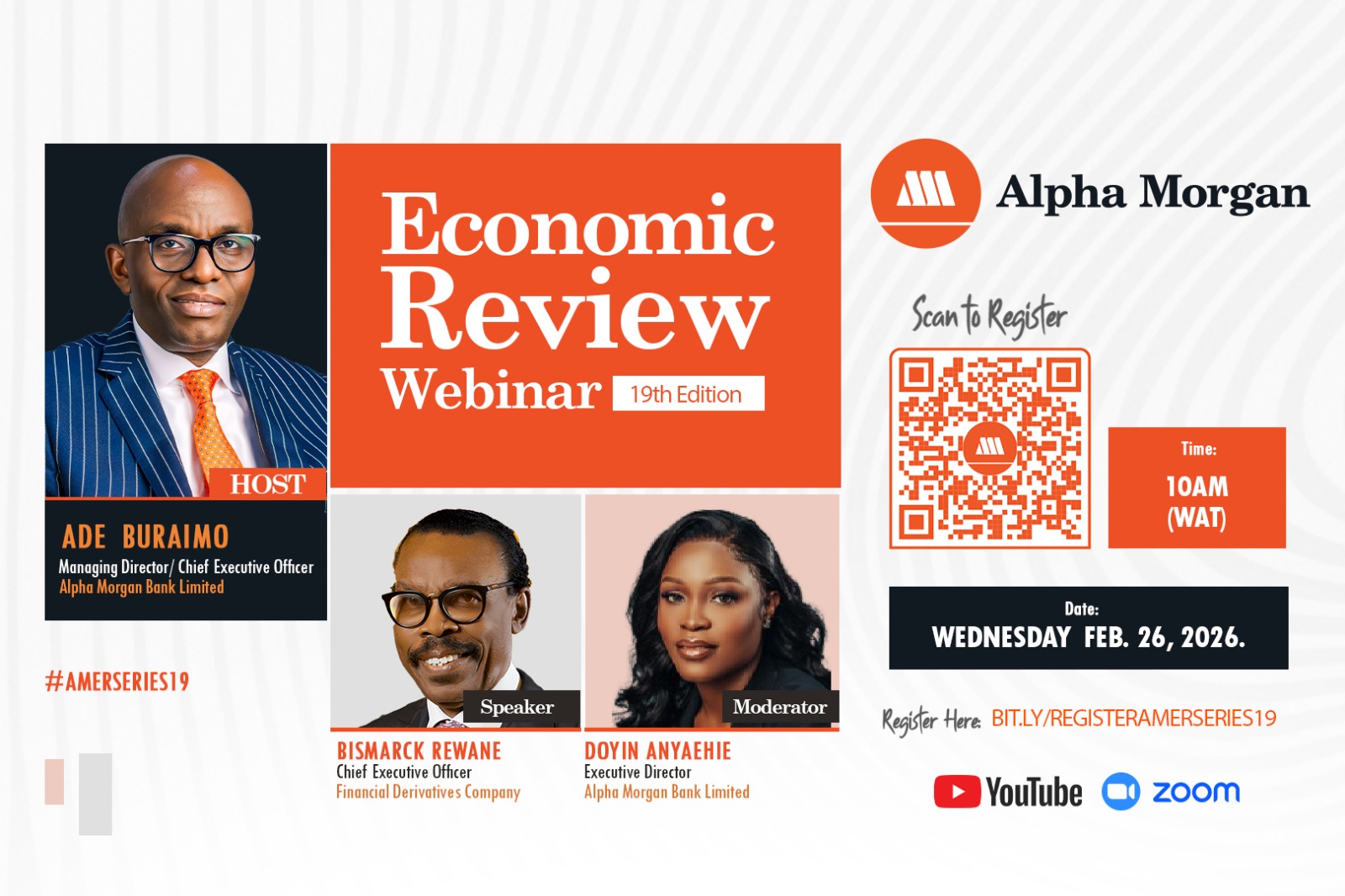
On Wednesday, February 25, 2026, Alpha Morgan Bank will host the 19th edition of its Economic Review Webinar, a high-level thought leadership session designed to equip businesses, investors, and individuals with timely financial and economic insight.
The session, which will hold live on Zoom at 10:00am WAT and will feature economist Bismarck Rewane, who will examine the key signals influencing Nigeria’s economic direction in 2026, including policy trends, market movements, and global developments shaping the local landscape.
With a consistent track record of delivering clarity in uncertain times, the Alpha Morgan Economic Review continues to provide practical context for decision-making in a dynamic environment.
Registration for the 19th Alpha Morgan Economic Review is free and can be completed via https://bit.ly/registeramerseries19
It is a bi-monthly platform that is open to the public and is held virtually.
Visit www.alphamorganbank to know more.
Bank
Separating Fact from Confusion: What Nigerians Need to Know About the 7.5% VAT on Banking Service Fees

In recent weeks, digital-banking customers and social media, especially on Twitter have raised concerns about deductions labelled as “VAT” on transfers and other charges.
Some dangerously false narratives, which when you take a critical look, you’ll clearly see that they have been orchestrated and sponsored by malicious elements, have given the impression that the 7.5% Value Added Tax (VAT) is a new or arbitrary charge introduced by fintechs, or that it applies to the amounts customers send. These claims are misleading and deserve careful clarification which is the purpose of this piece.
First, it’s important to understand how VAT works in Nigeria’s financial sector today. VAT on fees and charges for financial services has long been part of Nigeria’s tax system. The then Federal Inland Revenue Service (FIRS) had issued information circulars on March 31, 2021 where it stated that VAT on Financial Services (Circular No. 2021/04) that most fees, commissions, and charges by financial institutions (banks, insurance companies, brokers) are subject to 7.5% VAT.
This justifies a recent advertorial the Nigeria Revenue Service (NRS) which stated unequivocally that VAT was not newly introduced on banking service charges by recent tax reforms, and that it did not impose a new tax obligation on customers in that regard.
However what was left unsaid in that publication was that on the 12th of December, the tax agency had written to all financial institutions and payment gateways based on past meetings with operators that following from the new Tax Act, they were reminded of their mandatory obligations to collect, deduct and remit VAT at the prescribed rate.
The Agency then gave an 18- day grace period to all players to configure and align their systems while directing full compliance with the directive with effect from January 19, 2026. And so, some fintechs sent messages to their customers in the spirit of clarity and transparency.
It must be said that what has changed is that in a bid to widen the tax net, microfinance banks and fintechs who were not obligated to deduct and remit said VAT before now, have now become compelled to do so. The enforcement and standardised collection of VAT across banks and fintech platforms including mobile transfers, USSD transaction fees, and card issuance fees with compliance deadlines issued by tax authorities. So why anyone would vilify any financial institution obeying the laws of the land beats my imagination.
For those who have raised questions around transparency and wrongly suggesting that fintechs are suddenly imposing new, unexplained costs on users – as it has been explained above, this is a matter of regulatory compliance, not a lack of transparency or customer exploitation. These VAT deductions are not new fees created by the companies themselves, and providers are not arbitrarily raising their prices.
In closing, two things that everyone must bear in mind as we move forward in this new tax climate – all stakeholders including fintech platforms and regulators must communicate better and clearly. Nigerians must refrain from peddling unsubstantiated claims and malicious narratives, it has no benefits for anyone and erodes trust in systems.

FirstBank Introduces Exclusive 500-Seater Bleacher at Carnival Calabar & Festival 2025
Lagos, 26 December 2025 – FirstBank, West Africa’s premier financial institution and financial inclusion services provider, has officially announced its sponsorship of the Carnival Calabar & Festival 2025, unveiling a landmark addition set to redefine the carnival experience — the first-ever private premium seating area at the event.
The highlight of FirstBank’s participation is the construction of a 500-seater premium bleacher, designed to provide comfort, safety, and an elevated viewing experience for carnival enthusiasts.
Speaking on the sponsorship, the Acting Group Head Marketing and Corporate Communications, FirstBank, Olayinka Ijabiyi, noted that the carnival aligns with the Bank’s First@Arts initiative, a platform dedicated to supporting the creative arts value chain across Nigeria. He said, “We recognise the transformative power of the arts, including carnivals, in inspiring people and strengthening national unity. For more than 131 years, we have supported platforms that promote self-expression, social reflection and cultural exchange. Our investment in the Carnival Calabar & Festival demonstrates our commitment to preserving the nation’s rich cultural heritage through First@Arts.”
“As part of our sponsorship this year, we are introducing the first-ever private 500-seater premium bleacher to further elevate the carnival experience. This exclusive seating is designed to provide exceptional comfort and an unforgettable viewing experience for attendees,” Ijabiyi added.
The Chairman of the Cross River State Carnival Calabar Commission, Gabe Onah, also commented on FirstBank’s sponsorship. “FirstBank’s involvement is a strong demonstration of private-sector support for culture and tourism. This partnership not only enhances the overall quality of the carnival but also strengthens its global appeal,” he said.
The Carnival Calabar & Festival 2025 is officially marketed by Okhma Global Limited, the appointed Official Marketer responsible for brand partnerships, promotional engagements, and ticket sales. Okhma Global Limited has partnered with the Cross River State government in delivering Carnival Calabar & Festival for over ten years, playing a key role in strengthening the carnival’s commercial growth and global visibility.


-

 celebrity radar - gossips6 months ago
Why Babangida’s Hilltop Home Became Nigeria’s Political “Mecca”
-

 society6 months ago
Power is a Loan, Not a Possession: The Sacred Duty of Planting People
-

 news6 months ago
THE APPOINTMENT OF WASIU AYINDE BY THE FEDERAL GOVERNMENT AS AN AMBASSADOR SOUNDS EMBARRASSING
-
 society5 months ago
Religion: Africa’s Oldest Weapon of Enslavement and the Forgotten Truth