Connect with us

society

FOU Zone A generates ₦72.6m as revenue in March….

Published

on

FOU Zone A generates ₦72.6m as revenue in March….

Seize expired illicit drugs worth ₦1.4bn to NAFDAC

By Ifeoma Ikem


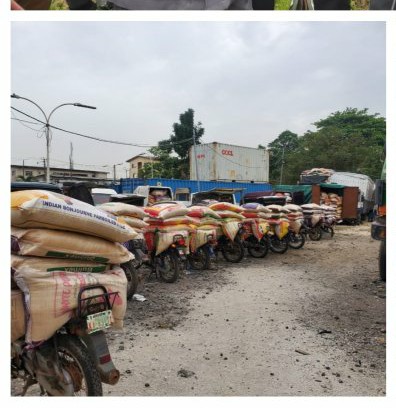
Federal Operations Unit, Zone A, Ikeja, Nigeria Customs Service, NCS,on Tuesday handed over intercepted expired drugs with Duty Pay Value, DPV of One Billion, Four Hundred and Twenty-two Million naira (₦1,422,000,000) that did not comply with the statutory import requirements to National Agency for Food and Drug Administration and Control, NAFDAC, for possible destruction.


FOU Zone A generates ₦72.6m as revenue in March....


Acting Comptroller Hussein Ejibunu while addressing journalists said, the operatives unit in March made seized of contraband goods worth duty paid value (DPV) of Six Hundred and Ninety-Four Million, Four Hundred and Sixty-Two Thousand, One Hundred and Fifty Naira (₦694,462,150.00) with arrest of five (5) suspects in connection with some of the goods.


He said among the seizures made for contravening various sections of the extant Customs laws are: 6,228 X 50kg bags of foreign parboiled rice (equivalent to 11 trailer loads); 35,325 liters of premium motor spirit (PMS); 279 Cartons of foreign poultry products; 105 parcels (50kg) of cannabis sativa and 2 x 40 ft containers said to contain 883 bales of used clothes 8 units of foreign used (Tokunbo) vehicles.

“These seizures are a reflection of our commitment to duty and non-compromise in the discharge of our functions; aimed at protecting the nation’s economy and preventing importation of prohibited and harmful products from entering our domestic markets.
The general public is encouraged to approach any Customs office across the country for information and guidance concerning international trade. Customs sign MoU, assure cartels of maximum loss,he added.

Ejibunu explained that the unit in an efforts to prevent loss of government revenue to duty underpayments that either arose from the undervaluation of imported items or wrong Harmonized System (HS) code classification recovered sum of Seventy-Two Million, Six Hundred and Ninety-Three Thousand, Three Hundred and Seven Naira, Nine Kobo (₦72,693,307.09).

This can be achieved by making sincere declarations, and being properly guided by the import/export prohibition lists.

It is imperative to note that the wisdom behind the government’s protectionist policy is to protect the national economy and safeguard its citizens’ lives and property.

Also smuggled bales of used clothes expose its users to fungal diseases and other skin diseases like scabies.


society

The Power Behind Every Success and Failure: Cause and Effect

Published

on

The Power Behind Every Success and Failure: Cause and Effect.

By George Omagbemi Sylvester — published by SaharaWeeklyNG.com

Cause and effect is not a soft, spiritual hunch. It is the hard backbone of reality. From the motion of galaxies to the choices we make at breakfast, actions precipitate consequences. That chain (sometimes linear, sometimes tangled) governs physical phenomena and human experience alike. To understand it is to gain leverage over the world; to ignore it is to surrender to confusion, superstition and avoidable failure.

The Power Behind Every Success and Failure: Cause and Effect.
By George Omagbemi Sylvester — published by SaharaWeeklyNG.com

The Physics: Where Causality Wears a Lab Coat. In physics, causality is the basic expectation that effects follow causes in an orderly sequence. Newton’s mechanics capture this clearly. His third law (“for every action there is an equal and opposite reaction”) does not merely describe colliding billiard balls; it codifies the reciprocity of interactions. Push the world and it pushes back with measurable, predictable force. That symmetry undergirds engineering, aerospace and even the feel of the ground beneath your feet.

Thermodynamics adds a crucial texture: direction. The second law tells us entropy tends to increase in a closed system. In plainer language, heat flows from hot to cold; eggs scramble but do not un-scramble by themselves. This “ARROW of TIME” is the macroscopic fingerprint of CAUSE-AND-EFFECT: we can distinguish past from future because the causal chain drives systems toward more dispersed, less ordered states unless we invest energy to reverse local disorder. Every refrigerator, air-conditioner and vaccine cold chain is a deliberate intervention against entropy’s drift.

Quantum mechanics complicates (but does not erase) this picture. At microscopic scales, we exchange deterministic prediction for probabilistic causation. We cannot predict exactly when a radioactive atom will decay, but the statistical laws are astonishingly precise. Even here, causes constrain effects, just with probability distributions instead of certainty. Einstein bristled at this fuzziness (“God does not play dice with the universe,” he famously remarked) but experiment after experiment confirms that probabilistic rules are still rules. The dice are loaded by the laws of nature.

The Philosophy: Making Sense of the Chain. Philosophers have wrestled with causation for centuries because it underwrites explanation itself. Aristotle mapped “FOUR CAUSES” material (what something is made of), formal (its form or pattern), efficient (the immediate trigger) and final (its purpose). Modern science largely trades in efficient causes: this force produced that acceleration; this pathogen triggered that fever.

David Hume, the great skeptic, warned that we never see causation directly; we see constant conjunctions and infer that one event makes another follow. “All events seem entirely loose and separate,” he wrote, insisting that necessity is a mental overlay on repeated patterns. Hume’s challenge matters because it humbles us: causal belief must be earned by evidence, not asserted by habit.

Bertrand Russell went further, provocatively declaring that “the law of causality is a relic of a bygone age.” What he meant (often misread) was not that causes do not exist, but that simplistic, single-line causal talk can fail in modern physics. That is a warning label against lazy thinking, not a license to deny causal structure. The right response is not abandonment, but refinement.

That refinement is exactly what contemporary researchers have delivered. Computer scientist Judea Pearl and colleagues formalized causal reasoning with graphical models and counterfactuals, giving us tools to move beyond mere correlation. Their message is simple and devastating to sloppy analysis: if you cannot say what would have happened if not for a given action, you do not understand the cause.

The Human Domain: Decisions, Systems and Consequences. If physics supplies CAUSE-AND-EFFECT with equations, everyday life supplies it with stakes. Actions and policies generate ripples; intended and unintended. In personal finance, spend more than you earn and debt compounds; invest regularly and returns compound. In public health, vaccination rates cause measurable shifts in disease prevalence. In education, hours of deliberate practice, quality of instruction and mentorship produce predictable distributions of skill.

Real life also features feedback loops, delays and hidden variables that make causality look messy. Consider traffic congestion: adding road capacity can initially relieve delays (short-term effect) but later induce more driving (long-term effect), landing us back in gridlock. Or economic policy: slash interest rates and you stimulate borrowing and growth; leave them low for too long and you may sow asset bubbles. Causes often arrive bundled and effects unfold on multiple clocks.

This is where causal thinking earns its keep. It forces us to ask:

What is the mechanism?

What time scale am I measuring?

What counterfactual am I comparing against?

What confounders might be fooling me?

“CORRELATION is not CAUSATION” is more than a slogan; it is a public-safety announcement for the mind. Ice cream sales rise with drownings, but neither causes the other; warm weather causes both. Without causal discipline, we will fall for mirages; superstitions in folk clothing or statistics in academic clothing.

Freedom, Responsibility, and the Myth of Inevitability. A common misreading of causality is fatalism: if everything has a cause, then nothing could be otherwise. Stephen Hawking skewered this posture with dry wit: people who say everything is predetermined still look before crossing the road. We behave as though our choices matter because they do. Causality does not erase agency; it explains it. Our brains are pattern-learning engines, exquisitely tuned to forecast consequences and choose actions accordingly. Habits are causal devices we install in ourselves.

At scale, the same logic governs institutions. Accountability is applied causality: trace an outcome back through decisions, incentives and failures, then re-engineer the system. Good governance is not about rhetoric; it is about pinpointing levers that predictably change results. Bad governance blurs causes with excuses and swaps evidence for slogans.

Evidence, Not Incantation: How to Think Causally. To move from slogans to substance, adopt the scientist’s discipline:

Define the intervention. What exactly is the action whose effect you care about? Vagueness kills causal inference.

Specify the counterfactual. Compared to what? Yesterday? A different policy? No intervention at all?

Measure on the right timeline. Short-run effects can conflict with long-run effects; report both.

Control confounders. If you can’t randomize, adjust intelligently: match groups, use instrumental variables or analyze natural experiments.

Seek mechanisms. Numbers persuade, mechanisms explain. How does A produce B?

Replicate. One study is a hint; converging evidence is a case.

These are not just academic niceties. They are the difference between policies that save lives and policies that waste money; between businesses that grow and businesses that guess.

The Moral of the Chain: Power With Responsibility. Causality confers power. If we can map the levers that move outcomes, we can design better cities, craft smarter regulations and build more resilient businesses. Power without humility invites catastrophe. Complex systems bite back. Interventions in healthcare, energy or education must be piloted, monitored and corrected. The goal is not perfect prediction, that belongs to Laplace’s mythical demon, an intelligence that knows every particle’s position and could thereby foresee the entire future. The goal is useful prediction: ENOUGH UNDERSTANDING to tilt probabilities in our favor.

We do this every day. Seat belts reduce fatalities. Smoking cessation lowers cancer risk. Early childhood education improves lifetime outcomes. These are not miracles; they are examples of measured causes yielding reliable effects. Progress is the patient accumulation of such levers.

Quotable Anchors for the Mind. A few concise lines, properly used, sharpen our causal instincts:

Isaac Newton: For every action, there is an equal and opposite reaction. That’s reciprocity made law.

Albert Einstein: “God does not play dice with the universe.” A dissent that keeps us honest about the limits of randomness.

David Hume: We infer necessary connection from repeated patterns; we must not mistake habit for proof.

Stephen Hawking: Even those who preach predestination look before crossing the street, agency lives within causality.

Judea Pearl (paraphrased): Without counterfactuals and models, we cannot speak meaningfully about causes.

Bertrand Russell: Beware simplistic causal talk; modern science demands precision.

Each quote, trimmed to its essence, points the same way: understand the chain or be dragged by it.

Closing Argument: Master the Chain, Don’t Be Chained by It. The law of cause and effect is the world’s operating system. It is not a metaphysical garnish but the main course. Physics gives it equations; philosophy gives it clarity; data science gives it tools; and everyday life gives it consequences. When we act with causal literacy (naming mechanisms, testing interventions, measuring timeliness) we become responsible authors of our outcomes.

Leave nothing to luck that you can assign to law. Name your levers. Test your assumptions. Demand the counterfactual. Then PULL, MEASURE and ADJUST. That is how rockets reach orbit, hospitals cut mortality, startups escape gravity and citizens bend history toward justice. The chain is unbreakable; but in your hands, it is also steerable.

The Power Behind Every Success and Failure: Cause and Effect.
By George Omagbemi Sylvester — published by SaharaWeeklyNG.com

Continue Reading

news

NNPP Chieftain Olufemi Ajadi writes a letter to President Trump over the stringent US visa rules for Nigerians

Published

on

NNPP Chieftain Olufemi Ajadi writes a letter to President Trump over the stringent US visa rules for Nigerians

NNPP Chieftain Olufemi Ajadi writes a letter to President Trump over the stringent US visa rules for Nigerians


Ambassador Ajadi and Donald Trump – By Our Correspondent


A chieftain of the New Nigeria People’s Party (NNPP), Ambassador Olufemi Ajadi Oguntoyinbo, has written an open letter to former United States President Donald J. Trump, advising to him to remove the stringent visa restrictions currently affecting Nigerians who wish to travel to the US.


In the strongly worded letter made available to journalists on Tuesday, Ajadi noted that Nigerians have long enjoyed cordial relations with the United States, and that the imposition of harsh visa rules undermines people-to-people ties, business collaborations, and educational opportunities.


According to him, many law-abiding Nigerians are unfairly denied access to the US due to policies that stereotype the country’s citizens, despite Nigeria’s significant contributions to global development and the large Nigerian diaspora community in America.


“Mr. President, Nigeria is a nation of hardworking and resourceful people,” Ajadi wrote. “Our citizens contribute positively to the US economy, academia, technology, medicine, and culture. It is therefore unfair to subject them to unnecessary bottlenecks and humiliating visa processes. I respectfully urge you to consider a review of these rules in the spirit of fairness, justice, and mutual respect.”


Ajadi, who is also a businessman and social activist, emphasized that easing visa restrictions would not only strengthen diplomatic ties but also create opportunities for trade, cultural exchange, and bilateral cooperation.


He called for fairer treatment of Nigerian travelers, while assuring that the government and people of Nigeria remain committed to international peace and collaboration.


READ ALSO: State Clear Reasons for U.S. Visa Denial -Ajadi’s Legal Team Demands CCTV, Audio Tape Review, Document Re-Examination


He further argued that many young Nigerians look up to the US as a destination for higher education and innovation, stressing that rigid visa hurdles discourage intellectual growth and international partnerships.


Ajadi concluded his letter by expressing optimism that President Trump, known for his bold decisions, would give fair consideration to the plight of millions of Nigerians who seek legitimate entry into the United States for studies, tourism, business, and family reunification.


The NNPP chieftain’s appeal adds to growing voices from civil society, political leaders, and the Nigerian diaspora calling for a review of immigration policies that affect the movement of Nigerians to the United States.

Continue Reading

society

“Lagos is Africa’s foremost investment destination,” Speaker Obasa Declares

Published

on

“Lagos is Africa’s foremost investment destination,” Speaker Obasa Declares

“Lagos is Africa’s foremost investment destination,” Speaker Obasa Declares


With a 20-million-strong population, $260 billion GDP, and status as West Africa’s maritime gateway, Speaker of the Lagos State House of Assembly, Rt. Hon.. (Dr.) Mudashiru Obasa has once again declared Lagos as Africa’s premium business destination.


“Lagos is Africa’s foremost investment destination,” Speaker Obasa Declares


The Speaker reaffirmed this stance when he hosted a high-profile delegation from China’s Guangxi Province, led by Zhang Xiaoqin, Vice Chairman of the Standing Committee of the Guangxi People’s Congress, on Monday at the Assembly complex.


While hailing the visit as a ‘watershed moment’ for cross-continental collaboration, Speaker Obasa lauded the delegation’s expression of interest in deepening bilateral ties between Nigeria and China, with Lagos as a focal point – saying it underscores the state’s growing geopolitical clout as Africa’s fifth-largest economy and a hub of innovation, commerce, and cultural dynamism.


“Lagos is Africa’s foremost investment destination,” Speaker Obasa Declares


He said, “Lagos is more than a city – it is a vision of progress. Lagos is the best place to invest in Africa because we have the population and the enabling laws for ease of doing business. Our economy is huge and vibrant, one of the biggest in Africa. Whatever you invest here, you will recoup your investment. In the area of tourism, we are still expanding, and every idea is welcome to make us harness our potential.”


Further, he declared the state’s readiness to welcome investments in infrastructure, citing the existing collaboration between Lagos and China Civil Engineering Construction Corporation (CCECC) in the construction and operation of the Red and Blue Rail lines.


“Lagos is Africa’s foremost investment destination,” Speaker Obasa Declares


The proposed engagement with Guangxi Province, the Speaker said, unlocks doors for mutual growth in trade, technology, and cultural exchange. Therefore, he continued, “Our Assembly is committed to crafting legislative frameworks that foster sustainable development and global partnerships, and collaborating in the area of legislation and exchange of ideas for good governance.


“Lawmaking is the bedrock of progress. We will ensure our statutes align with global best practices to secure win-win outcomes for Lagos and our partners.”


Earlier, Xiaoqin had described the visit as “a foundation for enduring friendship,” with plans for follow-up technical exchanges. He described Lagos as a “vibrant economic ecosystem” and said that it shares maritime advantages with Guangxi that could be leveraged to grow tourism. “We are looking forward to enhancing collaboration in the area of trade, economy, and tourism. We hope you will provide more care for the Chinese citizens in Lagos,” he said.


Indeed, Guangxi, a southern Chinese region bordering Vietnam and famed for its ASEAN trade corridors, shares synergies with Lagos in port logistics, agriculture, and tourism. Guangxi’s interest signals China’s broader strategy to expand its Belt and Road Initiative (BRI) footprint in Nigeria, with Lagos positioned as a linchpin.


For Obasa, the engagement is both diplomatic and symbolic: a reaffirmation of Lagos’s legislative maturity and its readiness to shape Africa’s 21st-century narrative.

Continue Reading

Cover Of The Week

Trending