
society
A Safer Tomorrow: Lessons from a Tragic Event

A Safer Tomorrow: Lessons from a Tragic Event
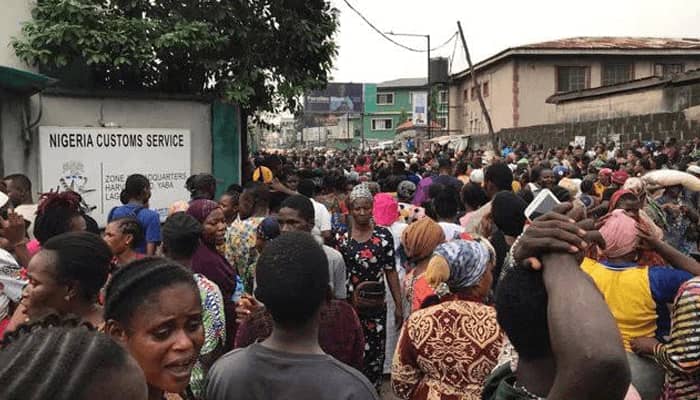
The sun was just beginning to rise over the bustling city of Ajayi as hundreds of people gathered outside the Civic Center. The event, a food distribution drive organized by a well-meaning NGO, promised relief to those struggling amidst the recent economic downturn. What began as a hopeful morning turned into a day etched in sorrow.
By noon, the crowd had swelled to thousands, including women cradling children, elderly men leaning on walking sticks, and teenagers who had come to secure meals for their families. The organizers, overwhelmed by the turnout, tried to maintain order, but the narrow entrance to the distribution hall became a bottleneck. As impatience grew, the atmosphere shifted from hopeful to tense.
When the gates finally opened, chaos erupted. People surged forward, pushing and shoving in a desperate bid to be among the first to receive the aid. A child’s cry pierced the air as bodies pressed against each other. Within moments, the situation spiraled out of control. In the ensuing stampede, dozens were injured, and eight lives were lost, including three children.
The tragedy sent shockwaves through the community and drew nationwide attention. Critics lambasted the event organizers for failing to anticipate the crowd size and implement adequate safety measures. The government, too, faced scrutiny for its lack of proactive policies to prevent such incidents.
In the days following the tragedy, the city of Ajayi became a focal point for discussions on public safety and crowd management. At a press conference, Mayor Adedayo Adekunle expressed profound regret for the loss of lives and pledged swift action. “This is a wake-up call for all of us. We cannot allow such a preventable tragedy to happen again. The safety of our citizens must always come first,” he stated.
In response, the city council introduced a new set of regulations for public events. Under the policy, any gathering expected to host more than 200 attendees required pre-approval from the newly formed Event Safety Commission (ESC). Organizers would need to submit detailed plans, including crowd control strategies, medical response teams, and security personnel deployment.
The ESC also mandated that venues have multiple entry and exit points to prevent bottlenecks, provide ample drinking water, and deploy trained volunteers to assist with managing queues. Additionally, the city’s emergency response hotline was upgraded, and public awareness campaigns were launched to educate citizens on safety protocols during large gatherings.
The tragedy also inspired grassroots efforts. Community leaders organized workshops on crowd safety and first aid. Churches, mosques, and other organizations reevaluated their event planning processes, emphasizing safety above all.
One of the most poignant moments came during a memorial service for the victims. Family members and community members gathered to honor the lives lost and advocate for change. Among the speakers was Mrs. Ifeoma Nnaji, who lost her six-year-old daughter, Ada, in the stampede. Holding back tears, she addressed the crowd: “Ada’s life was precious, and her death must not be in vain. Let this be the last time we mourn such a loss. Let us learn, let us act, and let us protect each other.”
Months later, Ajayi’s efforts began to show results. A subsequent food distribution event, held at a larger venue with stringent safety measures in place, went smoothly. Attendees praised the organizers and city officials for their diligence, noting how the lessons from the past had been implemented effectively.
The tragedy in Ajayi became a turning point for the entire nation. State governments adopted similar policies, and collaborations between public and private sectors strengthened safety frameworks. While the scars of that fateful day remained, the collective response demonstrated resilience and a commitment to preventing such incidents in the future.
As the city moved forward, it carried with it the memory of those who had lost their lives. Their legacy became a catalyst for change, ensuring that public events in Ajayi—and beyond—would be safer for everyone.
Epilogue
In a quiet corner of the city’s central park, a memorial was erected in honor of the victims. Inscribed on it were the words: “In their memory, we build a safer tomorrow.” It served as a somber reminder of the past and a beacon of hope for the future.





CSP Iniedu Pays Emotional Tribute To Fallen Officers, Appeals For Unity
A deeply emotional reflection by Chief Superintendent of Police, CSP Iniedu A.O., Head of the Complaint Response Unit at the Force Headquarters, Abuja, has highlighted the sacrifices of officers and renewed calls for stronger collaboration between the Nigeria Police Force and citizens.

Recounting his experience at a recent police parade on Tuesday, the senior officer described a moment of profound personal remembrance, seeing traces of his late father, a fallen officer, in the ceremonial conduct of serving personnel. “Not my father himself, he paid the ultimate price years ago. But in the crisp salute of a young constable, I saw him,” he said.
He noted that the occasion stirred memories of growing up in the barracks, where duty often overshadowed family life due to the constant risks associated with policing. According to him, “we grew up where ‘daddy is at work’ meant daddy might not come back,” underscoring the emotional realities faced by families of officers.
CSP Iniedu disclosed that the solemn bugle played in honour of fallen officers revived painful memories, emphasizing the heavy price many families continue to pay. “In the silence that fell when the bugle honoured the fallen, I heard the phone calls that never came home,” he added.
Reflecting on his emotional response, he said his tears were not a sign of weakness but a burden of memory and sacrifice. “Today, I wept. Not from weakness, but from the weight of memory,” he stated, adding that he also mourned colleagues and course mates who died in active service.
The senior officer used the moment to stress the need to bridge the gap between the police and the public. “The gap between police and citizen is not filled by blame. It is filled by bridges,” he said, calling for mutual trust and understanding.
He urged Nigerians to see police officers as partners in nation building, noting that those in uniform are part of the same society they serve. “The officer standing night watch in your street is someone’s child,” he said, appealing for greater public cooperation in security efforts.
CSP Iniedu further emphasized that effective policing requires shared responsibility. “Transparency is our pledge to you. Collaboration is our request of you. Accountability is our covenant with you,” he declared.
While acknowledging that the Force is not without its challenges, he maintained that officers remain committed to their duty. “We are not perfect. But we are present. And we choose every single day to stand between danger and the people we swore to protect,” he said.
The statement ended with a call for unity and collective responsibility in strengthening national security, alongside prayers for the Nigeria Police Force and the Federal Republic of Nigeria.
society
AjadiOyoOmituntun 3.0: Grassroots Walkout, Consultations Boost Ajadi’s Oyo Governorship Momentum

AjadiOyoOmituntun 3.0: Grassroots Walkout, Consultations Boost Ajadi’s Oyo Governorship Momentum
Members of the Peoples Democratic Party (PDP) in Egbeda Local Government Area of Oyo State staged a consultation walkout on Tuesday in support of the governorship aspiration of Ambassador Olufemi Ajadi Oguntoyinbo, reaffirming their confidence in his candidacy ahead of the party’s primaries.
The peaceful political procession, held across major communities within the council area, attracted party leaders, grassroots mobilisers, youths, market vendors, and supporters who described Ajadi as a loyal party member with strong grassroots appeal.
The consultation walkout, which commenced at Osengere in Ward 8—Ajadi’s political base—moved through Gbagi Market, Iwo Road, Monatan, Olodo and Erunmu, drawing enthusiastic reactions from residents and traders who came out to welcome the PDP gubernatorial aspirant and his supporters.
Speaking during the walkout, Ambassador Ajadi expressed appreciation to party members and residents for their show of solidarity, describing the exercise as a demonstration of unity within the PDP in Egbeda.
This show of love from my people in Egbeda Local Government means a lot to me. I am a committed member of the PDP and I remain dedicated to the growth and progress of our great party,” Ajadi said.
He added that his governorship ambition is driven by his desire to consolidate on the achievements of Governor Seyi Makinde and further deepen good governance in Oyo State.
“Our goal is to build on the good governance already established by His Excellency, Governor Seyi Makinde. We want to expand opportunities for our youths, strengthen the local economy and ensure that development gets to every community,” he stated.
At Gbagi International Market, one of the major commercial hubs visited during the walkout, Ajadi addressed traders and artisans, assuring them of inclusive governance if given the mandate.
“I am coming with a clear vision to serve the people of Oyo State. Our administration, by God’s grace, will prioritise traders, artisans and small business owners because they are the backbone of our economy,” he told the cheering crowd.
The walkout was attended by notable PDP leaders including the Chairman of Egbeda Local Government and Oyo State Chairman of the Association of Local Governments of Nigeria (ALGON), Hon. Sikiru Oyedele Sanda; the Political Head/Administrator of Ajorosun LCDA, Hon. Ibrahim Oladebo, popularly known as Simple; the Chief of Staff to the Egbeda Local Government Chairman, Hon. Kabiru Siyanbola; and the PDP Chairman in Egbeda Local Government, Chief Alawe Olawale Ebenezer, among others.
Speaking on the significance of the exercise, Hon. Sanda described Ajadi as a dedicated party man whose aspiration deserves consideration.
“Ambassador Ajadi has demonstrated commitment to the PDP over the years. What we are witnessing today is a reflection of the acceptance he enjoys at the grassroots. Leaders will always consider candidates who have the support of the people,” he said.
Additionally, Chief Alawe noted that the consultation walkout was intended to reaffirm Ajadi’s loyalty to the PDP and to demonstrate his electability.
“Ajadi is not a stranger at our party. He is from Ward 8 here in Egbeda and he has remained consistent. We believe he is marketable and capable of flying the PDP flag if given the opportunity,” he said.
The event also featured entertainment performances by popular juju and gospel musician Otunba Femi Fadipe, popularly known as Femo Lancaster, alongside Bullion Records fast-rising hip-hop artiste Harcher (Abdul Rahman Yusuf), whose musical performances added colour to the political outing and attracted more young supporters.
Party faithful who spoke with journalists during the event said the turnout of supporters and the convoy of vehicles and motorcycles that accompanied the walkout showed the growing acceptance of Ajadi’s aspiration within the local government.
Observers noted that the consultation tour forms part of Ajadi’s ongoing grassroots engagement strategy aimed at strengthening his support base across Oyo State ahead of the PDP governorship race.
The walkout ended with a renewed call by supporters for party leaders to consider Ajadi’s popularity and loyalty to the PDP when the process of selecting the party’s governorship candidate begins.
NIGERIA’S EDUCATION STRIDES, GLOBAL ACKNOWLEDGMENT: When Evidence Travels from Jigawa
…as President Tinubu set to commission Africa’s largest schools complex in Lagos
By O’tega Ogra
There is a quiet shift happening in Nigeria’s education system. You will not find it in speeches neither will you find it in long policy documents. But if you look closely, you will see it in something far more difficult to dismiss. Evidence.
Last week in San Francisco, at the Comparative and International Education Society (CIES) conference, data from classrooms in Jigawa State was presented before a global audience. Not projections. Not estimates. A record of what is happening inside a public system in Nigeria. 
That distinction matters. For years, much of what the world has understood about education in countries like ours has been assembled from a distance. National averages. Modelled estimates and reports written long after the fact. What was presented this time came from within. Attendance tracked daily. Teachers reassigned based on need. Classrooms observed as they function. All under a digitalised ecosystem.
In Jigawa, under the JigawaUNITE foundational learning digital programme, the numbers tell a simple story. Within roughly 150 days of implementation which commenced at the end of 2024, 95 previously understaffed schools were fully staffed. Pupil teacher ratio moved from 114:1 to 70:1. Daily attendance rose from 39 per cent to 77 per cent. This remarkable improvement was not achieved by expanding the workforce. It came from reorganising what already existed under a digital umbrella.
There is something instructive in that. Nigeria has never lacked policy. What we have often lacked is the discipline of execution. The ability to take what already exists and make it work as intended. That is where the real shift is beginning to show.
But it would be too convenient to reduce this to one programme.
At the federal level, the direction has also been adjusting. The Minister of Education, Dr. Maruf Tunji Alausa, has placed measurable outcomes, foundational learning, and teacher quality back at the centre of policy. UBEC, the Federal Government’s Universal Basic Education body, continues to drive national interventions around school improvement and teacher development, even as it insists that reform must remain system-led and not fragmented.
The First Lady’s education interventions, through the Renewed Hope Initiative, have reinforced education as a national priority, particularly around access, learning materials, and inclusion. These are different levers, but they are part of the same ecosystem.
And then there is the fiscal reality.
Recent reforms under President Bola Ahmed Tinubu have increased allocations to subnational governments, creating more room for states to act. In a federation like Nigeria, that matters. Because education is not delivered from Abuja. It is delivered in states. In schools. In classrooms.
What Jigawa has done is to use that room and the Executive Governor of the state, the State Universal Basic Education Board, and their partners on the JigawaUNITE project, New Globe, must be given kudos.
However, Jigawa is not alone in this journey.
In Kwara, efforts to align teaching with actual learning levels are beginning to correct a structural mismatch in classrooms. In Lagos and Edo, structured pedagogy and closer monitoring are improving consistency in teaching. Across the entire ecosystem, state governments, federal institutions like UBEC, and delivery partners like NewGlobe are pushing at the same question from different angles.
How do children actually learn better?
In a prior reflection, Ifeyinwa Ugochukwu, VP at NewGlobe, captured the urgency clearly. With the right tools, training, and use of data, foundational learning outcomes can improve at scale. The real risk, she noted, is delay, allowing learning gaps to become permanent.
That warning should not be ignored because the context remains difficult. Nigeria still carries one of the largest out of school populations in the world. Learning gaps remain. Progress in one state does not resolve a national challenge, but it does something else.
It proves that movement is possible.
What was presented in Washington did not claim success. It demonstrated function. It showed that a Nigerian sub-national can generate evidence that holds up in a global room. That reform does not always require something new. Sometimes it requires using what already exists more honestly and more efficiently.
The real question now is whether this remains an exception.
Or whether it becomes a pattern.
Because reform at scale is never built on isolated wins. It is built on systems that can reproduce them.
And perhaps that is why the timing matters.
This week, another subnational, Lagos State, is expected to commission the Tolu Schools Complex in Ajegunle, a sprawling 36-school integrated facility spread across 11.7 hectares, designed to serve over 20,000 students, and described as the largest school community in Africa. 
There is a connection here that should not be missed.
On one hand, a classroom system in Jigawa is learning how to organise itself better. On the other, a state like Lagos is building the physical scale required to carry thousands of learners at once.
One is structure. The other is capacity.
Real progress sits where both meet because education reform is not only about what we build, it is about how well what we build actually works.
For once, the data was not explaining Nigeria from the outside.
It was coming from within.
And it carried weight.


- National Council for Curriculum Development (NCDC) seeks Shs17 Billion for curriculum review, teacher training April 9, 2026
- Senegal: A Decade of Unresolved Climate Displacement April 9, 2026
- Uganda engages its diaspora in Japan on national policy framework for inclusive development April 9, 2026
- Afreximbank supports Dangote Group as it targets US$100 billion annual revenue by 2030 April 8, 2026
- Africa's top-ranked Global Reporting Initiative (GRI) Training Partner launches 15th cohort of globally recognized sustainability reporting certification April 8, 2026
- African Energy Chamber (AEC) Intervenes in Landmark Climate Case to Defend Africa’s Energy Future April 8, 2026
- Eswatini opens to investors for first-of-its-kind roadshow April 8, 2026
- Egypt: President El-Sisi Meets Ministers of Electricity, Petroleum April 8, 2026
- Seychelles and Japan explore expanded cooperation and future partnerships April 8, 2026
- President Mahama to headline The Africa Debate 2026 as Ghana-United Kingdom (UK) investment ties deepen April 8, 2026
- National Council for Curriculum Development (NCDC) seeks Shs17 Billion for curriculum review, teacher training April 9, 2026
- Senegal: A Decade of Unresolved Climate Displacement April 9, 2026
- Uganda engages its diaspora in Japan on national policy framework for inclusive development April 9, 2026
- Afreximbank supports Dangote Group as it targets US$100 billion annual revenue by 2030 April 8, 2026
- Africa's top-ranked Global Reporting Initiative (GRI) Training Partner launches 15th cohort of globally recognized sustainability reporting certification April 8, 2026
- African Energy Chamber (AEC) Intervenes in Landmark Climate Case to Defend Africa’s Energy Future April 8, 2026
- Eswatini opens to investors for first-of-its-kind roadshow April 8, 2026
-

 news4 months ago
WHO REALLY OWNS MONIEPOINT? The $290 Million Deal That Sold Nigeria’s Top Fintech to Foreign Interests
-

 society7 months ago
“You Are Never Without Help” – Pastor Gebhardt Berndt Inspires Hope Through Empower Church (Video)
-

 celebrity radar - gossips2 months ago
Dr. Chris Okafor Returns with Power and Fire of the Spirit -Mounts Grace Nation Altar with Fresh Anointing and Restoration Grace on February 1, 2026
-

 celebrity radar - gossips4 months ago
Prophet Kingsley Aitafo Releases 2026 Prophecy: ‘Nigeria Will Rise, but the World Must Prepare for Turbulence’