
celebrity radar - gossips
Abiodun celebrates 61st birthday at orphanage

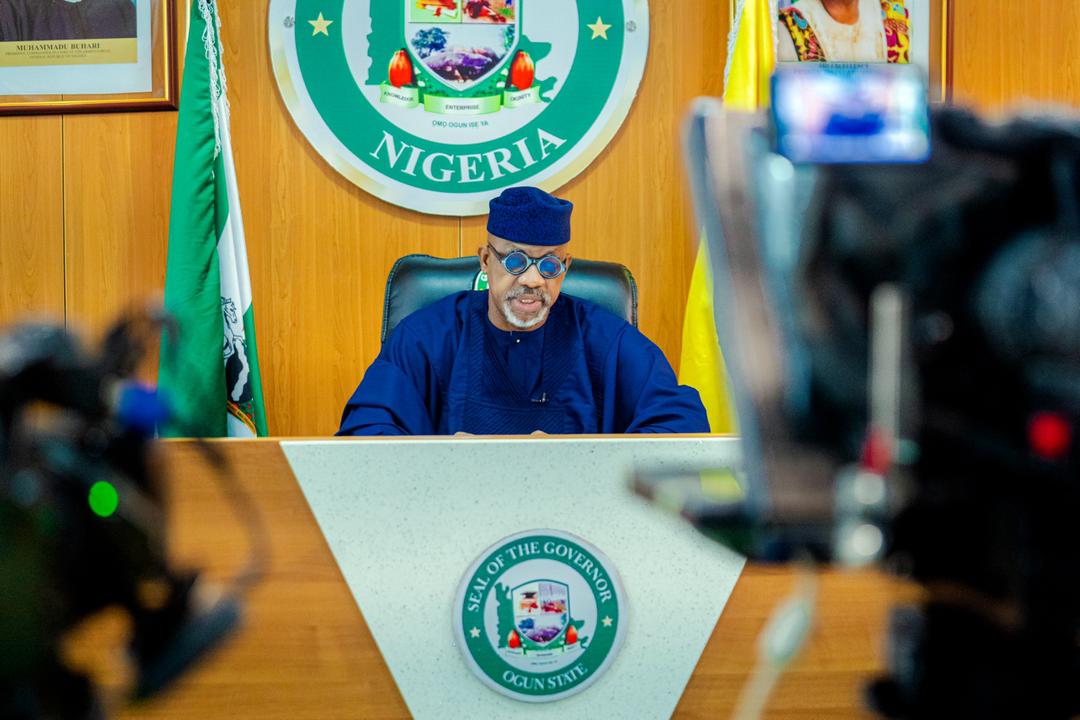
Abiodun celebrates 61st birthday at orphanage
…declares ‘we are a promise keeping administration’
Ogun State governor, Dapo Abiodun on Saturday, celebrated his 61st birthday with children at the Stella Obasanjo Children’s Home, Abeokuta, and charged the children not to be distracted by their present conditions, but remain committed to the pursuance of their aspirations.
The governor, accompanied by members of the State Executive Council to the Home, specifically admonished the children not to settle for anything less in the course of pursuing their dreams and aspirations in life.
The governor, who promised to always make himself available for the children, also instructed them to improve themselves towards achieving their set goals in life and be determined to be good citizens of the country.
As part of his commitment towards identifying with the course of the children, Abiodun however, promised that each of the children at the orphanage would be presented with a befitting state’s luxurious gifts to mark their respective birthdays beginning from Saturday.
The governor however, presented sets of computers, food items, including bags of rice to the Home.
He also inaugurated the computer section of the Home for use at the center.
Meanwhile, Abiodun, has declared that his administration has recorded giant strides since it came on board two years ago, despite COVID-19 and other challenges.
Abiodun, who equally scored his administration high, said even strident critics of his government had concurred that the incumbent administration had made positive impacts in housing, infrastructure, education, health, agriculture, youth empowerment and other critical sectors.
The governor stated this in his state broadcast on the scorecard of his administration in the last two years.
While saying “ours is a promise keeping administration”, Abiodun however, said his government would continue to be strategic and deliberate in the allocation of resources, just as he restated that Ogun under his leadership would continue to prioritise projects that have direct and positive impact on the people and remain frugal in the management of the “commonwealth”
He said the current government in the state would sustain the tempo of delivering good governance, assuring residents to expect more projects in infrastructure, housing, health, education, amongst several others.
The governor declared that he was at peace with himself and delighted that he stuck with the promise he made to deliver good governance and espouse government that would be fair, just, equitable, accountable, open, transparent, inclusive and obey the rule of law, 731 days ago when he was sworn-in as the 5th civilian governor of Ogun State.
“In my inaugural speech, I made a covenant with God, and the good people of Ogun State that I will provide good governance. That is, a government that is fair, just, equitable, accountable, open, transparent, inclusive and obeys the rule of law. Two years down the line, I am proud to say that we are a promise keeping Administration. We have either fulfilled or are fulfilling all our electoral promises, in practical terms”, Abiodun noted.
He said his administration did not allow challenges of COVID-19 and #EndSARS to dampen its resolve to deliver on his electoral promises to the people of Ogun State, disclosing his first year in office witnessed commencement and completion of some infrastructural projects across the state.
Highlighting some projects espoused by his administration in 24 months, Abiodun said no fewer than 34 roads spanning over 270km had been reconstructed, while another set of 41 roads had benefitted from rehabilitation covering over 322 km.
“We have worked on over 600km of rural, intra-state, and inter-state roads spread across the three Senatorial Districts of the State, in line with our commitment to an even development of the state and the completion of inherited projects that benefit the citizens.
“It is important to note that some of the reconstructed roads are Federal Government roads which we have been compelled to do, because citizens do not care about the ownership of the roads, but geo-locate the pains they experience at the point of contact. Your government is committed to bringing relief to our citizens regardless of the cause or source of the discomfort.
“The reconstructed roads include our arterial roads linking us with Lagos State, such as Ray Power Road and Ikola/Navy-Osi-Ota Road in Ota which were commissioned three days ago; Ijebu -Ode to Epe road, scheduled for commissioning in the next few days; and Atan – Lusada-Agbara road which was flagged off last month and is due for completion in 15 months. Of note also is the reconstruction of Abeokuta-Sagamu Interchange, the major road to the State capital.
There are several other roads spread across the State that are either completed or at various stages of completion at an average of 3 roads per each of the 20 Local Government Areas”. The governor stated.
He added that the state had developed a multi-modal transportation master plan for the state that will integrate road, railway, water and air transport systems, saying work had also begun in earnest on the revived cargo airport at Ilishan-Remo which is strategically located to boost the agriculture value-chain and serve as the hub for export of agric products, not only for the State but for the region.
On youth development and empowerment, the governor said his administration determined to harness the potentials of “our technology savvy youth and the status of our State as the Education Capital of the nation in the digital economy”, adding “this has informed a number of initiatives, including the establishment of the Ogun Techhub and the recent flag off of Ogun State Digital Economy Infrastructure Project (OGDEIP)”.
“6,000 kilometers of fibre optic cables will be laid across the state to provide easily accessible and affordable broadband Internet connectivity across the nooks and crannies of the State, including our health and educational institutions. This digital infrastructure will bridge digital divide, support the industry as well as other initiatives in health (telemedicine) and education (virtual learning), amongst other benefits”. Abiodun pointed out.
While disclosing that the state had signed a Memorandum of Understanding to generate power for the state, with a target to achieve a 24 hour uninterrupted power supply to Abeokuta, the state capital, and a number of our major towns before next year, the governor added efforts would be put in place to explore alternative source of energy and power.
On health, Abiodun noted that his administration has invested heavily in health infrastructure and human capital development, saying “no fewer than 100 Primary Healthcare Centres (PHCs) have either been rebuilt or newly constructed and adequately equipped, in line with World Health Organisation (WHO) standard”.
“Our target is to have at least a functional primary healthcare centre (PHC) in each of our 236 wards. We have concentrated on the PHCs because they are the closest to the people and as the foundation for our hub and bespoke healthcare delivery system. Our secondary and tertiary health facilities have also been given adequate attention to offer referral health service.
“The number of ambulances in the State has increased from 5 to 30 with provision of 24 hour ambulance service across the State. Furthermore, we have restructured the Ogun State Health Insurance Scheme (HIS) to address identified lapses and make it more efficient and affordable.
“The provision of health infrastructure, equipment and other initiatives are complemented with incentives to motivate the workforce. The incentives include upward review of salaries and allowances of health workers, provision of health insurance for the 7,800 healthcare workers, and recruitment of over 300 health personnel across various cadres for Olabisi Onabanjo University Teaching University. In addition, there is ongoing recruitment of additional health personnel for other health facilities in the State.
On his administration’s intervention in housing, the governor said “our housing programme is the most ambitious in the history of our State. The Ministry of Housing and its two major implementation Agencies – Ogun State Housing Corporation, and, the Ogun State Property Investment Corporation (OPIC) are fully engaged in the provision of affordable housing units and medium to high income houses across the State.
“Already, over 1,300 units have either been completed or at different stages of completion. The target is about 3,000 units by 2023. I will be commissioning some of them in the coming weeks”.
He added that the security architecture in the had been enhanced by restructuring and reinvigorating Ogun State Security Trust Fund, with a new legislation and made it private sector led, with the view to ensuring security of lives and property of the residents.
“This was followed quickly with initial provision of over 100 patrol vehicles and 200 motorcycles fitted with communication equipment to our security agencies, thus facilitating timely information sharing and communication amongst the security agencies and their formations whilst enhancing operational effectiveness and efficiency.
“Furthermore, in response to some security challenges such as herders/ farmers skirmishes and kidnapping, we set up the Joint Security Intervention Squad (JSIS), a special task force, and deployed additional resources to the trouble spots. The State Security Network, Amotekun, has also been inaugurated and activated to complement other security agencies. Arrangements are in top gear to relaunch Operation MESA, a joint patrol that includes the Army, Police, Civil Defence, State Security Service and others. All these coordinated initiatives have yielded the desired results with our State being adjudged the most secure State in the country”. The governor stated.
Abiodun noted further that his government has restored the lost glory of the state in education, by declaring a state of emergency in the sector and initiated a number of multi-dimensional policies and programmes.
“For a start, we effected the promotion of over 10,000 teaching and non-teaching staff that had been outstanding for three years and resumed the payment of running costs to our public schools with over 120% increase. In tertiary education sub-sector, our first interventions was to restore Moshood Abiola Polytechnic (MAPOLY), Abeokuta and provide the conducive environment for academic activities at Tai Solarin College of Education (TASCE), Omu Ijebu to resume and be sustained.
“We have also intervened in provision of infrastructure in all public schools primary, secondary and tertiary levels. About 1,800 units of classrooms have been renovated or constructed. Over 25, 000 school furniture have also been provided. The recruitment of 5,000 teachers under the OgunTeach scheme is on-going to fill the vacancies in the teaching service. Other initiatives include restoration of the award of scholarships for outstanding students payment of bursary to Ogun State Indigenes in Nigerian Tertiary Institutions”. Abiodun reeled out.
He said the creation of the Ogun Job portal, through which the unemployed or under-employed youth in the state were registered, had helped tremendously in matching the registered youth with job opportunities and other interventions both in the public and private sectors.
The governor added that through Ogun Youth Empowerment Scheme, 10,000 artisans annually undergo paid training and provided job opportunities, just as 35,584 jobs were created through linkage of farmers, including youth to Agricultural opportunities such as Central Bank of Nigeria (CBN) Anchor Borrowers and other intervention schemes.
“The economy of the State has improved tremendously under our watch. This has been due largely to a number of policy and regulatory reforms that we have implemented.
Some of these reforms include, but not limited to establishment of Public-Private Partnership (PPP) office backed with necessary legislation to provide the regulatory framework for investment engagement with private sector investors; standardize the partnership process with the state, and facilitate new infrastructure development projects”. He stated.
Abiodun further noted that the public service, as the engine room of the government, has been accorded the deserved importance by his administration, through prompt payment of salaries, pensions, promotions, training and capacity building.
“Ogun State is one of the first few states to fully implement the minimum wage and we will continue to pay as and when due, despite the obvious paucity of funds. We are also clearing the backlog of inherited pension liabilities. The ongoing promotion exercise is another demonstration of our commitment to staff welfare.
In addition, we are intensifying our efforts to create the conducive work environment, provide tools and training to bring out the creativity and professionalism of our Public Servants”, he said.
“In two years, we have delivered on most of our promises and working on others; you now have a government you can trust; a government that is indeed for all parts of the state and all citizens, regardless of faith, political affiliation or ethnic groups. We have touched lives of the citizens of Ogun State; we are building the new Ogun State; and, we are institutionalizing a new culture and approach of keeping faith with the people. We do not promise to solve all the problems in four years, but we will deliver on whatever promise we make and leave Ogun State better than we met it.
“You are witnesses to the fact that we have delivered and continue to deliver on our promises in the last two years. Independent and respected organisations, based on empirical facts, have honoured us for our outstanding performance and deliverables. Even our most strident critics attest that we have performed outstandingly; that we have recorded giant strides in the last two years, despite COVID-19 and other challenges. Nonetheless, the outlook for the years ahead is even brighter. Indeed, our initiatives are gaining stronger traction and yielding dividends.
“Your government will continue to be strategic and deliberate in the allocation of resources. We will continue to prioritise projects that have direct and positive impact on the citizenry and remain frugal in the management of our commonwealth. We will sustain the tempo whilst you should expect more projects in infrastructure, housing, health, education, amongst several others. All we need from you is more collaboration, cooperation, support and prayers in the joint task of Building Our Future Together.
“Your government further needs you to discharge your civic responsibilities by paying your taxes and levies and taking ownership of the projects in your communities, protecting and guarding them against misuse or vandalisation. Those projects are not just public projects, they are our common patrimony; they are indeed returns on your investments through your prompt and appropriate tax remittances”. Abiodun submitted.
The governor, however, thanked members of Executive Council for their service and dedication, the state House of Assembly, development partners, judiciary and the people of Ogun for their trust and commitment to the success story of the Ogun State project.
E-signed
Kunle Somorin




celebrity radar - gossips
Adron Homes Celebrates Visionary Chairman, Aare Adetola Emmanuel King, at 51
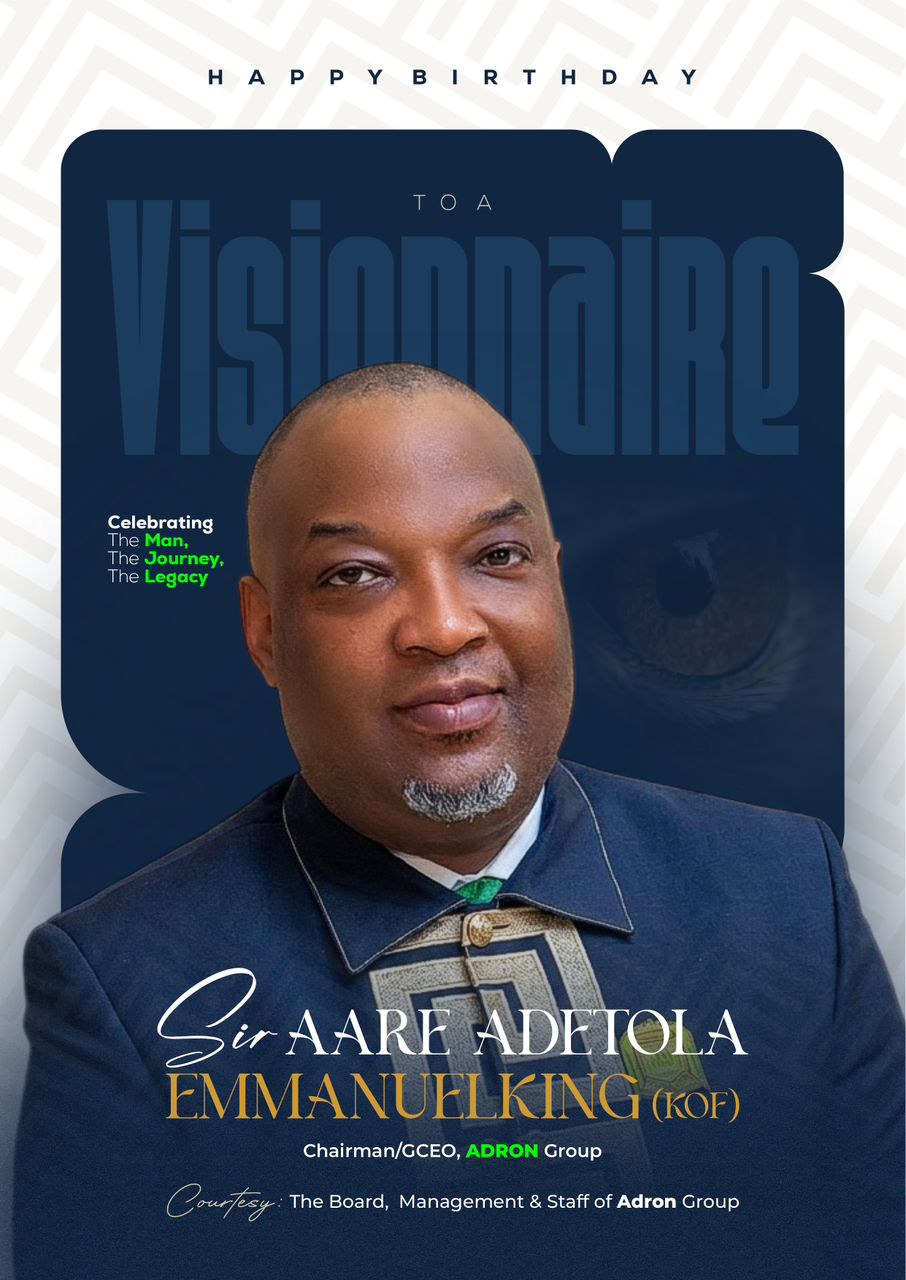
Adron Homes Celebrates Visionary Chairman, Aare Adetola Emmanuel King, at 51
The management and staff of Adron Homes and Properties Limited have joined family, friends, associates, and well-wishers across the globe to celebrate their Chairman and Chief Executive Officer, Aare Adetola EmmanuelKing, as he marks his 51st birthday.

In a statement released by the company, the milestone was described as a celebration of an exceptional leader whose vision, resilience, and entrepreneurial brilliance have not only transformed Adron Homes into a household name in Nigeria’s real estate sector but have also redefined affordable housing across the country.
Under his dynamic leadership, Adron Homes has continued to expand its footprint, delivering value-driven residential solutions while empowering thousands of Nigerians with opportunities for home ownership. His commitment to excellence, innovation, and customer satisfaction has remained the driving force behind the company’s sustained growth and industry leadership.
The statement further highlighted Aare EmmanuelKing’s passion for nation-building and community development, noting his significant contributions to job creation, youth empowerment, and the promotion of socio-economic development through real estate investments.
“As a leader, mentor, and visionary, Aare Adetola EmmanuelKing has consistently inspired a culture of excellence, integrity, and dedication within the organization. His ability to turn bold ideas into reality continues to position Adron Homes as a trailblazer in the industry,” the statement read.
The company expressed profound gratitude for his steadfast leadership and prayed for continued wisdom, strength, and sound health as he embarks on another year of impactful achievements.
As he celebrates his 51st birthday, the entire Adron Homes family proudly honours a man whose legacy continues to shape the future of real estate in Nigeria.
Happy 51st Birthday, Aare Adetola EmmanuelKing!

Oba Ara Releases Emotional Tribute to Late Taiwo Adegbodu
Taofik Afolabi
The gospel music community continues to grieve the painful loss of Taiwo Adegbodu, a beloved figure whose sudden departure left a deep void among fans, colleagues, and loved ones. In response to this loss, renowned gospel minister Rotimi Onimole, popularly known as Oba Ara, has released a moving tribute song that captures both the sorrow of the moment and the enduring legacy of the late singer.
Oba Ara, a proud son of Isale Eko, channels raw emotion throughout the song, using heartfelt lyrics and soul-stirring melodies to reflect on his personal connection with Taiwo Adegbodu. In the tribute, he openly expresses how deeply the news of Adegbodu’s passing shook him, describing it as a painful and unexpected loss that is difficult to come to terms with.
The song goes beyond mourning, it celebrates the life, ministry, and impact of Taiwo Adegbodu. Oba Ara highlights the late artist’s dedication to spreading the gospel through music, his inspiring voice, and the spiritual influence he had on many within and beyond Nigeria. Through powerful verses, he paints a picture of a man who lived for God and touched countless lives through his ministry.
Listeners have described the tribute as both comforting and deeply emotional, as it resonates with the collective grief of the gospel music community. It serves as a reminder that although Taiwo Adegbodu is no longer physically present, his music, message, and legacy will continue to live on.
In honoring his late colleague, Oba Ara not only pays his respects but also offers a source of healing for fans and fellow ministers, using music as a tool to process grief and celebrate a life well lived.
celebrity radar - gossips
Buratai, Fagbemi , Shagaya, Olofa, Others Eulogise Olowu Kuta’s Olori On 60th Birthday, Foundation Launch

Buratai, Fagbemi , Shagaya, Olofa, Others Eulogise Olowu Kuta’s Olori On 60th Birthday, Foundation Launch
Eminent personalities across the Nigeria stormed the TFK Event Centre, Bala Mohammed Way, Guzape, Abuja, to celebrate the 60th birthday of Olowu Kuta’s Olori, Queen Jumai Amoke and her Foundation Launch on Saturday 28, March 2026.

From former Chief of Army Staff, Lt Gen TY Buratai rtd, to the Minister of Justice and Attorney-General of the Federation, Prince Lateef Fagbemi; Olofa of Offa, HRM Oba Mufutau Gbadamosi. Even top businesswoman and socialite, Chief (Mrs) Bola Shagaya, was in attendance.


Other dignitaries were newly promoted Deputy Inspector-General of Police and former AIG Zone 2 , Lagos , Adegoke Fayoade, Major General Abdumalik, Major General Samuel Adebayo rtd (Fmr CDI);
Major General Anthony Omozoje rtd (Fmr Copp);
Alhaji Tajudeen Owoyemi (Asiwaju of Offa and CEO Radisson Hotel Nigeria;
Dr Waheed Olagunju, former managing director of Bank of Industry, Oniba of Iba, Lagos State, HRM Oba Dr Suleiman Raji ;
Justice Falola, Olu of Ile-Ogbo , Oba Adetoyese amongst many traditional rulers and captains of industry too numerous to mention.
Speaking at the occasion, the Chief Host, Olowu of Kuta, HRM Oba Dr Adekunle Oyelude Makama, CON , Tegbosun iii, who is also the husband of the celebrant commended Queen Jumai for ‘ her slender arms full of kindness’ to establish such humanitarian Foundation, ‘Amoke Children and mother in Need Foundation’ at a time Nigerians are going through economic crisis occassioned by the global meltdown.
Olowu also commended her steadfastness and love for the less privileged and downtrodden.
The monarch refrenced the task before his wife’s humanitarian gesture said her best is yet to come.
” Olori Amoke Jumai, I celebrate you. You will celebrate 70, 80, 90 and continue to shine as you continue to put a smile on people’s faces. I love you, “Olowu Kuta added.
To Lt Gen Buratai, a former army chief and former Nigerian Ambassador to Benin Republic, the reward of hard work is more work.
Buratai, who also doubles as Balogun Agba of Owu Kuta, a chieftaincy title reserved for a generalismo congratulated Queen Jumai for attaining the age of 60 in good health.
The retired army General said he’s not surprised by the turn out of eminent personalities across the country to celebrate the Olowu Kuta’s Olori because she merited it through her hospitality to all, adding that Allah the most merciful, most beneficial would accept all her act of ibadah.
The minister of Justice, Prince Fagbemi, was full of praises for Queen Jumai for deeming it fit to have a place in her heart to accommodate the needy and less privileged in ‘our society.’
Prince Fagbemi urged the guests to contribute generously to support the Foundation in order to continue to alleviate poverty and put a smile on the faces of the people.
” I congratulate you on your 60th birthday and Foundation Launch. I wish you many happy returns of the day and many more fruitful services to the country and motherland”, Prince Fagbemi added.
The celebrant, Queen Jumai who was grining from ear to ear thankfully said she was excited by the turn out and the response of the people to her foundation.
Queen Jumai, however, promised to continue to use her resources and donations received for the good of the needy and less privileged in the society.
” I want to appreciate my own Kabiesi Olofa of Offa , for his presence and im I’m using him as a point of contact to all other Kabiesis present here, the minister of justice and Attorney-General, you’re welcome, sir; Mrs Bola Shagaya, I salute your enterprise, Lt Gen Buratai, I’m grateful, sir; DIG Fayoade, Justice Falola and other dignitaries too numerous to mention, I thank you, all. To my darling husband, Kabiesi Olowu , I thank you immensely for your support. And to my family and friends, I thank you , all. E se pupo!”, she said.


-

 society7 months ago
Religion: Africa’s Oldest Weapon of Enslavement and the Forgotten Truth
-

 news4 months ago
WHO REALLY OWNS MONIEPOINT? The $290 Million Deal That Sold Nigeria’s Top Fintech to Foreign Interests
-

 society6 months ago
“You Are Never Without Help” – Pastor Gebhardt Berndt Inspires Hope Through Empower Church (Video)
-

 celebrity radar - gossips2 months ago
Dr. Chris Okafor Returns with Power and Fire of the Spirit -Mounts Grace Nation Altar with Fresh Anointing and Restoration Grace on February 1, 2026