
celebrity radar - gossips
AFRICA, O MOTHER AFRICA By Femi Fani-Kayode

First to come to Africa were the Arabs. They hunted us down like animals, captured us, castrated us, sold us into slavery and kept us in total bondage for 1300 years.
What the Arabs did to Africans over that period of time makes everything else that they were subjected to after that by others, including the trans-Atlantic slave trade, look like childsplay.
Worse of all is the fact that in places like Saudi Arabia and Mauritania many black Africans still live in slavery till today.
After the Arabs came the Europeans arrived and also enslaved us, shipped us overseas, subjected us to barbarous cruelty and bestial servitude and described us as nothing more than chattel with the brain of a quarter of a man.
After the Europeans came the Chinese. They have come in their full power and glory with their enticing and intoxicating massive bags of money, cheap loans, suspect grants, fake and deceptive smiles and evil intentions with a view to turning us into perpetual serfs, debtors, beggars and economic slaves.
Like a snake coiled around our hapless necks, they are snuffing and suffocating the life out of us more and more as each day goes by and they are turning us into their slaves and minions just as others that came before them once did.
Sadly we may never be in a position to free ourselves from the bondage of their sinister and pervasive yoke or to pay off our debts to them. That is where we are today.
O Africa, who has bewitched thee? O mother Africa, who shall deliver thee?
I have asked myself these two questions over and over again over the years and I still do not have the answers.
Yet such is our pitiful plight today that it calls for some painful introspection and the sharing of some home truths.
In William Shakespeare’s “Julius Caesar”, the character Cassius said,
“the fault, dear Brutus, is not in our stars but in ourselves that we are underlings.”
Nothing could be more appropriate than these words when trying to analyse, decipher and comprehend the African condition and mind-set.
I apologise in advance if anyone is offended by my assertions in this essay but if we are really interested in making progress as a race and if we wish to change our dastardly ways and improve our fortunes then the truth, no matter how bitter, must be spoken. That is the purpose of this contribution.
The illustrious West Indian revolutionary and foremost intellectual, Marcus Garvey, who was undoubtedly one of the most brilliant minds in history, once wrote the following. He said,
“having had the wrong education as a start in his racial career, the negro has become his own greatest enemy. Most of the trouble I have had in advancing the cause of the race has come from negroes”.
On his part another great thinker and formidable intellectual, the celebrated black American Booker T. Washington, aptly described the black race in one of his many lectures by stating that they were “like crabs in a barrel”.
He said that none would allow the other to climb over the top and, in the event of any such attempt, ALL would continue to pull back into the barrel the one crab that makes the effort to climb out.
I wholeheartedly agree with both Garvey and Washington. The black man is his own worse enemy and in the case of the African this is even more pronounced and self-evident. Permit me to expand on this.
There are a few exceptions to the rule but generally speaking the greatest weakness of the African is his inability to provide good leadership, his inability to demand for good quality leaders, his ignorance, his cowardice, his envy and his poverty.
This combination and cocktail of deadly afflictions makes us nothing but expendable prey to the rest of the world.
As the famous 19th century Arab slave trader Mehmet Ali once wrote, “you do not need to destroy the black African because he always ends up destroying himself and his people for you”.
He went on to say that “the minute ANY black African rises up, emerges, starts talking sense and telling the others how to escape our bondage and slavery it is his fellow Africans who he seeks to help that will undermine him, insult him, expose him, ridicule him, destroy him, sell him and kill him. That is the nature of the black African. He reasons more like a wild ape than any other creature on earth”.
Standing up for Africa is a risky business because those that will hate you most of all for doing so are the Africans themselves.
They would rather listen to a heartless and savage beast and support and follow him than to someone that truly loves and cares for them, that treats them with restraint, dignity, respect, compassion and kindness and that wishes them well.
I do not know where this sickness of mind and malevolent and self-destructive disposition derives from but I suspect that it is a deep-seated case of self-hate and self-loathing and a touch of what psychiatrics describe as the ‘Stockholm syndrome’.
The African always loves his slave-master more than he does his liberator. Worse still he resists the notion of good education and he barely reads. There are a few exceptions to the rule but this is true of most of them.
If you want to keep a secret from an African put it in a book or write it in a long essay. He cannot and will not read either of the two because he is mentally immature, chronically lazy, morbidly indisciplined and utterly shortsighted and because he sees no immediate personal gain or value in it.
He would rather listen to music and dance for one hour non-stop or watch a football or a boxing match instead. To him that is far more important and gratifying than anything else. Simply put he is stirred and motivated by his excitable and primitive passions and not by reason or logic.
Nigeria, which was meant to be the leading light of Africa, has now become its irredeemable and irretrievable basket case and the laughing stock of the world.
This is a “country” of 200 million hapless and ill-fated people who are still struggling with the very concept of nationhood and who have their own internal colonial sysytem of bondage and servitude where one small race of non-indegineous and non-negroid people have enslaved all the others and laud it over them.
This is a country where genocide, mass murder, ethnic cleansing, islamist terrorism, poverty, the persecution of political opponents and religious minorities, failure, evil, incompetence, insensitivity and wickedness is not only perceived as being a normal way of life and system of governance but also encouraged and celebrated.
Like the proverbial zoo or jungle, only the strongest and fittest can survive or get to the top in such a hellish place and shithole of a country. There is literally no hope for the weak, the poor, the vulnerable or the decent in such an environment and callousness, doublespeak, deceit and impunity appear to be well rewarded.
If this were not the case how can one explain the fact that a so-called nation that once had the greatest, most progressive, most dynamic and most educated people in Africa will accept a barely educated and clearly unfit neanderthal like Muhammadu Buhari as its leader on three separate occasions and continue to support and hail him even after he openly insults them before world leaders and treats them like filth.
His Army has failed woefully in its war against Boko Haram because he has refused to empower and equip them adequately and because he pampers and encourages the terrorists.
His economy is heading for the greatest recession in Nigeria’s history due to his incompetence and inability to save money for a rainy day.
His impoverished and desperate people are marching, robbing and rioting in the streets of Lagos, in the outskirts of Abuja and in one or two other major cities looking for food and threatening the worse if they cannot find any.
As anarchy looms and sets in on parts of the country, Nigerians are being attacked openly and robbed by massive rampaging and hungry mobs made up of very angry, desperate and wild young men and he has said nothing about it let alone try to put a stop to it.
His airforce bombed scores of innocent and defenceless civilians, including women and children, to death two days ago yet it was barely reported in the press, there was no sense of outrage about it from the people and no-one in the country really gives a damn.
He has locked down his people at home in the nation’s densely populated commercial and administrative capitals of Lagos and Abuja and one or two other provinces in an attempt to prevent the spread of the corona virus without providing any provisions, money, food, water and electricity for them and without offering them any meaningful palliatives even though he knows that they are suffering badly and that his country has been officially designated as the “poverty capital of the world” by numerous international institutions!
It takes a cruel and callous man to do this and turn his back on his people in their time of need. Worse still when it comes to the fight against coronavirus itself in the last 3 weeks he has only managed to test between 10,000 to 20,000 people for the disease in a country of 200 million!
As if that were not bad enough, as his citizens are being beaten up, tortured, humiliated, insulted, dragged out of their homes and hotels and made homeless in China and as they are being accused by the Chinese authorities of “creating” and “spreading” Covid 19 he encourages, supports and commends the Chinese Government for doing all this and he welcomes Chinese doctors into his country for an unknown and unstated purpose even though the Nigerian people and the Nigerian Medical Association have expressed their grave concerns and deepest fears about this and kicked and warned against it.
Yours truly was so disgusted and appaulled by Buhari’s servile and cowering disposition towards the Chinese that he was constrained to tweet the following this morning.
“The support and defence that Geoffrey Onyeama, Nigeria’s otherwise erudite Foreign Minister, provided for China yesterday, even in the light of the barbaric atrocities that Africans are being subjected to in China, was embarrassing, gutless and shameful. Must Buhari always lick foreign arses?”
I am still waiting for an answer to the question but needless to say I will not hold my breath.
Things are so pitiful in Buhari’s Nigeria today that even the IMF has refused to touch her with a barge pole and has excluded her from the massive $21 billion USD bail-out and pay packet that they have just offered many other African nations as their contribution to fighting Covid 19 on the African continent.
If there were ever a country that could be best described as a nation of self-flagellatiing masochists it would have to be Nigeria. It is a country in which the worlds most cruel and heartless sadists are in power and the people appear to like it just like that.
Those that go by the name of IPOB and that have had the presence of mind, decency and courage to protest and say that they have had enough and wish to break out and establish their own country have been locked up, demonized, insulted, maligned and murdered and they have been declared as terrorists even though they never threatened or used violence to effect their purpose.
To say that you want to be free from bondage, tyranny and subjugation and that you wish to chart a new course for your ethnic nationality or tribe because the accursed Lugardian amagamation and forced marriage union between the north and the south of 1914 has never worked has now become a mortal sin and an unforgivable crime in Nigeria and self-determination has become a dirty word. What a tragedy!
Africa does not need to be conquered because she has already conquered itself. Today Africans are slaves in Libya, they are treated like animals in the Middle East and China, they are barely tolerated in Europe and they are hated and treated with contempt and disdain in Asia and North and South America.
All this yet they still believe that their leaders will lead them to the promise land and cut them a better deal in the world. This is nothing but delusion. What a sorry lot we are.
Sent from my iPhone




celebrity radar - gossips
Adron Homes Celebrates Visionary Chairman, Aare Adetola Emmanuel King, at 51
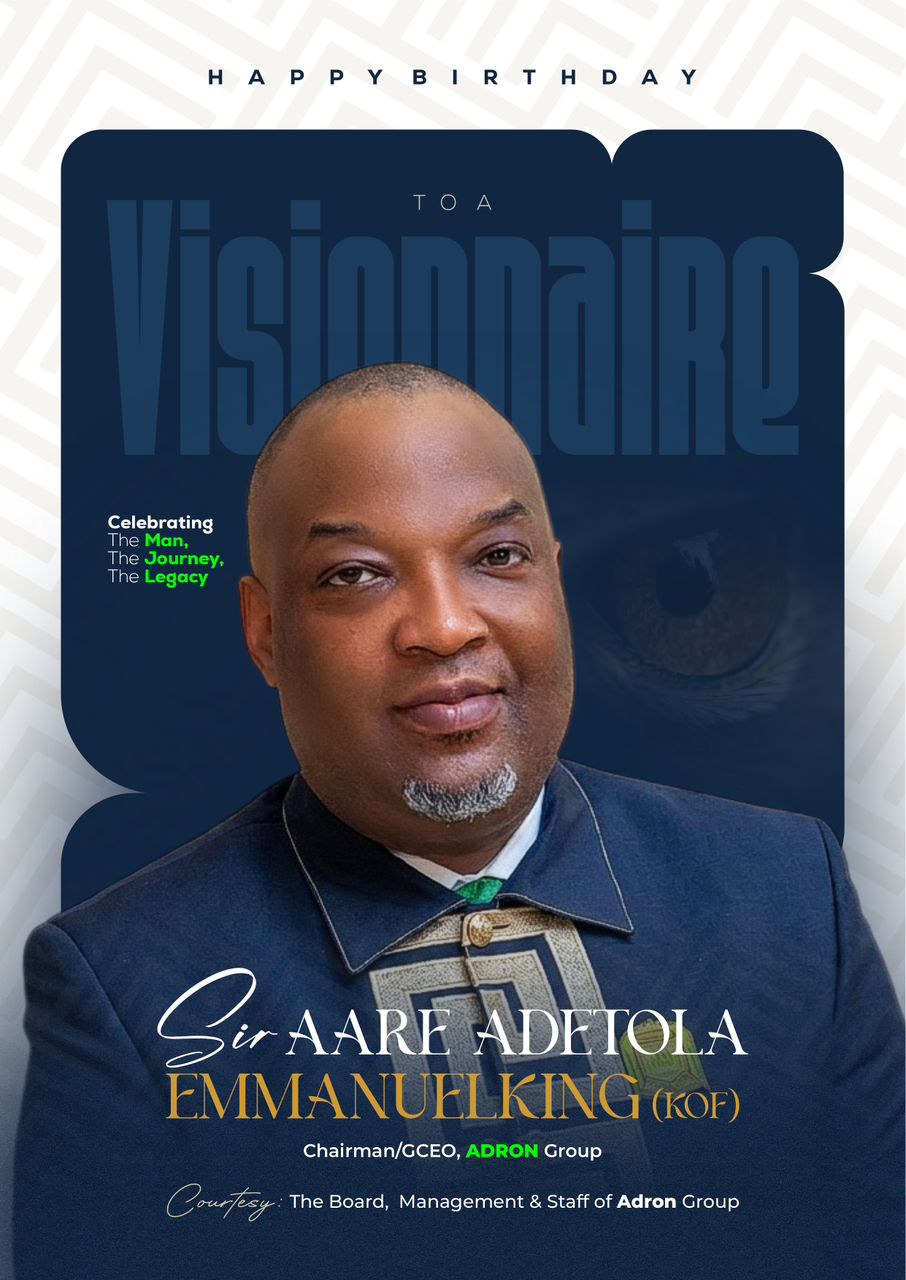
Adron Homes Celebrates Visionary Chairman, Aare Adetola Emmanuel King, at 51
The management and staff of Adron Homes and Properties Limited have joined family, friends, associates, and well-wishers across the globe to celebrate their Chairman and Chief Executive Officer, Aare Adetola EmmanuelKing, as he marks his 51st birthday.

In a statement released by the company, the milestone was described as a celebration of an exceptional leader whose vision, resilience, and entrepreneurial brilliance have not only transformed Adron Homes into a household name in Nigeria’s real estate sector but have also redefined affordable housing across the country.
Under his dynamic leadership, Adron Homes has continued to expand its footprint, delivering value-driven residential solutions while empowering thousands of Nigerians with opportunities for home ownership. His commitment to excellence, innovation, and customer satisfaction has remained the driving force behind the company’s sustained growth and industry leadership.
The statement further highlighted Aare EmmanuelKing’s passion for nation-building and community development, noting his significant contributions to job creation, youth empowerment, and the promotion of socio-economic development through real estate investments.
“As a leader, mentor, and visionary, Aare Adetola EmmanuelKing has consistently inspired a culture of excellence, integrity, and dedication within the organization. His ability to turn bold ideas into reality continues to position Adron Homes as a trailblazer in the industry,” the statement read.
The company expressed profound gratitude for his steadfast leadership and prayed for continued wisdom, strength, and sound health as he embarks on another year of impactful achievements.
As he celebrates his 51st birthday, the entire Adron Homes family proudly honours a man whose legacy continues to shape the future of real estate in Nigeria.
Happy 51st Birthday, Aare Adetola EmmanuelKing!
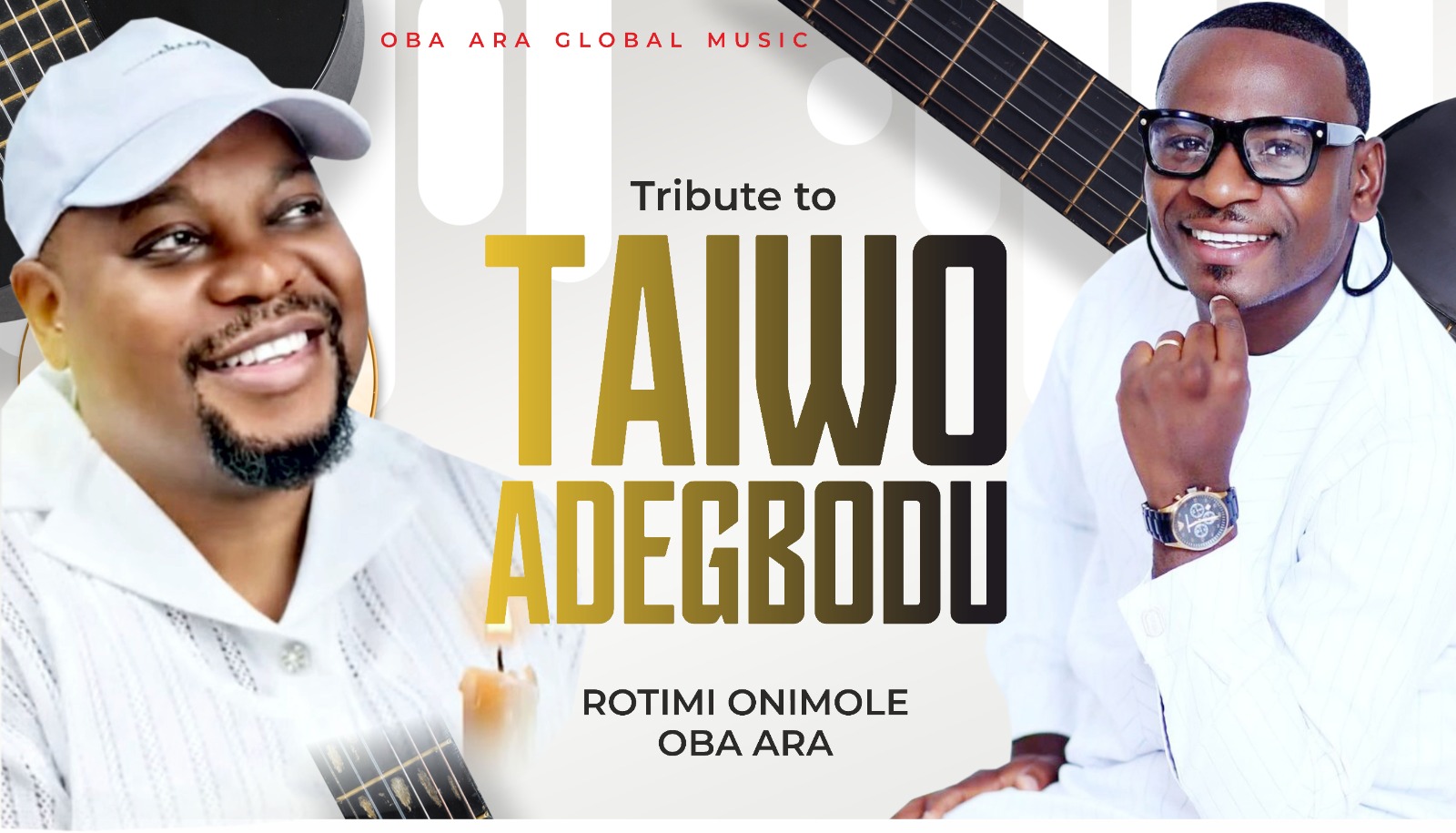
Oba Ara Releases Emotional Tribute to Late Taiwo Adegbodu
Taofik Afolabi
The gospel music community continues to grieve the painful loss of Taiwo Adegbodu, a beloved figure whose sudden departure left a deep void among fans, colleagues, and loved ones. In response to this loss, renowned gospel minister Rotimi Onimole, popularly known as Oba Ara, has released a moving tribute song that captures both the sorrow of the moment and the enduring legacy of the late singer.
Oba Ara, a proud son of Isale Eko, channels raw emotion throughout the song, using heartfelt lyrics and soul-stirring melodies to reflect on his personal connection with Taiwo Adegbodu. In the tribute, he openly expresses how deeply the news of Adegbodu’s passing shook him, describing it as a painful and unexpected loss that is difficult to come to terms with.
The song goes beyond mourning, it celebrates the life, ministry, and impact of Taiwo Adegbodu. Oba Ara highlights the late artist’s dedication to spreading the gospel through music, his inspiring voice, and the spiritual influence he had on many within and beyond Nigeria. Through powerful verses, he paints a picture of a man who lived for God and touched countless lives through his ministry.
Listeners have described the tribute as both comforting and deeply emotional, as it resonates with the collective grief of the gospel music community. It serves as a reminder that although Taiwo Adegbodu is no longer physically present, his music, message, and legacy will continue to live on.
In honoring his late colleague, Oba Ara not only pays his respects but also offers a source of healing for fans and fellow ministers, using music as a tool to process grief and celebrate a life well lived.
celebrity radar - gossips
Buratai, Fagbemi , Shagaya, Olofa, Others Eulogise Olowu Kuta’s Olori On 60th Birthday, Foundation Launch
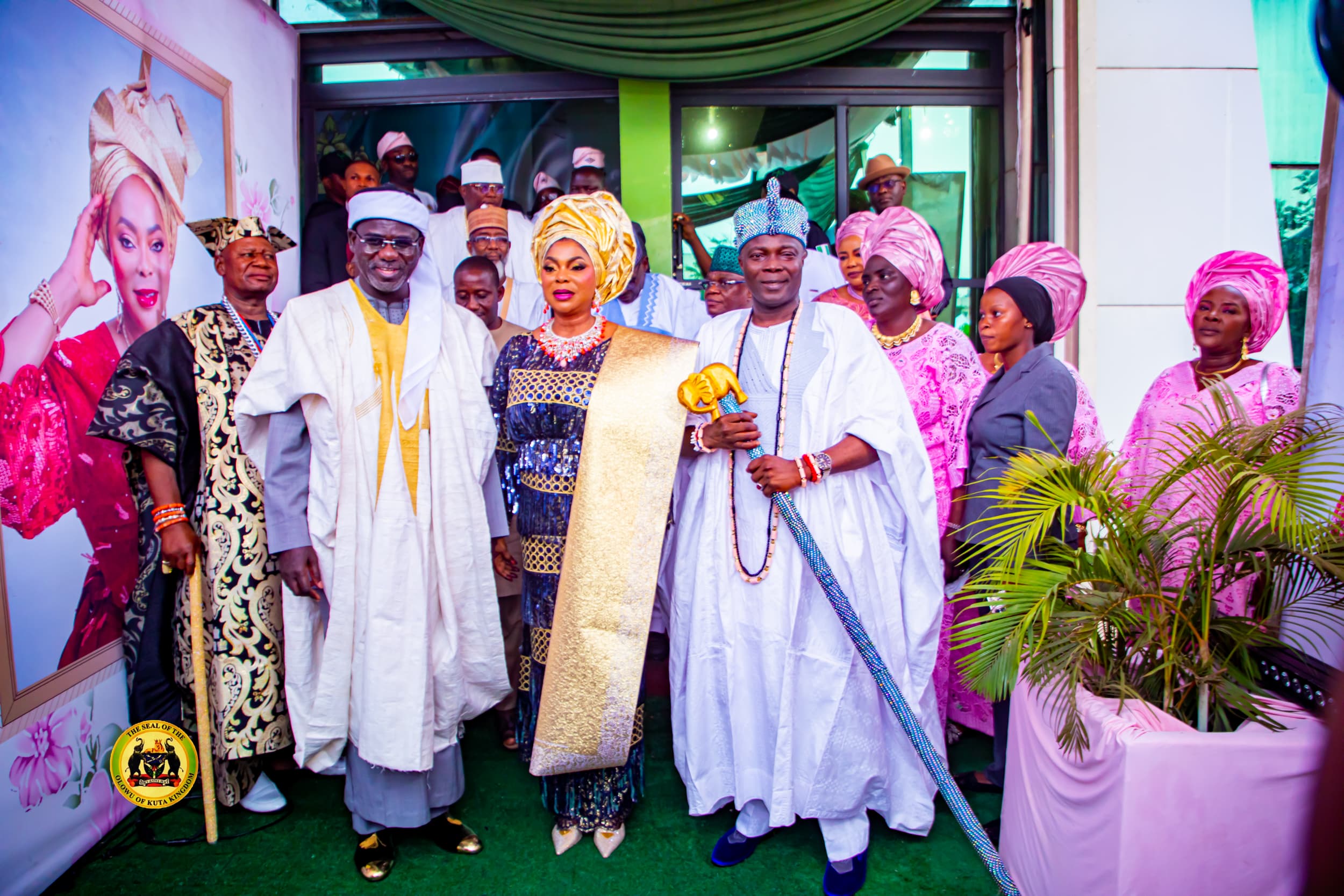
Buratai, Fagbemi , Shagaya, Olofa, Others Eulogise Olowu Kuta’s Olori On 60th Birthday, Foundation Launch
Eminent personalities across the Nigeria stormed the TFK Event Centre, Bala Mohammed Way, Guzape, Abuja, to celebrate the 60th birthday of Olowu Kuta’s Olori, Queen Jumai Amoke and her Foundation Launch on Saturday 28, March 2026.

From former Chief of Army Staff, Lt Gen TY Buratai rtd, to the Minister of Justice and Attorney-General of the Federation, Prince Lateef Fagbemi; Olofa of Offa, HRM Oba Mufutau Gbadamosi. Even top businesswoman and socialite, Chief (Mrs) Bola Shagaya, was in attendance.


Other dignitaries were newly promoted Deputy Inspector-General of Police and former AIG Zone 2 , Lagos , Adegoke Fayoade, Major General Abdumalik, Major General Samuel Adebayo rtd (Fmr CDI);
Major General Anthony Omozoje rtd (Fmr Copp);
Alhaji Tajudeen Owoyemi (Asiwaju of Offa and CEO Radisson Hotel Nigeria;
Dr Waheed Olagunju, former managing director of Bank of Industry, Oniba of Iba, Lagos State, HRM Oba Dr Suleiman Raji ;
Justice Falola, Olu of Ile-Ogbo , Oba Adetoyese amongst many traditional rulers and captains of industry too numerous to mention.
Speaking at the occasion, the Chief Host, Olowu of Kuta, HRM Oba Dr Adekunle Oyelude Makama, CON , Tegbosun iii, who is also the husband of the celebrant commended Queen Jumai for ‘ her slender arms full of kindness’ to establish such humanitarian Foundation, ‘Amoke Children and mother in Need Foundation’ at a time Nigerians are going through economic crisis occassioned by the global meltdown.
Olowu also commended her steadfastness and love for the less privileged and downtrodden.
The monarch refrenced the task before his wife’s humanitarian gesture said her best is yet to come.
” Olori Amoke Jumai, I celebrate you. You will celebrate 70, 80, 90 and continue to shine as you continue to put a smile on people’s faces. I love you, “Olowu Kuta added.
To Lt Gen Buratai, a former army chief and former Nigerian Ambassador to Benin Republic, the reward of hard work is more work.
Buratai, who also doubles as Balogun Agba of Owu Kuta, a chieftaincy title reserved for a generalismo congratulated Queen Jumai for attaining the age of 60 in good health.
The retired army General said he’s not surprised by the turn out of eminent personalities across the country to celebrate the Olowu Kuta’s Olori because she merited it through her hospitality to all, adding that Allah the most merciful, most beneficial would accept all her act of ibadah.
The minister of Justice, Prince Fagbemi, was full of praises for Queen Jumai for deeming it fit to have a place in her heart to accommodate the needy and less privileged in ‘our society.’
Prince Fagbemi urged the guests to contribute generously to support the Foundation in order to continue to alleviate poverty and put a smile on the faces of the people.
” I congratulate you on your 60th birthday and Foundation Launch. I wish you many happy returns of the day and many more fruitful services to the country and motherland”, Prince Fagbemi added.
The celebrant, Queen Jumai who was grining from ear to ear thankfully said she was excited by the turn out and the response of the people to her foundation.
Queen Jumai, however, promised to continue to use her resources and donations received for the good of the needy and less privileged in the society.
” I want to appreciate my own Kabiesi Olofa of Offa , for his presence and im I’m using him as a point of contact to all other Kabiesis present here, the minister of justice and Attorney-General, you’re welcome, sir; Mrs Bola Shagaya, I salute your enterprise, Lt Gen Buratai, I’m grateful, sir; DIG Fayoade, Justice Falola and other dignitaries too numerous to mention, I thank you, all. To my darling husband, Kabiesi Olowu , I thank you immensely for your support. And to my family and friends, I thank you , all. E se pupo!”, she said.


-

 society7 months ago
Religion: Africa’s Oldest Weapon of Enslavement and the Forgotten Truth
-

 news4 months ago
WHO REALLY OWNS MONIEPOINT? The $290 Million Deal That Sold Nigeria’s Top Fintech to Foreign Interests
-

 society6 months ago
“You Are Never Without Help” – Pastor Gebhardt Berndt Inspires Hope Through Empower Church (Video)
-

 celebrity radar - gossips2 months ago
Dr. Chris Okafor Returns with Power and Fire of the Spirit -Mounts Grace Nation Altar with Fresh Anointing and Restoration Grace on February 1, 2026