
celebrity radar - gossips
Ambode At 55:Lowers his voice, raises his logic! -BY IDOWU AJANAKU

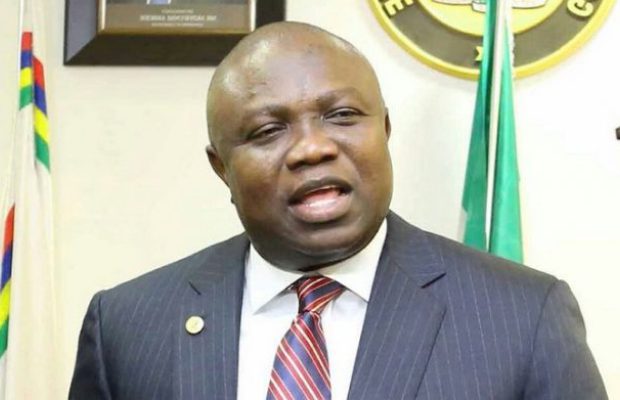
“Good Leader ate trailblazers ,making a path for others to follow”
Forbes.com
As global attention is riveted on the unfolding spectacle of the 21st edition of the FIFA World Cup in Russia today, there are interesting parallels to draw with a goal-getting Nigerian, whose illustrious life trajectory clocks 55 years on this same day. Much like the world-acclaimed beautiful game, which few observers gave a chance to survive, talk less of exploding when it began back in England in 1863, Lagos State Governor Mr. Akinwunmi Ambode was the little known aspirant when political pundits began to permutate on the likely successor to erstwhile Governor Babatunde Raji Fashola then in 2014.
But the leadership narrative has since changed, as Lagos state has become a reference point to Nigerians, nay Africans within the political power context. In a similar compelling, centripetal attraction that soccer enjoys amongst people of diverse races and religion, social strata and even political persuasion, the question on virtually everyone’s lip is what magic wand has Ambode waved to turn Lagos into an emerging smart city? That is, within a short span of three years in the saddle of the world’s fastest growing city and Africa’s fifth largest economy. The questions persist.
However, to be on the good side of history and more significantly to become better by the day, let us attempt answers from Ambode’s life experiences. Especially, those that have stood him in good stead. Just like football, with its thrills and frills and its team- game format there are rules to obey. We can only win life’s daily matches if we, like Ambode have the focus, the desire, the determination to excel no matter who would tackle us when we eventually have the ball.
For instance, the early death of his father was one of such challenges. However, instead of capitulating, he took it as a stepping stone to climb to greater heights by sacrificing his time and talents to concentrate on his studies. That he emerged the second-best student in the West African Examination Council(WAEC) O\L examinations at the end of his secondary school days is a testament to such iron-will determination to succeed against the odds, as John Harold Johnson(now late) of Ebony Magazine fame once admonished.
Secondly, Ambode was one young man who was written off by his uncle, at the age of 11 years, especially when he expressed his desire to becoming an accountant. The older man thought he did not possess the DNA to ever qualify as one. But the story has since changed its tempo and tenor. By 2015 when Mr. Akinwunmi Ambode became the APC flag-bearer of the state, he had already metamorphosed into a thoroughbred, tested and trusted technocrat. He was the former Accountant –General, Permanent Secretary Ministry of Finance and Auditor-General who has traversed several of the local government councils in the state.
Another salient, vital feature of successful leadership, as exemplified by Ambode is to be fully prepared for the onerous tasks at hand. Based on his wealth of experience he knew the needs and nuances of the state like the lines on his palms. So, he hit the ground running.
Little wonder that within six months in office his forward-looking administration, achieved all these and more. Specifically, in the health sector, the governor commissioned 20 Mobile Intensive Care Units (MICU) and 26 Transport Ambulances one for each of the 26 General hospitals. He ensured that ambulances were bought for all the public hospitals in the state, paid the aggrieved medical doctors their outstanding salaries and the long-suffering pensioners.
Similarly, Ambode approved the recruitment of more paramedic staff and special medical coordinators to guarantee 24 hours service. Besides, he upgraded the General Hospitals and constructed a Medical Park fully equipped with quality drugs and new mobile X-Ray machines. He similarly lent helping hand to victims of disasters including motor-accidents, fire outbreaks as well as mudslide in addition to diffusing governance to those at the lower rung of the Lagos society.
Making a wise choice, he began by beefing up security across the state. This he did by acquiring 10 armoured tanks, three helicopters for aerial surveillance and policing, two gun boats, 15 armoured personnel carriers and dozens of Isuzu trucks. Still on security, he initiated the Light Up Lagos Project covering at least 365 streets across the state.
On the massive infrastructural development, Ambode has turned Lagos into a vast construction site, as people are currently awed by the 10-lane Airport Road and the Oshodi Interchange edifice. Indeed, Lagos now boasts of state-of-the art flyover bridges at Ajah and Abule-Egba with that of the popular Pen-Cinema in the works.
Also, in less than one year in office some 282 inner roads received massive rehabilitation, as requested by the people during his tour of the LCDAs before his election. In fact, his ‘114 Roads’ project where each of the 57 local councils in the state got two good roads was completed by May, 2016.
Economic empowerment was next. It received a boost in December of that year as he began the disbursement of the N25 billion Employment Trust Fund,(ETF) to carpenters, tailors, hairdressers, vulcanizers and other players in the informal sector in the state. The initiative will see the disbursement of N6.25 billion annually over the next four years. It was also one of the promises he made during his campaign in 2015.
The food security issue was kick started with the launch of the Lagos-Kebbi (LaKe Rice) in December 2016. It came at the right time as thousands of residents trooped out to various centres across the three senatorial districts to buy the commodity which sold for N12,000 (50kg bag); N6,000 (25kg); and N2,500 (10kg). It was a much needed respite for a population that had been reeling under the impact of economic recession. The smiles widen as Lagos is getting ready to commission one of Africa’s largest rice mills months from now.
Barely over two years in office the state had raked in N287 billion in IGR, a whopping N19 billion more than was generated the year before. A revamp of the state’s revenue generation agency played a major role in this feat, but Mr. Ambode also gave credit to tax-paying citizens in the state.
It is a similar swan song from education through agriculture, to transportation and tourism. One great lesson for millions to learn from the governor’s success story therefore, is for one to be blessed with a strong God-fearing family. Both he and Bolanle, his woman of virtue have their lives firmly rooted in God. She is there as a pillar of support and as one who has stood by him through thick and thin. Besides, is their humility and tracing every success to the throne of God.
Said he, at a recent Sunday Service to mark his three years in office: “No matter how much strategy that you have read in school or how much work you have done in the public service, …if it is working back- to -back and consistently, there has to be some other source that is making it work because you are just one out of several others. Why it works for Lagos is the more reason why one has to be very sober and humble, to actually know that there is something that is making that to happen and that has to be God”.
If, for the first time in the history of Lagos state and indeed Nigeria no other politician has come forward to challenge Gov. Ambode, nine good months to the 2019 gubernatorial election , it must be God. That explains why he is being celebrated nationally and globally, like a World Cup winning goal!
Many happy returns, my dear, iconic boss.
Ajanaku is the Special Adviser, Information and Strategy to the governor




celebrity radar - gossips
Adron Homes Celebrates Visionary Chairman, Aare Adetola Emmanuel King, at 51
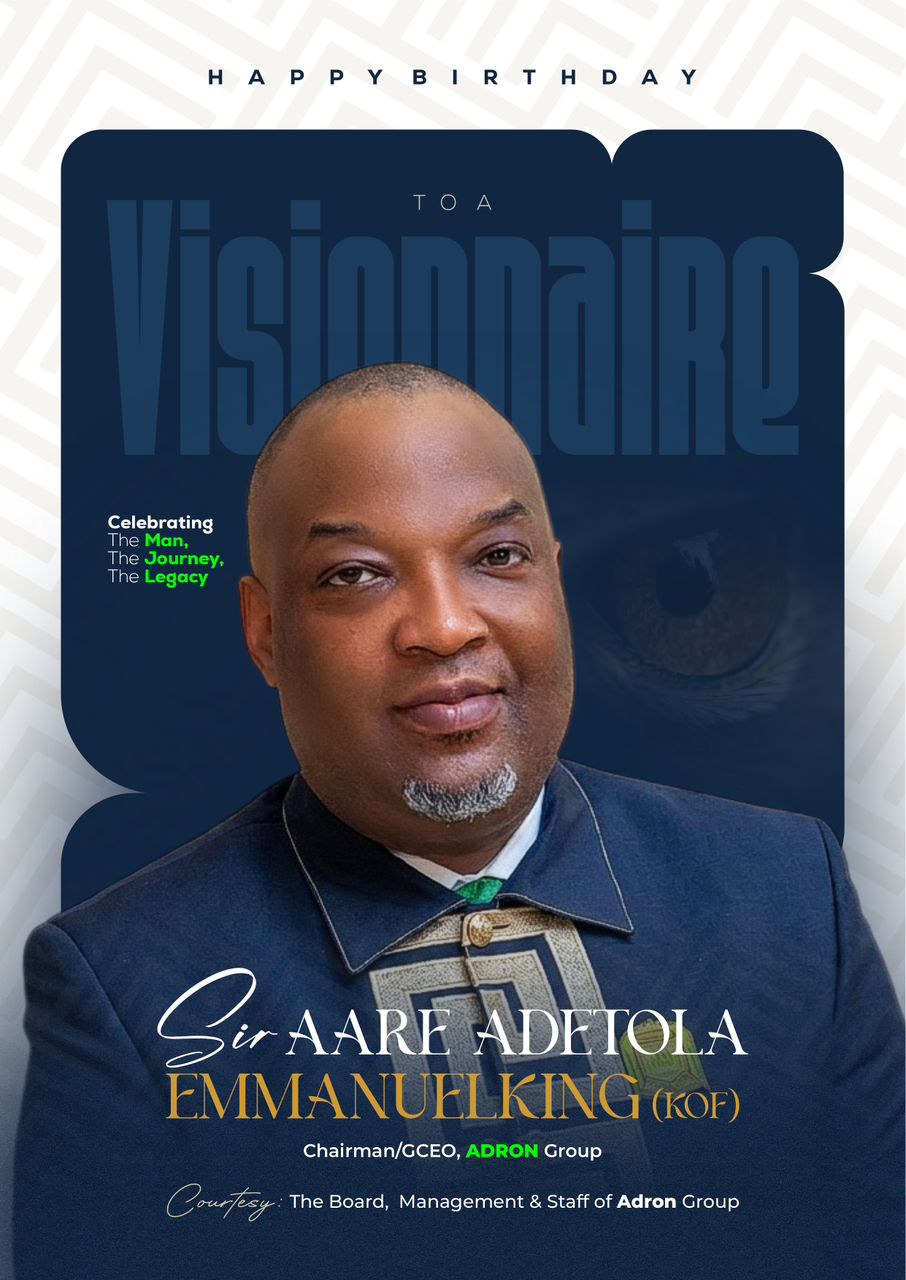
Adron Homes Celebrates Visionary Chairman, Aare Adetola Emmanuel King, at 51
The management and staff of Adron Homes and Properties Limited have joined family, friends, associates, and well-wishers across the globe to celebrate their Chairman and Chief Executive Officer, Aare Adetola EmmanuelKing, as he marks his 51st birthday.

In a statement released by the company, the milestone was described as a celebration of an exceptional leader whose vision, resilience, and entrepreneurial brilliance have not only transformed Adron Homes into a household name in Nigeria’s real estate sector but have also redefined affordable housing across the country.
Under his dynamic leadership, Adron Homes has continued to expand its footprint, delivering value-driven residential solutions while empowering thousands of Nigerians with opportunities for home ownership. His commitment to excellence, innovation, and customer satisfaction has remained the driving force behind the company’s sustained growth and industry leadership.
The statement further highlighted Aare EmmanuelKing’s passion for nation-building and community development, noting his significant contributions to job creation, youth empowerment, and the promotion of socio-economic development through real estate investments.
“As a leader, mentor, and visionary, Aare Adetola EmmanuelKing has consistently inspired a culture of excellence, integrity, and dedication within the organization. His ability to turn bold ideas into reality continues to position Adron Homes as a trailblazer in the industry,” the statement read.
The company expressed profound gratitude for his steadfast leadership and prayed for continued wisdom, strength, and sound health as he embarks on another year of impactful achievements.
As he celebrates his 51st birthday, the entire Adron Homes family proudly honours a man whose legacy continues to shape the future of real estate in Nigeria.
Happy 51st Birthday, Aare Adetola EmmanuelKing!
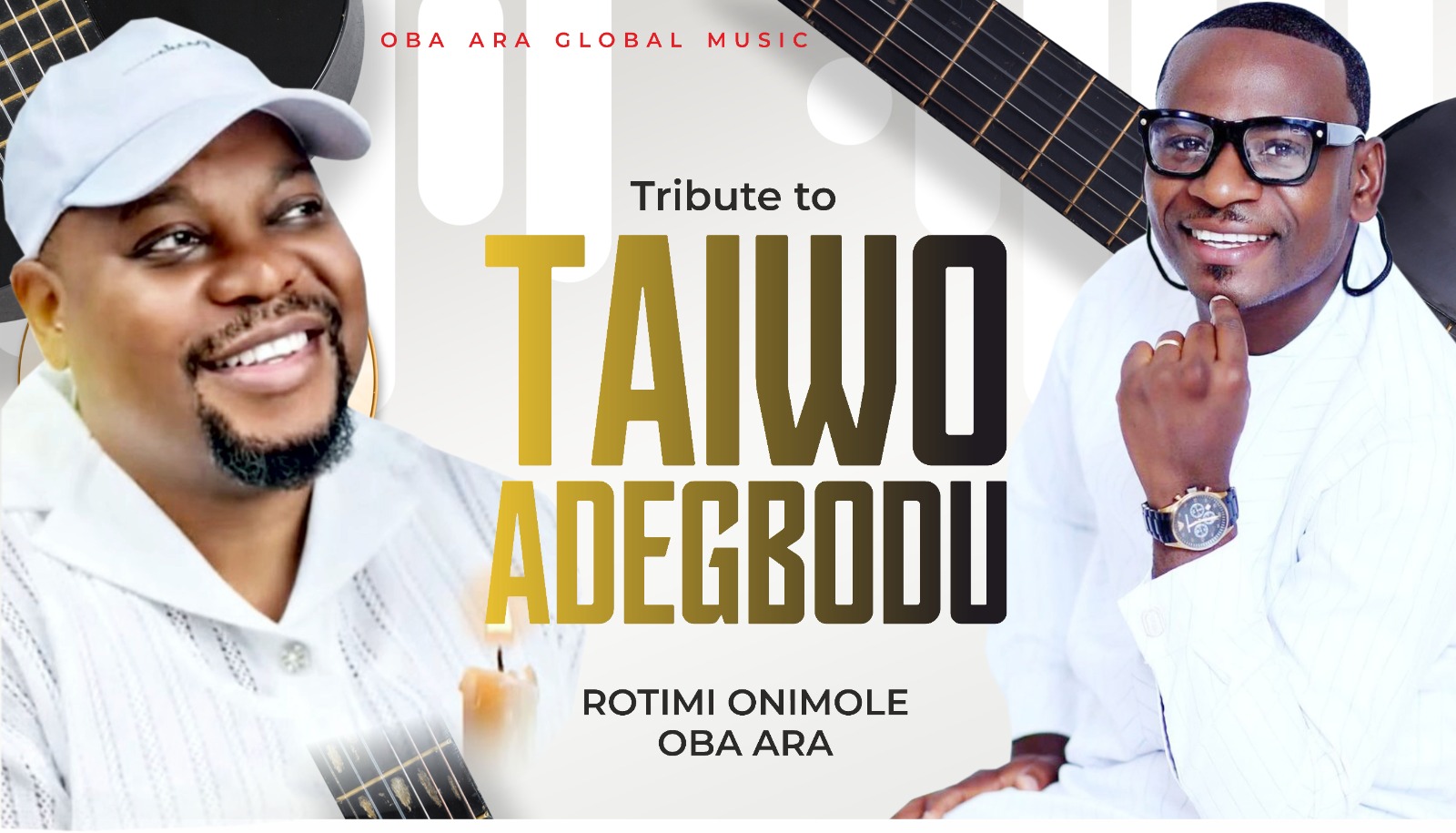
Oba Ara Releases Emotional Tribute to Late Taiwo Adegbodu
Taofik Afolabi
The gospel music community continues to grieve the painful loss of Taiwo Adegbodu, a beloved figure whose sudden departure left a deep void among fans, colleagues, and loved ones. In response to this loss, renowned gospel minister Rotimi Onimole, popularly known as Oba Ara, has released a moving tribute song that captures both the sorrow of the moment and the enduring legacy of the late singer.
Oba Ara, a proud son of Isale Eko, channels raw emotion throughout the song, using heartfelt lyrics and soul-stirring melodies to reflect on his personal connection with Taiwo Adegbodu. In the tribute, he openly expresses how deeply the news of Adegbodu’s passing shook him, describing it as a painful and unexpected loss that is difficult to come to terms with.
The song goes beyond mourning, it celebrates the life, ministry, and impact of Taiwo Adegbodu. Oba Ara highlights the late artist’s dedication to spreading the gospel through music, his inspiring voice, and the spiritual influence he had on many within and beyond Nigeria. Through powerful verses, he paints a picture of a man who lived for God and touched countless lives through his ministry.
Listeners have described the tribute as both comforting and deeply emotional, as it resonates with the collective grief of the gospel music community. It serves as a reminder that although Taiwo Adegbodu is no longer physically present, his music, message, and legacy will continue to live on.
In honoring his late colleague, Oba Ara not only pays his respects but also offers a source of healing for fans and fellow ministers, using music as a tool to process grief and celebrate a life well lived.
celebrity radar - gossips
Buratai, Fagbemi , Shagaya, Olofa, Others Eulogise Olowu Kuta’s Olori On 60th Birthday, Foundation Launch

Buratai, Fagbemi , Shagaya, Olofa, Others Eulogise Olowu Kuta’s Olori On 60th Birthday, Foundation Launch
Eminent personalities across the Nigeria stormed the TFK Event Centre, Bala Mohammed Way, Guzape, Abuja, to celebrate the 60th birthday of Olowu Kuta’s Olori, Queen Jumai Amoke and her Foundation Launch on Saturday 28, March 2026.

From former Chief of Army Staff, Lt Gen TY Buratai rtd, to the Minister of Justice and Attorney-General of the Federation, Prince Lateef Fagbemi; Olofa of Offa, HRM Oba Mufutau Gbadamosi. Even top businesswoman and socialite, Chief (Mrs) Bola Shagaya, was in attendance.


Other dignitaries were newly promoted Deputy Inspector-General of Police and former AIG Zone 2 , Lagos , Adegoke Fayoade, Major General Abdumalik, Major General Samuel Adebayo rtd (Fmr CDI);
Major General Anthony Omozoje rtd (Fmr Copp);
Alhaji Tajudeen Owoyemi (Asiwaju of Offa and CEO Radisson Hotel Nigeria;
Dr Waheed Olagunju, former managing director of Bank of Industry, Oniba of Iba, Lagos State, HRM Oba Dr Suleiman Raji ;
Justice Falola, Olu of Ile-Ogbo , Oba Adetoyese amongst many traditional rulers and captains of industry too numerous to mention.
Speaking at the occasion, the Chief Host, Olowu of Kuta, HRM Oba Dr Adekunle Oyelude Makama, CON , Tegbosun iii, who is also the husband of the celebrant commended Queen Jumai for ‘ her slender arms full of kindness’ to establish such humanitarian Foundation, ‘Amoke Children and mother in Need Foundation’ at a time Nigerians are going through economic crisis occassioned by the global meltdown.
Olowu also commended her steadfastness and love for the less privileged and downtrodden.
The monarch refrenced the task before his wife’s humanitarian gesture said her best is yet to come.
” Olori Amoke Jumai, I celebrate you. You will celebrate 70, 80, 90 and continue to shine as you continue to put a smile on people’s faces. I love you, “Olowu Kuta added.
To Lt Gen Buratai, a former army chief and former Nigerian Ambassador to Benin Republic, the reward of hard work is more work.
Buratai, who also doubles as Balogun Agba of Owu Kuta, a chieftaincy title reserved for a generalismo congratulated Queen Jumai for attaining the age of 60 in good health.
The retired army General said he’s not surprised by the turn out of eminent personalities across the country to celebrate the Olowu Kuta’s Olori because she merited it through her hospitality to all, adding that Allah the most merciful, most beneficial would accept all her act of ibadah.
The minister of Justice, Prince Fagbemi, was full of praises for Queen Jumai for deeming it fit to have a place in her heart to accommodate the needy and less privileged in ‘our society.’
Prince Fagbemi urged the guests to contribute generously to support the Foundation in order to continue to alleviate poverty and put a smile on the faces of the people.
” I congratulate you on your 60th birthday and Foundation Launch. I wish you many happy returns of the day and many more fruitful services to the country and motherland”, Prince Fagbemi added.
The celebrant, Queen Jumai who was grining from ear to ear thankfully said she was excited by the turn out and the response of the people to her foundation.
Queen Jumai, however, promised to continue to use her resources and donations received for the good of the needy and less privileged in the society.
” I want to appreciate my own Kabiesi Olofa of Offa , for his presence and im I’m using him as a point of contact to all other Kabiesis present here, the minister of justice and Attorney-General, you’re welcome, sir; Mrs Bola Shagaya, I salute your enterprise, Lt Gen Buratai, I’m grateful, sir; DIG Fayoade, Justice Falola and other dignitaries too numerous to mention, I thank you, all. To my darling husband, Kabiesi Olowu , I thank you immensely for your support. And to my family and friends, I thank you , all. E se pupo!”, she said.


-

 society7 months ago
Religion: Africa’s Oldest Weapon of Enslavement and the Forgotten Truth
-

 news4 months ago
WHO REALLY OWNS MONIEPOINT? The $290 Million Deal That Sold Nigeria’s Top Fintech to Foreign Interests
-

 society6 months ago
“You Are Never Without Help” – Pastor Gebhardt Berndt Inspires Hope Through Empower Church (Video)
-

 celebrity radar - gossips2 months ago
Dr. Chris Okafor Returns with Power and Fire of the Spirit -Mounts Grace Nation Altar with Fresh Anointing and Restoration Grace on February 1, 2026
You must be logged in to post a comment Login
You must log in to post a comment.