
Business
An account of the Alleged mind-blowing corruption of ex- NDLEA boss Ahmadu Giade


NDLEA official petitions Buhari
*Alleges fresh plot to abduct Senator Kashamu
A top official of the National Drug Law Enforcement Agency (NDLEA), Paul Audu, a lawyer, has written a petition to President Muhammadu Buhari.
In the petition, Barrister Audu urged him to order an investigation into alleged atrocities committed by the former Chairman/Chief Executive of the Agency, Alhaji Ahmadu Giade during his 10-year tenure.
The petition was titled “A Call for Investigation of Allegations of Corrupt Practices and Clandestine Activities of Alhaji Ahmadu Giade (Former NDLEA Chairman/Chief Executive), dated 28th March, 2016.
[Audu is a Chief Superintendent of Narcotics.]
He said he was constrained to send the petition to the President because no action was taken on an earlier one he sent to the Attorney-General of the Federation and Minister of Justice in December, 2015.
Specifically, he said the petition was received in the Office of the AGF on the 11th of December, 2015.
In the earlier petition dated December 1, 2015, Audu had alleged, among others, that Giade embezzled the sum of Five Hundred Million Naira (N500, 000,000.00).
That being the fund remitted to the Agency by the Federal Government of Nigeria in 2008 for the purpose of carrying out Drug Demand Reduction enlightenment campaign.
The campaign was aimed at reducing and discouraging illicit drug business and consumption in Nigeria.
He also accused Giade of converting to personal use the sum of Sixteen Million Naira (N16,000,000.00).
The said sum was the balance of the sum of Thirty Four Million Naira (N34,000,000.00) remitted to the Agency (NDLEA) by National Emergency Management Agency (NEMA).
It was earmarked for the training of its staff at the NDLEA Academy, Jos, Plateau State.
The petitioner also urged the President to order the relevant anti-graft agencies to probe how Giade allegedly doubled for himself the estacode due to him.
It doubled from Five Hundred and Fifty Dollars per night ($550.00) to One Thousand Dollars ($1,000.00) per night for all the foreign trips embarked upon by him during his headship of the Agency.
The former NDLEA boss was further accused of corruptly enriching himself with the sum of One Billion, Five Hundred Thousand Naira (N1.5billion).
That was the fund remitted to the Agency in 2014 as Intervention Fund by the Federal Government.
Giade was also said to have allegedly misappropriated the sum of Nine Hundred Million Naira (N900, 000,000).
The said sum was realized through the Agency’s recruitment portals.
He made applicants for the Agency’s job to pay the sum of One Thousand Five Hundred Naira (N1, 500.00) as application/access fees.
According to Audu, the Area Commander of Gada Area Command in Sokoto State, he realized the said amount without offering them jobs.
Audu further alleged that contrary to Giade’s term of employment on the 24th November, 2005, for a term of 4 years, he (Giade) stayed in office for six (6) more years without valid renewal of his tenure.
“[He] thereby fraudulently occupied the said office for a period of 10 years (i.e. from 24th November, 2005 to 24th November, 2015) during which he was remunerated with tax payers’ money and thereby conferred unfair advantage on himself.”
The petitioner alleged further that Giade flagrantly disobeyed a superior circular from a constituted authority to wit;
The Federal Civil Service Commission with Ref. no; FC.6243/S.1/XVIII/5 dated 28th May, 2010 and received in his office on 7th June, 2010.
He, however, deliberately refused/failed to promote the staff/officers of the Agency already due or in arrears of promotion on or before 30th of November, 2010, as directed in the said circular.
He, therefore, stagnated several officers of the Agency for upward of six to 10 years or more.
Audu also accused the former Narcotics czar of stealing the sum of One Billion, Five Hundred Million Naira (N1.5b).
That was the fund remitted to the Agency between October, 2014 and March, 2015, by the Federal Government to be disbursed to officers of the Agency for the March and April, 2015 general elections.
The petitioner accused Giade of compromising national security.
This he did by collaborating with and permitting the Drug Enforcement Administration (DEA) Office of the United States of America to install surveillance/intelligence gathering gadgets.
Said gadgets were installed at Nigerian International Airports and the Agency’s national headquarters, Ikoyi, Lagos, under US officials’ control and management.
Through those gadgets, they directly spy over Nigeria territory and our military formations within the areas of coverage, including the Nigerian Air Force Base, Ikeja, Lagos.
They continuously gather intelligence on Nigeria to the detriment of the Federal Government.
In the latest petition to President Buhari, Audu quipped, “The question then is: since those gadgets do not and cannot detect drugs, what then could be the motive for installing them?
“The motive obviously cannot be far from espionage. Can Nigeria do this in America? Certainly not!
“We must be able to strike a balance between foreign aid and our national security which must be held sacrosanct, inviolable and non-negotiable as a sovereign nation.”
Audu alleged that “Giade’s lawlessness and disobedience for the rule of law and court orders have no boundary.
“The dramo-hypocritical and orchestrated invasion of the premises of Senator Kashamu in May, 2015 cannot be forgotten in a hurry.
“I am very much aware that the Agency had previously sent some of its very senior officers to London to give evidence in Buruji Kashamu’s favour.
“[They] equally deposed to affidavit in his favour at the Federal High Court, Lagos in 2002 and 2013 respectively (i.e. under Giade’s administration).
“So, how can we now reasonably explain the sudden dramatic twist ignited by Giade against the same Kashamu soon after your victory at the poll?”
The top NDLEA official more or less confirmed the recent alarm raised by the Senator representing Ogun East Senatorial District of Ogun State, Buruji Kashamu.
Kashamu had alleged that Giade and some powerful persons were planning to abduct him and forcibly take him to the U.S.
“However, I recently read of the alarm raised by Senator Kashamu about yet another attempt by Giade to abduct him’
“[That] made him to sue the AGF, NDLEA and Giade, and also petitioned the National Assembly.
“Knowing Giade’s predilection for illegalities, this might not be unfounded.
“Information is rife now again within the Agency about such planned abduction in another form by Giade, in collaboration with US Embassy officials in Nigeria and DEA agents.”
Audu commended President Buhari’s anti-corruption war “more so that it leaves no room for sacred cows, and Alhaji Ahmadu Giade must not be an exception”.
He faulted the appointment of Giade as Special Assistant to the Attorney-General of the Federation and Minister of Justice.
He wondering what such “a lawless fellow” was doing in the office of the Chief Law Officer of the Federation.
In conclusion, the operative said, “All the criminal allegations contained in the attached Appendix A against him are evidently verifiable.
“Giade should be asked to step aside from his position and referred to the appropriate Agency for investigation in order to establish the veracity or otherwise of the allegations against him.
“Even if it is for the sake of restoring order to the system and recovering the stupendous public funds looted by him.”





Fidelity Bank grows gross earnings by 38% to N434.95b in Q1
Fidelity Bank Plc recorded 37.9 per cent growth in gross earnings to N434.95 billion in first quarter 2026 as the international commercial bank continued to expand its core banking market share.
Interim report and accounts of Fidelity Bank for the three months ended March 31, 2026 released at the Nigerian Exchange (NGX) showed that gross earnings rose from N315.42 billion in first quarter 20025 to N434.95 billion in first quarter 2026, representing an increase of 37.9 per cent.
The top-line performance was driven by impressive growth in the bank’s core business operations with interest incomes rising by 22.8 per cent to N314.48 billion in first quarter 2026 as against N256.10 billion in first quarter 2025.
With net interest income at N180.97 billion, the bank closed the period with profit before tax of N92.48 billion. After taxes, net profit stood at N74.47 billion for the three-month period. Earnings per share remained high at N5.69, underlining the capacity of the bank to reward its shareholders.
The balance sheet of the bank also emerged stronger. Total assets crossed the N11 trillion mark to N11.35 trillion by March 2026 compared with N10.46 trillion recorded in December 2025. Customers’ deposits increased from N6.89 trillion to N7.38 trillion. Total equity rode on the back of earnings growth to a 27.5 per cent increase from N1.09 trillion in December 2025 to N1.39 trillion by March 2026.
The first quarter 2026 results further consolidated the strong earnings outlook of the bank, which had successfully completed its recapitalisation amidst impressive earnings performance in 2025.
Fidelity Bank had recorded double-digit growths in interest and non-interest incomes as well as key balance sheet items during the year ended December 31, 2025.
The audited report showed that gross earnings rose from N1.04 trillion in 2024 to N1.52 trillion in 2025, an increase of 45.6 per cent. Interest and similar incomes had grown by 38.7 per cent from N803.1 billion in 2024 to N1.11 trillion in 2025. Fees and commission incomes also rose by 44.7 per cent from N78.4 billion to N113.4 billion. The bank recorded net profit after tax of N242.4 billion in 2025.
The bank’s balance sheet emerged stronger with total assets rising by 18.6 per cent to N10.46 trillion in 2025 as against N8.82 trillion in 2024. Customer deposits increased by 16.1 per cent from N5.94 trillion to N6.89 trillion, reflecting continued franchise strength and an improved funding profile. Net loans and advances meanwhile declined by 2.4 per cent to N4.28 trillion in 2025 as against N4.39 trillion in 2024, attributable to customers paying down on their mature obligations.
The bank had in 2025 strengthened its capital position, with eligible capital rising to N561 billion, above the regulatory minimum of N500 billion for banks with international authorisation. In addition, capital adequacy had remained robust, with Capital Adequacy Ratio of 30.94 per cent by December 2025 as against 23.47 per cent by December 2024.
Managing Director, Fidelity Bank Plc, Dr. Nneka Onyeali-Ikpe, said the first quarter 2026 results reinforced the bank’s strong and resilient business model.
She noted that with the remarkable success of its recapitalisation programme and continuing expansion, Fidelity Bank has entered a new era of growth and impressive returns.
“We are on a stronger footing and confident that we will set new growth records that are reflective of our legacy and the future we are working on,” Onyeali-Ikpe said.
Business
Dangote Refinery Ends Nigeria’s Era of Fuel Import Dependence, Boosts GDP, FX Earnings — EIU
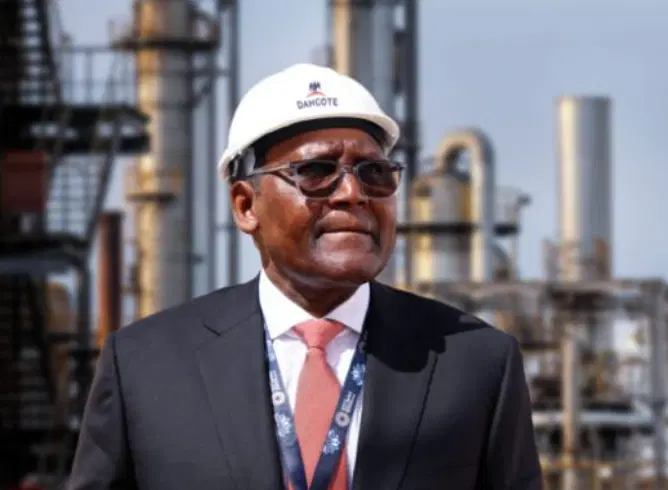
Dangote Refinery Ends Nigeria’s Era of Fuel Import Dependence, Boosts GDP, FX Earnings — EIU
The operational ramp up of the 650,000 barrels per day Dangote Petroleum Refinery & Petrochemicals is fundamentally reshaping Nigeria’s downstream oil sector, significantly reducing the country’s dependence on imported refined petroleum products and strengthening its external position, according to the Economist Intelligence Unit (EIU).
In its latest assessment on Nigeria’s fuel market and regulatory environment, the EIU said the refinery has already transformed a sector that was previously characterised by heavy reliance on imported fuel despite Nigeria being Africa’s largest crude oil producer. The report noted that the refinery met nearly 80 per cent of domestic petrol demand in April and produced enough volumes to satisfy local consumption requirements as operations approached full capacity.
The EIU described Nigeria’s downstream petroleum sector before the refinery as “long dysfunctional”, noting that the country had remained almost entirely dependent on costly imported fuel while producing nearly 1.5 million barrels of crude oil daily.
According to the report, the emergence of the refinery has reduced import dependence, improved domestic fuel availability and strengthened Nigeria’s balance of payments position through lower import demand and rising exports of refined petroleum products.
“The gradual ramp up of the 650,000 barrel/day Dangote refinery since May 2023 has transformed Nigeria’s long dysfunctional downstream sector,” the report stated. “The country’s main refineries, all state owned, had been inoperative for years and Nigeria was almost entirely reliant on costly imported fuel.”
The research and analysis division of The Economist Group, London added that the refinery’s attainment of full operational capacity and its planned expansion would further support Nigeria’s economic growth and foreign exchange earnings over the medium term.
“Meanwhile, the attainment of full capacity at, and an increase in exports from, the Dangote refinery will support real GDP growth and foreign exchange earnings in 2026 and 2027 and beyond, as a planned doubling of the plant’s output comes on stream around the end of the decade,” it added.
Industry analysts said the refinery is increasingly positioning Nigeria as an emerging refining and export hub, altering energy trade flows across Africa and reducing the vulnerability associated with fuel import dependence.
The EIU noted that the refinery’s expansion has coincided with major reforms in Nigeria’s downstream sector, including the removal of fuel subsidies and the introduction of market driven pricing mechanisms.
The report, however, said the transition from a state dominated fuel import structure to large scale domestic refining has triggered resistance from interests linked to the old import regime.
The latest tensions emerged following the decision by the Nigerian Midstream and Downstream Petroleum Regulatory Authority to relax restrictions on petrol imports despite the refinery’s growing capacity to meet domestic demand.
Dangote Industries subsequently initiated legal action, arguing that continued import approvals undermine domestic refining investments and conflict with the objectives of the Petroleum Industry Act, which seeks to encourage local refining capacity and reduce import dependence.
Analysts noted that the availability of large-scale domestic refining capacity has improved Nigeria’s energy security and reduced exposure to external supply shocks and foreign exchange volatility.
The Centre for the Promotion of Private Enterprise also cautioned against unrestrained importation of petroleum products, warning that such a policy could weaken Nigeria’s industrialisation drive and discourage investments in domestic refining.
Chief Executive Officer of CPPE, Muda Yusuf, said continued dependence on imported fuel had historically contributed to pressure on foreign reserves, exchange rate instability and fiscal leakages.
The refinery’s growing impact is also being reflected in Nigeria’s broader macroeconomic indicators. Earlier this month, S&P Global Ratings cited increased domestic refining capacity and rising hydrocarbon exports among the major factors supporting Nigeria’s sovereign credit rating upgrade – the first in 14 years.
Beyond Nigeria, analysts said the refinery is increasingly being viewed as a strategic industrial asset for Africa, where many countries remain heavily dependent on imported fuel despite rising demand for transportation, manufacturing, and power generation.
Business
BREAKING: Court Dismisses $19.6 Million Claim Against NNPCL — Rules Contract Scope Cannot Be Changed Orally

BREAKING: Court Dismisses $19.6 Million Claim Against NNPCL — Rules Contract Scope Cannot Be Changed Orally
In a landmark ruling on Friday, May 22, 2026, the Federal Capital Territory High Court in Abuja threw out a $19.6 million lawsuit filed by Alternate Dimensions Ventures Ltd against the Nigerian National Petroleum Company Limited (NNPCL), affirming a key legal principle: a written contract cannot be expanded through oral agreements or conduct.
Alternate Dimensions had sought $19,600,000 in professional fees, claiming the scope of its Direct Sale, Direct Purchase (DSDP e-pro) contract with NNPCL was orally expanded. Represented by counsel Patrick Peter, the firm argued it was entitled to the revised sum for services rendered under the alleged new terms.
But NNPCL, through its lawyer Ituah Imhanze of KENNA LP, pushed back sharply, arguing that parties are bound exclusively by the clear terms of their written agreement. Imhanze contended that without any written amendment, the claim was legally unsound, and the court agreed.
Delivering judgment, Justice Hamza Mu’azu upheld NNPCL’s defense, stating that the contract was unambiguous and that no evidence was adduced during the trial, which supported the alleged scope expansion. The court further found that NNPCL fully complied with all contractual terms and committed no breach.
Dismissing the suit as meritless, Justice Mu’azu reinforced the doctrine of sanctity of contract: any amendment to a written agreement must be express, unequivocal, and documented, not implied or verbal.
The ruling spares NNPCL from the S19.6 million claim and also a floodgate of similar potential liabilities.


- Deputy (Dep.) Finance Minister Courts Investors to Transform Ghana’s rice Economy June 4, 2026
- Mobile health services in Kenya reduce the risk of stillbirths June 4, 2026
- JustMarkets Research Highlights Global Growth Divergence as a Key Market Driver June 4, 2026
- African Development Bank Group approves $125 million investment in African Trade and Investment Development Insurance (ATIDI) to expand risk insurance capacity in Africa June 4, 2026
- Congo Energy & Investment Forum 2027 to Position Brazzaville as a Hub for Global Energy Deal-Making June 4, 2026
- Africa Skills Hub (ASH) Transitions to ASH Africa as it Marks 10 Years of Impact June 4, 2026
- When women farm better, Eswatini eats better June 3, 2026
- Togo Hosts the 8th Annual Forum of National Volunteer Agencies in the Economic Community of West African States (ECOWAS) Region June 3, 2026
- Indigenous Peoples gravely vulnerable to Ebola epidemic, warn United Nations (UN) independent experts June 3, 2026
- Meeting between Parliamentary Vice-Minister ONISHI and His Excellency (H.E.) Mr. Cosgrow, Principal Minister and Minister for Agriculture, Fisheries and Blue Economy of Seychelles June 3, 2026
- Deputy (Dep.) Finance Minister Courts Investors to Transform Ghana’s rice Economy June 4, 2026
- Mobile health services in Kenya reduce the risk of stillbirths June 4, 2026
- JustMarkets Research Highlights Global Growth Divergence as a Key Market Driver June 4, 2026
- African Development Bank Group approves $125 million investment in African Trade and Investment Development Insurance (ATIDI) to expand risk insurance capacity in Africa June 4, 2026
- Congo Energy & Investment Forum 2027 to Position Brazzaville as a Hub for Global Energy Deal-Making June 4, 2026
- Africa Skills Hub (ASH) Transitions to ASH Africa as it Marks 10 Years of Impact June 4, 2026
- When women farm better, Eswatini eats better June 3, 2026
-

 news6 months ago
WHO REALLY OWNS MONIEPOINT? The $290 Million Deal That Sold Nigeria’s Top Fintech to Foreign Interests
-

 society1 month ago
SOCIAL MEDIA IS NOT A BATTLEFIELD COMMAND – WHY THE NIGERIAN ARMY’S ACTION AGAINST JUSTICE CRACK IS A NATIONAL SECURITY IMPERATIVE
-

 celebrity radar - gossips4 months ago
Dr. Chris Okafor Returns with Power and Fire of the Spirit -Mounts Grace Nation Altar with Fresh Anointing and Restoration Grace on February 1, 2026
-

 celebrity radar - gossips6 months ago
Prophet Kingsley Aitafo Releases 2026 Prophecy: ‘Nigeria Will Rise, but the World Must Prepare for Turbulence’
You must be logged in to post a comment Login
You must log in to post a comment.