
society
Banditry in Nigeria: When Governance Failure Becomes Armed Authority


Banditry in Nigeria: When Governance Failure Becomes Armed Authority
By George Omagbemi Sylvester | Published by SaharaWeeklyNG
“Why military force alone cannot defeat a crisis rooted in poverty, political incentives and institutional retreat.”
In large stretches of Nigeria’s Northwest, the state no longer holds a monopoly on violence or authority. Armed groups raid villages, collect levies, regulate mining routes, negotiate ransoms and enforce their own rules. This is commonly described as a “security crisis.” It is more accurate (and more troubling) to describe it as governance failure that has matured into armed parallel administration.
Banditry is not merely a breakdown of law and order. It is what happens when the social contract collapses.
Between 2018 and 2023, thousands of Nigerians were killed or abducted in Zamfara, Katsina, Kaduna, and Sokoto states. Mass school kidnappings in Kankara, Jangebe and Kuriga drew global attention. Entire farming communities have been displaced, deepening food insecurity in a region already burdened by poverty. According to national data, the Northwest consistently records some of the highest poverty and out-of-school rates in the country; structural conditions that create fertile ground for recruitment into armed networks.
But statistics alone do not explain why banditry became systemic.
The roots lie in prolonged institutional retreat. Rural policing is thin. Judicial access is limited. Land governance mechanisms to resolve farmer–herder disputes remain weak or politicized. Youth unemployment remains chronically high. In many districts, citizens interact more frequently with traditional rulers or armed actors than with formal state institutions. Over time, coercive groups evolve from opportunistic criminals into structured authorities.
The 2011 collapse of Libya after the fall of Muammar Gaddafi further intensified this trajectory. Arms proliferation across the Sahel dramatically increased the lethality and organizational capacity of non-state actors. Nigeria’s porous northern borders allowed weapons trafficking networks to expand faster than enforcement capacity. What were once communal clashes involving rudimentary weapons transformed into heavily armed insurgent-style operations.
Nigeria has seen this pattern before.
The rise of Boko Haram in the Northeast offers a cautionary precedent. In its formative years, the group was often underestimated, politically entangled, or viewed through a narrow security lens. Allegations referenced in a United Nations Panel of Experts report connected early elements of the group to political actors, including former Borno governor Ali Modu Sheriff, who has denied wrongdoing. Regardless of individual culpability, the broader institutional lesson is clear: political systems that tolerate, manipulate, or underestimate armed movements risk enabling forces that ultimately escape all control.
Today’s bandit formations in the Northwest differ ideologically from Boko Haram, but they share structural similarities: they emerged where governance deficits were deepest.
The political economy of insecurity complicates resolution. Kidnapping-for-ransom has become a multi-million-naira industry. Informal taxation systems imposed by armed groups generate steady revenue. Illicit gold mining operations flourish under armed protection. Meanwhile, security votes allocated to state executives remain largely unaudited, and emergency procurement frameworks often operate with limited transparency. When instability expands discretionary authority or financial opacity, reform incentives weaken.
This incentive distortion is central. Sustainable peace requires that the political and financial costs of insecurity outweigh any perceived benefits derived from it.
Military force remains necessary. Territorial recovery and civilian protection demand it. However, purely kinetic responses cannot dismantle recruitment ecosystems rooted in poverty, illiteracy, land disputes, and institutional distrust. Each successful operation that clears a forest camp without restoring governance presence creates only temporary stability.
The deeper crisis is absence of state legitimacy in rural zones. Where courts are inaccessible, armed arbiters emerge. Where taxation yields no visible services, alternative collectors impose their own levies. Where young men perceive no economic pathway, armed entrepreneurship becomes rational.
Reversing this trajectory requires structural intervention:
Institutionalized farmer–herder mediation mechanisms with enforceable land titling frameworks.
Rural education investment targeting out-of-school populations vulnerable to recruitment.
Transparent auditing of security expenditures to realign incentive structures.
Border security cooperation with Sahelian neighbors focused on arms tracing.
Targeted agricultural modernization and rural employment programs.
Crucially, governance must return visibly and credibly; not as episodic military convoys, but as functioning courts, schools, healthcare systems and accountable budgeting processes.
Nigeria’s banditry crisis is not accidental. It is the predictable outcome of prolonged neglect intersecting with regional destabilization and distorted political incentives. The language of “war against bandits” obscures the more urgent imperative: reconstruction of state authority through legitimacy, transparency and service delivery.
Until governance reaches the villages, forests will continue to produce armed alternatives.
And no volume of airpower can permanently defeat a vacuum.




society
United Kingdom of Atlantis Issues Comprehensive Public Disclaimer Warning Against Unauthorized Coin Promotion
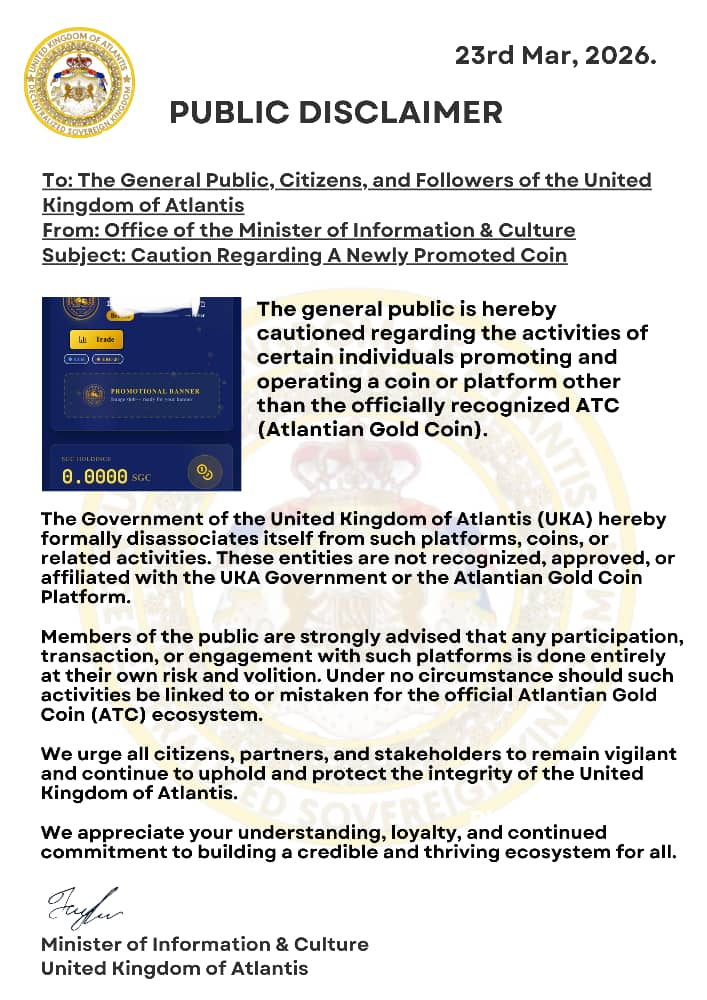
United Kingdom of Atlantis Issues Comprehensive Public Disclaimer Warning Against Unauthorized Coin Promotion
23rd March, 2026 – The Office of the Minister of Information & Culture of the United Kingdom of Atlantis (UKA) has issued an official public disclaimer cautioning citizens, followers, and the general public about the activities of individuals promoting and operating a coin or platform that is *not* the officially recognized Atlantian Gold Coin (ATC).
### Official Statement from the UKA Government
The Government of the United Kingdom of Atlantis formally *disassociates* itself from any such unauthorized platforms, coins, or related activities. These entities are *not recognized, approved, or affiliated* with the UKA Government or the official Atlantian Gold Coin (ATC) ecosystem. The UKA reaffirms its commitment to protecting its citizens from fraudulent financial schemes and maintaining the credibility of its national monetary instruments.
### Key Highlights of the Public Disclaimer
1. *Public Warning*: The general public is advised that participation in, transaction with, or engagement in these unauthorized platforms is undertaken entirely at the individual’s *own risk and volition*. The UKA will not provide any protection or recourse for losses incurred from such engagements.
2. *No Association*: The UKA government explicitly states that the unofficial coin should *not* be linked to or mistaken for the legitimate Atlantian Gold Coin (ATC) platform. Any branding or naming similarity is purely coincidental and unauthorized.
3. *Call for Vigilance*: Citizens, partners, and stakeholders are urged to remain vigilant and to uphold and protect the integrity of the United Kingdom of Atlantis. The government encourages proactive verification of all financial products to safeguard national economic stability.
4. *Appreciation*: The government expresses gratitude for the public’s understanding, loyalty, and continued commitment to building a credible and thriving ecosystem for all Atlantians. This support is vital for the sustainable development of the UKA’s financial infrastructure.
5. *Actionable Advice*: The Minister of Information & Culture advises citizens to conduct thorough due diligence, seek official certifications, and consult authorized financial institutions before investing in any coin or digital platform.
### Minister’s Emphasis on Transparency & Security
The Minister of Information & Culture emphasizes that the UKA is dedicated to maintaining transparency and security within its financial ecosystem. The government has established regulatory frameworks to ensure that only authorized and vetted financial instruments operate within the Atlantian economy. The public is encouraged to report any suspicious activities related to unauthorized coins or platforms to the appropriate authorities.
### Impact on the Atlantian Economy
The unauthorized promotion of alternative coins poses risks of financial fraud, market disruption, and reputational damage to the legitimate Atlantian Gold Coin (ATC). The UKA’s disclaimer aims to protect investors and preserve trust in the national monetary system, fostering a safe environment for economic growth and innovation.
Next Steps for Stakeholders
– *Verification*: Check official registries for approved financial products.
– *Reporting*: Submit information on suspicious platforms to the UKA regulatory authorities.
– *Education*: Engage in public awareness campaigns about the risks of unregulated financial instruments.

Crisis Everywhere, Governance Nowhere: What The Omoluabi Ethos Demands
Nigeria stands at a crossroads, gripped by multiple crises while governance appears slow, distant, and at times absent. From rising insecurity to deepening economic strain, citizens face daily hardships that demand urgent and decisive leadership. Yet the response has often seemed reactive rather than strategic, leaving millions to navigate uncertainty on their own in a country of over 200 million people.
Security challenges continue to spread at an alarming rate. The insurgency in the North East, now over 15 years old, persists despite repeated military campaigns. In 2025 alone, hundreds of civilians were killed in attacks across Borno, Zamfara, and Plateau states, while kidnapping for ransom has become a thriving criminal enterprise. More than two million Nigerians remain internally displaced in the North East, and several rural communities across the North West and North Central have effectively fallen outside full state control. What began as a regional crisis has evolved into a nationwide threat, weakening agriculture, disrupting supply chains, and discouraging investment.
Economic realities offer little comfort. Nigeria’s GDP grew by about 3.87 percent in 2025, up slightly from 3.38 percent in 2024, yet this growth has not translated into improved living standards. Inflation, though moderating from over 30 percent in 2024 to around 15 percent in early 2026, continues to erode purchasing power. Food inflation remains particularly severe, with staples rising beyond the reach of average households. With a minimum wage that struggles to match the cost of living, millions of Nigerians now spend a disproportionate share of their income on basic survival.
Poverty and food insecurity deepen the strain. An estimated 129 million Nigerians live below the poverty line, while nearly 100 million face varying levels of food insecurity. Malnutrition rates among children remain high, and access to basic healthcare and education continues to decline in vulnerable communities. The informal sector, which employs over 80 percent of the workforce, remains largely unregulated and unstable. Official unemployment figures hover around 4.9 percent, but this masks widespread underemployment and precarious work conditions that offer little economic security.
Fiscal pressures further complicate the situation. Recent reforms, including the removal of fuel subsidies and the unification of exchange rates, have improved government revenue and reduced the fiscal deficit to about 4.5 percent of GDP. However, these gains have come at a steep social cost, with transport, energy, and food prices rising sharply. Public debt stands at roughly 34 percent of GDP, while oil production, Nigeria’s primary revenue source, continues to underperform. Although output recovered to about 1.5 million barrels per day in 2025, it remains below both OPEC quotas and national targets due to theft, pipeline vandalism, and chronic underinvestment.
These challenges are deeply interconnected and point to a broader governance deficit. Insecurity disrupts farming and trade, economic hardship drives poverty, and limited fiscal space constrains effective intervention. The result is a cycle of vulnerability that continues to tighten around millions of citizens.
The Omoluabi ethos offers a clear alternative. It represents leadership defined by character, discipline, accountability, and an unwavering duty to the people. Under such a framework, security would be treated as a sacred responsibility, not a recurring crisis. Government would act with urgency and coordination to protect lives and property, while economic policy would be deliberately people centred, focused on reducing the cost of living, stabilising prices, and supporting small businesses and agriculture. Growth would be measured not just in statistics but in the improved welfare of citizens.
Public institutions under this ethos would function with purpose and discipline. Ministries would operate with clear targets, coordination, and accountability for results. Fiscal decisions would reflect prudence, balancing reforms with social protection so that citizens are not crushed under the weight of policy adjustments. Above all, leadership would be empathetic and present, grounded in the daily realities of the people and responsive to their needs. Governance, in this sense, would not be distant or abstract but a visible commitment to improving lives.
Measured against this standard, the present stewardship of the Nigerian state clearly falls outside the Omoluabi ethos. Persistent insecurity, rising living costs, and the widening gap between economic indicators and lived reality reflect a leadership approach that lacks the discipline, accountability, and people centred focus that define that value system. Rather than embodying empathy and responsibility, governance has often appeared distant, reactive, and insufficiently attuned to the human consequences of its decisions. The issue, therefore, is not merely one of policy but of principle. Until leadership aligns with values that prioritise service, accountability, and the welfare of the people, the crises will endure and the question will remain, se na like this we go de dey?

Lagos CP Clears Task Force of WrongDoing
…Says No Evidence of Human Rights Abuse was committed


-

 society6 months ago
Religion: Africa’s Oldest Weapon of Enslavement and the Forgotten Truth
-

 news3 months ago
WHO REALLY OWNS MONIEPOINT? The $290 Million Deal That Sold Nigeria’s Top Fintech to Foreign Interests
-

 society6 months ago
“You Are Never Without Help” – Pastor Gebhardt Berndt Inspires Hope Through Empower Church (Video)
-

 celebrity radar - gossips2 months ago
Dr. Chris Okafor Returns with Power and Fire of the Spirit -Mounts Grace Nation Altar with Fresh Anointing and Restoration Grace on February 1, 2026