
news
Buhari: From Washington with dignity By FEMI ADESINA


It was an official visit that attracted not only national, but also international attention. President Muhammadu Buhari was going to visit the United States of America for four days, on the invitation of President Barack Obama. Was this going to be just another jamboree, or truly an event that would reset the buttons in the relationship between the two countries?
Sure, there had been some cooling of passion between the two erstwhile allies during the dying days of the Goodluck Jonathan administration, and American experts sent here to train our military had even been asked to leave. She had also refused to sell us Cobra helicopters and other armaments, which could have made a lot of difference in our fight against insurgents in the North-east of the country. America had cited some reasons, including alleged human rights violations. The then President Jonathan was thus forced to look towards South Africa for arms. He loaded millions of dollars in a private jet as if going to Oyingbo market, and got his fingers burnt in the process. South Africa seized the cash, and also impounded the aircraft for some time. The Nigerian government could only huff and puff for a while, and then licked its wounds quietly.
No doubt, the kiln of passion needed to be kindled anew between Nigeria and America, and the invitation extended to President Buhari during the G7 Summit in Germany in June, was a much needed elixir. The Nigerian leader accepted the offer, and so was in Washington between Sunday, July 19 and Wednesday, July 22.
But another whiff of controversy had presaged the meeting. America, through its Supreme Court, had recently legitimized same sex relationship. A man could marry a man if he wanted, while a woman could also marry a woman. It was against the laws of God, but heck, what did America care? God was either dead due to old age, or now belongs to the old school. What matters now are rights, and people with homosexual or lesbian cravings must have their rights protected under the law.
It was into the eye of this storm that some Nigerians felt President Buhari would be flying, on his trip. True, he had been asked to bring a ‘wish list’ by his host, but is there ever free lunch in America? Yes, your wish would be granted. America would help you decapitate Boko Haram, would help you trace and repatriate billions of dollars salted away in foreign banks by past rulers, would help boost your economy and generate employment, but at what price? At a price of endorsing same sex marriage, which would be contrary to our laws as a country, and to the laws of the God that majority of Nigerians believe in, and serve? Would President Buhari capitulate simply because America would help him fulfill promises he made during election campaigns?
To America we flew last Sunday, arriving after a voyage of 12 hours. Our President was accommodated along with some members of the entourage at the historic Blair House, just a peeping distance from the White House. A good number of meetings were to hold at that Blair House in the next four days.
You would be permitted if you had jet lag after 12 hours in the air, punctuated only by a one hour technical stopover at a Portuguese island called Santa Maria, to refuel your plane. But President Buhari was still spry enough to settle down to business immediately. We have heard of the work rate of former Army General and later civilian president, Olusegun Obasanjo. Now we see another retired Army General now civilian president, exhibiting the same horsepower work ethics. Could it be true that they give them some injections in the military, which makes them go on and on? Well, I did not say so. I only heard of it.
After a briefing of what was to come in the next four days by Professor Ade Adefuye, Nigerian Ambassador to the United States of America, the President played host to former American Ambassador in Nigeria, Thomas Pickering and Professor Jean Herskovits. The man who has been quite outspoken about Nigeria, and who had doubted if the country would survive the 2015 general elections, Ambassador John Campbell, also came, among other people.
The day was not done until Madeline Albright (remember her? A large number of people across the world were mad about Madeline years back when she was American Secretary of State. She did the work admirably). Well, Madeline came to dinner with our President. She has aged, but rather gracefully.
Day 2 was the day the world had been waiting for. Day of meeting with the world’s most influential president, Barak Obama. But not so fast! First, breakfast with the Vice President, Joe Biden. Venue was the Naval Observatory, which is the official residence of the American number 2 man. What did he tell our President?
Biden gave an overview of the objectives of the entire visit,assuring Nigeria of the goodwill and support of America. He shared perspectives on the terror war, drawing from America’s experiences after the September 2001 assault, in which thousands were killed by Al-Qaeda inspired terrorists. He said Boko Haram, which has now pledged loyalty to ISIS, should not be battled with just military option. There was also the need to combine the war with strong socio-economic programs. He said the U.S would be ready to work with Nigeria in that direction.
On the Nigerian economy, Biden bade the leadership to tackle the issue of corruption, strengthen the institutions, and appoint tested hands to man critical sectors. If all these were done, he assured that investors would flood Nigeria in droves.
President Buhari thanked his host, and added that the role played by America prior to general elections, sending Secretary of State John Kerry to convey that America would not tolerate the subversion of the people’s will, went a long way to guarantee fairness and justice.
Having served as Minister for Petroleum Resources for over three years in the 1970s, President Buhari did not forget to mention the oil sector. He said between 10 to 20 billion dollars may have been lost to oil theft in the past one year, and pledged to sanitize the sector. He welcomed American assistance.
The much awaited meeting with President Obama came up a while later at the White House. American leaders have been known to be fairly parsimonious with praises, particularly when talking about leaders of other countries. But Obama was effusive. He described President Buhari as a man of integrity, needed for such a time as this in Nigeria. He congratulated him for winning the March 2015 presidential election, adding that Nigeria was very important to Africa. The destiny of the continent was tied to Nigeria’s, he said, pledging that America would continue to support, as long as Nigeria does the right things.
Every patriotic Nigerian must have stood several feet taller, as Obama eulogized our President. It served to rekindle confidence in our country. With the right leadership, Nigeria can, and will get there. Sure.
The American president charted the same course as his deputy on the issue of Boko Haram. According to him, economic and social programs must run concurrently with military option, to conclusively defeat insurgency.
Obama said the diversity of Nigeria, rather than be a centrifugal force, must be a centripetal one. The disparate parts of the country should be harnessed to become source of strength, adding that no part of the country should be left behind, or alienated.
Buhari, the American president observed, was hugely popular, judging by the enormous goodwill that surrounded his election. He urged him to use the goodwill to serve Nigeria, alongside the governors that accompanied him. The governors are Rochas Okorocha, Imo, Adams Oshiomhole, Edo, Tanko Al-Makura, Nasarawa, Kashim Shettima, Borno, and Abiola Ajimobi, Oyo.
Speaking on behalf of the governors, Okorocha assured Obama that the states’ helmsmen would back up Buhari to bring enduring change to Nigeria.
President Obama made pledges. America would help Nigeria in diverse ways: checkmate insurgency, train and equip her military, recover monies siphoned out of federal coffers, and many others. And with no strings attached.
The bilateral meetings/ audiences with the Nigerian president at Blair House, and other venues, were worth their weight in gold. The American Secretary of Commerce met with the Nigerian team, so did Loretta Lynch, U.S Attorney General, Jack Lew, Secretary of the Treasury, the Barker Group, potential investors in the Agriculture and Power sectors. There was an interactive dinner hosted by U.S Chamber of Commerce and Corporate Council for Africa, and captains of industry from Nigeria and America were there, among others.
What of the meeting with Dr Pate of the World Health Organization (WHO), representatives of the World Bank, and of the Bill and Melinda Gates Foundation? Refreshing. WHO unfolded plans to spend 300 million dollars to fight malaria in Nigeria, while the World Bank, subject to ratification by its board of directors, will make available the princely sum of 2.1 billion dollars for the rebuilding of infrastructure in the North-east, a region beleaguered by insurgency in the past six years. The fund, under the auspices of International Development Agency (IDA) will be made available as loans for Nigeria, at very low interest rates. The first 10 years would be interest free, while an additional 30 years would be granted at rates lower than that of the capital market.
A delighted President Buhari said priority would be given to the resettlement of more than one million internally displaced persons (IDPs), and directed that a team be set up on the side of the Federal Government, which would meet and harmonize plans with the World Bank team as soon as possible.
The Bill and Melinda Gates Foundation also disclosed plans to work with the Dangote Foundation to ensure that Nigeria gets a clean bill of health on polio. Already, no case of polio has been recorded in the country for a full year, and if the position subsists for another full year, Nigeria would be declared polio free.
Cheery news also from the session between the Nigerian team and the American Attorney General. The host country would track illicit money from Nigeria in all their jurisdictions, including the U.S, while training would also be provided for our judicial officers, prosecutors, police, and other security agencies, to track and recover stolen funds.
There were other bilateral meetings with John O. Brennan, Director of the CIA and Deputy Secretary of Defence, Robert Work, and Chairman, Joint Chiefs of Staff, Gen Martin Dempsey.
Oh, the courtesy call by the Class of 1980 of the United States War College, in which the then Col Muhammadu Buhari participated, and got glowing recommendations. It was a time to go down memory lane.
Same sex issue enters the scene. On Tuesday afternoon, President Buhari was in his right elements, as he attended a joint session by the Senate and House Committees on Foreign Affairs at the Capitol Hill. Many issues came up for discussion, ranging from foreign relations, to growing democracy, human rights, and many others. Then a senator brought in the clincher. What does Nigeria think of the rights of homosexuals and lesbians.
Sodomy or anything of such kind is against the laws of Nigeria, and, indeed, the Nigerian society abhors such practices, the President declared. Pastor Tunde Bakare of The Latter Rain Assembly was in the audience, and from the delight on his face, he could have carried the President shoulder high, if protocol had permitted such.
To cap that delightful day, the president headed to the Chancery, Nigeria Embassy. He had two assignments there. A Meet and Greet session had been packaged by Mo Abudu of Ebony Life TV, in which Nigerian youths, who are professionals, had been invited from across America to greet President Buhari, and share their dreams of a greater country with him. The young people were really happy to have their president and father figure in their midst.
Next was the meeting with Nigerians in Diaspora, who also came from across America. Biodun Ogunjobi had driven 12 hours to attend the event. He alo had waited for four hours outside the Embassy gates, till the program commenced. Such is the fervor Nigerians in America have for their country, and for a president they see as symbol of change. For about two hours, the President interacted with them, answering all the questions.
The night did not end without the president meeting with the All Progressives Congress (APC) members in USA and Canada. The previous day, the party members had massed at the gate of Blair House, bearing different placards hailing President Buhari. When he saw them, he got down from his vehicle to greet them. The gesture drew sustained applause.
On the final day of the visit, it was an interactive event at the United States Institute of Peace (USIP). It was jointly organized by the National Democratic Institute, International Republican Institute, Centre for Strategic Studies and Atlantic Council. Ambassador Johnny Carson, who coordinated the session, described the guest as a man of honour and integrity. The event included a question and answer session, a round table discussion, and a presentation by the Nigerian president. And did the man sparkle? In fact, so remarkable was that outing that Pastor Bakare told this writer: “He obviously left the best for the last. That was simply brilliant.”
President Buhari went to America, he saw, and he conquered. As I watched him signing the Visitors’ Register as he attempted to leave that historic monument called Blair House, I wondered how many people in the world would ever have such privilege. Not many. An American official had given him a pen, and the president wrote for about three minutes. He also must have been effusive in his appreciation. When he finished, he read over what he had written, put the pen back in its casing, rose, and handed it to the American official. That one collected it, and solemnly handed it back to the Nigerian president as a gift. Very solemn. And moving.
As President Buhari strode out of Blair House for the last time, with his entourage in tow, one could see that an invisible Nigerian flag had been hoisted in the American sky, and it was fluttering proudly. The Nigerian president had come with dignity, attended all the sessions lined up for him, not missing a single one, and was returning home with an enhanced reputation, not just for himself but also for about 170 million of his country men and women. Who says change will not come to Nigeria?




news
Ex-APC Deputy Guber flag bearer, Joshua MacIver backs Tinubu, express fears over implosion in Bayelsa APC
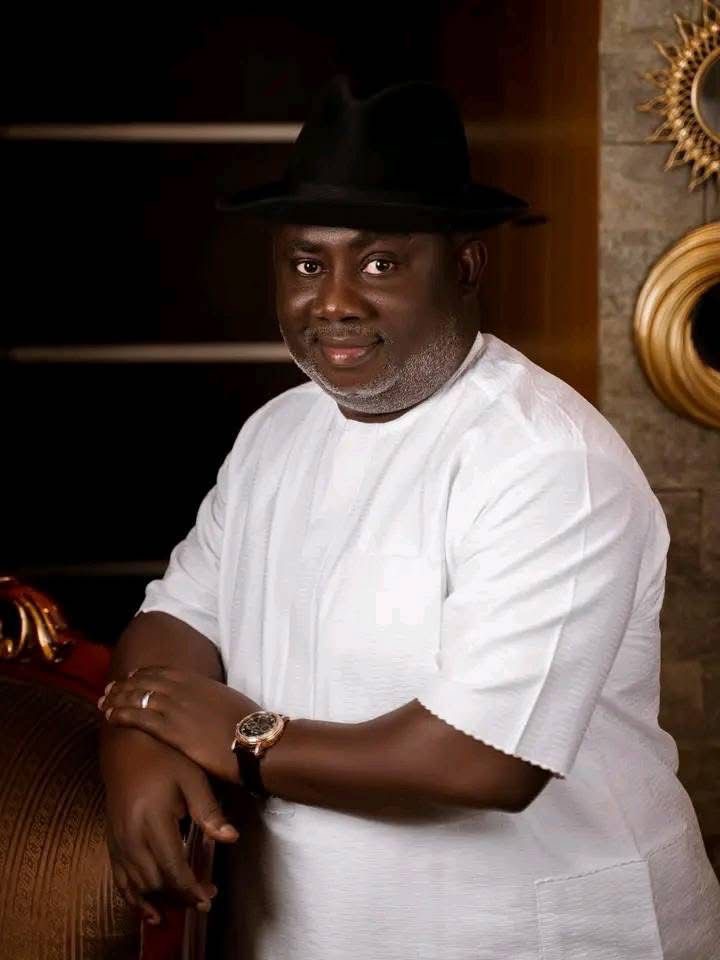
….congratulates new State Party Chairman, Warman Ogoriba
APC Deputy Governorship Candidate in the 2023 general elections in Bayelsa State, Great Joshua MacIver has declared his total commitment to the re-election of President Bola Tinubu come 2027, declaring that the Tinubu re-election project is non-negotiable.
Great Joshua MacIver, in his statement titled ” BAYELSA APC CONGRESSES: GOING FORWARD, A CALL TO LOOK INWARDS” and made available to newsmen in Yenagoa, warned APC leaders in the state to look Inward and take note of certain factors which may hinder or cut short our victory.
According to Great Joshua MacIver, such noticeable pitfalls include the imbalance in the united front being put up by the State Governor,Senator Douye Diri among various political blocs in the state.
In the statement issued at the weekend. Great Joshua MacIver stated that “First, before His Excellency, Senator Douye Diri, joined the APC in the state, there were clearly two political blocs that made up the party, with the approximate population ratios of the blocs standing at 95% to 5%.”
“After the entrance of His Excellency, Senator Douye Diri, ONLY THE SMALLER BLOC IS BEING CARRIED ALONG IN THE AFFAIRS OF THE PARTY, leaving the greater percentage to their fate, and this situation has the potential to build anger and dissatisfaction in our dear party.”
” The consequence of this has been the high level defection we have witnessed in the party recently and we believe more may likely follow, if we do not put our house in order.”
” If we do not pull together as a party, we may witness a situation where we will lose key stakeholders, especially after the State and National Assembly Primaries as well the Gubernatorial Primaries.”
“Finally, while it is very clear that we are the party to beat in the 2027 elections and that our loyalty to Mr. President IS NON-NEGOTIABLE, we must make haste to say that we cannot afford to create situations or loopholes in our unity which will be exploited by other political interests in the state. We cannot afford to under-rate anyone.”
“Our core interest remains the re-election of Mr. President, a project to which we have committed our all. We also pledge our total loyalty to the party as we have no alternative to the APC. However, our concern is that we must, as a party, look inwards and ensure that we do not create loopholes that can impede our common goal.”
Great Joshua MacIver, however congratulated the newly elected State Executives of the APC in Bayelsà State led by Hon. Warman Ogoriba, saying their emergence is welcomed at this critical time in our national history.
At least 23 people were killed in a series of suspected suicide bombings, police in Nigeria’s northeastern city of Maiduguri said on Tuesday.

https://www.stanbicibtcbank.com/nigeriabank/personal/products-and-services/all-loans/stanbic-ibtc-mreif-home-loans
More than 100 other people were injured in the blasts that took place on Monday evening in the capital of Nigeria’s restive Borno state.
No group has claimed responsibility for the suspected attacks.
The deadly blasts come after a military post was attacked overnight Sunday to Monday, which authorities blamed on suspected Islamist militants.
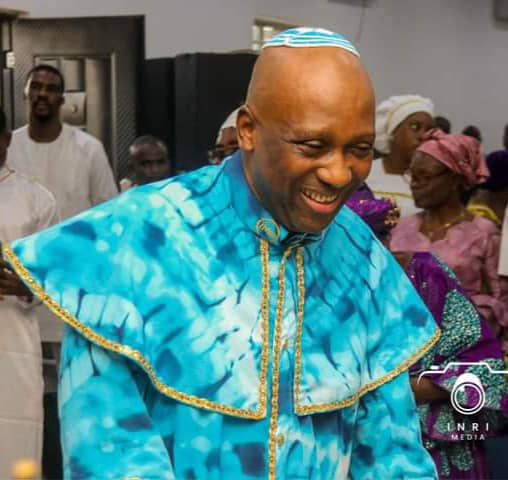
This sad incident is coming barely two weeks after Primate Elijah Ayodele, the Leader of INRI Evangelical Spiritual Church specifically warned against attacks in some states. He mentioned these states while calling on security operatives to pay close attention to them.
These were his words:
“Another attack is coming up in these following states where the military must watch carefully and intelligently; Kano, Kaduna, Zamfara, Kebbi, Niger, Borno, Kwara and Kogi state. They want to do a deadly attack, it’s preventable but it depends on how they will handle it. I have told you about the danger coming up.”
@primateayodele
Unfortunately, some of our military agencies don’t believe spiritual intelligence can save the country from so much danger hence, their neglect of this prophetic warning but now, it has been fulfilled with the miliary losing credibility by the day while Primate Ayodele continues to gain momentum.
Likewise, At least 26 passengers and crew sustained varying degrees of injuries on Monday following an accident involving the Kaduna–Abuja train, according to the Nigerian Railway Corporation (NRC).
Opeifa explained that the train departed Rigasa in Kaduna at 7:15 a.m. and was approaching Asham station around 9:16 a.m. when a loud bang was heard after the power car and trailing locomotive collided with one of the passenger coaches.
In July 2025, Primate Ayodele asked nigerians to pray not to see train mishap on the Kaduna-Abuja route.
@primateayodele #nigeriantiktok🇳🇬 #fulfillment #train #abuja #primateayodele
“Let’s pray not to see train mishap in Abuja-Kaduna, Kaduna-Abuja route.”
This has also been fulfilled.
The project ends decades search for investors, boosts Nigeria’s blue economy
By Prince Adeyemi Shonibare
Nigeria’s maritime sector is set for a major transformation following a landmark agreement involving the world’s largest container shipping company, Mediterranean Shipping Company (MSC), which has secured a 45-year concession to build, manage and operate a modern container terminal at Snake Island Port in Lagos.
The project, to be developed in partnership with Nigerdock, marks one of the most significant private sector investments in Nigeria’s port infrastructure in recent decades and is expected to strengthen the country’s role as a major maritime gateway in West and Central Africa.
For Nigeria, the agreement brings to close decades of efforts to attract large-scale investors to develop Snake Island Port, a strategically located maritime asset in Lagos.
Long-standing concession history
Snake Island’s maritime facilities date back several decades. In 1992, the Federal Government granted a 99-year concession for the island’s port and industrial facilities to Nigerdock, a major maritime engineering and logistics company.
Nigerdock was later privatised and is currently operated by the Jagal Group owned by Nigerian industrialist Maher Jarmakani.
Over the years, the Island Container Terminal fell into disrepair, requiring major rehabilitation and modernization to meet modern global shipping standards.
The new partnership with MSC is expected to transform the port into a state-of-the-art container handling facility capable of attracting larger vessels and increasing Nigeria’s cargo throughput capacity.
Buhari administration approved the project.
The investment framework for the Snake Island development was approved in May 2023 by the Federal Executive Council under then President Muhammadu Buhari.
The approval authorised total private investment of approximately $974.1 million for the project under a Public-Private Partnership structure, including the 45-year concession period.
At the same time, the Federal Government also approved two other major maritime infrastructure projects:
• Development of the Ondo Multipurpose Port in Ilaje, Ondo State, with $1.48 billion in private investment and a 50-year concession.
• Expansion and development of the Burutu Sea Port in Delta State, involving $1.2 billion in private investment and a 40-year concession.
These projects form part of Nigeria’s broader effort to develop its blue economy and expand maritime trade capacity.
Construction partners
Engineering and construction of the Snake Island container terminal will be handled by:
• ITB Nigeria Limited
• DEME Group
ITB Nigeria Limited is part of the Chagoury Group and owned by the Chagoury family, while DEME Group is a globally recognised Belgian marine engineering and dredging company with extensive experience in port construction.
MSC profile
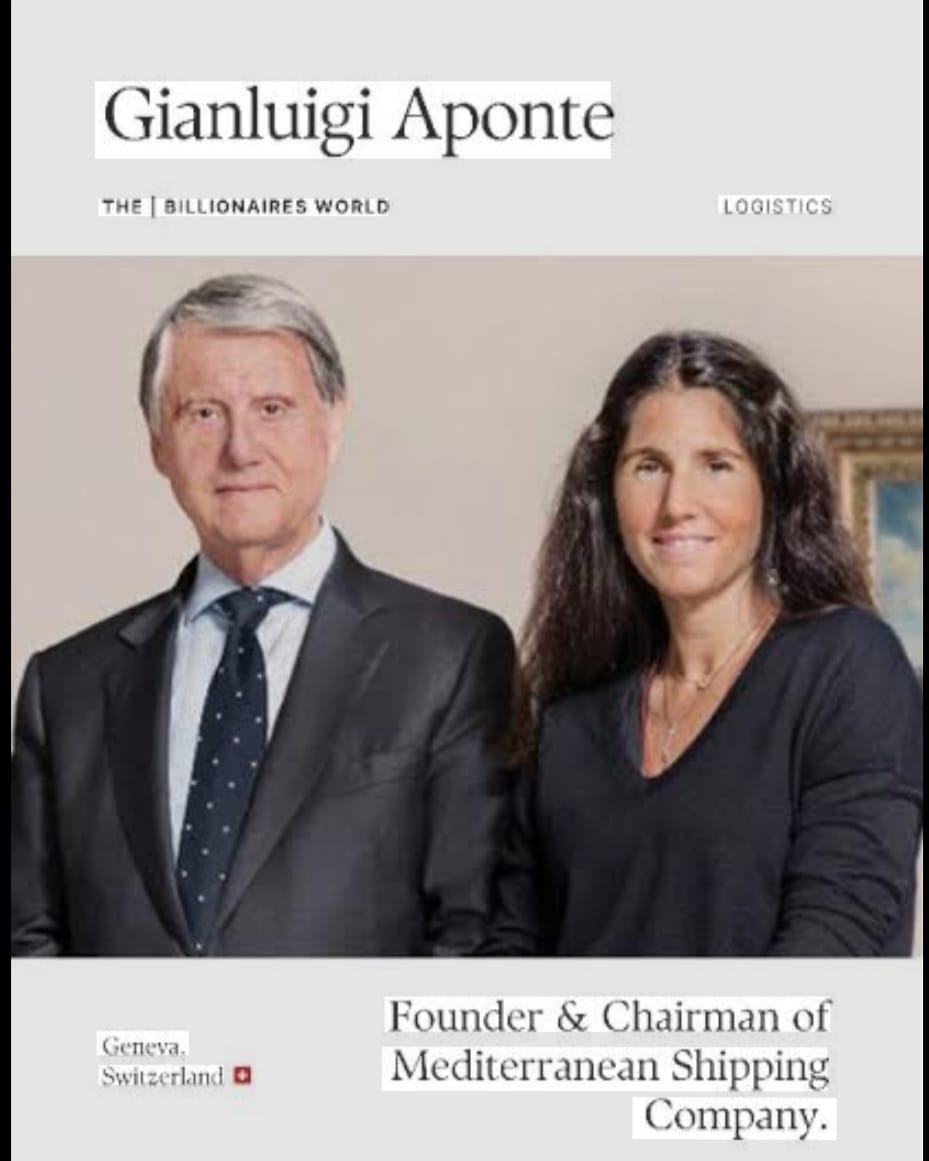
Founded in 1970 by Italian shipping entrepreneur Gianluigi Aponte and his wife Rafaela Aponte-Diamant, MSC has grown from a single cargo vessel into the largest container shipping company in the world.
Headquartered in Geneva, Switzerland, the company operates in more than 155 countries and serves over 500 ports worldwide, with a fleet of roughly 900 container ships and over 200,000 employees globally.
The MSC Group also operates major logistics and maritime businesses including inland logistics through Medlog, cruise tourism through MSC Cruises, and port terminal operations across several continents.
According to Forbes, the estimated net worth of MSC founder Gianluigi Aponte is about $43.9 billion as of February 2026, placing him among the world’s richest shipping magnates. The company remains privately owned by the Aponte family, with both founders holding equal ownership stakes.
Management comments
Speaking on the development, MSC Group President Diego Aponte said the company is committed to strengthening its operations in Nigeria and across Africa.
“We are proud to expand our presence in Nigeria through this important infrastructure project. The Snake Island terminal will enhance service delivery and improve port efficiency for our customers and partners in the region,”
Chief Executive Officer of Nigerdock, Maher Jarmakani, described the agreement as a major milestone for the Nigerian maritime sector.
“We are delighted to partner with MSC in developing a world-class container terminal that will enhance Nigeria’s logistics capabilities and support economic growth,” he said.
Economic impact
Industry analysts say the project could significantly strengthen Nigeria’s maritime economy by expanding cargo handling capacity, reducing congestion at Lagos ports and attracting additional international shipping traffic.
The development is also expected to create thousands of direct and indirect jobs across maritime operations, logistics, transport services and port-related commercial activities.
Infrastructure expansion
Beyond the port development, plans are also underway for Nigeria’s first underwater tunnel, linking Ahmadu Bello Way in Victoria Island through Snake Island and connecting the Lagos-Calabar Coastal Highway with the Sokoto-Badagry Superhighway corridor through Badagry.
The tunnel project is expected to significantly improve freight movement and road connectivity between Lagos ports and national transport networks.
Strategic milestone
With the entry of MSC into the Snake Island development, industry observers say Nigeria is taking a significant step toward modernizing its maritime infrastructure and positioning itself as a regional hub for global shipping and trade.
For a project that has waited for decades for major international investors, the Snake Island concession represents a turning point in Nigeria’s port development strategy and a strong signal of global confidence in the country’s maritime future.
By Prince Adeyemi Shonibare


-

 society6 months ago
Religion: Africa’s Oldest Weapon of Enslavement and the Forgotten Truth
-

 news3 months ago
WHO REALLY OWNS MONIEPOINT? The $290 Million Deal That Sold Nigeria’s Top Fintech to Foreign Interests
-

 society6 months ago
“You Are Never Without Help” – Pastor Gebhardt Berndt Inspires Hope Through Empower Church (Video)
-

 celebrity radar - gossips2 months ago
Dr. Chris Okafor Returns with Power and Fire of the Spirit -Mounts Grace Nation Altar with Fresh Anointing and Restoration Grace on February 1, 2026
You must be logged in to post a comment Login
You must log in to post a comment.