
society
Carry‑On Chaos: Travelers Clash Over Tightened Size Rules in 2026


Carry‑On Chaos: Travelers Clash Over Tightened Size Rules in 2026
By George Omagbemi Sylvester | Published by SaharaWeeklyNG
“As airlines worldwide strictly enforce carry‑on dimensions, social media erupts, passengers incur surprise fees, and industry experts warn that confusion and inconsistent policies are straining the travel ecosystem.”
A growing storm of discontent has erupted across social media platforms, particularly on TikTok, as air travelers from the United States to Europe and beyond grapple with the tightening of carry‑on luggage size enforcement in 2026. What began as a viral video warning about changing baggage measurements has ballooned into a widespread debate over airline policies that many passengers say are opaque, inconsistent and financially punitive.
The spark was a clip shared by TikTok user karenschaler, a screenwriter and travel enthusiast, urging fellow flyers to reexamine their carry‑on bags before their next trip. She insisted that “so many carry‑on bags that used to get through fine are now getting pulled, gate checked and you are being charged,” especially if those suitcases have hard shells, bulky wheels, or extended handles that make them technically oversize.
What most passengers didn’t realize until recently is that this isn’t a new rule implemented by governments, there’s no global treaty or international regulator that set new carry‑on dimensions for 2026. Rather, what’s changed is the degree of enforcement by airlines and how they interpret their own size restrictions, which often include wheels and handles in the measurement.
At the centre of the controversy is the 22 x 14 x 9 inches limit (56 x 36 x 23 cm), a standard carried by many U.S. carriers, including American Airlines and others. Under these policies, the size limit now explicitly counts everything on the bag not just the main compartment, but also the wheels and pull handle. Bags exceeding this, even by fractions of an inch, are being flagged at gates and subjected to surprise “gate‑check” fees that can range from around $35 to $65 or more.
A particularly viral incident that fuelled the debate involved an NHS doctor denied boarding on an easyJet flight because her carry‑on (though marketed as compliant) was deemed too large when measured by airline staff at the gate. That moment, widely shared and criticized online, has given tangible form to passenger frustration.
Experts point to multiple forces behind this shift. Airlines are under growing pressure to reduce boarding times and streamline turnaround operations. Flight delays often are caused by bottlenecks at boarding gates when oversized bags are discovered last‑minute. Stricter enforcement, carriers say, helps ensure that baggage physically fits into overhead compartments and that flights depart on schedule.
Dr. Sarah Rodrigues, an aviation policy expert at the Global Transport Institute, explains: “Airlines are trying to balance operational efficiency with passenger convenience. When policies lack clarity and consistency, you inevitably get confusion and frustration and especially when their interpretation varies from one airport or carrier to another.”
Some carriers, like American Airlines, have even removed rigid bag sizers from gate areas, instead training agents to use discretion when assessing bags, with instructions to “err on the side of the customer” for borderline cases. But that discretion itself is part of the confusion, with travelers unsure what will be accepted at one airport and rejected at another.
On TikTok and Reddit threads, travelers have shared anecdotes of bags that flew without issue in 2025 now being denied in 2026. Common complaints include unclear advertising by luggage manufacturers and many still label products as “carry‑on approved” without noting that airline measurements must account for wheels and handles.
One frequent commenter lamented, “We bought a new bag last year to fit requirements now it’s suddenly not good. This is the biggest scam. Every year the airlines seem to change rules for carry‑ons.” Another quipped, “Did the overhead bins shrink?” encapsulating a sentiment that the rules are arbitrary rather than grounded in real capacity needs.
Travel consumer advocate Mark Jenkins, director of the Airline Passenger Rights Foundation, warns: “When airlines tighten enforcement without clear, unified communication, you disenfranchise passengers. Clarity, not ambiguity, should be the lodestar of airline policy.”
Part of the frustration stems from the sheer lack of global standardization. In the U.S., many carriers still adhere to the 22 x 14 x 9 standard, while some, like Southwest Airlines, maintain slightly larger allowances for now. Other parts of the world feature entirely different rules; some European proposals even aim to mandate free hand luggage for passengers, another layer of policy that can run counter to carriers’ current practices.
The result is confusion among passengers who might (without a global regulatory baseline) find their luggage acceptable on one flight and penalized on the next.
Consumer groups advise that travelers measure their luggage carefully (including wheels and handles) and check airline‑specific policies before booking. In an era where ancillary fees contribute significantly to airline revenue, passengers increasingly find themselves navigating a labyrinth of hidden charges.
Dr. Elizabeth Moreno, a transportation economist, notes: “Air travel is no longer just about the ticket price. It’s the sum of every fee (checked bags, carry‑ons, seat selection) and when airlines alter enforcement without uniform messaging, it erodes consumer trust.”
The carry‑on debate of 2026 reflects broader tensions in modern air travel: operational efficiency versus passenger rights, profitability versus transparency, efficiency versus customer experience. As travelers share their frustrations online and industry policies continue to evolve, one thing remains clear, the skies may be busy, but the policies on the ground need greater clarity, cohesion, and fairness if passengers and airlines are to move forward together peacefully.




society
GEN CHRISTOPHER GWABIN MUSA SUPPORT INITIATIVE EXTENDS WARM BIRTHDAY FELICITATIONS TO PRESIDENT TINUBU ON 74TH BIRTHDAY
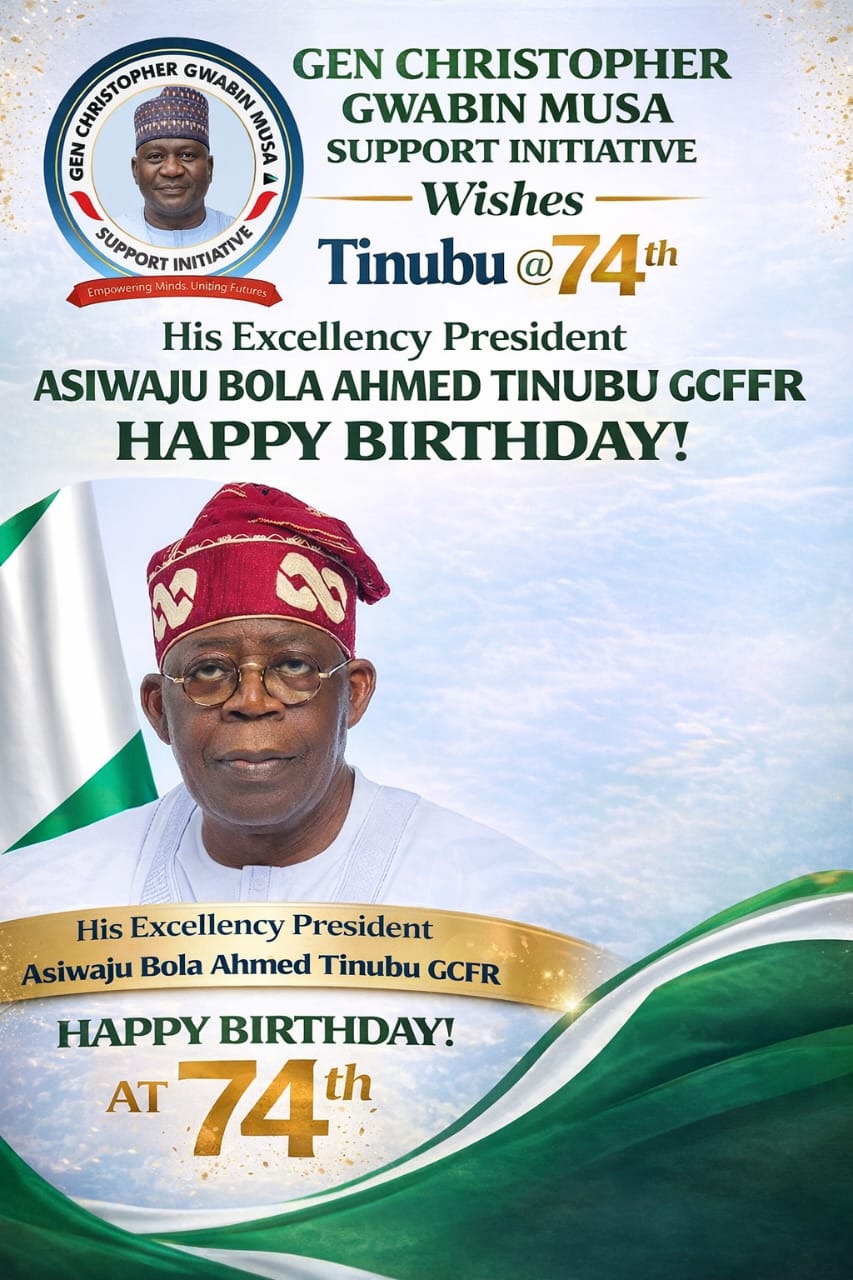
GEN CHRISTOPHER GWABIN MUSA SUPPORT INITIATIVE EXTENDS WARM BIRTHDAY FELICITATIONS TO PRESIDENT TINUBU ON 74TH BIRTHDAY
The Gen Christopher Gwabin Musa Support Initiative has extended heartfelt congratulations to His Excellency President Asiwaju Bola Ahmed Tinubu, GCFR, on the occasion of his 74th birthday.
In a statement released to the press, the Initiative conveyed warm wishes for the President’s personal well-being and for his continued leadership of the nation. The statement, signed by the Convener, Ibrahim Dahiru Danfulani, Sadaukin Garkuwan Keffi/Betara Biu, expressed hope that the coming year would bring the President “renewed strength and more wisdom in guiding the nation.”
The statement further noted that the Grand Patron of the Initiative, His Excellency Gen Christopher Gwabin Musa, OFR, Minister of Defence of the Federal Republic of Nigeria, joined in celebrating the milestone. It added, “Wishing Your Excellency continued good health, vitality, and determination as you lead the country towards greater unity and progress.”
The message underscores support for President Tinubu’s administration and its national objectives, marking the birthday as an occasion to reaffirm commitment to the nation’s unity and advancement under his stewardship.
society
Dominion City to Host Global Camp Meeting, “2 Nights of Glory” 2026 in Lagos, Enugu …Calls for Moral Renewal
*Dominion City to Host Global Camp Meeting, “2 Nights of Glory” 2026 in Lagos, Enugu
…Calls for Moral Renewal
Lagos – Dominion City has announced plans to host its annual Global Camp Meeting alongside a special “2 Nights of Glory” gathering in April 2026, with events scheduled to be held simultaneously in Lagos and Enugu.
The week-long programme is expected to draw tens of thousands of participants onsite and millions of virtual attendees from across the globe.
The Global Camp Meeting will run from Wednesday, April 1 to Monday, April 6, featuring daily sessions at 8:00 a.m. and 5:00 p.m. The “2 Nights of Glory” is slated for Friday, April 3 and Saturday, April 4 at the Golden Heart Place, Km 22 Lekki-Epe Expressway, beside Lagos Business School, Ajah, Lagos.
Organised by Dominion City, a global church focused on raising transformational leaders, the conference will centre on revival, spiritual renewal, and practical teachings. This year’s theme, “Redigging the Wells of Our Fathers,” underscores a call to return to foundational values and principles.
Speaking ahead of the event, Nobbert Onaga, President, Golden Heart Foundation and Senior Pastor, DC Lagos & Europe, emphasised the need for moral reawakening as a pathway to national transformation. He described the Church as “the pillar and foundation of truth,” noting that the conference aims to confront moral decline and restore core values within society.
“We are going back to foundational truths that established the Church. These truths will help repair societal damage and reposition the Church as a source of hope and light,” Onaga said.
Also speaking, Shola Olapade, Senior Pastor of Dominion City Headquarters, highlighted the Church’s role in addressing ethical and cultural challenges, particularly among young people. He added that the programme would go beyond spiritual teachings to include sessions on artificial intelligence, innovation, business, media, arts, and career development.
“We are equipping people not just spiritually, but with relevant 21st-century skills to thrive in today’s world,” Olapade noted.
The conference will feature teachings and ministrations from a lineup of international ministers, including Dr. David Ogbueli, Dr. Charles Ndifon, Andres Bisonni, Pastor Randy Mitchell, Apostle Ikechukwu Peter Nnajiofor, Dr. Ferdinand Nweke, Apostle Ben Hanyani Ndobe, Evangelist Dan Scott, and Dr. Chiefo Ejiofobiri.
Music ministrations will also be led by notable gospel artists such as Grace Idowu, Rhema Onuoha, Once More Six, David Nkennor, Anthony Kani, and GUC.
Organisers disclosed that over 30,000 participants are expected to attend in person, with free transportation provided from designated locations across Lagos to ease access. In addition, free medical services will be offered daily, building on previous outreaches that benefited over 1,700 people.
To ensure safety and order, more than 200 traffic marshals will be deployed in collaboration with relevant authorities.
Beyond its spiritual impact, organisers project that the event will stimulate local economic activity across hospitality, transportation, and retail sectors.
The Global Camp Meeting remains a key platform for spiritual impartation, leadership development, and societal transformation, aligning with Dominion City’s mission to equip believers to influence their communities positively.
Participation is open to the public, with registration available online for both physical and virtual attendance. //END.//
*PHOTO CAPTIONS:*
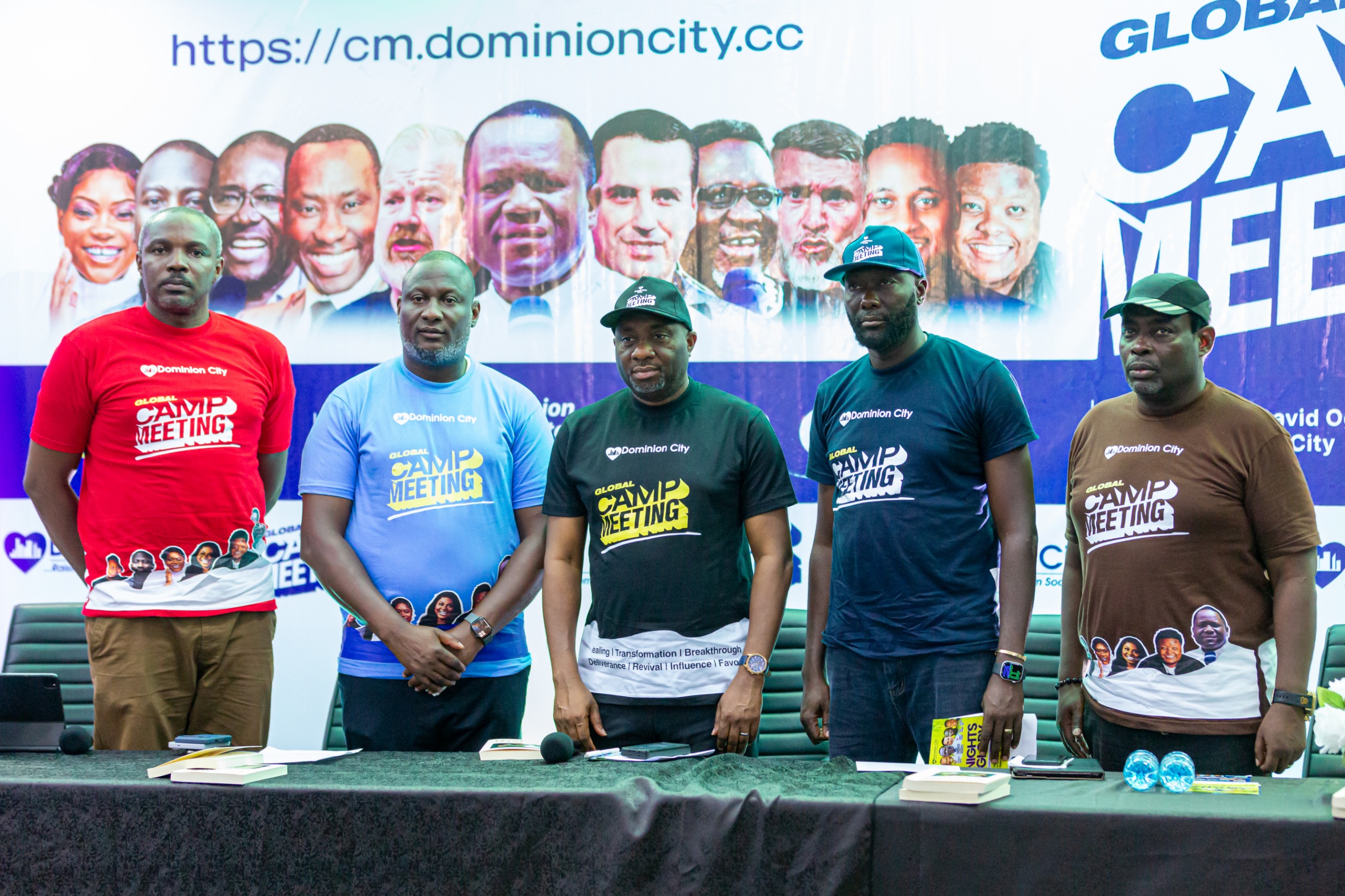
L-R: Dr. Godwin Efobi, Head, Medical Team, Dominion City Headquarters (DCHQ); Pastor Shola Olapade, Senior Pastor, DCHQ; Pastor Nobbert Onaga, President, Golden Heart Foundation and Senior Pastor, DC Lagos & Europe; Pastor Chuks Anochie, Head of Security and Traffic Control, Dominion City Headquarters (DCHQ), Camp Meeting 2026; Pastor Josh Tim Vaduchi, Head of Event & Programmes, DCHQ, during the press briefing of the forthcoming Global Camp Meeting, held the weekend of 2026 at the Dominion City Headquarters (DCHQ), Lagos.
L-R: Pastor Chuks Anochie, Head of Security and Traffic Control, Dominion City Headquarters (DCHQ), Camp Meeting 2026; Pastor Shola Olapade, Senior Pastor, DCHQ; Pastor Nobbert Onaga, President, Golden Heart Foundation and Senior Pastor, DC Lagos & Europe; Dr. Godwin Efobi, Head, Medical Team, DCHQ; and Pastor Josh Tim Vaduchi, Head of Event & Programmes, during the press briefing of the forthcoming Global Camp Meeting, held over the weekend in 2026 at the Dominion City Headquarters (DCHQ), Lagos.
society
Oloworo of Oworosoki Kingdom, Oba Babatunde Saliu, Felicitates President Bola Ahmed Tinubu at 74

Oloworo of Oworosoki Kingdom, Oba Babatunde Saliu, Felicitates President Bola Ahmed Tinubu at 74
By Adeyemi Obadimu
The Oloworo of Oworosoki Kingdom, His Royal Majesty, Oba Babatunde Saliu, Elebo II, has extended warm felicitations to the President of the Federal Republic of Nigeria, Bola Ahmed Tinubu, GCFR, on the occasion of his 74th birthday.
In a goodwill message issued from his palace, the revered monarch described President Tinubu as a visionary statesman, a courageous reformer, and an indefatigable democrat whose lifelong commitment to nation-building continues to shape Nigeria’s progress.
Oba Babatunde Saliu praised the President’s unwavering dedication to public service, noting that his leadership has ushered in a new phase of economic reform, infrastructural renewal, and institutional strengthening across the country.
According to the monarch, the President’s Renewed Hope Agenda has begun yielding tangible relief and renewed confidence among citizens, reflecting his determination to reposition Nigeria for sustainable growth and prosperity.
“President Bola Ahmed Tinubu has demonstrated exceptional resilience, strategic foresight, and a deep love for Nigeria. His administration’s bold initiatives are laying the foundation for long-term national transformation. At 74, he remains steadfast in his resolve to build a stronger, more united, and economically vibrant nation,” the monarch stated.
Oba Babatunde further commended the President’s legacy of leadership, describing him as a bridge-builder, a mentor to many leaders, and a symbol of democratic stability. He acknowledged the President’s decades of sacrifice and contribution to the advancement of democracy in Nigeria.
On behalf of the Oworosoki Kingdom, the royal father prayed for divine wisdom, sound health, and renewed strength for the President to successfully complete the noble reforms and developmental strides he has embarked upon for the benefit of all Nigerians.
“As Your Excellency marks 74 remarkable years, we pray that Almighty God grants you long life, continued wisdom, and the fortitude to steer our great nation toward greater heights. May your days be filled with strength and grace as you continue to serve Nigeria with distinction,” Oba Babatunde Saliu added.
President Bola Ahmed Tinubu clocks 74 as a leader whose enduring influence, bold reforms, and steadfast patriotism remain central to Nigeria’s ongoing journey of national renewal.


-

 society6 months ago
Religion: Africa’s Oldest Weapon of Enslavement and the Forgotten Truth
-

 news4 months ago
WHO REALLY OWNS MONIEPOINT? The $290 Million Deal That Sold Nigeria’s Top Fintech to Foreign Interests
-

 society6 months ago
“You Are Never Without Help” – Pastor Gebhardt Berndt Inspires Hope Through Empower Church (Video)
-

 celebrity radar - gossips2 months ago
Dr. Chris Okafor Returns with Power and Fire of the Spirit -Mounts Grace Nation Altar with Fresh Anointing and Restoration Grace on February 1, 2026