
society
DIVINE CALLING, BEAN CAKES, AND A BUSINESS BLESSED BY FAITH: THE REMARKABLE RISE OF VICTORIA KITCHEN


A JOURNEY OF DEDICATION: THE STORY OF EDEH CHINENYE JESSICA
Born on the 7th of February, 1988, in Akpugo, Nkanu West LGA of Enugu State, Edeh Chinenye Jessica grew up with a quiet but determined resolve — to grow, to give, and to support humanity in every way she could. Her early years in Onitsha laid the foundation for her academic journey, beginning at Santa Maria Primary School, where she obtained her First School Leaving Certificate in 2001.
Fuelled by curiosity and a love for learning, she continued her education at St. Cyprian Special Science School, Nsukka, earning her West African Senior School Certificate (WAEC) in 2007. It was there her interest in the growing world of technology began to take root — a passion that would shape the next phase of her journey. In pursuit of excellence and technical knowledge, Chinenye enrolled at the Institute of Management and Technology (IMT), Enugu, where she studied Computer Science.
She first bagged an Ordinary National Diploma (OND) in 2012 and, driven by a desire to deepen her competence, she returned to complete her Higher National Diploma (HND) in 2015. Along the way, she supplemented her classroom knowledge with practical skills, earning a certificate in Computer Applications from Mecxon Computer School the same year.
Her industrial training at Alo Aluminum Company (2012–2013) gave her firsthand experience in applying IT knowledge in a real-world setting. But Chinenye’s heart longed for more than just technical mastery — she yearned to serve.
This inner passion led her to the development sector. In 2015, she joined Happy Home Foundation, a non-governmental organization in Enugu, where she served with dedication. Her work revolved around supporting vulnerable groups, coordinating programs, and delivering hope to many.
During her National Youth Service Corps (NYSC) year from 2016 to 2017, she was posted to Succour and Development Service Initiative, continuing her humanitarian efforts with focus and compassion.
Following NYSC, Chinenye returned to Happy Home Foundation, where she worked until 2019 — years marked by growth, service, and the strengthening of her commitment to people-centered work.
Then came a new season.
In 2019, she stepped into entrepreneurship, founding Victoria’s Kitchen, a food business inspired by her mother’s legacy and her own culinary passion. What began as a small initiative soon blossomed into a platform not only for nourishment but also for empowerment, as she blended her business skills, integrity, and warmth to serve others in new ways.

Chinenye’s journey is one of consistent learning and meaningful impact — from the computer labs of IMT to the mission fields of NGOs, and now to the kitchens where food meets purpose. Through every step, her story reflects not just experience, but character, vision, and a heart that continues to work hard towards supporting the human person.
A Voice, a Prayer, and an Akara Revelation
At exactly 12 noon on an otherwise ordinary afternoon in 2019, a young Nigerian woman named Chinenye Edeh—now the proud founder of Victoria Kitchen—heard a voice. She was seated, working quietly when she felt an overwhelming urge to pause and go to a small image of the Blessed Virgin Mary located just six steps away from her workstation.
“I didn’t understand the restlessness,” she recounts. “But I obeyed.”
As Chinenye knelt before the image, she carefully articulated her thoughts, “I’m not worshiping this image, o,” she confessed, “but I know it reminds us of Mary’s presence in heaven, interceding for us.” With a heart full of sincere longing, she poured out her petition:
“What can I do to save more and raise money for my Master’s program?”
At first, there was no answer. But within minutes, a still voice echoed thrice:
“Akara… Akara… Akara.”
At first, she thought someone nearby had said it, but a check revealed no one.
The compound was silent. It wasn’t external; it was spiritual. That moment marked the genesis of what would become a thriving food business, rooted in obedience, sustained by resilience, and crowned by faith.
The Priest, the Prophet, and the First Push
Chinenye shared the experience with a close friend, a medical doctor, who suggested she see a priest. “He told me jokingly to prepare to be called Nwanyi Akara,” she recalls, laughing. But then he added something unexpectedly profound:
“If you do this akara business, it will take you to heaven.”
That single statement struck a chord. She was intrigued—not just by the business idea—but by the fact that something so ordinary could be divine.
However, it wasn’t easy walking away from a formal job. After giving notice for two months, it still took her almost six to seven months to finally resign.
Wandering in the Wilderness of Locations
With resignation behind her, the next mountain was where to start.
Chinenye Edeh consulted a security man at her former workplace—also a Keke rider—who recommended two possible selling locations. The first required writing a proposal, but the idea of competing for space discouraged her. She withdrew.
The second option was busier but already had a woman frying akara. Would it be rivalry? Would it breed tension? She pushed forward, tried it—and within days—heard another divine whisper:
“Are you supposed to be here?” She knew the answer in her heart. “I didn’t like the place,” she confesses. She told her little sister, “We won’t return tomorrow.” But family criticism followed swiftly. “You resigned for this, and you’re giving up already?” one sibling retorted. The backlash was harsh.
Despite the noise, she pivoted. She fried akara close to her home instead—something felt right. Again, the gentle voice returned:
“You’re supposed to be in a quiet place.”
Finding Purpose in the Park. The voice led her to remember a woman she deeply admired. Upon meeting her, the woman directed her to a quiet park nearby. She arrived to find only birds and a single taxi. But as she stood in that peace-filled environment, it clicked.
A security man escorted her to meet the landlord of a small adjoining space. To her surprise, the landlord was a young man.
They both laughed at the oddity of the situation, but when she explained her mission, he gave her permission to use the space—at no cost.
“It was like God had laid the path in front of me,” she says. “All I had to do was walk it.”
Humble Beginnings, Homemade Taste
On the first day of operations, she spent just ₦1,400:
₦400 for beans (half paint measure),
₦600 for groundnut oil,
₦100 for pepper,
₦200 for pap.
She used a small gas cooker, a single frying pan, and some transparent rubber containers.
To her amazement, she made N3,200 that day.
From that day onward, she never looked back.
Beyond Akara: Growing with Demand Soon, customers began asking for more than akara and pap. Some wanted rice. Others requested beans. Then came porridge yam. And by afternoon, people were demanding swallow.
“I wasn’t a professional cook,” she says, “but I knew how we cooked food at home. I just replicated that.”
Positive feedback came rolling in.
Her style? “Simple. Homemade. Clean.”
Eventually, she turned to YouTube and watched a woman demonstrate akara frying. She tried the new method—and it was a hit. Victoria Kitchen was evolving.
A Test of Fire – Finding a New Location
In 2023, the landlord informed her they had six months to vacate. Desperate but prayerful, she cried out for help. Once again, her loyal customers—many of whom were estate agents—stepped in.
One agent helped her find a new empty plot of land. She and her team gathered money, bought metal sheets, contracted a welder, and built a custom food stall.
From frying akara under a tree to building her own food space, the journey was never easy—but always graced.
Why “Victoria Kitchen”?
The business name was no coincidence.
She named it after her beloved mother, Victoria, a strong woman who—despite marital struggles—raised brave and responsible children with the help of her siblings.
“Our food tastes like the one you eat at home,” many customers would say. That feedback inspired the tagline:
“Victoria’s Homemade Food.” For branding purposes, they shortened it to:
“Victoria Kitchen.”
Grace, Not Pressure
Chinenye Edeh wasn’t driven by profits, pressure, or popularity.
“There was no high expectation. I just wanted to obey and do something with my hands. God took care of the rest.”
From ½ paint measure of beans to 25 litres of akara frying per session, the business now feeds dozens daily and has expanded into full meal services—offering rice, beans, swallows, yam, pap, and more.
From Vision to Victory
Today, Victoria Kitchen is not just a food business; it’s a movement of purpose. It stands as a symbol of spiritual obedience, resilience against societal doubt, and triumph against financial limitations.
Her advice to other dreamers?
“Start where you are. Use what you have. Be faithful. It’s not always about capital. Sometimes, all you need is grace—and grit.”
Closing Note
In a world where most people wait for the “perfect opportunity,” this woman listened to a whisper, followed a strange instruction, and built something that now nourishes both body and soul. Victoria Kitchen isn’t just feeding people.
It’s feeding dreams.
Find Victoria Kitchen at Location 36 Nza street Independence Layout, Enugu
For orders or enquiries,
Follow on Instagram: victorias_homemadefood
Motto: “Memorable and healthy food in a plate and sip”




society
GEN CHRISTOPHER GWABIN MUSA SUPPORT INITIATIVE EXTENDS WARM BIRTHDAY FELICITATIONS TO PRESIDENT TINUBU ON 74TH BIRTHDAY
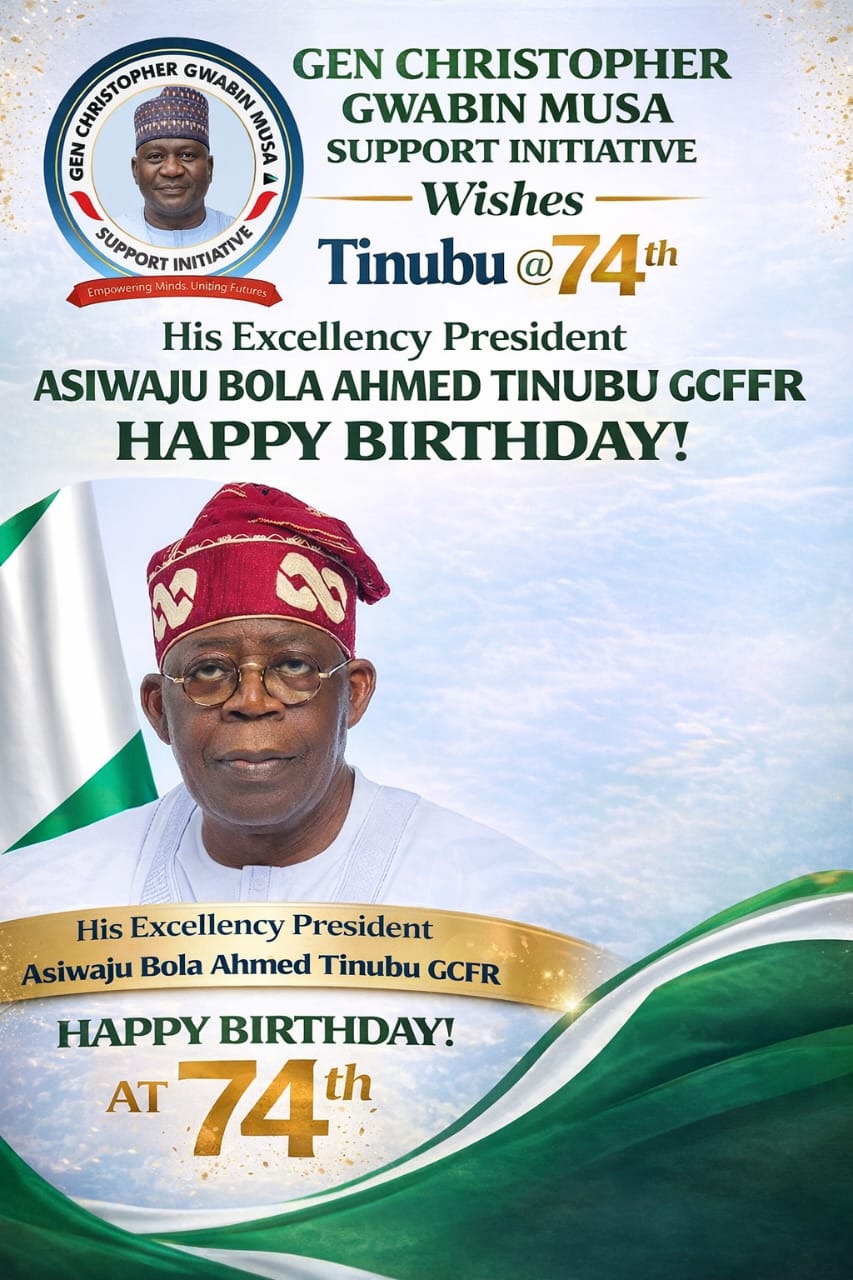
GEN CHRISTOPHER GWABIN MUSA SUPPORT INITIATIVE EXTENDS WARM BIRTHDAY FELICITATIONS TO PRESIDENT TINUBU ON 74TH BIRTHDAY
The Gen Christopher Gwabin Musa Support Initiative has extended heartfelt congratulations to His Excellency President Asiwaju Bola Ahmed Tinubu, GCFR, on the occasion of his 74th birthday.
In a statement released to the press, the Initiative conveyed warm wishes for the President’s personal well-being and for his continued leadership of the nation. The statement, signed by the Convener, Ibrahim Dahiru Danfulani, Sadaukin Garkuwan Keffi/Betara Biu, expressed hope that the coming year would bring the President “renewed strength and more wisdom in guiding the nation.”
The statement further noted that the Grand Patron of the Initiative, His Excellency Gen Christopher Gwabin Musa, OFR, Minister of Defence of the Federal Republic of Nigeria, joined in celebrating the milestone. It added, “Wishing Your Excellency continued good health, vitality, and determination as you lead the country towards greater unity and progress.”
The message underscores support for President Tinubu’s administration and its national objectives, marking the birthday as an occasion to reaffirm commitment to the nation’s unity and advancement under his stewardship.
society
Dominion City to Host Global Camp Meeting, “2 Nights of Glory” 2026 in Lagos, Enugu …Calls for Moral Renewal

*Dominion City to Host Global Camp Meeting, “2 Nights of Glory” 2026 in Lagos, Enugu
…Calls for Moral Renewal
Lagos – Dominion City has announced plans to host its annual Global Camp Meeting alongside a special “2 Nights of Glory” gathering in April 2026, with events scheduled to be held simultaneously in Lagos and Enugu.
The week-long programme is expected to draw tens of thousands of participants onsite and millions of virtual attendees from across the globe.
The Global Camp Meeting will run from Wednesday, April 1 to Monday, April 6, featuring daily sessions at 8:00 a.m. and 5:00 p.m. The “2 Nights of Glory” is slated for Friday, April 3 and Saturday, April 4 at the Golden Heart Place, Km 22 Lekki-Epe Expressway, beside Lagos Business School, Ajah, Lagos.
Organised by Dominion City, a global church focused on raising transformational leaders, the conference will centre on revival, spiritual renewal, and practical teachings. This year’s theme, “Redigging the Wells of Our Fathers,” underscores a call to return to foundational values and principles.
Speaking ahead of the event, Nobbert Onaga, President, Golden Heart Foundation and Senior Pastor, DC Lagos & Europe, emphasised the need for moral reawakening as a pathway to national transformation. He described the Church as “the pillar and foundation of truth,” noting that the conference aims to confront moral decline and restore core values within society.
“We are going back to foundational truths that established the Church. These truths will help repair societal damage and reposition the Church as a source of hope and light,” Onaga said.
Also speaking, Shola Olapade, Senior Pastor of Dominion City Headquarters, highlighted the Church’s role in addressing ethical and cultural challenges, particularly among young people. He added that the programme would go beyond spiritual teachings to include sessions on artificial intelligence, innovation, business, media, arts, and career development.
“We are equipping people not just spiritually, but with relevant 21st-century skills to thrive in today’s world,” Olapade noted.
The conference will feature teachings and ministrations from a lineup of international ministers, including Dr. David Ogbueli, Dr. Charles Ndifon, Andres Bisonni, Pastor Randy Mitchell, Apostle Ikechukwu Peter Nnajiofor, Dr. Ferdinand Nweke, Apostle Ben Hanyani Ndobe, Evangelist Dan Scott, and Dr. Chiefo Ejiofobiri.
Music ministrations will also be led by notable gospel artists such as Grace Idowu, Rhema Onuoha, Once More Six, David Nkennor, Anthony Kani, and GUC.
Organisers disclosed that over 30,000 participants are expected to attend in person, with free transportation provided from designated locations across Lagos to ease access. In addition, free medical services will be offered daily, building on previous outreaches that benefited over 1,700 people.
To ensure safety and order, more than 200 traffic marshals will be deployed in collaboration with relevant authorities.
Beyond its spiritual impact, organisers project that the event will stimulate local economic activity across hospitality, transportation, and retail sectors.
The Global Camp Meeting remains a key platform for spiritual impartation, leadership development, and societal transformation, aligning with Dominion City’s mission to equip believers to influence their communities positively.
Participation is open to the public, with registration available online for both physical and virtual attendance. //END.//
*PHOTO CAPTIONS:*
L-R: Dr. Godwin Efobi, Head, Medical Team, Dominion City Headquarters (DCHQ); Pastor Shola Olapade, Senior Pastor, DCHQ; Pastor Nobbert Onaga, President, Golden Heart Foundation and Senior Pastor, DC Lagos & Europe; Pastor Chuks Anochie, Head of Security and Traffic Control, Dominion City Headquarters (DCHQ), Camp Meeting 2026; Pastor Josh Tim Vaduchi, Head of Event & Programmes, DCHQ, during the press briefing of the forthcoming Global Camp Meeting, held the weekend of 2026 at the Dominion City Headquarters (DCHQ), Lagos.
L-R: Pastor Chuks Anochie, Head of Security and Traffic Control, Dominion City Headquarters (DCHQ), Camp Meeting 2026; Pastor Shola Olapade, Senior Pastor, DCHQ; Pastor Nobbert Onaga, President, Golden Heart Foundation and Senior Pastor, DC Lagos & Europe; Dr. Godwin Efobi, Head, Medical Team, DCHQ; and Pastor Josh Tim Vaduchi, Head of Event & Programmes, during the press briefing of the forthcoming Global Camp Meeting, held over the weekend in 2026 at the Dominion City Headquarters (DCHQ), Lagos.
society
Oloworo of Oworosoki Kingdom, Oba Babatunde Saliu, Felicitates President Bola Ahmed Tinubu at 74

Oloworo of Oworosoki Kingdom, Oba Babatunde Saliu, Felicitates President Bola Ahmed Tinubu at 74
By Adeyemi Obadimu
The Oloworo of Oworosoki Kingdom, His Royal Majesty, Oba Babatunde Saliu, Elebo II, has extended warm felicitations to the President of the Federal Republic of Nigeria, Bola Ahmed Tinubu, GCFR, on the occasion of his 74th birthday.
In a goodwill message issued from his palace, the revered monarch described President Tinubu as a visionary statesman, a courageous reformer, and an indefatigable democrat whose lifelong commitment to nation-building continues to shape Nigeria’s progress.
Oba Babatunde Saliu praised the President’s unwavering dedication to public service, noting that his leadership has ushered in a new phase of economic reform, infrastructural renewal, and institutional strengthening across the country.
According to the monarch, the President’s Renewed Hope Agenda has begun yielding tangible relief and renewed confidence among citizens, reflecting his determination to reposition Nigeria for sustainable growth and prosperity.
“President Bola Ahmed Tinubu has demonstrated exceptional resilience, strategic foresight, and a deep love for Nigeria. His administration’s bold initiatives are laying the foundation for long-term national transformation. At 74, he remains steadfast in his resolve to build a stronger, more united, and economically vibrant nation,” the monarch stated.
Oba Babatunde further commended the President’s legacy of leadership, describing him as a bridge-builder, a mentor to many leaders, and a symbol of democratic stability. He acknowledged the President’s decades of sacrifice and contribution to the advancement of democracy in Nigeria.
On behalf of the Oworosoki Kingdom, the royal father prayed for divine wisdom, sound health, and renewed strength for the President to successfully complete the noble reforms and developmental strides he has embarked upon for the benefit of all Nigerians.
“As Your Excellency marks 74 remarkable years, we pray that Almighty God grants you long life, continued wisdom, and the fortitude to steer our great nation toward greater heights. May your days be filled with strength and grace as you continue to serve Nigeria with distinction,” Oba Babatunde Saliu added.
President Bola Ahmed Tinubu clocks 74 as a leader whose enduring influence, bold reforms, and steadfast patriotism remain central to Nigeria’s ongoing journey of national renewal.


-

 society6 months ago
Religion: Africa’s Oldest Weapon of Enslavement and the Forgotten Truth
-

 news4 months ago
WHO REALLY OWNS MONIEPOINT? The $290 Million Deal That Sold Nigeria’s Top Fintech to Foreign Interests
-

 society6 months ago
“You Are Never Without Help” – Pastor Gebhardt Berndt Inspires Hope Through Empower Church (Video)
-

 celebrity radar - gossips2 months ago
Dr. Chris Okafor Returns with Power and Fire of the Spirit -Mounts Grace Nation Altar with Fresh Anointing and Restoration Grace on February 1, 2026