
society
Experts call for regulation, licensing of domestic workers


Experts call for regulation, licensing of domestic workers
By Ebere Agozie/Anita Uzoagba
Experts have called for urgent formalisation and regulation of domestic work in Nigeria, stressing that domestic workers remain largely invisible, unprotected and vulnerable to exploitation.
They made this know at the conclusion of the five-day 7th Annual Criminal Law Review Conference organized by the Rule of Law Development Foundation (ROLDF) on Friday in Abuja.
Mrs Ozioma Izuora, Lecturer, Baze University, Abuja said that domestic workers are the people you see every day. They have always been part of our households, yet they have remained invisible and unprotected.
According to her, the Igbo apprenticeship scheme is a positive institutional pathway for training and wealth creation.
“It is unfortunate that the government has not paid enough attention to formalising or learning from this model.
Izuora said that cases of exploitation, underpayment, physical abuse and sexual violence are still widespread, despite protections under the Child Rights Act.
“Stories abound of children being beaten, burned, denied food or left to sleep outside.
“Some agents run rackets where they rotate young girls between households, and many of these children have no contracts, no voice and no access to their own wages”.
She added that some domestic workers, due to lack of education and guidance, also violate trust by abandoning work without notice or engaging in criminal activity.
She underscored the need for government monitoring, licencing of private agencies, and the establishment of a dispute-resolution mechanism.
She added that Nigeria’s adoption of International Labour Organisation (ILO) Convention 189 places it under obligation to ensure decent working conditions for millions of domestic workers who have long been marginalised.
“If domestic work is to be formalised, then government must monitor implementation closely”, she said.
Mr Hygenus Ibaga, a Legal Practitioner, said that domestic work remains one of the most undervalued and least regulated sectors in Nigeria despite its vital role in supporting households and the wider economy.
According to him, domestic work in Nigeria has historically been treated as a private or charitable arrangement rather than a formal job.
“We often say, I’m helping that small boy or girl but what we want now is a legal framework that recognises the cleaner or caregiver as a staff entitled to rights and protection.
He noted that while the Constitution protects rights such as dignity, liberty and freedom from discrimination, the absence of a dedicated law leaves domestic workers vulnerable.
He added that existing laws such as the Child Rights Act, the Penal Codes and criminal laws offer some protection, but enforcement remains weak.
Ibaga noted that Nigeria has yet to ratify ILO Convention 189, which guarantees rights to fair remuneration, working hours, rest periods and social security.
He noted that two earlier Senate bills have been consolidated into the Domestic Workers’ Protection Bill, which the Senate passed on Nov. 12, 2025 and the House of Representatives is yet to pass the bill.
He further urged the National Assembly to strengthen implementation capacity, speed up passage of the bill and create mechanisms that domestic workers can actually access.
For her part, Mrs Linda Raji, project Officer, ROLDF, said that weak institutions and entrenched social norms are the biggest obstacles to enforcing domestic workers’ rights in Nigeria.
According to her, informality remains the major barrier to enforcement, as recruitment of domestic workers often happens secretly through unlicensed agents without any written contract.
“I once overheard someone say, I need a girl, 16 years old, send her here, within two days, the girl arrived. You wonder if the parents even know where their child is.
She noted that domestic workers are predominantly women and girls, many of them underage, poorly educated and at constant risk of retaliation if they report abuse.
She added that another challenge was the long-standing cultural belief that domestic work was not a real work and therefore undeserving of dignity or rights.
She expressed concern that some recruitment agents may continue to exploit the system if licencing and oversight remain weak.
“Many employers genuinely do not know their obligations, so sensitisation is key”.
She stressed the need for safe reporting channels, such as hotlines and anonymous systems, to protect workers who fear losing their jobs.
She called for nationwide awareness campaigns by the National Orientation Agency and civil society groups, stressing that domestic work should not involve children below 16.
Dr. Balogun Makanjuola, said that Nigeria’s failure to use data-driven decision-making, alongside widespread poverty and unemployment, remains a major obstacle to effectively protecting domestic workers in the country.
According to him, the supply of cheap labour, especially girls and young people, continues to rise due to poverty, out-of-school rates, and lack of opportunities.
He added that domestic workers accept low pay because employers know they have no bargaining power.
“The law of supply applies here. When workers are in excess, the price of labour falls and that is why people pay N20,000 or N30,000, even my personal driver, a graduate, earns N30,000, and there are ten others waiting to take the job,” he said.
He noted that applying formalised standards without considering economic realities could create friction.
He emphasised that unemployment, poverty, poor governance and regulatory capture are major structural barriers that may limit the effectiveness of the proposed domestic worker legislation.
“If we do not address poverty, bad governance and corruption, the legislation will struggle. Domestic workers need protection, but implementation must be grounded in Nigeria’s socioeconomic realities,” he said.
In his remarks, Mr Massoud Oredola, said that there should be greater protection and fair treatment of domestic workers in Nigeria, drawing on Islamic teachings that highlight leadership, duty, and compassion within households.
“Domestic workers should not be overburdened with work and additional tasks should either come with assistance or fair compensation, similar to overtime and holiday pay standards globally.
“The law alone is insufficient to guarantee justice, and that kindness and service to others remain fundamental principles, our prime purpose in this life is to help others. If you cannot help, at least don’t hurt, exploit or add to their misery.
“Service and kindness to others is the rent you pay for your room here on earth, we are all tenants; God Almighty is our landlord,” he said.





US-Based Society Lady, Fehintola-Brat Extends Eid-El-Kabir Greetings To Muslims
United States based fahionista of class, Chief (Mrs) Ayoola Fehintola-Brat has extended a warm greetings to Muslim faithful all over the world on the occasion of the 2026 Eid-El-Kabir celebration.
Fehintola-Brat who is the Balogun Egbe Obaneye Obinrin Akile Ijebu, and the Yeye Asofin of Idenaland in her message to Journalists urged Muslim to continually uphold the enduring values of sacrifice, obedience, faith, and compassion, which are central to the significance of Eid-El-Kabir festival.
A quiet philantropist whose humanitarian services has won her several laurels urged Muslims to use the spiritual occasion to pray for the peace co-existence of Nigerians regardless of religious, social and political leanings stressing that the oneness of the country should not be underplay.
In a related development, she expressed her felicitations to all sons and daughters of Ijebuland on the forthcoming Ojude Oba 2026 celebration, tasking age-groups otherwise known as Regbregbe to be more proactive in giving back to their immediate communities.
According to her, the beauty of the age-groups in Ijebuland is the need to contribute immensely to the development of the land in no small means. “This we will continue to achieve with God on our side”, she concluded.
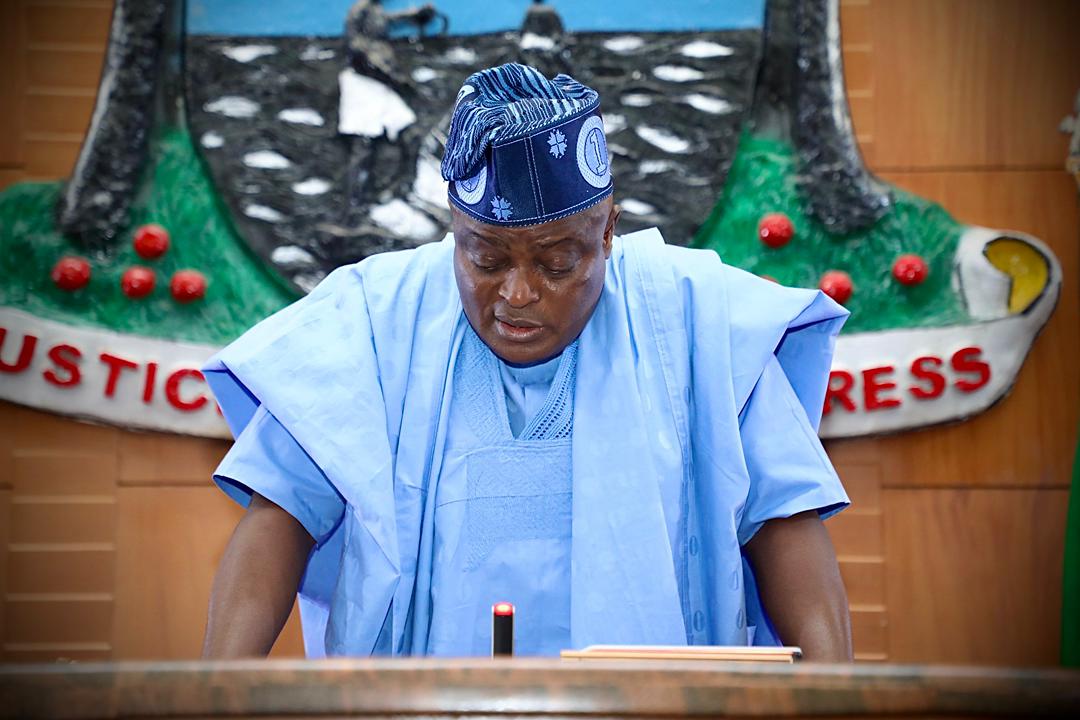
Sallah: Obasa Felicitates Muslim Ummah, Commends Nigerians for APC Primaries Turnout
The Speaker of the Lagos State House of Assembly, Rt. Hon. Mudashiru Obasa has extended warm felicitations to Muslims in Lagos State and across Nigeria on the occasion of Eid al-Adha.
In a statement released by his Chief Press Secretary, Mr. Dave Agboola, Obasa described the festival as a season of sacrifice, reflection, and gratitude, urging the faithful to continue to uphold the values of peace, unity, and love that strengthen the nation.
He noted that the celebration of Eid al-Adha is not only a spiritual milestone but also a reminder of the importance of togetherness and collective responsibility in building a stronger society.
He, likewise, emphasized that the festival provides an opportunity for Nigerians to renew their commitment to national progress and to support leadership that prioritizes development and prosperity.
Obasa, however, commended Nigerians, particularly members of the All Progressives Congress (APC), for their massive turnout during the recently concluded party primaries. He described the participation as a clear demonstration of the people’s confidence in the government of President Bola Ahmed Tinubu and their belief in the administration’s vision for a greater Nigeria.
“The APC primaries have shown the resilience of our democracy and the confidence Nigerians have in the leadership of President Bola Ahmed Tinubu and the Renewed Hope Agenda. This is a strong message that our people are ready to continue supporting policies that will drive growth and prosperity,” Obasa stated.
The Speaker further encouraged Muslims to celebrate responsibly, stressing that the joy of Eid should be accompanied by prayers for the continued peace and progress of Lagos State and Nigeria.
“As you celebrate with family and loved ones, may this season bring joy, peace, and prosperity to your homes. Let us remain united in our resolve to build a stronger nation,” he added.
On behalf of the Lagos State House of Assembly, Obasa wished all Muslims a happy and fulfilling Eid al-Adha celebration.

ABEOKUTA FILM FESTIVAL AT ILEYA
Kayshow Multimedia a filmmaking and Media organization this year 2026 holds its annual Abeokuta film festival at the Ake Palace in Abeokuta.
Alake of Egba land, Ọba Michael Adedotun Arẹmu Gbadebo has graciously endorsed the Free Training of Egba Youths on Film and Arts and the Entertainment of the the People with a FREE FILM SHOW at the AKE PAVILION. as part of the ABEOKUTA FILM FESTIVAL 2.0.
The Convener of the Film Festival Honorable Kehinde Soaga says this year’s event promises to be more exciting as distinguished personalities are sure to attend.
This includes the honorable Minister for Art Culture and Creative Economy in Nigeria, Barr. Hannatu Musa Musawa, Ààrẹ Lai Labode, Sen. Ibikunle Amosun and other special guests.
The event will feature Film, Cultural Dance Cultural foods and Award Ceremony.
The general public is hereby invited to the Free film show at the Abeokuta film festival at the Alake Palace Pavilion on Thursday 28th of May 2026 by 4:00 p.m.
Only well dressed is the Entry. The Abeokuta Film Festival is an annual event taking place in the capital city of Ogun State state.


- Qrent says delaying Information Technology (IT) refresh cycles may be increasing operational risk for businesses in Africa May 27, 2026
- Dentons’ Iyunola Adekanye Appointed to African Mining Week (AMW) Advisory Board May 27, 2026
- United Nations (UN) Women Liberia and Partners Convene for Spotlight Initiative 2.0 Women’s Economic Empowerment Inception Meeting May 27, 2026
- African Mining Week (AMW) to Host Central Bank Governors Roundtable as Monetary Authorities Deepen Role in Mining Sector Growth May 27, 2026
- Eritrea: Diaspora Nationals Celebrate Independence Day Anniversary May 27, 2026
- Africa Unveils Landmark Humanitarian Coordination Platform to Strengthen aligned Response to Humanitarian Crises May 27, 2026
- Seychelles: President Herminie Engages with Police and Fire Services on Praslin May 27, 2026
- Issue 3 of Mining Review Africa now available for free download May 27, 2026
- NOV Joins African Energy Week (AEW) 2026 as Gold Sponsor Amid Africa’s Offshore Expansion Push May 26, 2026
- African Union of Broadcasting (AUB) and United Nations University Institute for Water, Environment and Health (UNU-INWEH) Launch Landmark Webinar Series on Africa’s Water Crisis, Starting June 2, 2026 May 26, 2026
- Qrent says delaying Information Technology (IT) refresh cycles may be increasing operational risk for businesses in Africa May 27, 2026
- Dentons’ Iyunola Adekanye Appointed to African Mining Week (AMW) Advisory Board May 27, 2026
- United Nations (UN) Women Liberia and Partners Convene for Spotlight Initiative 2.0 Women’s Economic Empowerment Inception Meeting May 27, 2026
- African Mining Week (AMW) to Host Central Bank Governors Roundtable as Monetary Authorities Deepen Role in Mining Sector Growth May 27, 2026
- Eritrea: Diaspora Nationals Celebrate Independence Day Anniversary May 27, 2026
- Africa Unveils Landmark Humanitarian Coordination Platform to Strengthen aligned Response to Humanitarian Crises May 27, 2026
- Seychelles: President Herminie Engages with Police and Fire Services on Praslin May 27, 2026
-

 news5 months ago
WHO REALLY OWNS MONIEPOINT? The $290 Million Deal That Sold Nigeria’s Top Fintech to Foreign Interests
-

 society3 weeks ago
SOCIAL MEDIA IS NOT A BATTLEFIELD COMMAND – WHY THE NIGERIAN ARMY’S ACTION AGAINST JUSTICE CRACK IS A NATIONAL SECURITY IMPERATIVE
-

 celebrity radar - gossips4 months ago
Dr. Chris Okafor Returns with Power and Fire of the Spirit -Mounts Grace Nation Altar with Fresh Anointing and Restoration Grace on February 1, 2026
-

 celebrity radar - gossips6 months ago
Prophet Kingsley Aitafo Releases 2026 Prophecy: ‘Nigeria Will Rise, but the World Must Prepare for Turbulence’