
society
Tinubu’s Trip Cancellation: A Masterclass in Political Tokenism and National Neglect


Tinubu’s Trip Cancellation: A Masterclass in Political Tokenism and National Neglect.
By George Omagbemi Sylvester | Published by SaharaWeeklyNG.com
“Why Symbolic Gestures Cannot Substitute Real Leadership in a Nation Under Siege.”
Nigeria stands once again at the crossroads of tragedy and spectacle. The recent announcement by President Bola Ahmed Tinubu that he had cancelled his planned diplomatic trip to South Africa and Angola has been celebrated by his spokespersons as a sign of empathy and national concern. Yet, upon deeper scrutiny, this decision is nothing more than a politically expedient performance; an empty gesture crafted for media applause rather than national healing.
True leadership is not measured by cancelled flights or televised speeches. It is measured by courage, presence, decisions and the unwavering will to confront crises head-on. What the Tinubu administration has offered Nigerians, however, is a steady parade of optics devoid of substance.
The Nation is Burning, Yet Leadership Remains Distant. The kidnapping of the Maga schoolgirls in Kebbi State is not an isolated tragedy; it is part of an entrenched pattern of violence born from years of weak security architecture. According to the UNICEF 2024 Nigeria Education Safety Report, more than 1,680 schoolchildren have been abducted in northern Nigeria since 2014. The Global Terrorism Index (GTI) 2024 identifies Nigeria as the 8th MOST TERROR-IMPACTED nation in the world, a decline from its earlier ranking but still a staggeringly high position for Africa’s SUPPOSED giant.
In this context, President Tinubu’s cancelled trip falls flat. It does not address the root of the insecurity crisis. It does not inspire confidence. It does not change the fact that 25 innocent schoolgirls remain missing, their families plunged into grief, uncertainty and fear.
Instead, what Nigerians received was a symbolic gesture; what American political theorist Dr. David Easton once termed “the politics of attention without the politics of solution.”
If the Presidency disagrees with the assertion that this is mere tokenism, then let it prove otherwise:
Let President Tinubu temporarily relocate to Kebbi and other conflict zones in the North.
Let him walk the streets where blood has been spilled.
Let him face the parents whose children were taken under his watch.
Let him demonstrate what leadership looks like in times of trial. Anything less is political theatre.
Leadership is Proven on the Frontlines, Not Inside the Villa. History honours leaders who stand with their people in times of peril. During World War II, Winston Churchill famously declared, “I must up and doing-standing firm with my people in the darkest hour.” He walked through bombed-out London streets, inspiring courage that outlived him.
On the African continent, Nelson Mandela repeatedly emphasised that “a leader must be prepared to give up everything for the freedom and safety of his people.”
President Tinubu, however, remains ensconced within the safety of the Presidential Villa while ordinary Nigerians are slaughtered, kidnapped or forced to flee their communities.
The contrast is jarring. The optics are damning. And the symbolism is hollow.
If a political crisis broke out, such as the Rivers State controversy earlier this year, President Tinubu would deploy negotiations, resources, intelligence networks, emissaries and even questionable state powers to restore political control.
But when the blood of children is involved, when families are destroyed, the response suddenly becomes gentle, symbolic and empty.
The APC’s Governance Model: Deny, Deflect, Distract. The pattern under the APC-led administration is now unmistakable:
Deny the scale of insecurity
Deflect responsibility
Distract the public with symbolic gestures
From the excuses surrounding fuel subsidy removal chaos, to the controversial foreign trips, to the ongoing collapse in purchasing power as confirmed by the National Bureau of Statistics (NBS), the government’s instinct has been defensive rather than reformative.
When 121 students were abducted in Kaduna in March 2024, the government promised decisive action. Today, many remain unaccounted for.
When bandits sacked communities in Niger, Benue and Zamfara, government spokespersons issued standard press releases condemning the attacks and nothing more.
When farmers in Plateau were massacred on Christmas Eve 2023, the Presidency pledged “RENEWED RESOLVE.” Yet attacks have continued into 2024 and 2025.
As Prof. Jibrin Ibrahim, a respected political scientist, stated in a 2024 security symposium in Abuja: “Nigeria’s problem is not the absence of policies but the absence of political will to enforce them.”
This absence of political will is what makes Tinubu’s trip cancellation both predictable and meaningless.
Insecurity Has Become Part of Nigeria’s Daily Vocabulary. The recent attacks in Kwara State serve as a grim reminder that insecurity is not a northern problem, it is a Nigerian problem. In the last 18 months alone, the following tragedies have unfolded:
Over 4,300 Nigerians killed in violent attacks (ACLED Data, 2024).
More than 7,800 kidnappings recorded nationwide (SBM Intelligence).
Over 3 million displaced persons, predominantly in the North (International Organization for Migration, 2024).
These numbers are not mere statistics. They are a reflection of the lived reality of Nigerians who sleep with one eye open and pray that bandits, terrorists or unknown gunmen do not strike before dawn.
As Kenyan writer Ngũgĩ wa Thiong’o once said,
“A nation that cannot guarantee the safety of its citizens has forfeited the moral right to govern.” This is the tragic threshold Nigeria continues to approach under the APC-led government.
A Nation Cannot Be Saved by Optics. A cancelled trip to South Africa and Angola does nothing to:
Improve intelligence gathering
Strengthen border security
Restore morale among troops
Rescue abducted children
Stop bandit financing networks
Reform the broken policing system
Restore confidence in national leadership
Nigeria does not need presidential theatrics. It needs a leader ready to confront danger, not one who stands afar issuing statements.
Leadership is action—not ANNOUNCEMENT.
Leadership is sacrifice—not SYMBOLISM.
Leadership is presence—not PERFORMANCE.
Anything short of this will continue to erode the credibility of a Presidency struggling to command public trust.
Nigerians Are Tired of Tokenism. Enough of platitudes. Enough of condolences. Enough of optics. Enough of “we condemn this attack.” Enough of “the President has cancelled his trip.” The Nigerian people demand serious, sustained and tangible actions:
A national security overhaul
Real reforms within the police and military
Decentralised community policing
Cutting off the financial networks of bandits and terrorists
Holding governors accountable for security lapses
Presidential presence in conflict zones; not aloofness in Abuja
As the late Chinua Achebe wisely noted:
“A leader who does not listen will eventually be surrounded by people who have nothing to say.” Nigeria is rapidly approaching that point.
Ultimate Assessment: Rise to the Occasion or Step Aside. The safety of Nigerians cannot be reduced to a political drama staged for international cameras. It cannot be managed through symbolism, optics, or cancelled trips.
This nation demands seriousness—not SYMBOLISM.
If President Bola Ahmed Tinubu truly wishes to write his name in the book of honour, he must:
Leave the Villa
Stand with the people
Reclaim the nation from agents of terror
Demonstrate courage worthy of the office he holds
And if he cannot, he must make way for those who can.
Nigeria deserves no less.
Nigeria demands far more.
Nigeria cannot survive on tokenism.






US-Based Society Lady, Fehintola-Brat Extends Eid-El-Kabir Greetings To Muslims
United States based fahionista of class, Chief (Mrs) Ayoola Fehintola-Brat has extended a warm greetings to Muslim faithful all over the world on the occasion of the 2026 Eid-El-Kabir celebration.
Fehintola-Brat who is the Balogun Egbe Obaneye Obinrin Akile Ijebu, and the Yeye Asofin of Idenaland in her message to Journalists urged Muslim to continually uphold the enduring values of sacrifice, obedience, faith, and compassion, which are central to the significance of Eid-El-Kabir festival.
A quiet philantropist whose humanitarian services has won her several laurels urged Muslims to use the spiritual occasion to pray for the peace co-existence of Nigerians regardless of religious, social and political leanings stressing that the oneness of the country should not be underplay.
In a related development, she expressed her felicitations to all sons and daughters of Ijebuland on the forthcoming Ojude Oba 2026 celebration, tasking age-groups otherwise known as Regbregbe to be more proactive in giving back to their immediate communities.
According to her, the beauty of the age-groups in Ijebuland is the need to contribute immensely to the development of the land in no small means. “This we will continue to achieve with God on our side”, she concluded.
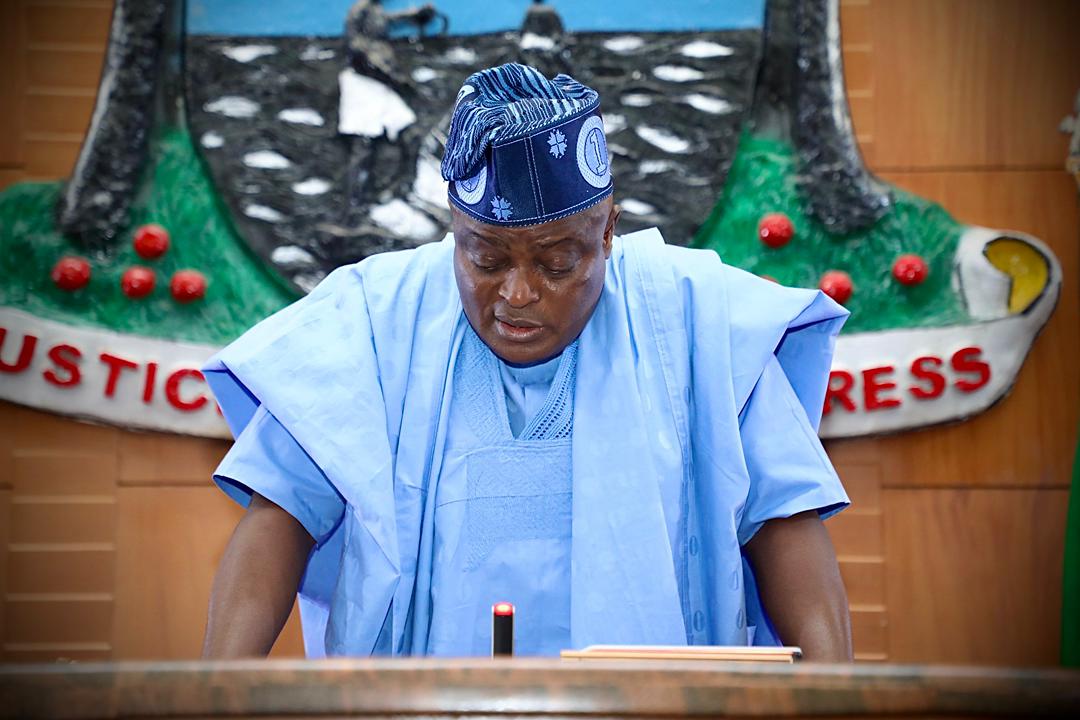
Sallah: Obasa Felicitates Muslim Ummah, Commends Nigerians for APC Primaries Turnout
The Speaker of the Lagos State House of Assembly, Rt. Hon. Mudashiru Obasa has extended warm felicitations to Muslims in Lagos State and across Nigeria on the occasion of Eid al-Adha.
In a statement released by his Chief Press Secretary, Mr. Dave Agboola, Obasa described the festival as a season of sacrifice, reflection, and gratitude, urging the faithful to continue to uphold the values of peace, unity, and love that strengthen the nation.
He noted that the celebration of Eid al-Adha is not only a spiritual milestone but also a reminder of the importance of togetherness and collective responsibility in building a stronger society.
He, likewise, emphasized that the festival provides an opportunity for Nigerians to renew their commitment to national progress and to support leadership that prioritizes development and prosperity.
Obasa, however, commended Nigerians, particularly members of the All Progressives Congress (APC), for their massive turnout during the recently concluded party primaries. He described the participation as a clear demonstration of the people’s confidence in the government of President Bola Ahmed Tinubu and their belief in the administration’s vision for a greater Nigeria.
“The APC primaries have shown the resilience of our democracy and the confidence Nigerians have in the leadership of President Bola Ahmed Tinubu and the Renewed Hope Agenda. This is a strong message that our people are ready to continue supporting policies that will drive growth and prosperity,” Obasa stated.
The Speaker further encouraged Muslims to celebrate responsibly, stressing that the joy of Eid should be accompanied by prayers for the continued peace and progress of Lagos State and Nigeria.
“As you celebrate with family and loved ones, may this season bring joy, peace, and prosperity to your homes. Let us remain united in our resolve to build a stronger nation,” he added.
On behalf of the Lagos State House of Assembly, Obasa wished all Muslims a happy and fulfilling Eid al-Adha celebration.

ABEOKUTA FILM FESTIVAL AT ILEYA
Kayshow Multimedia a filmmaking and Media organization this year 2026 holds its annual Abeokuta film festival at the Ake Palace in Abeokuta.
Alake of Egba land, Ọba Michael Adedotun Arẹmu Gbadebo has graciously endorsed the Free Training of Egba Youths on Film and Arts and the Entertainment of the the People with a FREE FILM SHOW at the AKE PAVILION. as part of the ABEOKUTA FILM FESTIVAL 2.0.
The Convener of the Film Festival Honorable Kehinde Soaga says this year’s event promises to be more exciting as distinguished personalities are sure to attend.
This includes the honorable Minister for Art Culture and Creative Economy in Nigeria, Barr. Hannatu Musa Musawa, Ààrẹ Lai Labode, Sen. Ibikunle Amosun and other special guests.
The event will feature Film, Cultural Dance Cultural foods and Award Ceremony.
The general public is hereby invited to the Free film show at the Abeokuta film festival at the Alake Palace Pavilion on Thursday 28th of May 2026 by 4:00 p.m.
Only well dressed is the Entry. The Abeokuta Film Festival is an annual event taking place in the capital city of Ogun State state.


- Qrent says delaying Information Technology (IT) refresh cycles may be increasing operational risk for businesses in Africa May 27, 2026
- Dentons’ Iyunola Adekanye Appointed to African Mining Week (AMW) Advisory Board May 27, 2026
- United Nations (UN) Women Liberia and Partners Convene for Spotlight Initiative 2.0 Women’s Economic Empowerment Inception Meeting May 27, 2026
- African Mining Week (AMW) to Host Central Bank Governors Roundtable as Monetary Authorities Deepen Role in Mining Sector Growth May 27, 2026
- Eritrea: Diaspora Nationals Celebrate Independence Day Anniversary May 27, 2026
- Africa Unveils Landmark Humanitarian Coordination Platform to Strengthen aligned Response to Humanitarian Crises May 27, 2026
- Seychelles: President Herminie Engages with Police and Fire Services on Praslin May 27, 2026
- Issue 3 of Mining Review Africa now available for free download May 27, 2026
- NOV Joins African Energy Week (AEW) 2026 as Gold Sponsor Amid Africa’s Offshore Expansion Push May 26, 2026
- African Union of Broadcasting (AUB) and United Nations University Institute for Water, Environment and Health (UNU-INWEH) Launch Landmark Webinar Series on Africa’s Water Crisis, Starting June 2, 2026 May 26, 2026
- Qrent says delaying Information Technology (IT) refresh cycles may be increasing operational risk for businesses in Africa May 27, 2026
- Dentons’ Iyunola Adekanye Appointed to African Mining Week (AMW) Advisory Board May 27, 2026
- United Nations (UN) Women Liberia and Partners Convene for Spotlight Initiative 2.0 Women’s Economic Empowerment Inception Meeting May 27, 2026
- African Mining Week (AMW) to Host Central Bank Governors Roundtable as Monetary Authorities Deepen Role in Mining Sector Growth May 27, 2026
- Eritrea: Diaspora Nationals Celebrate Independence Day Anniversary May 27, 2026
- Africa Unveils Landmark Humanitarian Coordination Platform to Strengthen aligned Response to Humanitarian Crises May 27, 2026
- Seychelles: President Herminie Engages with Police and Fire Services on Praslin May 27, 2026
-

 news5 months ago
WHO REALLY OWNS MONIEPOINT? The $290 Million Deal That Sold Nigeria’s Top Fintech to Foreign Interests
-

 society3 weeks ago
SOCIAL MEDIA IS NOT A BATTLEFIELD COMMAND – WHY THE NIGERIAN ARMY’S ACTION AGAINST JUSTICE CRACK IS A NATIONAL SECURITY IMPERATIVE
-

 celebrity radar - gossips4 months ago
Dr. Chris Okafor Returns with Power and Fire of the Spirit -Mounts Grace Nation Altar with Fresh Anointing and Restoration Grace on February 1, 2026
-

 celebrity radar - gossips6 months ago
Prophet Kingsley Aitafo Releases 2026 Prophecy: ‘Nigeria Will Rise, but the World Must Prepare for Turbulence’