
celebrity radar - gossips
Faithia Balogun set to give marriage a second chance


Popular actress, Faithia Balogun, recalls how her acting career started and also the challenges she has faced over the years
Can you recall some of your most memorable childhood experiences?
The only thing I can vividly remember is my experience in school. I went to one of the most popular schools in those days, Maryland Comprehensive High School, Ikeja. I loved going to school because every morning, my father would drive me to school and I always looked forward to seeing him after school or whenever he returned from the office.
What kind of family do you come from?
My family is a very small one. We were not extremely rich but we were very comfortable. I had everything a kid desired and I really enjoyed my childhood.
When was the first time you considered acting as a career?
I was a student of the Kwara State Polytechnic, Ilorin and I came home for a brief vacation. One day, my late foster brother, Fatai Teniola, was waiting for one of his casts to show up for a movie production. When the actress didn’t come, he and Kokonsari asked me if I could play the role. I replied that I couldn’t and that I was not even interested in acting. However, after much pleading, I decided to do it. I went back to school after that and I didn’t return for a long time so I forgot all about acting because it wasn’t in my plans. As of then, I was studying for a diploma in Law, with the intention of switching over to accounting because my father really wanted me to become an accountant. But I didn’t get admission to study accounting because I wasn’t good at mathematics. After school, I didn’t have anything to do, so I joined my foster brother’s production outfit and that was how it started. I then realised that it was something I enjoyed and I decided to go with the flow. Because I began to enjoy acting, I didn’t go back to school for my Higher National Diploma. That was when it occurred to me that I could take it up as a sustainable career. I rose fast in the movie industry because as of the time I joined, there weren’t too many actresses in the industry and I was getting ample jobs. However, after few years of acting, I travelled to the United Kingdom.
Did you eventually complete your studies in the UK?
Yes, I enrolled in a part-time drama course, though I did not finish because I got pregnant along the line. But I still had the determination that I would go back to school. Last year, I went to the Olabisi Onabanjo University to study Filming and I am happy about it.
Can you recall the first movie you acted in?
It was either T’alo pa Chief or Secretary and that was between 1989 and 1990.
Which movie made you popular?
T’alo pa Chief was a very popular movie back then and I played a major role in it. Then I was using the name, Faithia Williams and some people still refer to me by that name. After I got back from the UK, I acted in Abule Sowo by Yinka Quadri and that revived my career again.
What were some of the challenges you faced at the beginning of your career?
I usually tell people that there are challenges in all careers, even for meat sellers in the market. One has to pay his or her dues when coming up. You cannot just get there and think you would rise to the top in no time. If you don’t have endurance and patience, you wouldn’t be able to make it because you will get to hear a lot of messed up things. There is also an incident that happened at the early stage of my career. After returning from London, I was invited to act the sub-lead role in a movie outside Lagos. When we finished shooting the first day, the director said the lead actress, who was reigning at that time though I started acting before her, would sleep in the best hotel in that town, while I would follow him to his one-roomed apartment. I ended up sleeping on a couch for two days and I didn’t complain. But I prayed to God and asked Him to make me grow bigger than even the lady and I’m grateful for where I am today.
How many movies have you produced?
I’ve produced about 15 movies.
What were some of the challenges you faced while producing those movies?
If you ask me to choose between acting and producing, I will pick acting because it is less stressful. When you’re acting, you’re like the boss because everybody will be fussing over you. But when producing, you will be the one to run after the actors and make sure they’re okay. That makes me mad because some actors can be very difficult to handle, but you must not lose your calm. While producing Asa, which is my biggest movie, it was during the rainy season and I couldn’t shoot for some days. Meanwhile, I was feeding over 500 people on set. It was very tough but I was able to scale through.
Do you think there’s tribalism in the movie industry?
I wouldn’t call it tribalism; rather it has to do with how everybody started. We started acting in Yoruba while they were speaking English in their movies. If we want them to act in our movies, we would have to call them and vice versa. But the only painful part of it is that they feel we are not educated and cannot speak English. That irks me a lot because we have a lot of educated people in the Yoruba movie industry.
If you were not an actress, what do you think you would have been doing?
I honestly don’t know. Even if I had completed my education at the initial stage, I don’t think I would have worked with my certificate. However, I like engaging in business and I am already doing that alongside my acting career.
Would you consider yourself a fashionable person?
In my own little way, I think I’m fashionable. I like looking good and I spend a lot of money to achieve that. I love shoes and bags and I can do anything to get them.
What can you never be caught wearing?
I can never wear bum shorts, except in movies.
Why is that?
I feel my legs are not straight, they are bowed. I believe that wearing bum shorts with bow legs looks funny so when I see people doing that, I feel it’s awkward.
How do you unwind?
I’m a homely person and I cherish my privacy a lot. If I’m not working, I will either be sleeping or watch movies in my house. But once in a while, I visit cinemas.
Do you watch your own movies?
Not really, because I feel very stupid doing that and I criticise myself a lot.
Are you still willing to give marriage another shot?
I don’t know if I’ll fall in love again but let’s leave that to God. Never say never.
What are the qualities your ideal man must possess?
I wouldn’t tell you because anytime you see me with anybody who has those qualities, you would assume we’re dating. But the most important thing is that the person must be God-fearing.
Do you think it’s advisable for entertainers to date each other?
We all have our lives to live and I cannot dictate to anybody.
What is your official name now?
My name is Faithia Williams.
But most people know you as Faithia Balogun; don’t you think it would be confusing to your fans?
I don’t think so. Many of my fans still call me Faithia Balogun and even in movie credits, I am referred to by that name.
You recently celebrated your birthday, would anything be changing for you?
Yes. I have a lot of projects on my table and I also have a new management team that is working hard. It had always been hard for me to get my management team right but thank God I’ve got the best in town now and we’re working hand-in-hand to execute my projects. I am passionate about the girl child and I have a short movie coming soon about that. I featured in Kunle Afolayan’s new movie, Roti, and I’m very excited about it. It will be showing in cinemas soon and I want my fans to keep a lookout for it. I also hosted some of my loyal fans to brunch recently.
Are you really 50 years old?
I am not and my family knows that. If I clock 50, I would announce it to the world in a big way. I’m still in my 40s.
What’s your specific age?
I am in my mid 40s.
Is any of your children following your footsteps as an actress?
I have seen little traces. My son writes a lot of scripts and he wants to study Cinematography. My daughter also likes writing and she wants to study English. However, they both don’t like to act.
A lot of people don’t know that you’re not Yoruba?
Anybody that doesn’t know that is not my true fan. I’m from Delta State, Urhobo to be precise. Notwithstanding, I’m so proud and glad to be in the midst of Yoruba people because they are very wonderful.
Punch




celebrity radar - gossips
Adron Homes Celebrates Visionary Chairman, Aare Adetola Emmanuel King, at 51
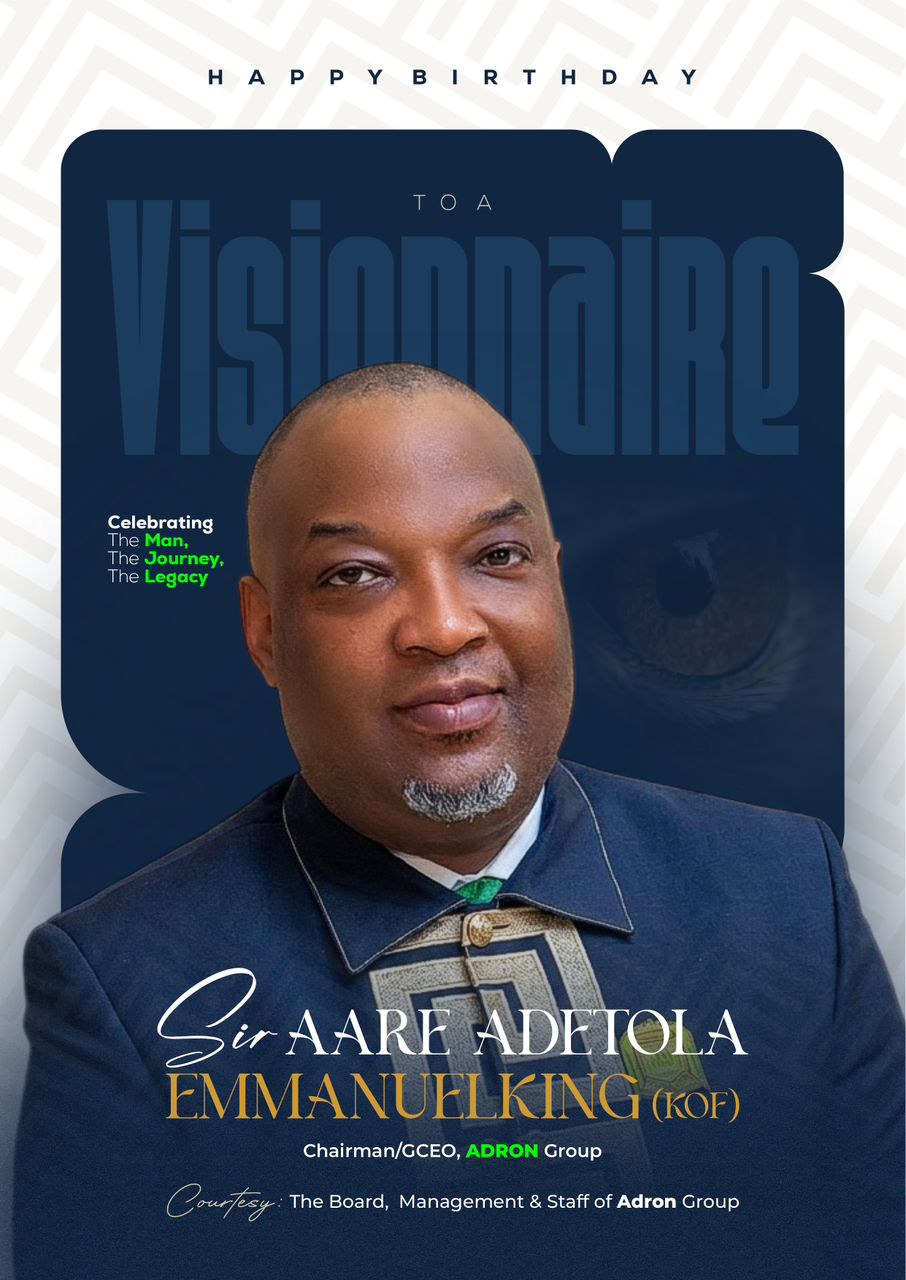
Adron Homes Celebrates Visionary Chairman, Aare Adetola Emmanuel King, at 51
The management and staff of Adron Homes and Properties Limited have joined family, friends, associates, and well-wishers across the globe to celebrate their Chairman and Chief Executive Officer, Aare Adetola EmmanuelKing, as he marks his 51st birthday.

In a statement released by the company, the milestone was described as a celebration of an exceptional leader whose vision, resilience, and entrepreneurial brilliance have not only transformed Adron Homes into a household name in Nigeria’s real estate sector but have also redefined affordable housing across the country.
Under his dynamic leadership, Adron Homes has continued to expand its footprint, delivering value-driven residential solutions while empowering thousands of Nigerians with opportunities for home ownership. His commitment to excellence, innovation, and customer satisfaction has remained the driving force behind the company’s sustained growth and industry leadership.
The statement further highlighted Aare EmmanuelKing’s passion for nation-building and community development, noting his significant contributions to job creation, youth empowerment, and the promotion of socio-economic development through real estate investments.
“As a leader, mentor, and visionary, Aare Adetola EmmanuelKing has consistently inspired a culture of excellence, integrity, and dedication within the organization. His ability to turn bold ideas into reality continues to position Adron Homes as a trailblazer in the industry,” the statement read.
The company expressed profound gratitude for his steadfast leadership and prayed for continued wisdom, strength, and sound health as he embarks on another year of impactful achievements.
As he celebrates his 51st birthday, the entire Adron Homes family proudly honours a man whose legacy continues to shape the future of real estate in Nigeria.
Happy 51st Birthday, Aare Adetola EmmanuelKing!

Oba Ara Releases Emotional Tribute to Late Taiwo Adegbodu
Taofik Afolabi
The gospel music community continues to grieve the painful loss of Taiwo Adegbodu, a beloved figure whose sudden departure left a deep void among fans, colleagues, and loved ones. In response to this loss, renowned gospel minister Rotimi Onimole, popularly known as Oba Ara, has released a moving tribute song that captures both the sorrow of the moment and the enduring legacy of the late singer.
Oba Ara, a proud son of Isale Eko, channels raw emotion throughout the song, using heartfelt lyrics and soul-stirring melodies to reflect on his personal connection with Taiwo Adegbodu. In the tribute, he openly expresses how deeply the news of Adegbodu’s passing shook him, describing it as a painful and unexpected loss that is difficult to come to terms with.
The song goes beyond mourning, it celebrates the life, ministry, and impact of Taiwo Adegbodu. Oba Ara highlights the late artist’s dedication to spreading the gospel through music, his inspiring voice, and the spiritual influence he had on many within and beyond Nigeria. Through powerful verses, he paints a picture of a man who lived for God and touched countless lives through his ministry.
Listeners have described the tribute as both comforting and deeply emotional, as it resonates with the collective grief of the gospel music community. It serves as a reminder that although Taiwo Adegbodu is no longer physically present, his music, message, and legacy will continue to live on.
In honoring his late colleague, Oba Ara not only pays his respects but also offers a source of healing for fans and fellow ministers, using music as a tool to process grief and celebrate a life well lived.
celebrity radar - gossips
Buratai, Fagbemi , Shagaya, Olofa, Others Eulogise Olowu Kuta’s Olori On 60th Birthday, Foundation Launch

Buratai, Fagbemi , Shagaya, Olofa, Others Eulogise Olowu Kuta’s Olori On 60th Birthday, Foundation Launch
Eminent personalities across the Nigeria stormed the TFK Event Centre, Bala Mohammed Way, Guzape, Abuja, to celebrate the 60th birthday of Olowu Kuta’s Olori, Queen Jumai Amoke and her Foundation Launch on Saturday 28, March 2026.

From former Chief of Army Staff, Lt Gen TY Buratai rtd, to the Minister of Justice and Attorney-General of the Federation, Prince Lateef Fagbemi; Olofa of Offa, HRM Oba Mufutau Gbadamosi. Even top businesswoman and socialite, Chief (Mrs) Bola Shagaya, was in attendance.


Other dignitaries were newly promoted Deputy Inspector-General of Police and former AIG Zone 2 , Lagos , Adegoke Fayoade, Major General Abdumalik, Major General Samuel Adebayo rtd (Fmr CDI);
Major General Anthony Omozoje rtd (Fmr Copp);
Alhaji Tajudeen Owoyemi (Asiwaju of Offa and CEO Radisson Hotel Nigeria;
Dr Waheed Olagunju, former managing director of Bank of Industry, Oniba of Iba, Lagos State, HRM Oba Dr Suleiman Raji ;
Justice Falola, Olu of Ile-Ogbo , Oba Adetoyese amongst many traditional rulers and captains of industry too numerous to mention.
Speaking at the occasion, the Chief Host, Olowu of Kuta, HRM Oba Dr Adekunle Oyelude Makama, CON , Tegbosun iii, who is also the husband of the celebrant commended Queen Jumai for ‘ her slender arms full of kindness’ to establish such humanitarian Foundation, ‘Amoke Children and mother in Need Foundation’ at a time Nigerians are going through economic crisis occassioned by the global meltdown.
Olowu also commended her steadfastness and love for the less privileged and downtrodden.
The monarch refrenced the task before his wife’s humanitarian gesture said her best is yet to come.
” Olori Amoke Jumai, I celebrate you. You will celebrate 70, 80, 90 and continue to shine as you continue to put a smile on people’s faces. I love you, “Olowu Kuta added.
To Lt Gen Buratai, a former army chief and former Nigerian Ambassador to Benin Republic, the reward of hard work is more work.
Buratai, who also doubles as Balogun Agba of Owu Kuta, a chieftaincy title reserved for a generalismo congratulated Queen Jumai for attaining the age of 60 in good health.
The retired army General said he’s not surprised by the turn out of eminent personalities across the country to celebrate the Olowu Kuta’s Olori because she merited it through her hospitality to all, adding that Allah the most merciful, most beneficial would accept all her act of ibadah.
The minister of Justice, Prince Fagbemi, was full of praises for Queen Jumai for deeming it fit to have a place in her heart to accommodate the needy and less privileged in ‘our society.’
Prince Fagbemi urged the guests to contribute generously to support the Foundation in order to continue to alleviate poverty and put a smile on the faces of the people.
” I congratulate you on your 60th birthday and Foundation Launch. I wish you many happy returns of the day and many more fruitful services to the country and motherland”, Prince Fagbemi added.
The celebrant, Queen Jumai who was grining from ear to ear thankfully said she was excited by the turn out and the response of the people to her foundation.
Queen Jumai, however, promised to continue to use her resources and donations received for the good of the needy and less privileged in the society.
” I want to appreciate my own Kabiesi Olofa of Offa , for his presence and im I’m using him as a point of contact to all other Kabiesis present here, the minister of justice and Attorney-General, you’re welcome, sir; Mrs Bola Shagaya, I salute your enterprise, Lt Gen Buratai, I’m grateful, sir; DIG Fayoade, Justice Falola and other dignitaries too numerous to mention, I thank you, all. To my darling husband, Kabiesi Olowu , I thank you immensely for your support. And to my family and friends, I thank you , all. E se pupo!”, she said.


-

 society6 months ago
Religion: Africa’s Oldest Weapon of Enslavement and the Forgotten Truth
-

 news4 months ago
WHO REALLY OWNS MONIEPOINT? The $290 Million Deal That Sold Nigeria’s Top Fintech to Foreign Interests
-

 society6 months ago
“You Are Never Without Help” – Pastor Gebhardt Berndt Inspires Hope Through Empower Church (Video)
-

 celebrity radar - gossips2 months ago
Dr. Chris Okafor Returns with Power and Fire of the Spirit -Mounts Grace Nation Altar with Fresh Anointing and Restoration Grace on February 1, 2026
You must be logged in to post a comment Login
You must log in to post a comment.