
Business
FASHOLA DEDICATES STEPHEN J. SOLARZ AWARD TO TEAM WORK


· As Founder of Mo Ibrahim Foundation, Dr. Mo Ibrahim, commends the former Lagos State Governor for good governance
· “It’s for commitment to resolving social, economic and security challenges in the world’s most challenging urbanenvironments”, says ICG
Immediate past Governor of Lagos State and Minister Designate, Mr. Babatunde Fashola SAN, in faraway New York, dedicated the honour of the prestigious annual Stephen J. Solarz Award presented to him by the International Crisis Group (ICG) to team work saying he was only privileged to be head of a dedicated team of men and women who devoted their lives to a chosen cause.
Fashola, who becomes the seventh recipient worldwide, got the award during the 2oth Anniversary Dinner Award of the global conflict
resolution organization in New York “for commitment to resolving
social, economic and security challenges” in Lagos, considered by the
world body as “one of the world’s most challenging urban
environments.”
In his short remark after receiving the award presented on behalf of
ICG by founder of Mo Ibrahim Foundation, Dr Mo Ibrahim, Mr. Fashola
insisted that what happened in the eight years he governed Lagos State
happened only because he was privileged to lead “a team of dedicated
men and women who devoted their lives to the same cause”.
While thanking the organization for the honour of the award, Fashola
noted, “When you talked of Ebola, when you talked of security, it was
the health workers and the Police who did the work and as leader of
the team, I was only blessed with the men and women who really were
ready to serve in the place we call home”.
The Minister Designate, who said he would have brought the whole team
to New York for the award if it were possible, added, “For me it is an
honour and it is on their behalf that I accept this award. Let me say
that such honour will continue to inspire us to make our State and our
country a better place to live for our people”.
Describing himself as lucky to be blessed with such a team, Fashola
declared, “In all our life’s journey we encounter, we meet people who
lend a hand, we meet people who inspire, we meet people who support
and all of the things that happened throughout the eight years I
served as Governor of Lagos State did not happen because of me”.
He congratulated the International Crisis Group for the work it has
been doing in the past two decades which he described as remarkable
and also thanked the Group for the honour accorded him in presenting
the award adding that the works of Stephen J. Solarz in whose memory
he was receiving the honour has continued to inspire good leadership
especially across Africa.
Fashola, who expressed his delight to have received the award from Mo
Ibrahim who he described as “my brother”, praised the Founder of Mo
Ibrahim Foundation for his commitment to the development of good
governance and the eradication of poverty in the Continent of Africa.
Earlier in his remarks before presenting the prestigious award, Mo
Ibrahim described former Governor Fashola as “a wonderful man” who,
for eight years, exhibited good governance in Nigeria, “a country
which suffered for many years from bad governance”.
According to Mo Ibrahim, the former Governor came and gave a new face
of governance to Nigeria and showed in his eight years in office that
he understood what he was sent to do, which according to him, “is to
deliver service to the people”.
Pointing out some of the remarkable landmarks of service by the former
Governor and his team, Mo Ibrahim declared, “For instance, before he
came into office, transport from the airport to the city was a
nightmare. But when he came he did a wonderful job and things began to
move”.
He recalled that before Fashola came into governance security was a
major challenge in in the country and the State with the Police in bad
shape due to lack of institutional support adding that with the coming
of the Governor, a new initiative was introduced into security
management whereby he invited the private sector and other major stakeholders to support.
According to him, the police were equipped with vehicles decent uniforms and other security gadgets and equipment and Lagos became safe again through the initiative adding that the former Lagos State Helmsman also did the same in the Education and Health sectors.
He recalled that in the area of Education, which according to him is a major challenge in Africa, Fashola invited the Private Sector and they supported in building new schools and equipping them with modern learning aids adding that in the area of Health his most prominent Achievement was the eradication of Ebola.
“I can keep going on and on about all his achievements but the important thing here is that all these happened in Nigeria where governance was a major issue. That is why I am happy today to offer this award to a man who has provided good governance in Nigeria”, he said.
The International Crisis Group is an independent, non-profit,
non-governmental organisation committed to preventing and resolving deadly conflicts across the globe with Mission and Method which include Field Work, Analysis and Advocacy in crisis locations based on seriousness of a situation, value to international understanding and response, availability of fund and safety of operation.
Former Governor Fashola was accompanied to the high profile event by several prominent members of the Class of 2011 – 2015 of the Lagos State Executive Council including former Commissioner for Economic Planning and Budget, Mr. Ben Akabueze, his Works and Infrastructure, Finance and Commerce and Industry counterparts, Dr. Obafemi Hamzat,
Mr. Ayo Gbeleyi and Mrs. Olusola Oworu respectively.
Also in the entourage were former Special Adviser on Public Health, Dr. Yewande Adeshina, and former General Manager of the Lagos State Pensions Commission, Mr. Kunle Hussien, as well as a Chieftain of the All Progressives Congress (APC) in Lagos, Pastor Akintola Daramola, among others.
And present at the impressive ceremony were Nigerian members of the Board of Trustees of ICG including the Vice Chairman and prominent legal practitioner, Mr. Ayo Obe and Founder of Fate Foundation, Mr. Fola Adeola, President & CEO of ICG, Mr. Jean-Marie Guehenno, fellow honorees including President Emeritus of the Group and former Minister of Foreign Affairs of Australia, Mr. Gareth Evans, who received the Founder’s Award and former Minister of Foreign Affairs of Italy, Ms Emma Bonino as well as Founder of Mo Ibrahim Foundation, Dr. Mo Ibrahim, who presented the Stephen J. Solarz Award on behalf ICG to
Mr. Fashola, among others.




Business
Alpha Morgan Bank Reinforces Commitment to Education at Redeemer’s University Business School Commissioning
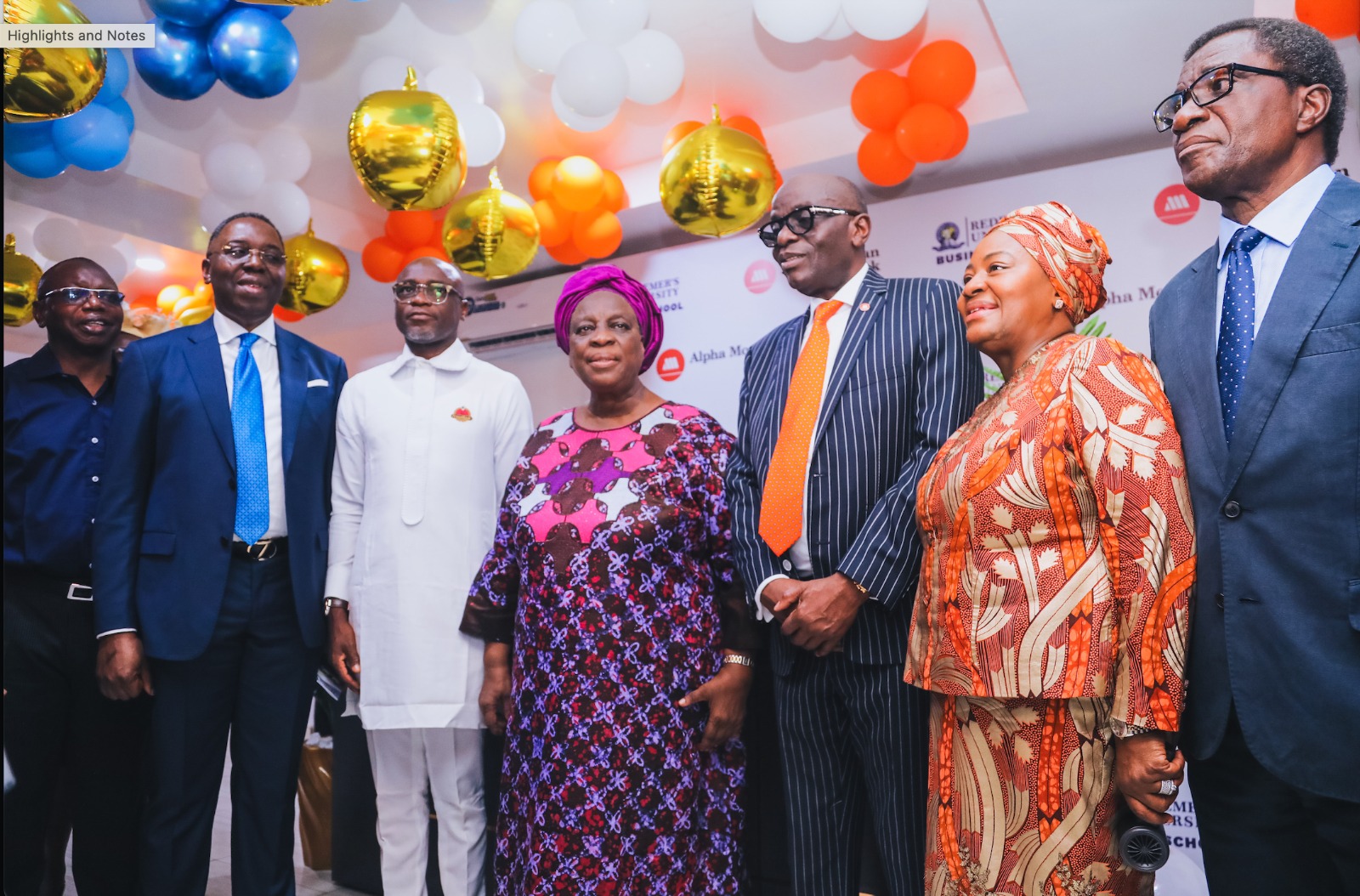
Alpha Morgan Bank Reinforces Commitment to Education at Redeemer’s University Business School Commissioning
Alpha Morgan Bank has reaffirmed its commitment to education and institutional development through its support for the commissioning of the Redeemer’s University Business School.
The Business School was officially inaugurated by Pastor (Mrs.) Folu Adeboye, at the commissioning ceremony attended by distinguished guests including Her Excellency, Mrs. Bola Obasanjo; the Pro-Chancellor and Chairman, Governing Council of Redeemers University, Professor Oluwatoyin Ogundipe; the Vice Chancellor, Professor Shadrach Olufemi Akindele; and other notable dignitaries.
Speaking at the event, the Managing Director of Alpha Morgan Bank reiterated the Bank’s commitment to supporting institutions that drive intellectual growth and national development.
As part of its broader focus on knowledge sharing and thought leadership, Alpha Morgan Bank will host its Economic Review Webinar in May 2026, bringing together experts to share insights on key economic trends and opportunities.
The Bank’s involvement reflects its continued dedication to empowering institutions and shaping the future of business and leadership in Nigeria.
Read more about Alpha Morgan Bank on www.alphamorganbank.com
PHOTO
L-R: Prof. Shadrach Olufemi Akindele, Vice Chancellor, Redeemers University, Engr. Eloka Eje, Dr Perez Araka, Pastor (Mrs) Folu Adeboye, Mother-In-Israel, The Redeemed Christian Church of God, Mr Ade Buraimo, MD/CEO Alpha Morgan Bank, Dr (Mrs) Oluwatomi Somefun, Dr. Simeon Ifere, at the inauguration of the Redeemer’s University Business School, Redemption City, Ogun State on Thursday 2nd April, 2026
Tinubu Aide Rebuts Rufai Oseni Over ₦3.3tn Power Debt Deal
Business
Aare Adetola Emmanuelking Welcomes President Tinubu to Gateway International Airport Commissioning in Iperu-Remo
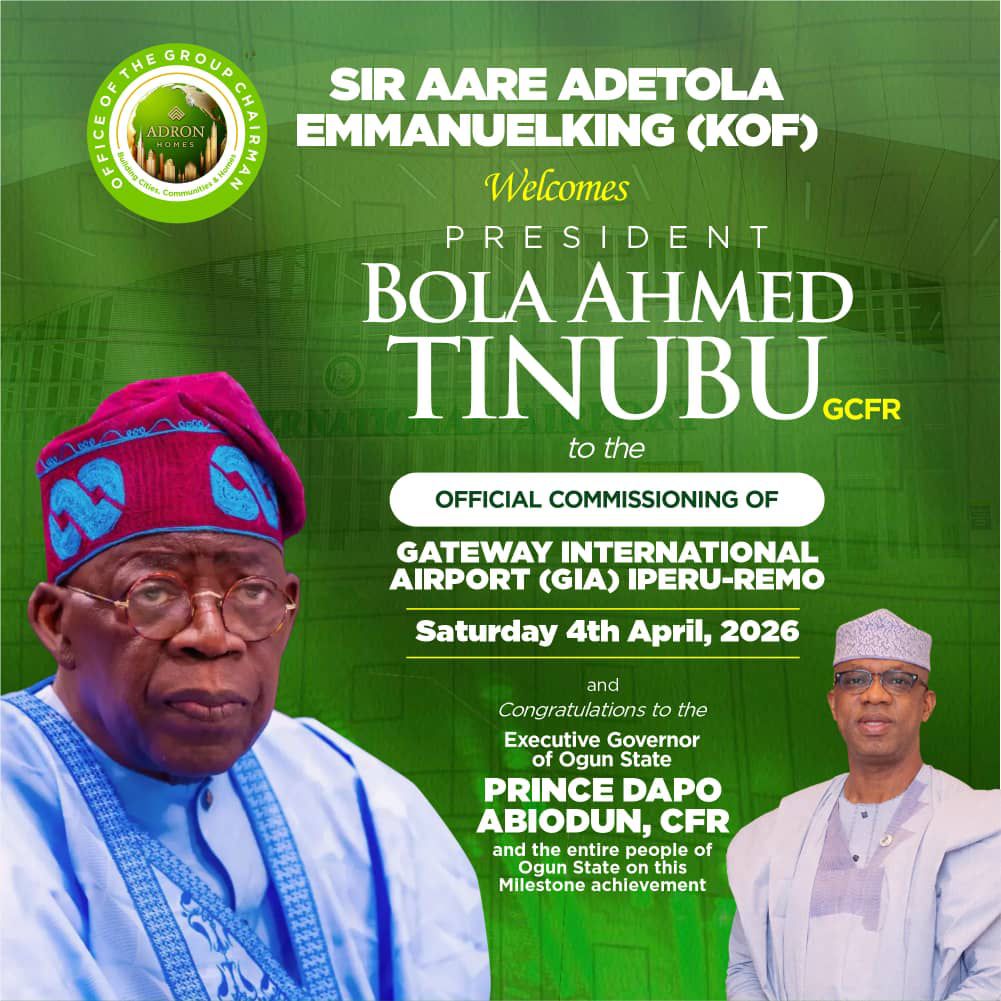
Aare Adetola Emmanuelking Welcomes President Tinubu to Gateway International Airport Commissioning in Iperu-Remo
In a momentous occasion that underscores the rapid infrastructural advancement of Ogun State, renowned real estate mogul and philanthropist, Aare Adetola Emmanuelking, warmly received the President of the Federal Republic of Nigeria, Bola Ahmed Tinubu, at the official commissioning of the Gateway International Airport, located in Iperu-Remo.
The landmark event, held under the visionary leadership of the Ogun State Governor, Dapo Abiodun, marks a significant stride in the state’s economic transformation agenda, positioning Ogun as a key hub for aviation, commerce, and investment in Nigeria.
Aare Emmanuelking, who is also the Chairman/CEO of Adron Homes and Properties, commended the Ogun State Government for its foresight and commitment to infrastructural excellence. He described the airport project as a “game-changer” that will not only boost connectivity but also stimulate real estate growth, tourism, and industrial expansion across the region.
Speaking during the commissioning, President Tinubu lauded Governor Abiodun’s administration for delivering a world-class facility that aligns with the Federal Government’s Renewed Hope Agenda, emphasizing the importance of strategic infrastructure in driving national development.
The Gateway International Airport is expected to serve as a critical gateway for investors and travelers, further enhancing Ogun State’s reputation as one of Nigeria’s most business-friendly environments.
The presence of top dignitaries, industry leaders, and stakeholders at the event underscores the project’s significance and its anticipated impact on the state’s socio-economic landscape and beyond.


- Seychelles Strengthens Human Rights Reporting through National Workshop April 8, 2026
- ABB’s Application Configurator brings speed and precision to grid-feeding protection system design April 7, 2026
- Can Equatorial Guinea Reposition as West Africa’s Gas Hub? April 7, 2026
- Afreximbank Partners with African Energy Week 2026 to Drive Africa-Led Energy Deals April 7, 2026
- Merck Foundation Marks ‘World Health Day’ 2026 – Transforming Patient Care in Africa and Beyond through 2600+ Scholarships for Healthcare Providers From 52 Countries April 7, 2026
- Morocco Gas Plan Reset Could Open Door to New Investment Models April 7, 2026
- African Petroleum Producers Organization (APPO) Secretary General Joins Angola Oil & Gas (AOG) 2026 as African Energy Bank Eyes June 2026 Debut April 7, 2026
- Ghanaian Biomedical Specialist Receives International Award April 7, 2026
- Grey Connects the Africa-Canada Money Corridor With Instant Transfers via Interac April 7, 2026
- Nigeria’s Oil Revival in Focus as Petroleum Minister Lokpobiri Joins Paris Energy Forum April 7, 2026
- Seychelles Strengthens Human Rights Reporting through National Workshop April 8, 2026
- ABB’s Application Configurator brings speed and precision to grid-feeding protection system design April 7, 2026
- Can Equatorial Guinea Reposition as West Africa’s Gas Hub? April 7, 2026
- Afreximbank Partners with African Energy Week 2026 to Drive Africa-Led Energy Deals April 7, 2026
- Merck Foundation Marks ‘World Health Day’ 2026 – Transforming Patient Care in Africa and Beyond through 2600+ Scholarships for Healthcare Providers From 52 Countries April 7, 2026
- Morocco Gas Plan Reset Could Open Door to New Investment Models April 7, 2026
- African Petroleum Producers Organization (APPO) Secretary General Joins Angola Oil & Gas (AOG) 2026 as African Energy Bank Eyes June 2026 Debut April 7, 2026
-

 news4 months ago
WHO REALLY OWNS MONIEPOINT? The $290 Million Deal That Sold Nigeria’s Top Fintech to Foreign Interests
-

 society7 months ago
“You Are Never Without Help” – Pastor Gebhardt Berndt Inspires Hope Through Empower Church (Video)
-

 celebrity radar - gossips2 months ago
Dr. Chris Okafor Returns with Power and Fire of the Spirit -Mounts Grace Nation Altar with Fresh Anointing and Restoration Grace on February 1, 2026
-

 celebrity radar - gossips4 months ago
Prophet Kingsley Aitafo Releases 2026 Prophecy: ‘Nigeria Will Rise, but the World Must Prepare for Turbulence’
You must be logged in to post a comment Login
You must log in to post a comment.