
celebrity radar - gossips
FORMER THISDAY SOCIETY EDITOR, LANRE ALFRED, RELEASES NEW BOOK ON NIGERIA @60

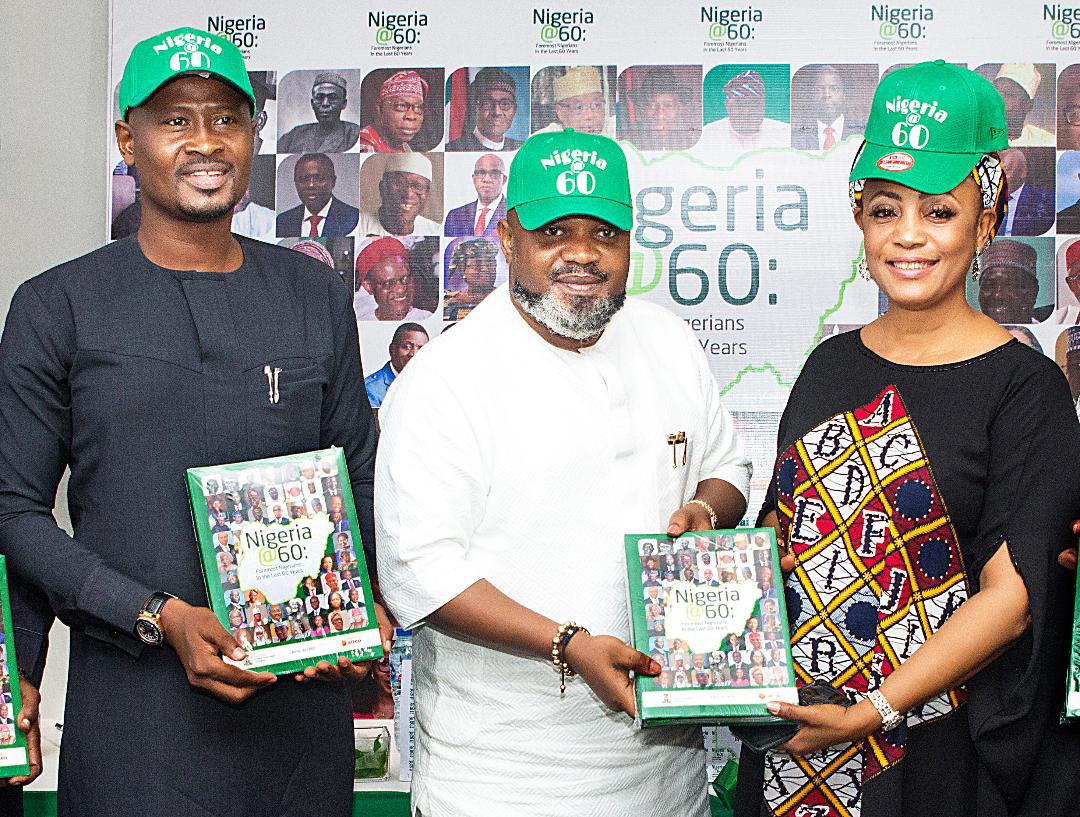
Last Sunday, former Society Editor of ThisDay Newspapers, Lanre Alfred, released his book, Nigeria @60: Foremost Nigerians in the Last 60years; before a colourful assemblage of the Nigerian media and high society.
The all-colour, all-gloss book, which has been widely hailed by many prominent Nigerians as a worthwhile educative and historical work, is published by Alfred’s Old English Partners, publishers of the widely popular coffee table books; Titans…The Amazing Exploits of Nigeria’s Greatest Achievers; and Highlife – Lifestyles of Nigeria’s Rich and Famous; and biographies like Pacemaker – Triumphs of IghoSanomi at 40; The Lion of Afia Nsit – Triumphs of Scott Tommey at 45; Julius Rone…The Jewel of the Delta; and Dapo Abiodun…The Heart of Prince.
Speaking, Alfred said that he was motivated to write the book because, “One of the biggest errors of our heritage as a nation is the failure to properly and periodically document in enduring forms, significant events of our national history and the roles of the personages. Such an important document helps to prevent the distortion of the feats and facts of our heroes and leaders.”
He added, “Whether we want to believe it or not, Nigeria is a nation guilty of not keeping data, which has, over the years, led to the distortion of her history. Many of those who came before us, despite their monumental talents and achievements, refused to pass on to us lessons from their trajectories. Our generation is the poorer for it because many do not have a sense of where they are coming from or where they are headed.”
Alfred said he made up his mind long ago that whatever it takes, he would do everything to be on the right side of history by deploying his resources, experience and skills to documenting for posterity and today’s youth – who are bereft of quality role models – the inspiring exploits and attainments of Nigeria’s foremost citizens of the last six decades whose contributions have been of an immense boost to nation-building.
According to him, “This book captures a critical period in our 60-year history as a nation; and fills a long-abandoned vacuum by bringing out of the shadows of history a silent army of men and women especially those that had until now, been unacknowledged and under-represented, despite their contributions to the nation we now proudly call ours. Through the individual stories and exploits of our heroes past and present, we’re given an insight into the strength and stamina that they evince (d) in the face of a system geared against them.”
Endorsed by the Federal Government of Nigeria through the National Council for Arts and Culture, NCAC, the Director-General, Otunba Olusegun Runsewe, said the book is of significant historical and cultural value to this generation especially as Nigeria celebrates her 60th independence anniversary.
“This is a trans-generational effort that is in tandem with the Federal Government’s appreciation of the need for proper documentation in enduring forms, significant events of our chequered history and the roles of outstanding men and women who created the history.” Runsewe further said.
In his Prologue entitled ‘Enriching the History of a Giant’, former Senate President, Dr Bukola Saraki espouses Nigeria’s greatness which he agrees had been tested in several ways, adding that though Nigeria might not have fully fulfilled the aspirations of her citizens and the rest of the world, she has continued to play a major role in stabilizing her region and the continent at large. Thus, he says he welcomes any attempt to give a good account of Nigeria’s existence as an independent country in the last six decades.
“This book by Lanre Alfred, a journalist with many years experience, is definitely going to add fresh pages to the body of literature and biographical work on this great country. This unique attempt at recounting our national history also seeks to put on display the roles of the selected players in national development over the years. It also presents a challenge for those key players, who are alive to strive to improve on their roles while also giving the rest of the citizenry the opportunity to honestly and genuinely assess the account and the roles it ascribes to these individuals.”
The former two-term governor of Kwara State concludes that Nigeria will overcome her challenges and fulfil her manifest destiny because there are several ways of leading Nigeria out of the woods; “One way is the one Lanre Alfred has taken with this book; celebrating the nation’s birthday through a revisit of the role of some of the key players.”
The Ekiti State governor, Dr Kayode Fayemi, in the Foreword, writes that Nigeria is an amazing story and an evolving power whose destiny is far beyond the convulsive spasm that often diminishes the narrative of her undeniable glory. “This lesson is what has attracted the intellectual lens of Lanre Alfred in this insightful book. He takes us through an undulating labyrinth of the Nigerian story and points our attention to the mesh of our socio-cultural plurality, which ultimately makes ours a complex political experiment.
“(Alfred) depicts the nation’s foundational challenge as that of a sailing mission without a rudder and a flying expedition without a compass. For it was clear that, at independence, there was no consensus around vision, purpose and strategy for the actualisation of the nation’s dream.”
Like Saraki, Governor Fayemi concurs that the irony of the Nigeria story is that while her inadequacies are apparent to all, her progress is difficult to ignore either. “And this is the reality, which many critics and commentators have failed to factor into their evaluation of the nation’s trajectory. One of the ways to appreciate this progress might be to focus on the contribution of many compatriots, who have invested their God-given talent and creativity for the progress of the nation in the different segments of our national life,” he says.
Governor Fayemi says he is satisfied with Alfred’s optimistic approach to the appreciation of Nigeria because, “He has elected to gauge our progress in terms of verifiable and invaluable contributions of some individuals, who have greatly impacted the nation and whose contributions to her development since independence, are of immense significance.
“This approach is not only a commendable reward system; it is also an effective story-telling strategy that properly situates the nation’s milestones around the exploits of her heroes and heroines. To suggest that Nigeria has not made progress is to declare that the works of her heroes and heroines are in vain. It is to assume that, generally, nonentities had led the nation in politics, business, culture, religion and leadership!”
He also commends the efforts that went into putting the book together, saying, “Alfred has launched his fecund mind into a fertile territory that many people would have ignored. It is another demonstration of his depth, prodigious intellect and mastery of the nation’s story as a social commentator and chronicler. He has taught us a new lesson that nation-building is a collective responsibility and that a nation’s prosperity is the aggregation of the industry and prosperity of her citizens.”
Interestingly, however, Alfred announced that the book is especially dedicated to Dr. Mike Adenuga Jnr, the man popularly called ‘The Bull’ as a homage to his humanity and relentless strides at rewriting the African business narrative; for standing tall and wading through odds with the courage of a knight and confidence of a champion.
Hugely successful, yet, affectionately humble, ‘The Bull’ as he is widely known is one of those risk-taking individuals that struckout on new paths, rather than travel the worn paths of accepted success to prosper themselves and their society. He has proved over time that if sent to Mars, he would still treat it as a stepping stone to Saturn – the quality of constant invention and self-improvement that has earned him worldwide acclaim and prosperity.
According to Alfred, “Adenuga does not believe in impossibilities. With just tenacity of purpose and a terrier devotion to his dreams, he bestrides, successfully, the gap between creativity and commerce.He started from the scratch, but kept his nose to the grindstone and has turned many seemingly insignificant ideas into behemoth industries.The story of Globacom – how it has survived a myriad of odds including a hostile economy, harsh government policies and competition – remains his magnum opus”.
He added that he is proud to associate with Dr Adenuga’ssuccess in turning generosity, excellence and humaneness into an art form, adding, “In an era beleaguered by the infamy of the human species, Dr Adenuga’s handiwork unfurls as an undying tribute to mankind’s better nature. He challenged resolve with steely grit and exploited the arduous planes of ambition and toil, till he encountered grandeur at the crossroads where wild contemplation and hard work morph into triumph.”
Glo, proudly Nigerian company with the wellbeing of Nigerians the core of its business principle has positively impacted on the lives of Nigerians; giving many uncut talents a platform to harness their talents through its reality television shows; while gifting hundreds of lucky subscribers life-changing prizes through its promos and providing direct and indirect employments to millions of Nigerians. In the intervening years, Globacom has made home-grown stars from the entertainment industry the faces (ambassadors) of its brand, while making them worth their popularity in affluence and influence.
INTERVIEW
“Why I’m Dedicating Nigeria @ 60 Compendium To Mike Adenuga” – Lanre Alfred Opens Up
Biographer extraordinaire, Lanre Alfred, is a prose stylist and celebrity journalist remarkable for the splendid force and ornate vigour of his words. Flaunting matchless fecundity, his writing births brilliant themes, and he effortlessly imbues the blandest motif with melody, and dramatic interest. Nobody forgets the first time they read a book by Alfred; everyone wishes for an encore. His words resonate profoundly, offering each reader a personalised experience even as he inspires all to journey with him, and savour the lyrical continuum and clarity of his thoughts. Thus the grandeur of his artistry and the deserved acclaim trailing his works. At the heel of his fifth book, Alfred has produced yet another inspiring literature: “Nigeria at 60: Foremost Nigerians of the Last 60 years”, a broad narrative of the exploits and monumental achievements of Nigeria’s finest league of extraordinary statesmen, magnates, professionals and patriots in the last 60 years. In this interview with…., the maverick and prodigious writer reveals why he embarked on the project and the adventures of his soul in putting it together. Excerpts…
What inspired the book, Nigeria @60: Foremost Nigerians of the Last 60 years?
If you examine my career over the past two decades, you will discover that I have specialised and excelled, to God be the glory, in chronicling people and events. Being a widely-travelled journalist has also opened up my eyes to the fact that our job as reporters does not start and end on the pages of our medium. So, a few years ago, I wrote my first book; a coffee table book called Lifestyle of the Rich and Famous. It was very well-accepted and it spurred me on to other book-writing ventures. In 2017, I published The Titans (The Amazing Exploits of Nigeria’s Greatest Achievers) and I was also widely applauded for it. But this latest effort attempts to fill a gap in our national history – the lack of books on some of our past and present heroes. Whether we want to believe it or not, Nigeria is a nation that is guilty of not keeping data, which has, over the years, led to the distortion of her history. Many of those who came before us, despite all their monumental talents and achievements, refused to pass on to us lessons that can guide us as we navigate through the labyrinth of life. Our generation is the poorer for it because many do not have a sense of where they are coming from or where they are headed. So, what this book has done is to spotlight and profile extensively those who have contributed to the development of this nation in their different fields of endeavour.
Indeed, Nigeria has many heroes and achievers across the different spectrum of the society; how easy or otherwise was it for you to zero in on those featured in the book?
That was one of my greatest challenges in writing the book. I have a close-knit team of researchers and for many weeks, we deliberated and argued, for and against, several names on the initial list. There were some people whose achievements, we felt, did not measure up to the standard of inclusion set for characters in the book, and we were unanimous and unbiased in de-listing them. Nigeria has been blessed with many great citizens; so, for instance, in football, how do you talk about Kanu Nwankwo and leave out Stephen Keshi? When you compare their antecedents, you would see that they both merit being listed but the dilemma would now be that only one of them can be profiled because of space constraints or some other of such factors. We had many of such knotty moments but at the end of the day, we are all happy with the output because no sector was left out and no worthy person was excluded.
How long did it take to write the book and what was the experience like?
I think more time was spent on researching and compiling the list than actual writing. By the time the list was compiled and I came into agreement with my team on what style to adopt, it was easy to start writing. I must confess that the COVID-19 lockdown was a blessing in disguise as it gave me a lot of time to write without the distractions of work and my other business endeavours. As regards the experience, well, I have been there before. So, it was nothing otherworldly. However, writing this book opened up my eyes to the richness of Nigeria’s socio-cultural and political history and the roles certain individuals played in her evolution.
What do you hope to achieve with this book?
That’s deep. I want this book to be available to secondary school students across the country, to read and be inspired in pursuit of greatness than those profiled in the book. Secondary school students, especially, are at an impressionable age and this is the time we, as parents and leaders, must observe a collective responsibility to present to them, a broader range of role models, and not narrow their choices to some fickle celebrities without substance. I would also like this book to be present on every library shelf in higher institutions in Nigeria and beyond.
Why did you dedicate the book to the chairman of Globacom, Dr. Mike Adenuga?
The story behind my decision is quite interesting. I have always followed his giant strides in the business world. After examining carefully, the impact of his business on the lives of Nigerians and Africans, in general, it was hard to pick anyone ahead of him. So, the book is especially dedicated to the man popularly called ‘The Bull’ as a homage to his humanity and relentless strides at rewriting the African business narrative; for standing tall and wading through odds with the courage of a knight and confidence of a champion. In a land dogged by human and infrastructural lapses, Dr. Adenuga’s humanity and entrepreneurial ingenuity nourishes the glands of kith and kin even as his genius oils the wheels of industry. What you would also find intriguing is that, unlike the proverbial warrior who lives to chant the poetry of his own deeds and derring-do, Dr. Adenuga remains impressively humble and immune to conceit, treading a rare path to acclaim. He attracts honour in torrents, at home and abroad. And I am happy to dedicate the book to him because his exploits continually resonate as an undying tribute to mankind’s better nature. Dr. Adenuga emerged as a worthy recipient of such honour because his deeds and recurring success establish him as a man who challenged resolve with steely grit, and exploited the arduous planes of ambition and toil, till he encountered grandeur at the crossroads, where wild contemplation and hard work morph into triumph. And interstingly, amid the ravage of the coronavirus, the widespread gloom and apprehensions of citizenry and industries caught on the receiving end of the pandemic, Adenuga has raised hopes and planted joy in the bosoms of Nigerians. His huge donations to the Federal Government and several state governments have been instrumental to the containment of the virus. These are no doubt the hallmarks of a selfless man and patriot, and are thus, worthy of being celebrated.
What do you seek to achieve with this new book?
I seek to celebrate Nigeria’s finest breed of entrepreneurs, statesmen, sportsmen, and other professionals – all patriots, across all fields of endeavour. I wrote the book keeping in mind the need to satisfy the needs of Nigeria’s upscale, intelligent, sophisticated, and proletariat demographic. The purpose is to emphasize that, whether you’re born with a silver spoon or not, it is possible for you to rise to acclaim through diligence and honest labour, as it was with the case with some of the personalities featured in the book. There is no way to emphasize my vision and sojourn in putting together this effort. I do not seek to demean or canonize any individual with impact neither do I seek to glamourise my access to Nigeria and some of Africa’s most powerful players, each person featured in the book is deserving and worthy of the appellation of ‘role model’ and ‘national hero.’ I hope that writing about them, one way or the other, will help inspire generations of Nigerian youth to greatness.
Let’s talk abour your genre of journalism. Why is celebrity journalism thriving these days?
With due respect, my genre of journalism has always been thriving, it has never suffered a lull. Celebrity journalism has always been part of journalism in plain sight. You see, there is a lot about journalism that has to do with this particular genre. Celebrity journalism, I would say, represents the kernel of journalism. It projects the essence of what is widely regarded as mainstream journalism. In a nutshell, celebrity journalism has always been mainstream. There is the argument that celebrity journalism only focuses on famous people, the filthy rich and so on, but isn’t mainstream journalism all about famous people? Isn’t celebrity journalism about famous people? If you take an indepth look into the philosophy of the five Ws and H of journalism, you would find that, journalism was and is still essentially modelled to perpetuate news about celebrities, the rich, the powerful and the famous. Journalism, basically, is about famous people and people who are extraordinary in some ways, thus standing out from the middling crowd. Journalism is also about ordinary people who become famous by doing extraordinary things. In the real sense of it, there is no difference between celebrity journalism and mainstream journalism.
You have put in almost two decades into this profession and it is obvious that you love it.
Yes, I really do love it. I believe that journalism is one of the most noble professions in the world. It is a calling and when you align yourself with that calling, it is only natural that you will love and enjoy it. And I have never had any struggle in loving the profession.
Your style of writing is particularly interesting. You begin your stories with proverbs, parables and commentaries. Why is it that you don’t like to go straight to the point?
It’s impossible for me to simply go straight to the point. Life is a dance of seduction, encompassing every living and inanimate thing into its intricate and sensual weave. And so is writing. No living thing or element can live in immunity of that slow, provocative dance of wonder and intrigues that characterises life. I apply similar wisdom to my writing. But let me hold back a bit before I start waxing too esoteric for the purpose of this interview.
I can’t write just for writing sake; I believe every story offers new opportunity to titillate the readers and lure them into the world or event being reported and the artistry of the reporter or writer. It doesn’t matter if the story you read does not bear my byline. It could be a piece I am editing; I simply can’t let a good story go unburnished with the needed shine. Even the most boring happenstance or person deserves to be reported with finesse. Writing should be rapturous to the writer and to the reader, it should be equally thriling. I write the way I do because that is who I am. Do not forget that the perfect window into the psyche of a writer is always through his writing.
One must admit that some of the intros in your stories make interesting read. But don’t you think they may not be suitable for people who are in a hurry?
I don’t think so. I believe that the man or woman who is too much in a hurry to read hasn’t the temperament or the depth for good literature.
You look so quiet and gentle, incapable of writing the kind explosive stories you write.
That is simply the way Lanre Alfred is cut out to be. (laughs). I am actually a very private fellow. I have a very close circuit of friends. And I think I attract like minds. On writing explosive stories? Well, we’ve all got a bit of thunder in us.
How do you write? Do you have some rituals or habits you must indulge in before you start writing?
I have an eclectic writing habit. But I love a bit of serenity most of the time. Yet, you would be amazed to see me scribbling away in the midst of some mad noise. Well, I will say that eclectic best defines my writing culture.




celebrity radar - gossips
Adron Homes Celebrates Visionary Chairman, Aare Adetola Emmanuel King, at 51
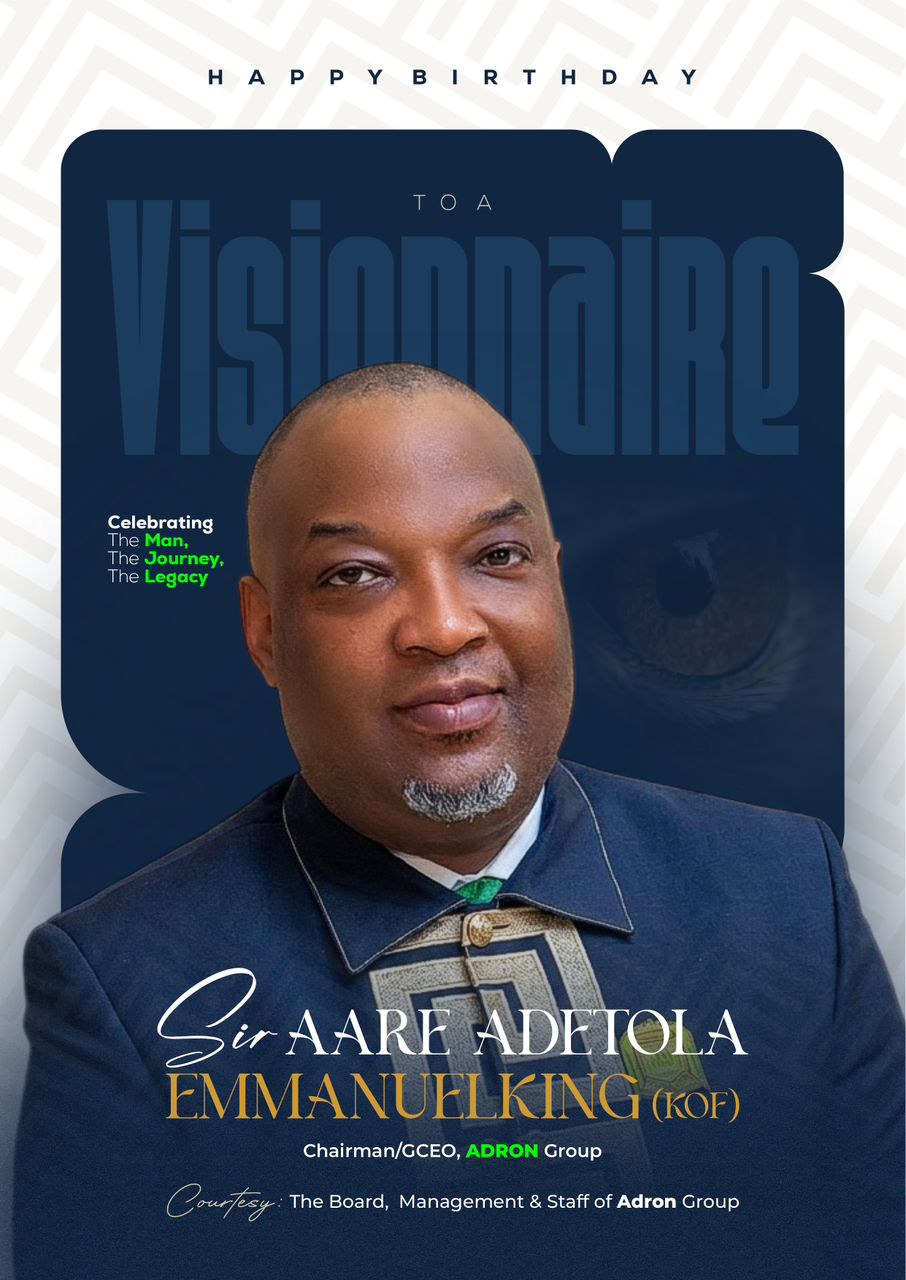
Adron Homes Celebrates Visionary Chairman, Aare Adetola Emmanuel King, at 51
The management and staff of Adron Homes and Properties Limited have joined family, friends, associates, and well-wishers across the globe to celebrate their Chairman and Chief Executive Officer, Aare Adetola EmmanuelKing, as he marks his 51st birthday.

In a statement released by the company, the milestone was described as a celebration of an exceptional leader whose vision, resilience, and entrepreneurial brilliance have not only transformed Adron Homes into a household name in Nigeria’s real estate sector but have also redefined affordable housing across the country.
Under his dynamic leadership, Adron Homes has continued to expand its footprint, delivering value-driven residential solutions while empowering thousands of Nigerians with opportunities for home ownership. His commitment to excellence, innovation, and customer satisfaction has remained the driving force behind the company’s sustained growth and industry leadership.
The statement further highlighted Aare EmmanuelKing’s passion for nation-building and community development, noting his significant contributions to job creation, youth empowerment, and the promotion of socio-economic development through real estate investments.
“As a leader, mentor, and visionary, Aare Adetola EmmanuelKing has consistently inspired a culture of excellence, integrity, and dedication within the organization. His ability to turn bold ideas into reality continues to position Adron Homes as a trailblazer in the industry,” the statement read.
The company expressed profound gratitude for his steadfast leadership and prayed for continued wisdom, strength, and sound health as he embarks on another year of impactful achievements.
As he celebrates his 51st birthday, the entire Adron Homes family proudly honours a man whose legacy continues to shape the future of real estate in Nigeria.
Happy 51st Birthday, Aare Adetola EmmanuelKing!
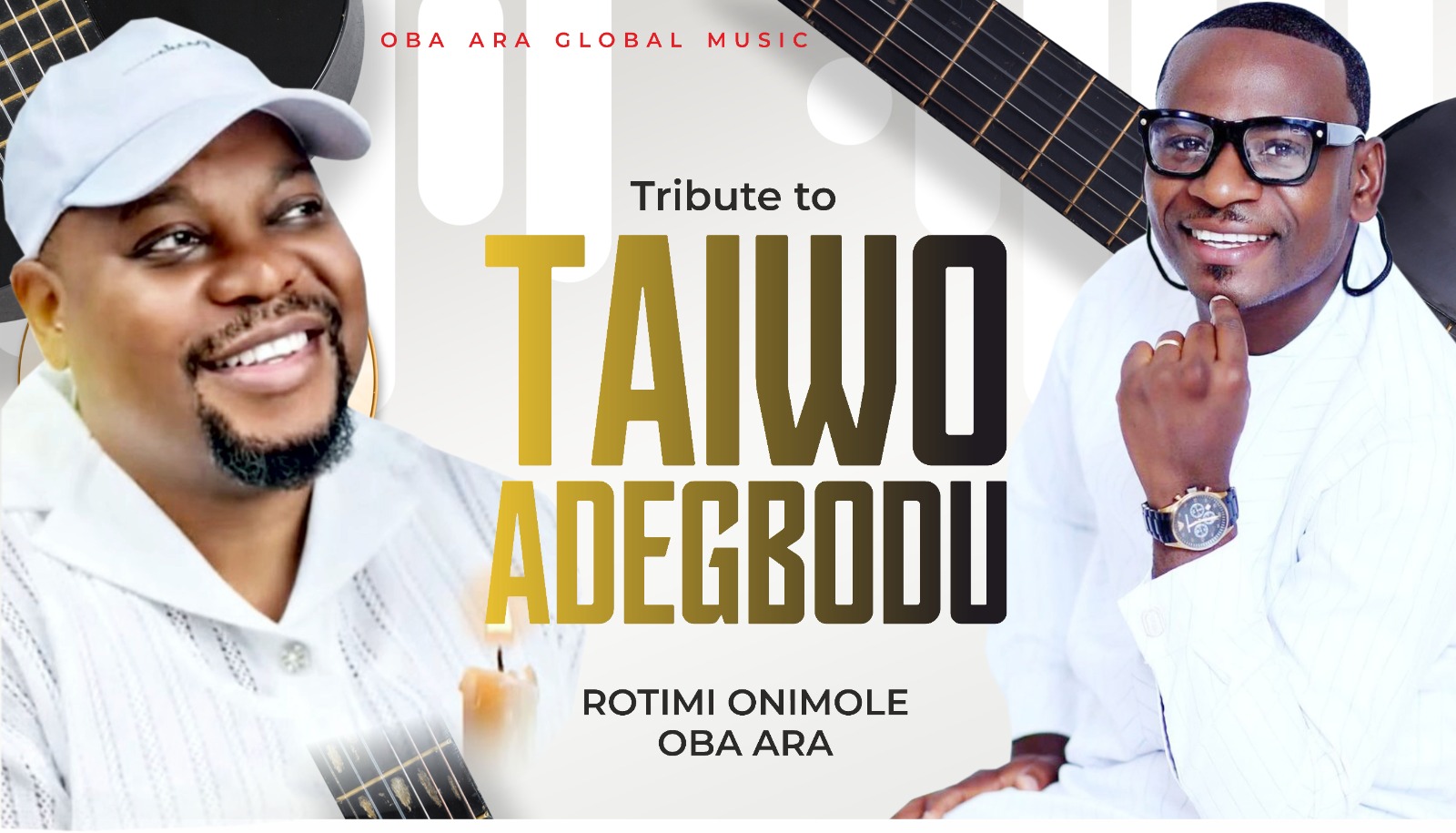
Oba Ara Releases Emotional Tribute to Late Taiwo Adegbodu
Taofik Afolabi
The gospel music community continues to grieve the painful loss of Taiwo Adegbodu, a beloved figure whose sudden departure left a deep void among fans, colleagues, and loved ones. In response to this loss, renowned gospel minister Rotimi Onimole, popularly known as Oba Ara, has released a moving tribute song that captures both the sorrow of the moment and the enduring legacy of the late singer.
Oba Ara, a proud son of Isale Eko, channels raw emotion throughout the song, using heartfelt lyrics and soul-stirring melodies to reflect on his personal connection with Taiwo Adegbodu. In the tribute, he openly expresses how deeply the news of Adegbodu’s passing shook him, describing it as a painful and unexpected loss that is difficult to come to terms with.
The song goes beyond mourning, it celebrates the life, ministry, and impact of Taiwo Adegbodu. Oba Ara highlights the late artist’s dedication to spreading the gospel through music, his inspiring voice, and the spiritual influence he had on many within and beyond Nigeria. Through powerful verses, he paints a picture of a man who lived for God and touched countless lives through his ministry.
Listeners have described the tribute as both comforting and deeply emotional, as it resonates with the collective grief of the gospel music community. It serves as a reminder that although Taiwo Adegbodu is no longer physically present, his music, message, and legacy will continue to live on.
In honoring his late colleague, Oba Ara not only pays his respects but also offers a source of healing for fans and fellow ministers, using music as a tool to process grief and celebrate a life well lived.
celebrity radar - gossips
Buratai, Fagbemi , Shagaya, Olofa, Others Eulogise Olowu Kuta’s Olori On 60th Birthday, Foundation Launch
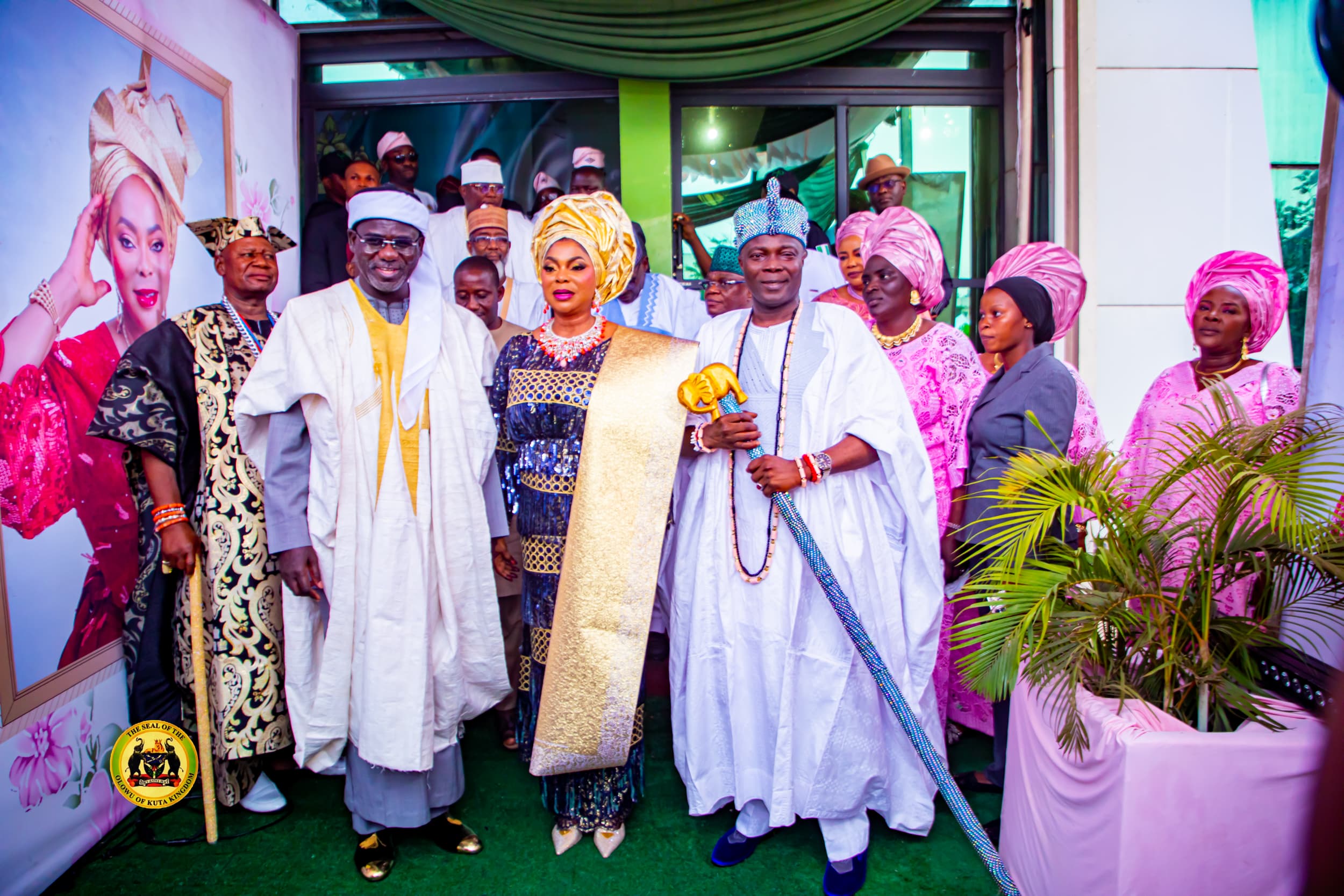
Buratai, Fagbemi , Shagaya, Olofa, Others Eulogise Olowu Kuta’s Olori On 60th Birthday, Foundation Launch
Eminent personalities across the Nigeria stormed the TFK Event Centre, Bala Mohammed Way, Guzape, Abuja, to celebrate the 60th birthday of Olowu Kuta’s Olori, Queen Jumai Amoke and her Foundation Launch on Saturday 28, March 2026.

From former Chief of Army Staff, Lt Gen TY Buratai rtd, to the Minister of Justice and Attorney-General of the Federation, Prince Lateef Fagbemi; Olofa of Offa, HRM Oba Mufutau Gbadamosi. Even top businesswoman and socialite, Chief (Mrs) Bola Shagaya, was in attendance.


Other dignitaries were newly promoted Deputy Inspector-General of Police and former AIG Zone 2 , Lagos , Adegoke Fayoade, Major General Abdumalik, Major General Samuel Adebayo rtd (Fmr CDI);
Major General Anthony Omozoje rtd (Fmr Copp);
Alhaji Tajudeen Owoyemi (Asiwaju of Offa and CEO Radisson Hotel Nigeria;
Dr Waheed Olagunju, former managing director of Bank of Industry, Oniba of Iba, Lagos State, HRM Oba Dr Suleiman Raji ;
Justice Falola, Olu of Ile-Ogbo , Oba Adetoyese amongst many traditional rulers and captains of industry too numerous to mention.
Speaking at the occasion, the Chief Host, Olowu of Kuta, HRM Oba Dr Adekunle Oyelude Makama, CON , Tegbosun iii, who is also the husband of the celebrant commended Queen Jumai for ‘ her slender arms full of kindness’ to establish such humanitarian Foundation, ‘Amoke Children and mother in Need Foundation’ at a time Nigerians are going through economic crisis occassioned by the global meltdown.
Olowu also commended her steadfastness and love for the less privileged and downtrodden.
The monarch refrenced the task before his wife’s humanitarian gesture said her best is yet to come.
” Olori Amoke Jumai, I celebrate you. You will celebrate 70, 80, 90 and continue to shine as you continue to put a smile on people’s faces. I love you, “Olowu Kuta added.
To Lt Gen Buratai, a former army chief and former Nigerian Ambassador to Benin Republic, the reward of hard work is more work.
Buratai, who also doubles as Balogun Agba of Owu Kuta, a chieftaincy title reserved for a generalismo congratulated Queen Jumai for attaining the age of 60 in good health.
The retired army General said he’s not surprised by the turn out of eminent personalities across the country to celebrate the Olowu Kuta’s Olori because she merited it through her hospitality to all, adding that Allah the most merciful, most beneficial would accept all her act of ibadah.
The minister of Justice, Prince Fagbemi, was full of praises for Queen Jumai for deeming it fit to have a place in her heart to accommodate the needy and less privileged in ‘our society.’
Prince Fagbemi urged the guests to contribute generously to support the Foundation in order to continue to alleviate poverty and put a smile on the faces of the people.
” I congratulate you on your 60th birthday and Foundation Launch. I wish you many happy returns of the day and many more fruitful services to the country and motherland”, Prince Fagbemi added.
The celebrant, Queen Jumai who was grining from ear to ear thankfully said she was excited by the turn out and the response of the people to her foundation.
Queen Jumai, however, promised to continue to use her resources and donations received for the good of the needy and less privileged in the society.
” I want to appreciate my own Kabiesi Olofa of Offa , for his presence and im I’m using him as a point of contact to all other Kabiesis present here, the minister of justice and Attorney-General, you’re welcome, sir; Mrs Bola Shagaya, I salute your enterprise, Lt Gen Buratai, I’m grateful, sir; DIG Fayoade, Justice Falola and other dignitaries too numerous to mention, I thank you, all. To my darling husband, Kabiesi Olowu , I thank you immensely for your support. And to my family and friends, I thank you , all. E se pupo!”, she said.


-

 society7 months ago
Religion: Africa’s Oldest Weapon of Enslavement and the Forgotten Truth
-

 news4 months ago
WHO REALLY OWNS MONIEPOINT? The $290 Million Deal That Sold Nigeria’s Top Fintech to Foreign Interests
-

 society6 months ago
“You Are Never Without Help” – Pastor Gebhardt Berndt Inspires Hope Through Empower Church (Video)
-

 celebrity radar - gossips2 months ago
Dr. Chris Okafor Returns with Power and Fire of the Spirit -Mounts Grace Nation Altar with Fresh Anointing and Restoration Grace on February 1, 2026