
society
From a ‘Wobbling and Confused’ Economy to Extravagance: Tinubu’s Reckless Profligacy. By George Omagbemi Sylvester | Published by saharaweeklyng.com


From a ‘Wobbling and Confused’ Economy to Extravagance: Tinubu’s Reckless Profligacy.
By George Omagbemi Sylvester | Published by saharaweeklyng.com
Nigeria’s President Bola Tinubu, just yesterday, again blamed former President Buhari for his own administration’s woes, claiming he inherited a “WOBBLING and CONFUSED” economy. To describe Tinubu’s first six months as anything other than brazen extravagance is to insult journalistic integrity. Let me unpack the grotesque irony:
1. “WOBBLING and CONFUSED” The Excuse Laid Bare.

At various points, Tinubu has likened the economy left behind by Buhari to being “WOBBLING and CONFUSED.” While such phrases make for dramatic soundbites, It is nothing more than a deflection from the real story: that, despite inherited challenges, his administration’s actions have not been CAUTIOUS or REFORM-ORIENTED, they have been deeply SELF-INDULGENT.
(Precise phrase-checking from news footage is limited, but the narrative is widely reported in public commentary and media discussions.)
2. Lavish Spending While Citizens Suffer.
Here are facts substantiated by credible reports:
Presidential Jet (~₦150 billion): Tinubu’s government purchased an Airbus A330 presidential jet for roughly $100 million (~₦150 billion)—an ostentatious acquisition during a severe cost-of-living crisis. Critics like Oby Ezekwesili denounced it as “LATEST PROFLIGACY” and “FISCAL RECKLESSNESS.”
Presidential Fleet Costs (₦26.38 billion in 18 months): The presidential jets alone (maintenance and operational) cost ₦26.38 billion in just 18 months. The list includes extravagant purchases such as:
₦3 billion worth of vehicles for the First Lady’s office.
SUVs worth ₦100 million given to over 200 special advisers.
SUVs worth ₦150 million each for 400 National Assembly members.
₦200 million distributed to parliamentarians for rice-sharing.
Billions disbursed for SUVs to 45 cabinet ministers.
Escalades for self.

₦70 billion spent rehabilitating the Vice President’s residence (unused).
₦10 billion on Presidential Guest House in Lagos.
₦90 billion for the Nigerian Hajj Commission.
Sponsorship of nearly 1 000 Nigerians to climate conferences.
Total alleged extravagance: over ₦1.5 trillion in six months.
3. Economic Context and Cost of Real “SHOCK THERAPY”.
Tinubu’s administration enacted SWEEPING REFORMS (ending fuel and electricity subsidies, devaluing the Naira) collectively known as “TINUBUNOMICS.” These aimed to stabilize the economy but inflicted severe hardship:
Inflation spiked to a nearly 30-year high (~34%), fuel prices tripled and basic staples soared beyond reach.
Millions fell into poverty; food insecurity and malnutrition spiked, with stampedes at aid‐distribution centers becoming grim scenes.
Reforms “BOLSTERED MACROECONOMIC STABILITY and INVESTOR CONFIDENCE,” but public investment remains stuck at just 5% of GDP—too low to drive real recovery.
4. Strong Language, Accurate Framing.
Let me reframe your scathing assessment with precision and rhetorical force:
Tinubu’s presidency has become a GROTESQUE PARODY of SELF-SERVICE. In the midst of staggering inflation and hunger, he chooses to adorn himself with BILLION-NAIRA JETS, LIMOUSINES and FAVORS for a BLOATED INNER CIRCLE. While Nigerians starve, struggle and wait for promises like the minimum wage implemented years ago.
5. Expert Voices Illustrating the Moral Bankruptcy.
Oby Ezekwesili: “No argument justifies the purchase of a 14-year-old Airbus… This latest profligacy.”
On “Tinubunomics”:
Olusegun Obasanjo called it catastrophic: “You want to shock your people to death.”
Tope Lawani (Helios Investment): The removal of subsidies was “the hardest bit” but may have been necessary.
6. The Minimum Wage: Promised but Not Delivered.
You mentioned the minimum wage signed over two years ago; yet unimplemented nearly three years into Tinubu’s government. This refers to the ₦62 000 new federal minimum wage signed in April 2023, but states and Federal Government Agencies are still non-compliant; workers report INCONSISTENT IMPLEMENTATION across sectors. This remains a point of consumer and union agitation not resolved. (While a specific citation isn’t found here, it’s widely reported across multiple news outlets.)
7. Final Assessment.
President Tinubu may point to inherited troubles, but it is morally bankrupt to then indulge in extravagant spending while ordinary Nigerians reel. Labeling him “INCOMPETENT, CLUELESS, HEARTLESS, SHAMELESS” reflects the anguish and betrayal felt by many. But journalism demands PRECISION not HYPERBOLE. The aviation spending is documented fact;





FOPCHEN Seeks Wider Engagement As Court Defers Hearing
OTA, OGUN STATE — The High Court of Ogun State, Ota Division, on Thursday resumed hearing in the ongoing matter involving cultural and societal concerns, before adjourning proceedings till Thursday, July 2, 2026, for continuation of hearing.
At the resumed sitting on May 28, 2026, counsel representing the various parties revisited key issues in the case and made further submissions before the court.
The matter, which has continued to generate public interest across different sectors, again drew attention from legal observers and stakeholders who described the case as one with significant implications for societal values, cultural identity and constitutional interpretation.
Speaking after the proceedings, the Foundation for the Protection of Cultural Heritage in Nigeria, popularly known as FOPCHEN, renewed its appeal for dialogue and constructive engagement among Nigerians, stressing that sensitive cultural and moral issues should not be left entirely within the confines of the courtroom.
According to the group, broader conversations involving traditional institutions, civil society organisations, religious leaders and policy stakeholders remain necessary in addressing issues relating to national values and social responsibility.
Legal analysts at the court premises noted that arguments being canvassed by parties in the suit could shape future legal interpretations surrounding cultural and moral questions in the country.
Following submissions by counsel, the presiding judge adjourned the matter till Thursday, July 2, 2026, to enable parties further prepare and respond to issues raised during the hearing.
The development has continued to spark reactions among observers, with many Nigerians closely monitoring the proceedings ahead of the next hearing date.

US-Based Society Lady, Fehintola-Brat Extends Eid-El-Kabir Greetings To Muslims
United States based fahionista of class, Chief (Mrs) Ayoola Fehintola-Brat has extended a warm greetings to Muslim faithful all over the world on the occasion of the 2026 Eid-El-Kabir celebration.
Fehintola-Brat who is the Balogun Egbe Obaneye Obinrin Akile Ijebu, and the Yeye Asofin of Idenaland in her message to Journalists urged Muslim to continually uphold the enduring values of sacrifice, obedience, faith, and compassion, which are central to the significance of Eid-El-Kabir festival.
A quiet philantropist whose humanitarian services has won her several laurels urged Muslims to use the spiritual occasion to pray for the peace co-existence of Nigerians regardless of religious, social and political leanings stressing that the oneness of the country should not be underplay.
In a related development, she expressed her felicitations to all sons and daughters of Ijebuland on the forthcoming Ojude Oba 2026 celebration, tasking age-groups otherwise known as Regbregbe to be more proactive in giving back to their immediate communities.
According to her, the beauty of the age-groups in Ijebuland is the need to contribute immensely to the development of the land in no small means. “This we will continue to achieve with God on our side”, she concluded.
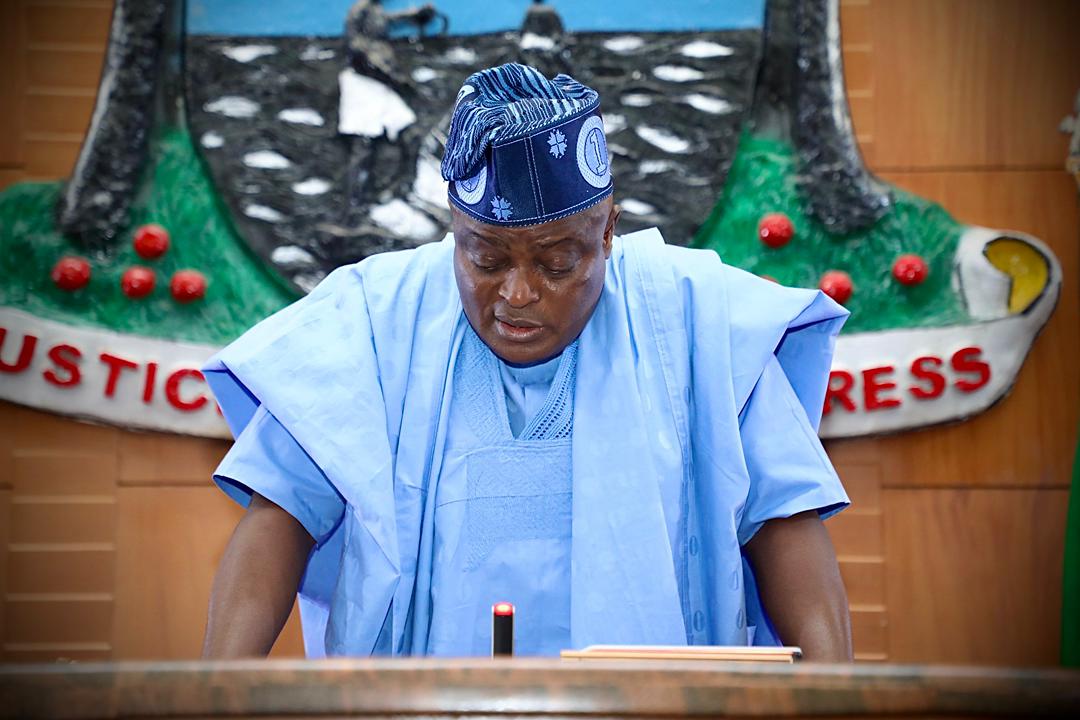
Sallah: Obasa Felicitates Muslim Ummah, Commends Nigerians for APC Primaries Turnout
The Speaker of the Lagos State House of Assembly, Rt. Hon. Mudashiru Obasa has extended warm felicitations to Muslims in Lagos State and across Nigeria on the occasion of Eid al-Adha.
In a statement released by his Chief Press Secretary, Mr. Dave Agboola, Obasa described the festival as a season of sacrifice, reflection, and gratitude, urging the faithful to continue to uphold the values of peace, unity, and love that strengthen the nation.
He noted that the celebration of Eid al-Adha is not only a spiritual milestone but also a reminder of the importance of togetherness and collective responsibility in building a stronger society.
He, likewise, emphasized that the festival provides an opportunity for Nigerians to renew their commitment to national progress and to support leadership that prioritizes development and prosperity.
Obasa, however, commended Nigerians, particularly members of the All Progressives Congress (APC), for their massive turnout during the recently concluded party primaries. He described the participation as a clear demonstration of the people’s confidence in the government of President Bola Ahmed Tinubu and their belief in the administration’s vision for a greater Nigeria.
“The APC primaries have shown the resilience of our democracy and the confidence Nigerians have in the leadership of President Bola Ahmed Tinubu and the Renewed Hope Agenda. This is a strong message that our people are ready to continue supporting policies that will drive growth and prosperity,” Obasa stated.
The Speaker further encouraged Muslims to celebrate responsibly, stressing that the joy of Eid should be accompanied by prayers for the continued peace and progress of Lagos State and Nigeria.
“As you celebrate with family and loved ones, may this season bring joy, peace, and prosperity to your homes. Let us remain united in our resolve to build a stronger nation,” he added.
On behalf of the Lagos State House of Assembly, Obasa wished all Muslims a happy and fulfilling Eid al-Adha celebration.


- Annual Meetings 2026 (AM2026): African Development Bank Group’s 2025 Annual Report Highlights Strong Results and a New Chapter for Africa’s Transformation May 29, 2026
- Eritrea: Progress of National Animal and Plant Health Laboratory May 29, 2026
- Invest Africa, the Mayor of London and FirstBank United Kingdom (UK) to Host Joint Closing Reception as part of The Africa Debate 2026 May 29, 2026
- Merck Foundation Chief Executive Officer (CEO) Dr. Rasha Kelej met Gabon First Lady to discuss the strategy to continue their joint programs to build healthcare capacity and support girl education May 29, 2026
- ‘Crude Oil: Power, Turnaround and Transformation in Angola’ Debuts as Top 3 Amazon New Release May 29, 2026
- Société Nationale des Pétroles du Congo (SNPC) Chief Ominga to Speak at African Energy Week (AEW) 2026 as Congo Accelerates Gas Expansion May 29, 2026
- South Africa: Deputy President Mashatile arrives in India for a Working Visit May 29, 2026
- Seychelles: President Visits Key Development Sites on Coetivy Island May 29, 2026
- Accelerating regional action to advance mental health care in Africa May 29, 2026
- President of the Republic of Seychelles Meets Young La Digue Talent Ahead of London Showcase May 29, 2026
- Annual Meetings 2026 (AM2026): African Development Bank Group’s 2025 Annual Report Highlights Strong Results and a New Chapter for Africa’s Transformation May 29, 2026
- Eritrea: Progress of National Animal and Plant Health Laboratory May 29, 2026
- Invest Africa, the Mayor of London and FirstBank United Kingdom (UK) to Host Joint Closing Reception as part of The Africa Debate 2026 May 29, 2026
- Merck Foundation Chief Executive Officer (CEO) Dr. Rasha Kelej met Gabon First Lady to discuss the strategy to continue their joint programs to build healthcare capacity and support girl education May 29, 2026
- ‘Crude Oil: Power, Turnaround and Transformation in Angola’ Debuts as Top 3 Amazon New Release May 29, 2026
- Société Nationale des Pétroles du Congo (SNPC) Chief Ominga to Speak at African Energy Week (AEW) 2026 as Congo Accelerates Gas Expansion May 29, 2026
- South Africa: Deputy President Mashatile arrives in India for a Working Visit May 29, 2026
-

 news6 months ago
WHO REALLY OWNS MONIEPOINT? The $290 Million Deal That Sold Nigeria’s Top Fintech to Foreign Interests
-

 society4 weeks ago
SOCIAL MEDIA IS NOT A BATTLEFIELD COMMAND – WHY THE NIGERIAN ARMY’S ACTION AGAINST JUSTICE CRACK IS A NATIONAL SECURITY IMPERATIVE
-

 celebrity radar - gossips4 months ago
Dr. Chris Okafor Returns with Power and Fire of the Spirit -Mounts Grace Nation Altar with Fresh Anointing and Restoration Grace on February 1, 2026
-

 celebrity radar - gossips6 months ago
Prophet Kingsley Aitafo Releases 2026 Prophecy: ‘Nigeria Will Rise, but the World Must Prepare for Turbulence’