
society
The Nigerian Constitution Lied To You: How Section 6(6)(c) Legalized Failure in Governance


The Nigerian Constitution Lied To You: How Section 6(6)(c) Legalized Failure in Governance.
By George Omagbemi Sylvester | Published by SaharaWeeklyNG.com
When the framers of the Nigerian Constitution assembled to write what would supposedly become the supreme law of the land, Nigerians were sold the illusion of a social contract. The Constitution is decorated with lofty promises, sweetened with elegant words and adorned with the kind of commitments that any citizen would be proud of.
You have seen them before in Chapter Two
“THE GOVERNMENT SHALL PROVIDE HEALTH CARE.”
“EVERY NIGERIAN CHILD HAS A RIGHT TO EDUCATION.”
“THE STATE SHALL ENSURE ADEQUATE SHELTER FOR ALL CITIZENS.”
These words were carefully crafted to inspire HOPE, to sell a DREAM, to convince a PEOPLE that the government exists to serve them; but behind those noble words lies the GREATEST FRAUD of all ~ Section 6(6)(c) of the same Constitution.
It is here that the Nigerian Constitution betrays its people. Hidden under legal jargon, Section 6(6)(c) quietly DISARMS the citizenry:
“The judicial powers vested in accordance with the foregoing provisions of this section (shall not, except as otherwise provided by this Constitution, extend to any issue or question as to whether any act or omission by any authority or person) is in conformity with the Fundamental Objectives and Directive Principles of State Policy.”
In simple English, this means the courts cannot punish the government for failing to keep its promises in Chapter Two.
Rights That Are Not Rights.
What does this mean for the ordinary Nigerian? It means that when your child is denied education, when your mother dies because of an empty hospital ward, when your community is cut off from civilization because of impassable roads, you cannot drag the government to court. You cannot enforce what was presented to you as your “RIGHT.”
In fact, these so-called RIGHTS are not RIGHTS at all. They are ASPIRATIONS, mere political poetry. They look good on paper, but they carry no weight in law. And so, Nigerians live under a system that openly mocks them: PROMISES WITHOUT ACCOUNTABILITY, rights without remedies.
This is not a mistake. It is deliberate.
The Anatomy of a Betrayal.
Professor Ben Nwabueze, one of Nigeria’s foremost constitutional law experts, once described Chapter Two as “THE CONSCIENCE OF THE NATION” but immediately lamented that Section 6(6)(c) “EMASCULATED” it. The Constitution itself admits that government MUST provide social justice, yet it simultaneously shields the same government from being held accountable.
The late legal luminary Chief Gani Fawehinmi repeatedly warned Nigerians that “A RIGHT WITHOUT A REMEDY IS A MEANINGLESS RIGHT.” He fought countless battles in court trying to stretch the interpretation of Chapter Two, but time and again, judges reminded him: THE LAW TIES THEIR HANDS.
And so, what we call the Nigerian Constitution is in truth a carefully written escape plan for politicians. It binds the poor, but frees the powerful.
Real-Life Consequences of Section 6(6)(c).
This constitutional sabotage is not theoretical, it is lived reality.
Education: According to UNESCO, Nigeria has the highest number of OUT-OF-SCHOOL children in the world, over 20 million. Yet, the Constitution boldly says “EVERY NIGERIAN CHILD HAS A RIGHT TO EDUCATION.” If that were true, how does Nigeria get away with this tragedy? Section 6(6)(c).
Healthcare: Nigeria accounts for 20% of global maternal deaths, according to the World Health Organization. Hospitals are empty shells, doctors underpaid and equipment outdated. The Constitution says “THE STATE SHALL PROVIDE ADEQUATE MEDICAL FACILITIES.” Yet, politicians fly abroad for checkups. Why? Section 6(6)(c).
Housing: Millions live in slums, shanties or under bridges. The United Nations estimates Nigeria has a housing deficit of over 28 million units. The Constitution promises shelter for all. In court, that “PROMISE” is not worth the paper it was written on. Again, Section 6(6)(c).
Employment: Youth unemployment in Nigeria is over 33%. Yet, the Constitution insists “THE STATE SHALL DIRECT ITS POLICY TOWARDS ENSURING THAT THERE ARE SUFFICIENT JOBS FOR ALL.” Try suing the government over joblessness and the judge will point to Section 6(6)(c).

A Rigged System.
This is not just about corruption. It is about a system designed to protect failure. Nigerians are ruled by laws that empower leaders to promise EVERYTHING and deliver NOTHING without consequence.
The Indian Constitution, which Nigeria borrowed heavily from, also has Directive Principles, similar to Chapter Two. Here’s the difference: India gradually converted some of these principles into enforceable rights. Today, education and healthcare are enforceable in Indian courts.
Nigeria copied the words but erased the ACCOUNTABILITY.
As Nobel Laureate Wole Soyinka once said: “The Nigerian Constitution is not a document of the people. It is a document of deception, written to preserve privilege and impunity.”
Why Nigerians Were Kept in the Dark?
The tragedy is that most Nigerians have never even heard of Section 6(6)(c). Schools don’t teach it. Civic education glosses over it. Politicians never mention it. The ignorance is intentional. If Nigerians truly understood how the Constitution cheats them, they would rise in collective anger.
This is why leaders prefer to distract the masses with RELIGIOUS RHETORIC, TRIBAL POLITICS and ELECTORAL DRAMA. Anything to keep the people from realizing that the very foundation of their suffering is enshrined in the law itself.
The Way Forward.
If Nigeria is ever to break free from this cycle of betrayal, Section 6(6)(c) must be abolished or reformed. Social and economic rights must be made justiciable; enforceable in court.
Constitutional lawyer Femi Falana, SAN, has argued consistently that unless Nigerians demand the enforceability of Chapter Two, governance will remain a theater of promises without performance. According to him: “Leaders must know that failure to provide education, health, housing and jobs is not an option, but a constitutional crime.”
Countries like South Africa have already done this. Their Constitution guarantees the right to housing, health care, food, water and social security and courts there regularly compel the government to act. If South Africa CAN, why CAN’T Nigeria?
Final Word: Burn That Section With Your Mouth.
Nigeria is not failing by accident. It is failing by design. That design is encoded in Section 6(6)(c). It is the most dangerous line in the Nigerian Constitution because it legalizes government irresponsibility.
They promised you heaven in Chapter Two, then quietly snatched it away in Section 6(6)(c).
It is time Nigerians stopped reciting the Constitution like poetry and started interrogating it as a political weapon; because right now, it is not a weapon for the people. It is a shield for the corrupt.
Until this section is reformed, every Nigerian must understand one painful truth: You were SET UP. You were LIED TO. Your Constitution is not YOUR FRIEND.
~ George Omagbemi Sylvester


Published by SaharaWeeklyNG.com





US-Based Society Lady, Fehintola-Brat Extends Eid-El-Kabir Greetings To Muslims
United States based fahionista of class, Chief (Mrs) Ayoola Fehintola-Brat has extended a warm greetings to Muslim faithful all over the world on the occasion of the 2026 Eid-El-Kabir celebration.
Fehintola-Brat who is the Balogun Egbe Obaneye Obinrin Akile Ijebu, and the Yeye Asofin of Idenaland in her message to Journalists urged Muslim to continually uphold the enduring values of sacrifice, obedience, faith, and compassion, which are central to the significance of Eid-El-Kabir festival.
A quiet philantropist whose humanitarian services has won her several laurels urged Muslims to use the spiritual occasion to pray for the peace co-existence of Nigerians regardless of religious, social and political leanings stressing that the oneness of the country should not be underplay.
In a related development, she expressed her felicitations to all sons and daughters of Ijebuland on the forthcoming Ojude Oba 2026 celebration, tasking age-groups otherwise known as Regbregbe to be more proactive in giving back to their immediate communities.
According to her, the beauty of the age-groups in Ijebuland is the need to contribute immensely to the development of the land in no small means. “This we will continue to achieve with God on our side”, she concluded.
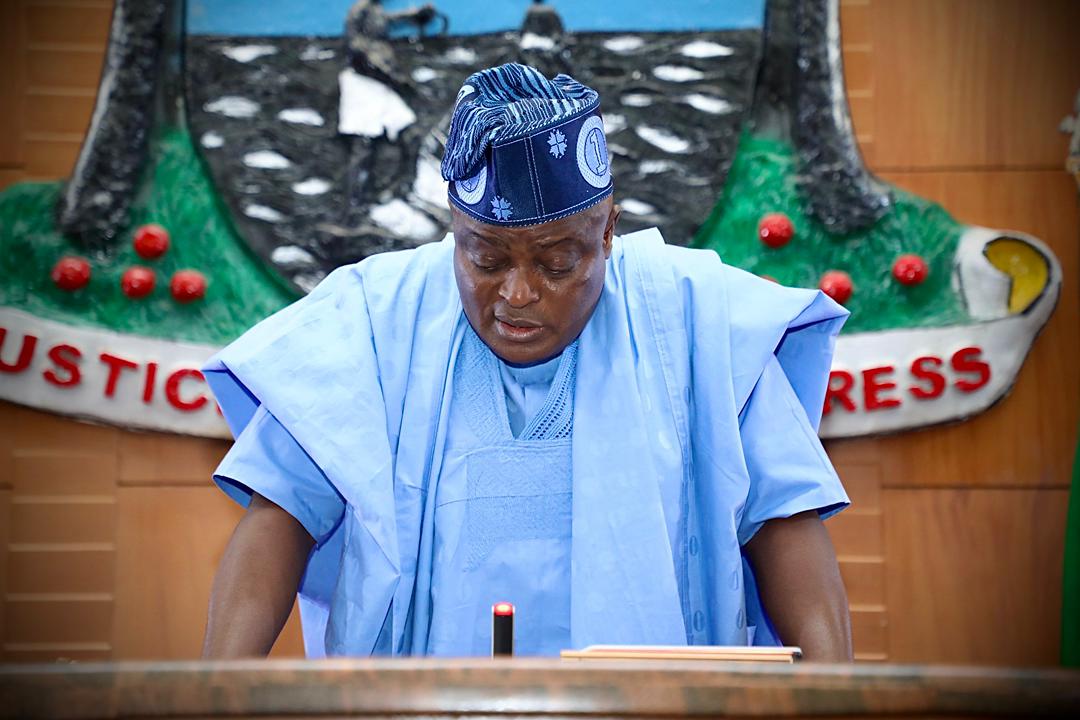
Sallah: Obasa Felicitates Muslim Ummah, Commends Nigerians for APC Primaries Turnout
The Speaker of the Lagos State House of Assembly, Rt. Hon. Mudashiru Obasa has extended warm felicitations to Muslims in Lagos State and across Nigeria on the occasion of Eid al-Adha.
In a statement released by his Chief Press Secretary, Mr. Dave Agboola, Obasa described the festival as a season of sacrifice, reflection, and gratitude, urging the faithful to continue to uphold the values of peace, unity, and love that strengthen the nation.
He noted that the celebration of Eid al-Adha is not only a spiritual milestone but also a reminder of the importance of togetherness and collective responsibility in building a stronger society.
He, likewise, emphasized that the festival provides an opportunity for Nigerians to renew their commitment to national progress and to support leadership that prioritizes development and prosperity.
Obasa, however, commended Nigerians, particularly members of the All Progressives Congress (APC), for their massive turnout during the recently concluded party primaries. He described the participation as a clear demonstration of the people’s confidence in the government of President Bola Ahmed Tinubu and their belief in the administration’s vision for a greater Nigeria.
“The APC primaries have shown the resilience of our democracy and the confidence Nigerians have in the leadership of President Bola Ahmed Tinubu and the Renewed Hope Agenda. This is a strong message that our people are ready to continue supporting policies that will drive growth and prosperity,” Obasa stated.
The Speaker further encouraged Muslims to celebrate responsibly, stressing that the joy of Eid should be accompanied by prayers for the continued peace and progress of Lagos State and Nigeria.
“As you celebrate with family and loved ones, may this season bring joy, peace, and prosperity to your homes. Let us remain united in our resolve to build a stronger nation,” he added.
On behalf of the Lagos State House of Assembly, Obasa wished all Muslims a happy and fulfilling Eid al-Adha celebration.

ABEOKUTA FILM FESTIVAL AT ILEYA
Kayshow Multimedia a filmmaking and Media organization this year 2026 holds its annual Abeokuta film festival at the Ake Palace in Abeokuta.
Alake of Egba land, Ọba Michael Adedotun Arẹmu Gbadebo has graciously endorsed the Free Training of Egba Youths on Film and Arts and the Entertainment of the the People with a FREE FILM SHOW at the AKE PAVILION. as part of the ABEOKUTA FILM FESTIVAL 2.0.
The Convener of the Film Festival Honorable Kehinde Soaga says this year’s event promises to be more exciting as distinguished personalities are sure to attend.
This includes the honorable Minister for Art Culture and Creative Economy in Nigeria, Barr. Hannatu Musa Musawa, Ààrẹ Lai Labode, Sen. Ibikunle Amosun and other special guests.
The event will feature Film, Cultural Dance Cultural foods and Award Ceremony.
The general public is hereby invited to the Free film show at the Abeokuta film festival at the Alake Palace Pavilion on Thursday 28th of May 2026 by 4:00 p.m.
Only well dressed is the Entry. The Abeokuta Film Festival is an annual event taking place in the capital city of Ogun State state.


- Qrent says delaying Information Technology (IT) refresh cycles may be increasing operational risk for businesses in Africa May 27, 2026
- Dentons’ Iyunola Adekanye Appointed to African Mining Week (AMW) Advisory Board May 27, 2026
- United Nations (UN) Women Liberia and Partners Convene for Spotlight Initiative 2.0 Women’s Economic Empowerment Inception Meeting May 27, 2026
- African Mining Week (AMW) to Host Central Bank Governors Roundtable as Monetary Authorities Deepen Role in Mining Sector Growth May 27, 2026
- Eritrea: Diaspora Nationals Celebrate Independence Day Anniversary May 27, 2026
- Africa Unveils Landmark Humanitarian Coordination Platform to Strengthen aligned Response to Humanitarian Crises May 27, 2026
- Seychelles: President Herminie Engages with Police and Fire Services on Praslin May 27, 2026
- Issue 3 of Mining Review Africa now available for free download May 27, 2026
- NOV Joins African Energy Week (AEW) 2026 as Gold Sponsor Amid Africa’s Offshore Expansion Push May 26, 2026
- African Union of Broadcasting (AUB) and United Nations University Institute for Water, Environment and Health (UNU-INWEH) Launch Landmark Webinar Series on Africa’s Water Crisis, Starting June 2, 2026 May 26, 2026
- Qrent says delaying Information Technology (IT) refresh cycles may be increasing operational risk for businesses in Africa May 27, 2026
- Dentons’ Iyunola Adekanye Appointed to African Mining Week (AMW) Advisory Board May 27, 2026
- United Nations (UN) Women Liberia and Partners Convene for Spotlight Initiative 2.0 Women’s Economic Empowerment Inception Meeting May 27, 2026
- African Mining Week (AMW) to Host Central Bank Governors Roundtable as Monetary Authorities Deepen Role in Mining Sector Growth May 27, 2026
- Eritrea: Diaspora Nationals Celebrate Independence Day Anniversary May 27, 2026
- Africa Unveils Landmark Humanitarian Coordination Platform to Strengthen aligned Response to Humanitarian Crises May 27, 2026
- Seychelles: President Herminie Engages with Police and Fire Services on Praslin May 27, 2026
-

 news5 months ago
WHO REALLY OWNS MONIEPOINT? The $290 Million Deal That Sold Nigeria’s Top Fintech to Foreign Interests
-

 society3 weeks ago
SOCIAL MEDIA IS NOT A BATTLEFIELD COMMAND – WHY THE NIGERIAN ARMY’S ACTION AGAINST JUSTICE CRACK IS A NATIONAL SECURITY IMPERATIVE
-

 celebrity radar - gossips4 months ago
Dr. Chris Okafor Returns with Power and Fire of the Spirit -Mounts Grace Nation Altar with Fresh Anointing and Restoration Grace on February 1, 2026
-

 celebrity radar - gossips6 months ago
Prophet Kingsley Aitafo Releases 2026 Prophecy: ‘Nigeria Will Rise, but the World Must Prepare for Turbulence’