
celebrity radar - gossips
God of Jets, Not Jobs: The Unholy Greed of Pastors


God of Jets, Not Jobs: The Unholy Greed of Pastors.
(While factories rot and youths starve, the pulpit dines with politicians).
By George Omagbemi Sylvester | published by saharaweeklyng.com
For years we have blamed Africa’s rot (Nigeria’s especially) on crooked politicians and collapsing institutions. That blame is deserved, but it is not complete. A hard, uncomfortable truth sits in plain sight: a powerful slice of the modern church has chosen spectacle over service, prosperity over productivity and miracle-marketing over the mundane work of industry and jobs. The result is moral confusion and economic decay. In cities like Warri, Lagos and Port Harcourt, abandoned factories that should hum with machines and paychecks now echo with microphones and offering baskets. When pulpits replace production lines, poverty becomes liturgy.

This is not a broadside against faith or the countless pastors and congregations who feed orphans, run clinics and tutor children. It is a charge sheet against a WELL-NETWORKED RELIGIOUS-POLITICAL complex that mirrors the habits of the corrupt state: acquiring land like a feudal lord, converting industrial sites into prayer camps and mega-cathedrals and justifying excess with pious slogans. Nigeria’s own manufacturers’ body reported that hundreds of factories shut down in 2023 under the weight of energy costs, policy whiplash and currency turmoil; 767 closures and 335 distressed firms, according to the Manufacturers Association of Nigeria. As industry gasped, many shuttered spaces found new life not as workshops but as worship halls. Punch and The Guardian (Nigeria) have chronicled churches becoming the “new tenants” of old industrial estates; policy analysts have flagged the conversion of factory premises into event and worship centers as “worrisome” for jobs and competitiveness.

Let’s call this what it is: a reallocation of scarce urban land from production to passion. Scholars studying Lagos’s urban form describe how neo-Pentecostal infrastructures (prayer camps, auditoria and religious real estate) are literally remaking the city’s map, often without a corresponding boost to broad-based employment or skills. The political economy of these prayer cities may create enclaves of private order, but they do not substitute for the machine shop that trains apprentices or the light-manufacturing plant that anchors a value chain.
This drift has spiritual consequences, too. Paul Gifford, one of the most important scholars of African Christianity, argues that parts of the prosperity gospel (“covenant wealth” secured through tithes and tokens) are the antithesis of the sober, work-ethic tradition that historically linked faith to productivity and institutional responsibility. In his reading, the pastor’s personality cult risks reproducing Africa’s “Big Man” politics inside the church. Ruth Marshall’s landmark study of Nigeria’s Pentecostal revolution shows how powerful ministries have become political actors, shaping public morality and elections, yet too often without the accountability that genuine public service demands.
Meanwhile, the optics are obscene. Even as factories die and graduates hawk sachet water, headlines and watchdogs periodically highlight televangelists defending private jets and fleets of luxury cars as “necessities” of ministry. The United States has its own gaudy examples and the rhetoric used to justify them is depressingly familiar on our shores: evangelism is faster in a Gulfstream; commercial flights are “hostile” to communion with God. When religious elites flaunt luxury while congregants struggle, the line between prophet and politician blurs into a single gilded table.
This is not merely an aesthetic problem. It is a moral failure that weakens the social contract. The late Archbishop Desmond Tutu warned, “If you are neutral in situations of injustice, you have chosen the side of the oppressor.” A church that refuses to challenge job-killing policies, that benefits from industrial collapse by buying up plants for prayer, cannot claim neutrality. It has chosen. Dr. Martin Luther King Jr. put it even more sharply in 1963: the church must not be a thermometer reflecting public opinion but a thermostat transforming society’s morals. Our religious establishment has often preferred the easy warmth of applause to the hard heat of reform.
To be crystal-clear: faith communities have enormous power for good. They educate millions, deliver health care where the state is absent and knit together fragile neighborhoods. Power misused is corruption by another name. If a governor who hoards SUVs while hospitals lack oxygen is condemned, then a pastor who hoards aircraft while members cannot afford insulin deserves the same scrutiny. That is not anti-Christian; it is pro-conscience.
The economic case: jobs not just jamborees.
Manufacturing is a jobs engine. When hundreds of Nigerian factories went under in 2023, the losses cascaded through suppliers, transporters, service firms and households. Turning those sites into worship arenas extracts demand from the surrounding economy (parking on weekends, a few vendors) but destroys the production ecosystems that train artisans and pay steady wages. When The Guardian and Punch reported churches taking over failed companies’ premises, they captured a symbolic tragedy: we are praying for jobs in the very halls where jobs once existed.
Urban scholars have documented how mega-ministries build parallel infrastructures (roads, utilities, private security) around prayer camps. That can look like “development,” but it is development for members, not citizens; for enclaves, not economies. Lagos’s reconfiguration by religious real estate should alarm any planner serious about inclusive growth.
The theological case: work as witness.
Max Weber’s classic insight (hotly debated but still useful) is that faith traditions can discipline economic life. He contrasted a stern work ethic with magical thinking that treats wealth as a sign of favor detached from productive effort. When pastors preach “breakthroughs” more than budgets, “mantles” more than machinery, they baptize a lottery mentality. Gifford’s critique tracks this drift in parts of African Christianity; Marshall shows how the spiritualization of politics can become an escape hatch from responsibility. A church obsessed with seed-sowing but bored by supply chains is not a thermostat; it’s a fog machine.
A five-point manifesto for reform.
If the church is serious about nation-building, it must prove it; in concrete, steel and payslips:
Re-industrialize the grounds you occupy. If a ministry acquires a defunct factory, it should revive production on-site: lease a wing to SMEs, install a training center linked to local manufacturers or run a cooperative that fabricates furniture, garments or solar kits. Sunday services should FUND MONDAY-THROUGH-FRIDAY WORK. (City authorities can incentivize this with tax rebates for every job created.) The alternative is sanctified de-industrialization.
Publish audited accounts and related-party transactions. If politicians must declare assets, pastors who solicit public donations should publish independent audits, disclose land banks and vehicle fleets and list any businesses owned by the “man of God” and relatives that contract with the church. Financial sunlight is spiritual hygiene.
Adopt a “No Jet Until 10,000 Jobs” covenant. Any church considering private aircraft should first demonstrate (publicly) that it has helped create or sustain 10,000 verifiable jobs in its host communities through investments, apprenticeships or supply-chain partnerships. If that sounds radical, compare it to the radicality of the gospel’s demands for the poor. (And remember how grotesque the justifications for jets have sounded in other contexts.)
Tithe to industry. Earmark at least 10% of all offerings to a transparent, independently governed Local Enterprise Fund that backs tool-shops, agro-processing and repair clusters around the church. Publish the portfolio quarterly. Transform “seed” into steel.
Preach the dignity of building as hard as you preach the danger of “enemies.” Replace warfare liturgies with workshops. Teach financial literacy, export basics, safety standards and coding. Partner with polytechnics. Make altar calls for welders and machinists.
A word to regulators and city planners.
Governments enabled this drift by failing at energy, logistics and credit and by looking the other way as zoning laws were bent into halos. Nigeria needs an industrial land-use compact: once-industrial zones should not be casually converted to non-productive uses; any religious conversion must carry binding obligations for vocational training and SME tenancy. When the FT, Punch and MAN warn about factory carnage, policymakers must treat industrial land as a strategic asset, not a soft target for quick sales.
The moral bottom line.
The church that dines with politicians while congregants queue for fuel has forfeited the authority to thunder about “destiny helpers.” The pastor who hoards land and jets while factories die is not merely tone-deaf; he is an accomplice to unemployment. Tutu’s admonition and King’s thermostat test stand at the door of the sanctuary. Pass or fail.
Nigeria does not need fewer prayers. It needs prayers with payrolls. It needs pulpits that can drill boreholes and balance books, that can bless machines as readily as microphones. It needs bishops who will turn back from vanity purchases and turn abandoned plants into vocational hubs. It needs ministries that trade celebrity for citizenship.
If you’re reading this as a church leader, consider it an altar call of a different kind. Open your books. Reopen a factory. Fund a welding school. Lease space to small manufacturers at peppercorn rent. Publish impact numbers. And when next you stand before your people, remember the standard King set: be a thermostat. Set the temperature of our public life to justice, truth and work, then hold it there.
Until the pulpit returns the factory to the people, the gospel we preach in Africa will remain a loud cymbal in an empty hall; BEAUTIFUL on Sunday, USELESS by Monday.


Byline: George Omagbemi Sylvester
Publication: saharaweeklyng.com




celebrity radar - gossips
Adron Homes Celebrates Visionary Chairman, Aare Adetola Emmanuel King, at 51
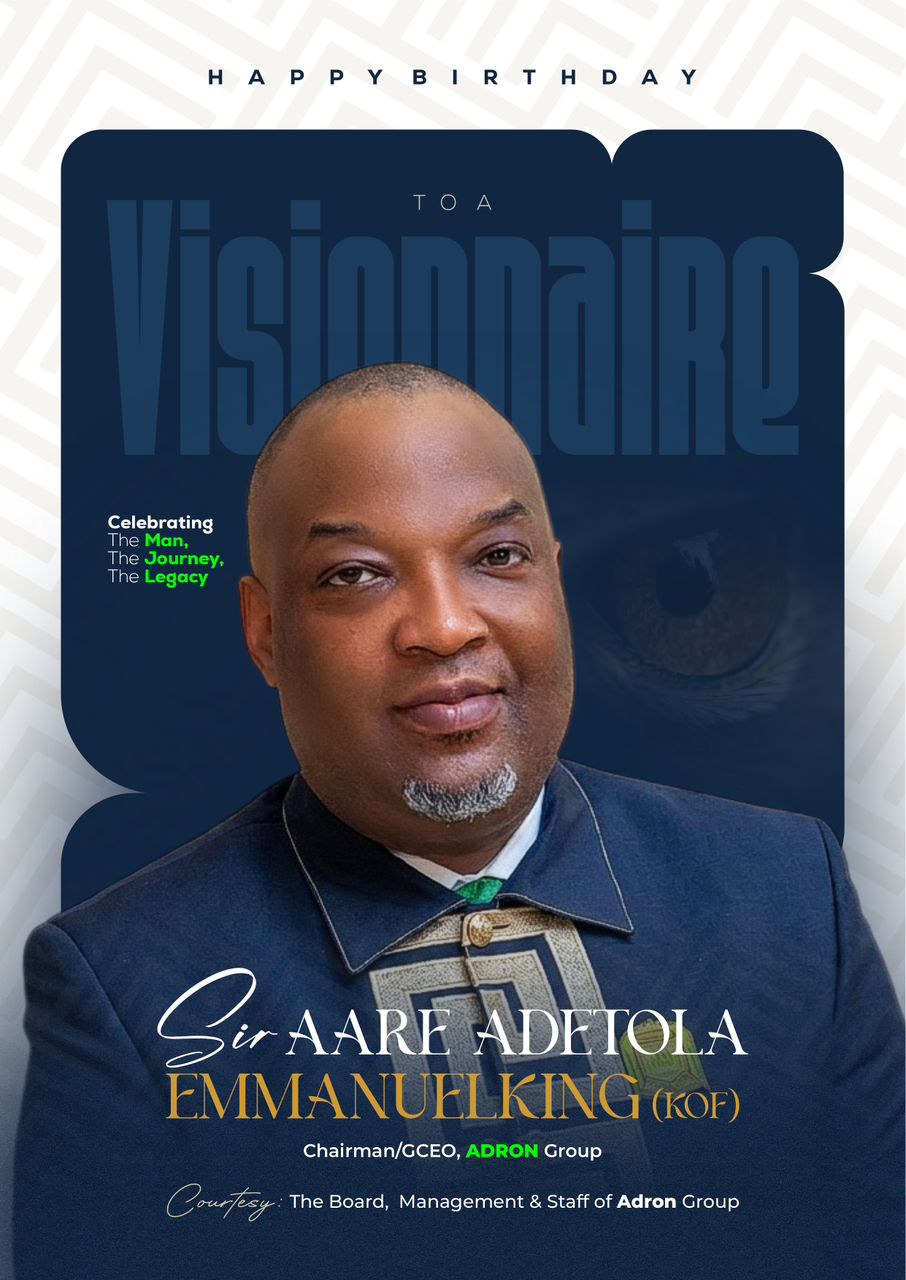
Adron Homes Celebrates Visionary Chairman, Aare Adetola Emmanuel King, at 51
The management and staff of Adron Homes and Properties Limited have joined family, friends, associates, and well-wishers across the globe to celebrate their Chairman and Chief Executive Officer, Aare Adetola EmmanuelKing, as he marks his 51st birthday.

In a statement released by the company, the milestone was described as a celebration of an exceptional leader whose vision, resilience, and entrepreneurial brilliance have not only transformed Adron Homes into a household name in Nigeria’s real estate sector but have also redefined affordable housing across the country.
Under his dynamic leadership, Adron Homes has continued to expand its footprint, delivering value-driven residential solutions while empowering thousands of Nigerians with opportunities for home ownership. His commitment to excellence, innovation, and customer satisfaction has remained the driving force behind the company’s sustained growth and industry leadership.
The statement further highlighted Aare EmmanuelKing’s passion for nation-building and community development, noting his significant contributions to job creation, youth empowerment, and the promotion of socio-economic development through real estate investments.
“As a leader, mentor, and visionary, Aare Adetola EmmanuelKing has consistently inspired a culture of excellence, integrity, and dedication within the organization. His ability to turn bold ideas into reality continues to position Adron Homes as a trailblazer in the industry,” the statement read.
The company expressed profound gratitude for his steadfast leadership and prayed for continued wisdom, strength, and sound health as he embarks on another year of impactful achievements.
As he celebrates his 51st birthday, the entire Adron Homes family proudly honours a man whose legacy continues to shape the future of real estate in Nigeria.
Happy 51st Birthday, Aare Adetola EmmanuelKing!

Oba Ara Releases Emotional Tribute to Late Taiwo Adegbodu
Taofik Afolabi
The gospel music community continues to grieve the painful loss of Taiwo Adegbodu, a beloved figure whose sudden departure left a deep void among fans, colleagues, and loved ones. In response to this loss, renowned gospel minister Rotimi Onimole, popularly known as Oba Ara, has released a moving tribute song that captures both the sorrow of the moment and the enduring legacy of the late singer.
Oba Ara, a proud son of Isale Eko, channels raw emotion throughout the song, using heartfelt lyrics and soul-stirring melodies to reflect on his personal connection with Taiwo Adegbodu. In the tribute, he openly expresses how deeply the news of Adegbodu’s passing shook him, describing it as a painful and unexpected loss that is difficult to come to terms with.
The song goes beyond mourning, it celebrates the life, ministry, and impact of Taiwo Adegbodu. Oba Ara highlights the late artist’s dedication to spreading the gospel through music, his inspiring voice, and the spiritual influence he had on many within and beyond Nigeria. Through powerful verses, he paints a picture of a man who lived for God and touched countless lives through his ministry.
Listeners have described the tribute as both comforting and deeply emotional, as it resonates with the collective grief of the gospel music community. It serves as a reminder that although Taiwo Adegbodu is no longer physically present, his music, message, and legacy will continue to live on.
In honoring his late colleague, Oba Ara not only pays his respects but also offers a source of healing for fans and fellow ministers, using music as a tool to process grief and celebrate a life well lived.
celebrity radar - gossips
Buratai, Fagbemi , Shagaya, Olofa, Others Eulogise Olowu Kuta’s Olori On 60th Birthday, Foundation Launch

Buratai, Fagbemi , Shagaya, Olofa, Others Eulogise Olowu Kuta’s Olori On 60th Birthday, Foundation Launch
Eminent personalities across the Nigeria stormed the TFK Event Centre, Bala Mohammed Way, Guzape, Abuja, to celebrate the 60th birthday of Olowu Kuta’s Olori, Queen Jumai Amoke and her Foundation Launch on Saturday 28, March 2026.

From former Chief of Army Staff, Lt Gen TY Buratai rtd, to the Minister of Justice and Attorney-General of the Federation, Prince Lateef Fagbemi; Olofa of Offa, HRM Oba Mufutau Gbadamosi. Even top businesswoman and socialite, Chief (Mrs) Bola Shagaya, was in attendance.


Other dignitaries were newly promoted Deputy Inspector-General of Police and former AIG Zone 2 , Lagos , Adegoke Fayoade, Major General Abdumalik, Major General Samuel Adebayo rtd (Fmr CDI);
Major General Anthony Omozoje rtd (Fmr Copp);
Alhaji Tajudeen Owoyemi (Asiwaju of Offa and CEO Radisson Hotel Nigeria;
Dr Waheed Olagunju, former managing director of Bank of Industry, Oniba of Iba, Lagos State, HRM Oba Dr Suleiman Raji ;
Justice Falola, Olu of Ile-Ogbo , Oba Adetoyese amongst many traditional rulers and captains of industry too numerous to mention.
Speaking at the occasion, the Chief Host, Olowu of Kuta, HRM Oba Dr Adekunle Oyelude Makama, CON , Tegbosun iii, who is also the husband of the celebrant commended Queen Jumai for ‘ her slender arms full of kindness’ to establish such humanitarian Foundation, ‘Amoke Children and mother in Need Foundation’ at a time Nigerians are going through economic crisis occassioned by the global meltdown.
Olowu also commended her steadfastness and love for the less privileged and downtrodden.
The monarch refrenced the task before his wife’s humanitarian gesture said her best is yet to come.
” Olori Amoke Jumai, I celebrate you. You will celebrate 70, 80, 90 and continue to shine as you continue to put a smile on people’s faces. I love you, “Olowu Kuta added.
To Lt Gen Buratai, a former army chief and former Nigerian Ambassador to Benin Republic, the reward of hard work is more work.
Buratai, who also doubles as Balogun Agba of Owu Kuta, a chieftaincy title reserved for a generalismo congratulated Queen Jumai for attaining the age of 60 in good health.
The retired army General said he’s not surprised by the turn out of eminent personalities across the country to celebrate the Olowu Kuta’s Olori because she merited it through her hospitality to all, adding that Allah the most merciful, most beneficial would accept all her act of ibadah.
The minister of Justice, Prince Fagbemi, was full of praises for Queen Jumai for deeming it fit to have a place in her heart to accommodate the needy and less privileged in ‘our society.’
Prince Fagbemi urged the guests to contribute generously to support the Foundation in order to continue to alleviate poverty and put a smile on the faces of the people.
” I congratulate you on your 60th birthday and Foundation Launch. I wish you many happy returns of the day and many more fruitful services to the country and motherland”, Prince Fagbemi added.
The celebrant, Queen Jumai who was grining from ear to ear thankfully said she was excited by the turn out and the response of the people to her foundation.
Queen Jumai, however, promised to continue to use her resources and donations received for the good of the needy and less privileged in the society.
” I want to appreciate my own Kabiesi Olofa of Offa , for his presence and im I’m using him as a point of contact to all other Kabiesis present here, the minister of justice and Attorney-General, you’re welcome, sir; Mrs Bola Shagaya, I salute your enterprise, Lt Gen Buratai, I’m grateful, sir; DIG Fayoade, Justice Falola and other dignitaries too numerous to mention, I thank you, all. To my darling husband, Kabiesi Olowu , I thank you immensely for your support. And to my family and friends, I thank you , all. E se pupo!”, she said.


-

 society6 months ago
Religion: Africa’s Oldest Weapon of Enslavement and the Forgotten Truth
-

 news4 months ago
WHO REALLY OWNS MONIEPOINT? The $290 Million Deal That Sold Nigeria’s Top Fintech to Foreign Interests
-

 society6 months ago
“You Are Never Without Help” – Pastor Gebhardt Berndt Inspires Hope Through Empower Church (Video)
-

 celebrity radar - gossips2 months ago
Dr. Chris Okafor Returns with Power and Fire of the Spirit -Mounts Grace Nation Altar with Fresh Anointing and Restoration Grace on February 1, 2026