
Business
Gov.Oshiomhole Fires Those Calling For CBN Governor Sack, Calls Them Palm wine Drinkers


Edo State Governor, Mr. Adams Oshiomhole and a coalition of civil society groups in the country yesterday condemned those calling for the sack of the Governor of the Central Bank of Nigeria (CBN), Mr. Godwin Emefiele, describing them as faceless manipulators of the Nigerian economy who are bent on wasting their time.
They stated that President Muhammadu Buhari would not be fooled by them into sacking the CBN governor.
Oshiomhole said the hiring and firing of the CBN governor is not a political decision because institutions such as the central bank are central to economic growth and development of any serious nation.
The governor argued that those angling for the sack of Emefiele were merely invisible hands who have continued to thwart the nation’s economic resources for their selfish interest.
The governor made the statement yesterday in Abuja during his visit to the National Universities Commission (NUC) to present a letter of recognition of the Edo University in Iyamho.
“If a governor is doing fine, his hiring and firing is not a matter that should be discussed by faceless Facebook manipulators, and by the time you unmask the people behind it, you will discover that they are palm wine drinkers,” he said.
Oshiomhole said with the challenge of running the economy undergoing a recession where there is limited inflow of foreign exchange, the government does not want to trigger a process that will lead to endless devaluation that will ultimately reduce the Nigerian naira to Zimbabwean dollar.
“President Buhari is not going to be fooled by people who want to have a regime where government is just an onlooker and allow the naira to become worthless and people are making money from speculation. So those guys are wasting their time,” he said.
The Edo State governor noted that the CBN governor was right in insisting on the 41 items that had been denied access to forex from the interbank forex market, adding that “people who have been feeding fat on our common patrimony, manipulating the exchange rate and moving money across boundaries are the speculators spreading the campaign for his sack”.
He explained that the country has a new federal government which won an election on the basis of the mantra of change and there are all kinds of people who have made money in this economy without contributing anything.
“We have a new federal government that has won election on the basis of change and there are all kinds of people who have made a lot of money from the economy without contributing anything by just playing on exchange rates and commercial papers.
“It is these speculators, because the CBN governor has been saying we cannot open the doors to all kinds of imports such as toothpicks, tomato paste and all sorts of things who have been feeding fat on our common patrimony, manipulating the exchange rate, moving money across borders, and taking advantage of electronic money transfers, that are behind these campaigns,” he said.
Oshiomhole added: “Of course there are some opportunistic elements, people who feel that if this man goes, I will get there and they are ready to go to any length to remove him.
“I think this government is making a point that the hiring and firing of CBN governors need not be a political decision, because we should respect institutions; the hiring and firing is not a decision by Facebook manipulators, and by the time you unmask the people behind it, you will discover that they are palm wine drinkers.
“I think the CBN governor is right, he is standing his grounds and those who are opposed to him are free to speak, but I know that President Buhari is not going to be fooled by people who want to see a regime where government is just an onlooker and allows our naira to become worthless and for people to make money from speculation, so those guys are wasting their time.”
Also, the executive committees of a coalition of civil society groups rose in defence of Emefiele and condemned the threat of a protest by “a shadowy, bogus and unscrupulous group parading itself as a civil society organisation”.
The civil society groups stated that the central bank governor was being persecuted for the policies on the implementation of the Bank Verification Number (BVN), restriction on foreign exchange allocation, reform of the bureau de change sub-sector, and refusal by the central bank to devalue the naira.
The groups also stated that the “phony” group threatening to hold a protest against Emefiele was not a civil society organisation and was therefore not recognised by the coalition of civil society groups in Nigeria.
In a statement yesterday, the coalition insisted that regardless of how this phony group tries to mask itself as a civil society organisation, an independent investigation had revealed that it was in fact a political organisation of paid agents and sponsored groups representing the interest of a certain geopolitical zone in the country.
The coalition revealed that the promoters of this group are persons who are known to be troublesome and have the capacity to disrupt the public peace.
The groups said they fully appreciate the difficulties and anxieties of many Nigerians given the present tough economic environment, but maintained that the situation was not caused by one man or one institution and considered it unfair for anyone or group to try to put the blame on only one person or organisation.
According to the coalition, relative to its peers, the Nigerian economy was not performing that badly.
“Among commodity-exporting economies, for instance, inflation, GDP growth and employment are far worse in countries like Zambia, Ghana, and Argentina with inflation rates of between 19-28 per cent. As a matter of fact, Brazil and Russia are in recession, while South Africa is struggling to record positive growth.
“These are all linked to the fall in commodity prices in the international market. Emefiele and the CBN have so far managed to keep inflation far below what has been recorded in many comparator countries,” the coalition said.
It insisted that the policies of the Emefiele-led CBN are aimed at protecting ordinary Nigerians from the destructive capitalistic instincts of a few speculators.
“Emefiele’s policies have truncated the rent-seeking ability of many of these economic parasites and saboteurs. And we believe it is for this singular reason that both Emefiele and the CBN are being vilified in the most unfair and disgraceful manner by a sponsored group of anarchists.
“Nigerians have been taken for a ride for too long. Our collective patrimony has been cornered by a few looters for too long. We can no longer stand idly by and watch these thieves, in collaboration with foreign neo-colonialists and imperialists, keep the masses of our people under perpetual bondage.
This is the time to free Nigeria and its people from the dirty hands and greedy mouths of a few,” the civil society groups added.
They stated that Emefiele’s detractors are aggrieved by his implementation of the BVN, which ensures that those who have looted the country’s resources and concealed them under various account names are detected.
“Given their inability to hide their identities these thieves have vowed to hound Emefiele for daring to destroy their criminal activities. May God never allow them to succeed,” the groups said.
They also noted that the list of 41 items not eligible for forex at the CBN did not go down well with Emefiele’s detractors, as the elite and business moguls had been depleting the country’s forex reserves by aggressively importing goods, which could be easily produced in Nigeria.
“By their action, these profiteers have killed jobs in Nigeria and created jobs abroad. They have exported prosperity abroad and imported poverty into their fatherland. But as long as their huge profit margins are guaranteed, they do not care.
What Emefiele and his team have done is to say that we can no longer import unemployment and export wealth out of Nigeria,” the groups explained.
The coalition also noted that Emefiele was being persecuted because of the reform of the BDC sub-sector that is being undertaken to ensure that genuine business people engage in the business and not serve as fronts for those who continuously loot the national treasury.
“Indeed these looters and their sponsors have used all sorts of guises to register several BDCs with which they drain foreign exchange from the CBN and use such to transfer their loot abroad. It is only in Nigeria that BDCs expect government (CBN) to give them foreign exchange before they do business,” they added.





Fidelity Bank grows gross earnings by 38% to N434.95b in Q1
Fidelity Bank Plc recorded 37.9 per cent growth in gross earnings to N434.95 billion in first quarter 2026 as the international commercial bank continued to expand its core banking market share.
Interim report and accounts of Fidelity Bank for the three months ended March 31, 2026 released at the Nigerian Exchange (NGX) showed that gross earnings rose from N315.42 billion in first quarter 20025 to N434.95 billion in first quarter 2026, representing an increase of 37.9 per cent.
The top-line performance was driven by impressive growth in the bank’s core business operations with interest incomes rising by 22.8 per cent to N314.48 billion in first quarter 2026 as against N256.10 billion in first quarter 2025.
With net interest income at N180.97 billion, the bank closed the period with profit before tax of N92.48 billion. After taxes, net profit stood at N74.47 billion for the three-month period. Earnings per share remained high at N5.69, underlining the capacity of the bank to reward its shareholders.
The balance sheet of the bank also emerged stronger. Total assets crossed the N11 trillion mark to N11.35 trillion by March 2026 compared with N10.46 trillion recorded in December 2025. Customers’ deposits increased from N6.89 trillion to N7.38 trillion. Total equity rode on the back of earnings growth to a 27.5 per cent increase from N1.09 trillion in December 2025 to N1.39 trillion by March 2026.
The first quarter 2026 results further consolidated the strong earnings outlook of the bank, which had successfully completed its recapitalisation amidst impressive earnings performance in 2025.
Fidelity Bank had recorded double-digit growths in interest and non-interest incomes as well as key balance sheet items during the year ended December 31, 2025.
The audited report showed that gross earnings rose from N1.04 trillion in 2024 to N1.52 trillion in 2025, an increase of 45.6 per cent. Interest and similar incomes had grown by 38.7 per cent from N803.1 billion in 2024 to N1.11 trillion in 2025. Fees and commission incomes also rose by 44.7 per cent from N78.4 billion to N113.4 billion. The bank recorded net profit after tax of N242.4 billion in 2025.
The bank’s balance sheet emerged stronger with total assets rising by 18.6 per cent to N10.46 trillion in 2025 as against N8.82 trillion in 2024. Customer deposits increased by 16.1 per cent from N5.94 trillion to N6.89 trillion, reflecting continued franchise strength and an improved funding profile. Net loans and advances meanwhile declined by 2.4 per cent to N4.28 trillion in 2025 as against N4.39 trillion in 2024, attributable to customers paying down on their mature obligations.
The bank had in 2025 strengthened its capital position, with eligible capital rising to N561 billion, above the regulatory minimum of N500 billion for banks with international authorisation. In addition, capital adequacy had remained robust, with Capital Adequacy Ratio of 30.94 per cent by December 2025 as against 23.47 per cent by December 2024.
Managing Director, Fidelity Bank Plc, Dr. Nneka Onyeali-Ikpe, said the first quarter 2026 results reinforced the bank’s strong and resilient business model.
She noted that with the remarkable success of its recapitalisation programme and continuing expansion, Fidelity Bank has entered a new era of growth and impressive returns.
“We are on a stronger footing and confident that we will set new growth records that are reflective of our legacy and the future we are working on,” Onyeali-Ikpe said.
Business
Dangote Refinery Ends Nigeria’s Era of Fuel Import Dependence, Boosts GDP, FX Earnings — EIU
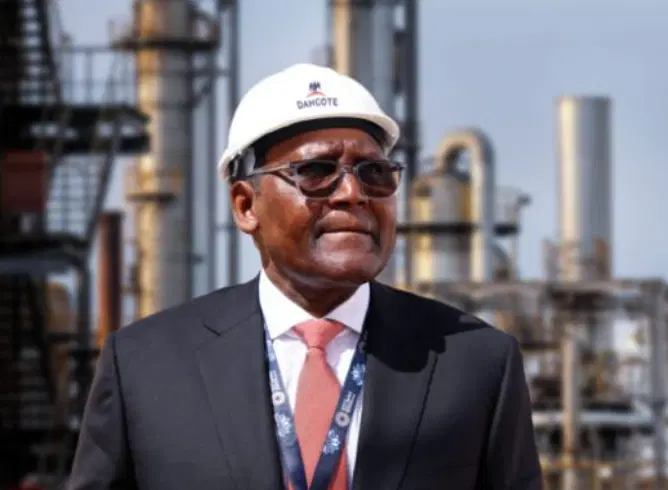
Dangote Refinery Ends Nigeria’s Era of Fuel Import Dependence, Boosts GDP, FX Earnings — EIU
The operational ramp up of the 650,000 barrels per day Dangote Petroleum Refinery & Petrochemicals is fundamentally reshaping Nigeria’s downstream oil sector, significantly reducing the country’s dependence on imported refined petroleum products and strengthening its external position, according to the Economist Intelligence Unit (EIU).
In its latest assessment on Nigeria’s fuel market and regulatory environment, the EIU said the refinery has already transformed a sector that was previously characterised by heavy reliance on imported fuel despite Nigeria being Africa’s largest crude oil producer. The report noted that the refinery met nearly 80 per cent of domestic petrol demand in April and produced enough volumes to satisfy local consumption requirements as operations approached full capacity.
The EIU described Nigeria’s downstream petroleum sector before the refinery as “long dysfunctional”, noting that the country had remained almost entirely dependent on costly imported fuel while producing nearly 1.5 million barrels of crude oil daily.
According to the report, the emergence of the refinery has reduced import dependence, improved domestic fuel availability and strengthened Nigeria’s balance of payments position through lower import demand and rising exports of refined petroleum products.
“The gradual ramp up of the 650,000 barrel/day Dangote refinery since May 2023 has transformed Nigeria’s long dysfunctional downstream sector,” the report stated. “The country’s main refineries, all state owned, had been inoperative for years and Nigeria was almost entirely reliant on costly imported fuel.”
The research and analysis division of The Economist Group, London added that the refinery’s attainment of full operational capacity and its planned expansion would further support Nigeria’s economic growth and foreign exchange earnings over the medium term.
“Meanwhile, the attainment of full capacity at, and an increase in exports from, the Dangote refinery will support real GDP growth and foreign exchange earnings in 2026 and 2027 and beyond, as a planned doubling of the plant’s output comes on stream around the end of the decade,” it added.
Industry analysts said the refinery is increasingly positioning Nigeria as an emerging refining and export hub, altering energy trade flows across Africa and reducing the vulnerability associated with fuel import dependence.
The EIU noted that the refinery’s expansion has coincided with major reforms in Nigeria’s downstream sector, including the removal of fuel subsidies and the introduction of market driven pricing mechanisms.
The report, however, said the transition from a state dominated fuel import structure to large scale domestic refining has triggered resistance from interests linked to the old import regime.
The latest tensions emerged following the decision by the Nigerian Midstream and Downstream Petroleum Regulatory Authority to relax restrictions on petrol imports despite the refinery’s growing capacity to meet domestic demand.
Dangote Industries subsequently initiated legal action, arguing that continued import approvals undermine domestic refining investments and conflict with the objectives of the Petroleum Industry Act, which seeks to encourage local refining capacity and reduce import dependence.
Analysts noted that the availability of large-scale domestic refining capacity has improved Nigeria’s energy security and reduced exposure to external supply shocks and foreign exchange volatility.
The Centre for the Promotion of Private Enterprise also cautioned against unrestrained importation of petroleum products, warning that such a policy could weaken Nigeria’s industrialisation drive and discourage investments in domestic refining.
Chief Executive Officer of CPPE, Muda Yusuf, said continued dependence on imported fuel had historically contributed to pressure on foreign reserves, exchange rate instability and fiscal leakages.
The refinery’s growing impact is also being reflected in Nigeria’s broader macroeconomic indicators. Earlier this month, S&P Global Ratings cited increased domestic refining capacity and rising hydrocarbon exports among the major factors supporting Nigeria’s sovereign credit rating upgrade – the first in 14 years.
Beyond Nigeria, analysts said the refinery is increasingly being viewed as a strategic industrial asset for Africa, where many countries remain heavily dependent on imported fuel despite rising demand for transportation, manufacturing, and power generation.
Business
BREAKING: Court Dismisses $19.6 Million Claim Against NNPCL — Rules Contract Scope Cannot Be Changed Orally

BREAKING: Court Dismisses $19.6 Million Claim Against NNPCL — Rules Contract Scope Cannot Be Changed Orally
In a landmark ruling on Friday, May 22, 2026, the Federal Capital Territory High Court in Abuja threw out a $19.6 million lawsuit filed by Alternate Dimensions Ventures Ltd against the Nigerian National Petroleum Company Limited (NNPCL), affirming a key legal principle: a written contract cannot be expanded through oral agreements or conduct.
Alternate Dimensions had sought $19,600,000 in professional fees, claiming the scope of its Direct Sale, Direct Purchase (DSDP e-pro) contract with NNPCL was orally expanded. Represented by counsel Patrick Peter, the firm argued it was entitled to the revised sum for services rendered under the alleged new terms.
But NNPCL, through its lawyer Ituah Imhanze of KENNA LP, pushed back sharply, arguing that parties are bound exclusively by the clear terms of their written agreement. Imhanze contended that without any written amendment, the claim was legally unsound, and the court agreed.
Delivering judgment, Justice Hamza Mu’azu upheld NNPCL’s defense, stating that the contract was unambiguous and that no evidence was adduced during the trial, which supported the alleged scope expansion. The court further found that NNPCL fully complied with all contractual terms and committed no breach.
Dismissing the suit as meritless, Justice Mu’azu reinforced the doctrine of sanctity of contract: any amendment to a written agreement must be express, unequivocal, and documented, not implied or verbal.
The ruling spares NNPCL from the S19.6 million claim and also a floodgate of similar potential liabilities.


- When women farm better, Eswatini eats better June 3, 2026
- Togo Hosts the 8th Annual Forum of National Volunteer Agencies in the Economic Community of West African States (ECOWAS) Region June 3, 2026
- Indigenous Peoples gravely vulnerable to Ebola epidemic, warn United Nations (UN) independent experts June 3, 2026
- Meeting between Parliamentary Vice-Minister ONISHI and His Excellency (H.E.) Mr. Cosgrow, Principal Minister and Minister for Agriculture, Fisheries and Blue Economy of Seychelles June 3, 2026
- Eritrea: Construction of Elementary School in Gogni Sub-Zone June 3, 2026
- African Union Commission (AUC) Chairperson His Excellency (H.E.) Mahmoud Ali Youssouf highlighted thePermanent Representatives’ Committee (PRC) critical role in advancing the Union’s agenda and laying the groundwork for the forthcoming Mid-Year Coordination Meeting (MYCM) June 3, 2026
- Eritrea: Eighth Grade National Examination Commences June 3, 2026
- Many Africans see justice system as unequal, costly, and slow, Afrobarometer survey reveals June 3, 2026
- Prof. Benedict Oramah to Chair Finance Summit as African Energy Week (AEW) 2026 Prepares for Major Deal Flow June 3, 2026
- The Islamic Development Bank (IsDB) Group Affiliates to Host the 14th Private Sector Forum in Baku, Azerbaijan (16-19 June 2026) June 3, 2026
- When women farm better, Eswatini eats better June 3, 2026
- Togo Hosts the 8th Annual Forum of National Volunteer Agencies in the Economic Community of West African States (ECOWAS) Region June 3, 2026
- Indigenous Peoples gravely vulnerable to Ebola epidemic, warn United Nations (UN) independent experts June 3, 2026
- Meeting between Parliamentary Vice-Minister ONISHI and His Excellency (H.E.) Mr. Cosgrow, Principal Minister and Minister for Agriculture, Fisheries and Blue Economy of Seychelles June 3, 2026
- Eritrea: Construction of Elementary School in Gogni Sub-Zone June 3, 2026
- African Union Commission (AUC) Chairperson His Excellency (H.E.) Mahmoud Ali Youssouf highlighted thePermanent Representatives’ Committee (PRC) critical role in advancing the Union’s agenda and laying the groundwork for the forthcoming Mid-Year Coordination Meeting (MYCM) June 3, 2026
- Eritrea: Eighth Grade National Examination Commences June 3, 2026
-

 news6 months ago
WHO REALLY OWNS MONIEPOINT? The $290 Million Deal That Sold Nigeria’s Top Fintech to Foreign Interests
-

 society1 month ago
SOCIAL MEDIA IS NOT A BATTLEFIELD COMMAND – WHY THE NIGERIAN ARMY’S ACTION AGAINST JUSTICE CRACK IS A NATIONAL SECURITY IMPERATIVE
-

 celebrity radar - gossips4 months ago
Dr. Chris Okafor Returns with Power and Fire of the Spirit -Mounts Grace Nation Altar with Fresh Anointing and Restoration Grace on February 1, 2026
-

 celebrity radar - gossips6 months ago
Prophet Kingsley Aitafo Releases 2026 Prophecy: ‘Nigeria Will Rise, but the World Must Prepare for Turbulence’
You must be logged in to post a comment Login
You must log in to post a comment.