
society
Greed, Corruption and the Nigerian Malaise: Why We Are an Embarrassment to Ourselves


Greed, Corruption and the Nigerian Malaise: Why We Are an Embarrassment to Ourselves.
Written by George Omagbemi Sylvaester |
Published by SaharaWeeklyNG.com
“How Self-Interest Has Undermined Nigeria’s Progress and What It Reveals About Our National Character.”
No nation’s identity is static, though it is forged in the crucible of history, culture, values and collective behaviour. Yet, for Nigeria, that crucible has, more often than not, revealed not our finest steel but our deepest corrosion. Today, billions around the world look at Nigeria not with admiration, but with exasperating disappointmentant not because we lack potential, but because we collectively betray it. The uncomfortable truth is this: Nigerians are an embarrassment to Nigeria when greed, corruption and self-interest become defining national traits.

This is not a cheap rhetorical flourish. It is a sober judgment backed by hard data, global indices and the frank observations of respected leaders and institutions.
A Nation Rankled by Corruption. The most authoritative global measure of corruption is the Corruption Perceptions Index (CPI) published annually by Transparency International. In the 2024 CPI, Nigeria scored a shocking 26 out of 100, placing it 140th out of 180 countries and among the world’s most corrupt nations. Low scores and rankings in this index signify a public sector perceived as deeply corrupt, where abuse of entrusted power for private gain is systemic rather than exceptional.
To put that into perspective: countries with similar scores include Iraq and Madagascar, while nations renowned for governance integrity (like Denmark and Finland) score above 88.
This is not just a poor showing and it is an indictment of a culture in which the stealing of public resources is so normalized that it has become a defining feature of our national identity.
Greed, Not Resources, Is the Real Curse. Nigeria’s overwhelming wealth in human and natural resources should have made it the envy of nations. We possess vast oil reserves, energy and a youthful population with boundless entrepreneurial energy. Yet, instead of translating into widespread prosperity, this bounty has become a resource curse with a situation in which wealth fuels CORRUPTION rather than DEVELOPMENT.

Institutions meant to safeguard the public interest are instead captured by private interests. Billions of dollars from oil revenues, subsidies and contracts vanish into private pockets or are siphoned overseas. Even when recovered, these funds tell a story of how much was stolen in the first place. The United States recently returned $52.8 million in assets linked to a former Nigerian oil minister accused of embezzlement, underscoring how leadership greed has internationalized our shame.
Former President Olusegun Obasanjo (a figure deeply intertwined with Nigeria’s post-military history) has stated bluntly that greed, selfishness and ignorance are the root causes of Nigeria’s malaise, saying that these forces undermine our collective destiny.
When Greed Becomes a National Habit. Greed manifests itself not only among political elites, but across society. It shapes decisions, behaviour and norms. For too many, the overriding question is: “WHAT’S IN IT FOR ME?” rather than “WHAT’S BEST FOR US ALL?”
The Economic and Financial Crimes Commission (EFCC) has noted that greed, laziness and peer pressure drive many youths into fraud and economic crimes. These are not isolated cases, but widespread issues that shape the country’s international image.

This is not merely a problem of a few “BAD APPLES” but it is a CULTURAL PATHOLOGY that erodes trust, destroys livelihoods and undermines institutions. When corruption becomes normalised, honesty becomes a liability and greed becomes an expected behaviour rather than an aberration.
The Economic Toll of Corruption and Greed.
Greed is not only immoral but economically destructive. Transparency International’s CPI and numerous global studies show a clear negative correlation between corruption and economic growth. Countries perceived as more corrupt attract far less foreign investment, suffer from weaker institutional trust, and have lower GDP per capita.
In Nigeria’s case, despite being Africa’s largest economy by GDP, its GDP per capita remains among the lowest on the continent and a sign that wealth is concentrated in the hands of few, while the majority languish in poverty. Corruption diverts public funds away from essential services like healthcare, education, power and infrastructure these sectors that should form the backbone of prosperity.
A Crisis of Trust and Values. When citizens see leaders behaving selfishly, it erodes trust in the entire social contract. Surveys reveal that while most Nigerians disapprove of corruption, many tolerate or rationalize it as a necessary evil in a dysfunctional system. This is tragic because it means the very fabric of civic morality is fraying.
A society that tolerates petty bribery, nepotism and embezzlement in public life also tolerates it in business, family and community. This betrayal of collective interest for personal advancement slowly transforms national identity into caricature.
Voices of Conscience: Scholars and Experts Speak
Renowned scholars have long warned of the dangers of institutionalised corruption. Pauline Baker, former President of the Global Fund for Peace, described Nigeria as an archetype of the “RESOURCE CURSE”, where wealth without accountability fuels corruption that cripples development.
Similarly, experts from Chatham House point out that corruption in Nigeria is not an isolated phenomenon but deeply embedded in social norms and expectations, impacting every level of governance and daily life.
These are not abstract academic critiques, they are reflections of a lived reality where greed has become systemic and self-interest undermines collective prosperity.
Cultural Change, Not Just Institutional Reform. To claim that “Nigerians are an embarrassment to Nigeria” is not to condemn individuals wholesale, but to call out a destructive culture that prioritises self-enrichment over national wellbeing. Change must be cultural as much as it is institutional.
The whistle-blowing policy introduced by Nigeria in 2016 (offering rewards for exposing corruption) is one initiative aimed at shifting behaviour, but it is not enough by itself.
Nigerians must reclaim values like integrity, accountability and patriotism. We must demand transparency from leaders, reject the notion that corruption is an acceptable survival strategy, and foster a culture that honours hard work and honesty.
Final Take: A Call to National Consciousness. We can no longer hide behind excuses. Our low ranking on the corruption index, the billions lost to embezzlement and the societal tolerance for greed are not just statistics, they are the everyday realities that have made Nigeria an embarrassment to itself, but this is also a moment for introspection and renewal. If we confront our faults honestly, embrace accountability and reject greed at every level, Nigeria can still rise to fulfill its promise.
As former President Obasanjo said, the problem is not destiny; it is human shortcomings like GREED and SELFISHNESS that have chained us.
The path forward demands courage and it is the courage to do what is right even when it is hard, the courage to serve others before self and the courage to restore Nigeria’s honour not through empty slogans, but through integrity and collective resolve.
Only then will we transform from an EMBARRASSMENT to an INSPIRATION.






US-Based Society Lady, Fehintola-Brat Extends Eid-El-Kabir Greetings To Muslims
United States based fahionista of class, Chief (Mrs) Ayoola Fehintola-Brat has extended a warm greetings to Muslim faithful all over the world on the occasion of the 2026 Eid-El-Kabir celebration.
Fehintola-Brat who is the Balogun Egbe Obaneye Obinrin Akile Ijebu, and the Yeye Asofin of Idenaland in her message to Journalists urged Muslim to continually uphold the enduring values of sacrifice, obedience, faith, and compassion, which are central to the significance of Eid-El-Kabir festival.
A quiet philantropist whose humanitarian services has won her several laurels urged Muslims to use the spiritual occasion to pray for the peace co-existence of Nigerians regardless of religious, social and political leanings stressing that the oneness of the country should not be underplay.
In a related development, she expressed her felicitations to all sons and daughters of Ijebuland on the forthcoming Ojude Oba 2026 celebration, tasking age-groups otherwise known as Regbregbe to be more proactive in giving back to their immediate communities.
According to her, the beauty of the age-groups in Ijebuland is the need to contribute immensely to the development of the land in no small means. “This we will continue to achieve with God on our side”, she concluded.
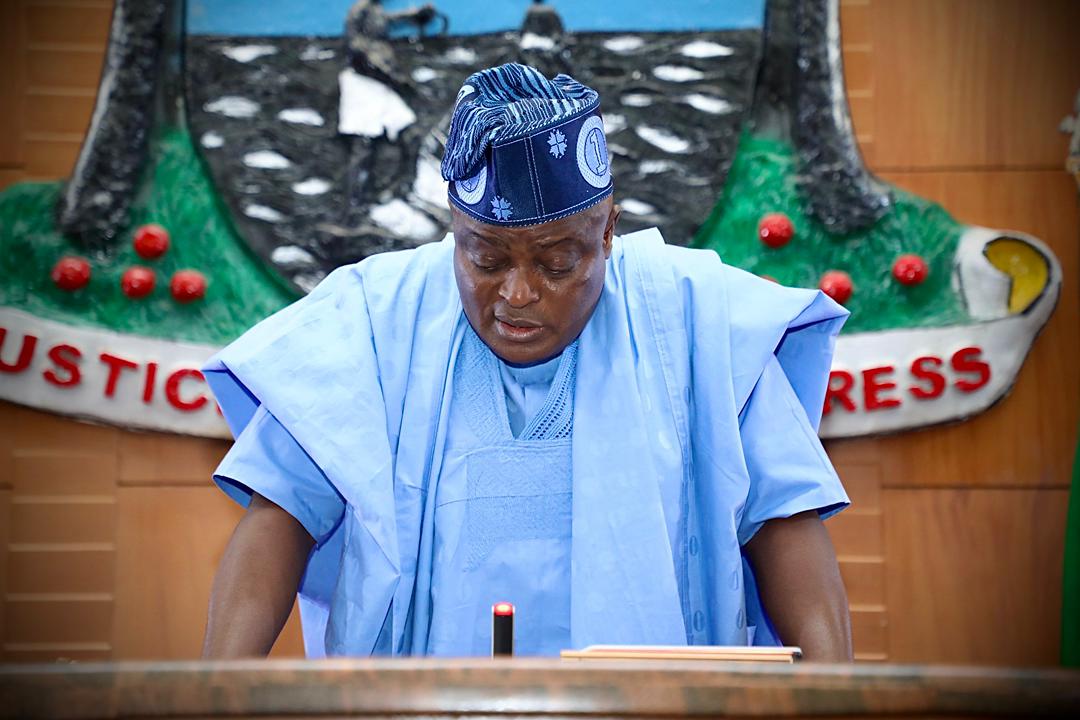
Sallah: Obasa Felicitates Muslim Ummah, Commends Nigerians for APC Primaries Turnout
The Speaker of the Lagos State House of Assembly, Rt. Hon. Mudashiru Obasa has extended warm felicitations to Muslims in Lagos State and across Nigeria on the occasion of Eid al-Adha.
In a statement released by his Chief Press Secretary, Mr. Dave Agboola, Obasa described the festival as a season of sacrifice, reflection, and gratitude, urging the faithful to continue to uphold the values of peace, unity, and love that strengthen the nation.
He noted that the celebration of Eid al-Adha is not only a spiritual milestone but also a reminder of the importance of togetherness and collective responsibility in building a stronger society.
He, likewise, emphasized that the festival provides an opportunity for Nigerians to renew their commitment to national progress and to support leadership that prioritizes development and prosperity.
Obasa, however, commended Nigerians, particularly members of the All Progressives Congress (APC), for their massive turnout during the recently concluded party primaries. He described the participation as a clear demonstration of the people’s confidence in the government of President Bola Ahmed Tinubu and their belief in the administration’s vision for a greater Nigeria.
“The APC primaries have shown the resilience of our democracy and the confidence Nigerians have in the leadership of President Bola Ahmed Tinubu and the Renewed Hope Agenda. This is a strong message that our people are ready to continue supporting policies that will drive growth and prosperity,” Obasa stated.
The Speaker further encouraged Muslims to celebrate responsibly, stressing that the joy of Eid should be accompanied by prayers for the continued peace and progress of Lagos State and Nigeria.
“As you celebrate with family and loved ones, may this season bring joy, peace, and prosperity to your homes. Let us remain united in our resolve to build a stronger nation,” he added.
On behalf of the Lagos State House of Assembly, Obasa wished all Muslims a happy and fulfilling Eid al-Adha celebration.
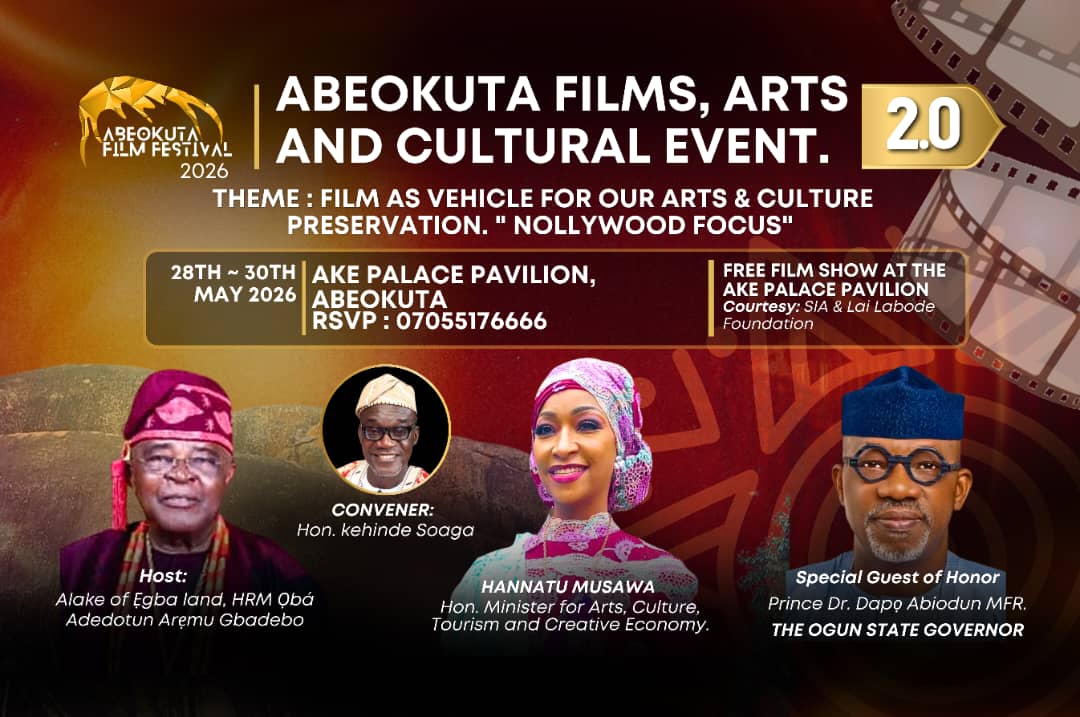
ABEOKUTA FILM FESTIVAL AT ILEYA
Kayshow Multimedia a filmmaking and Media organization this year 2026 holds its annual Abeokuta film festival at the Ake Palace in Abeokuta.
Alake of Egba land, Ọba Michael Adedotun Arẹmu Gbadebo has graciously endorsed the Free Training of Egba Youths on Film and Arts and the Entertainment of the the People with a FREE FILM SHOW at the AKE PAVILION. as part of the ABEOKUTA FILM FESTIVAL 2.0.
The Convener of the Film Festival Honorable Kehinde Soaga says this year’s event promises to be more exciting as distinguished personalities are sure to attend.
This includes the honorable Minister for Art Culture and Creative Economy in Nigeria, Barr. Hannatu Musa Musawa, Ààrẹ Lai Labode, Sen. Ibikunle Amosun and other special guests.
The event will feature Film, Cultural Dance Cultural foods and Award Ceremony.
The general public is hereby invited to the Free film show at the Abeokuta film festival at the Alake Palace Pavilion on Thursday 28th of May 2026 by 4:00 p.m.
Only well dressed is the Entry. The Abeokuta Film Festival is an annual event taking place in the capital city of Ogun State state.


- Qrent says delaying Information Technology (IT) refresh cycles may be increasing operational risk for businesses in Africa May 27, 2026
- Dentons’ Iyunola Adekanye Appointed to African Mining Week (AMW) Advisory Board May 27, 2026
- United Nations (UN) Women Liberia and Partners Convene for Spotlight Initiative 2.0 Women’s Economic Empowerment Inception Meeting May 27, 2026
- African Mining Week (AMW) to Host Central Bank Governors Roundtable as Monetary Authorities Deepen Role in Mining Sector Growth May 27, 2026
- Eritrea: Diaspora Nationals Celebrate Independence Day Anniversary May 27, 2026
- Africa Unveils Landmark Humanitarian Coordination Platform to Strengthen aligned Response to Humanitarian Crises May 27, 2026
- Seychelles: President Herminie Engages with Police and Fire Services on Praslin May 27, 2026
- Issue 3 of Mining Review Africa now available for free download May 27, 2026
- NOV Joins African Energy Week (AEW) 2026 as Gold Sponsor Amid Africa’s Offshore Expansion Push May 26, 2026
- African Union of Broadcasting (AUB) and United Nations University Institute for Water, Environment and Health (UNU-INWEH) Launch Landmark Webinar Series on Africa’s Water Crisis, Starting June 2, 2026 May 26, 2026
- Qrent says delaying Information Technology (IT) refresh cycles may be increasing operational risk for businesses in Africa May 27, 2026
- Dentons’ Iyunola Adekanye Appointed to African Mining Week (AMW) Advisory Board May 27, 2026
- United Nations (UN) Women Liberia and Partners Convene for Spotlight Initiative 2.0 Women’s Economic Empowerment Inception Meeting May 27, 2026
- African Mining Week (AMW) to Host Central Bank Governors Roundtable as Monetary Authorities Deepen Role in Mining Sector Growth May 27, 2026
- Eritrea: Diaspora Nationals Celebrate Independence Day Anniversary May 27, 2026
- Africa Unveils Landmark Humanitarian Coordination Platform to Strengthen aligned Response to Humanitarian Crises May 27, 2026
- Seychelles: President Herminie Engages with Police and Fire Services on Praslin May 27, 2026
-

 news5 months ago
WHO REALLY OWNS MONIEPOINT? The $290 Million Deal That Sold Nigeria’s Top Fintech to Foreign Interests
-

 society3 weeks ago
SOCIAL MEDIA IS NOT A BATTLEFIELD COMMAND – WHY THE NIGERIAN ARMY’S ACTION AGAINST JUSTICE CRACK IS A NATIONAL SECURITY IMPERATIVE
-

 celebrity radar - gossips4 months ago
Dr. Chris Okafor Returns with Power and Fire of the Spirit -Mounts Grace Nation Altar with Fresh Anointing and Restoration Grace on February 1, 2026
-

 celebrity radar - gossips6 months ago
Prophet Kingsley Aitafo Releases 2026 Prophecy: ‘Nigeria Will Rise, but the World Must Prepare for Turbulence’