
society
How Adaobi Alagwu and her Mother Turned Tunde Ayeni Into a Meal Ticket


*How Adaobi Alagwu and her Mother Turned Tunde Ayeni Into a Meal Ticket*
A fierce undertow runs beneath the sensational rumours of Adaobi Alagwu’s reconciliation with her estranged lover, Tunde Ayeni: it is that Ms. Alagwu and her mother, Adaora Amam, are shameless gold diggers who have turned Ayeni into their meal ticket. While Ayeni is far from blameless, the picture painted by close observers shows a calculated, deeply dependent relationship extended over years, not out of love, but out of financial survival and strategic leverage.
Sources close to the matter claim that Adaobi receives a monthly allowance from Ayeni ranging between N500,000 and N1 million, enough to underwrite much of her and her mother’s lifestyle. Even amid estrangement, she and her mother reportedly continue to occupy Ayeni’s properties: houses in Abuja, residences near his business facilities, and other assets he makes available for their use. Ayeni has become the anchor for a parasitic ecosystem, one that gladly tolerates public humiliation, controversy, even court battles, as long as the cash keeps flowing.
That ecosystem thrives on dependency. While Ayeni has publicly tried to reject or disown Adaobi even signing legal affidavits; she refuses to let go. She clings, because Ayeni remains her primary source of wealth and access, and because, despite multiple ruptures, he continues to fund her lifestyle. Her persistence goes beyond love or delusion: it looks like calculated survival.
Worse still, Adaobi has not confined her emotional life to Ayeni alone. Reports suggest that she has entertained multiple relationships with other men while still leveraging her connection to him. Such rumors, whether fully verified or not, point to a disconcerting reality: she may well treat Ayeni as the central pillar upon which she stages her social and material existence.
Her mother, according to several accounts, has played an even more troubling role: not as a protective parent, but as a strategist who both encourages and benefits from her daughter’s closeness to Ayeni. Insiders describe her as a woman who uprooted her life, abandoned her marital home, and relocated specifically to one of Ayeni’s houses at Plot 48, Mike Akhigbe Way, in Jabi, Abuja, while her daughter, Adaobi occupies Ayeni’s DD38, Lakeview Estates, off Alex Ekwueme Way, also in Abuja. For instance, Madam Adaora reportedly urged Adaobi to conceal vital truths at the beginning of her ill-fated romance with Ayeni, like her pregnancy, in a desperate bid to stretch the relationship’s limits until they could extract maximum advantage.
These findings are sharpened by commentary on a wider generational shift: wealthy older men who once wielded control in quiet, private ways now find themselves entangled with younger, digitally empowered women who understand emotional leverage, financial access, and social capital in ways their predecessors did not. The story of Ayeni, Adaobi, and her mother is not simply a private scandal. It is a dramatic confirmation of how power, money, and dependency have reconfigured contemporary relationships.
From those who know the players, Adaobi Alagwu was never cast in the role of a rescued young lover. Rather, she is portrayed as someone who recognized early that proximity to Ayeni could carry long-term benefit, and then positioned herself accordingly. Observers close to their circle say she never saw him merely as a romantic interest, but as an opportunity.
Evidence supporting this theory is public enough. Ayeni has reportedly provided her with a steady monthly stipend, and insiders claim she was still receiving those transfers even during times of public scandal. In some of his more revealing interviews, he has admitted regret, speaking of manipulation, entitlement, and emotional blackmail from Adaobi and her family.
According to those familiar with the situation, Adaobi never hesitated to dress elegantly and visit Ayeni’s office repeatedly, smiling through the awkwardness of knowing his wife was equally in Lagos. For years, whispers circulated about multiple men linked to Adaobi within their social circles, yet her mother continued to champion Ayeni as the ultimate catch. She even advised her daughter not to call him on weekends because “he would be with his wife in Lagos.”
When the secret “engagement” took place, an event without photographs at Ayeni’s insistence, the mother readily played along. Even after Ayeni questioned the child’s paternity, she would regularly show up at his office to beg. Ayeni would later remark that her requests had become routine, including asking for “One Million Naira for prayers.” And when he demanded the return of the bride price, she casually asked if it should be done formally or simply “arranged.”
Despite scolding from her husband’s kinsmen, she persisted, reportedly touring Abuja and introducing her daughter as “Mrs. Ayeni,” while simultaneously benefiting from his resources: a UK scholarship for her second daughter, and a lucrative job at NDHPC for her son. It became an ecosystem of dependence disguised as aspiration.
But money alone does not capture the full picture. According to Adaobi’s friends, her entanglement with Ayeni was never limited to transactional affection. They say she saw him as a source of security — not only financial, but social. The house she occupies, the staff who serve her, the status she carries in Abuja’s elite circles, all are attributed to her tie to him. Even when denied formal recognition, she continued to leverage that connection, refusing to relinquish it in word or deed.
At the height of their conflict, Adaobi’s mother allegedly pleaded with Ayeni to replace phones he had smashed, begged him for forgiveness when tensions threatened to boil over, and attended his office dressed elegantly to maintain visibility. One insider described the mother as “elaborately fearless,” someone who seemed unbothered by moral judgment and more focused on results.
To many of her critics, Adaobi does not simply want the luxury; she wants permanence without commitment. She appears to wield her dependence like a tool, playing on Ayeni’s guilt, his resources, and his public image, insisting on her place even as he insists on distancing himself. Her ability to remain physically present — living in his properties, frequently visiting his homes even after public fallout — distinguishes her from someone fighting for recognition, and aligns her with someone determined to preserve her access at all costs.
This orchestrated dependency, according to critics, reveals a moral erosion: not simply an opportunistic family, but one that has conflated ambition and entitlement, love and leverage, access and principle. The mother’s involvement complicates any argument that this is a romance gone wrong: it suggests a deeply embedded system of exploitation.
For Ayeni, the consequences have been serious and sustained. He once called this entanglement “one of the darkest moments” of his life, describing the family as his “greatest regret” in a televised interview. He accused both Adaobi and her mother of manipulation, emotional blackmail, and an unending sense of entitlement.
There have also been legal and reputational battles. Adaobi reportedly filed statements with the police, claiming harassment and intimidation. Ayeni’s camp, for its part, has denied several of her claims, painting a picture of a relationship replete with contradictions: on one hand, deep emotional entanglement; on the other, relentless exploitation.
Her friends say she blocks well-intended advice. Several have reportedly urged her to break free, reclaim her dignity, and build something independent of Ayeni. According to those close to her, she has gradually shut out those voices, preferring the access she still enjoys to the uncertainty that comes with cutting ties.
The question every critical observer is asking is simple: What is Adaobi really getting from keeping this connection alive? It is not only about the monthly stipend, though that is substantial. Beyond the cash, she benefits from physical spaces; houses, staff, and other material resources; that have enabled her to maintain a high-profile lifestyle without fully exposing vulnerability.
But the most baffling, most bewildering character in this entire sordid saga is Adaobi’s mother, the woman who flamboyantly calls herself Mrs. Princess Adaora Amam. She does not merely enable her daughter’s disasters; she escorts her into them with the confidence of someone utterly divorced from reality.
How does a woman who left her first marriage under scandal, and is knee-deep in crises with her second husband in Lagos, abandon her matrimonial home, her last claim to dignity, to go nest in her daughter’s lover’s house? And not just any lover: a fully married man, decades older, who has publicly humiliated them both, questioned the paternity of her granddaughter, and repeatedly denied them.
Yet instead of directing their rage at the person dragging them through the mud, Adaobi and her mother face the wrong direction entirely, charging at Ayeni’s wife, his girlfriend, and his associates with the fury of people determined to fight everyone except the man actually insulting them.
And floating above all this chaos is Madam Adaora’s grand delusion: the laughable insistence on calling herself Princess. A princess of where, exactly? Which kingdom? Which throne? Which lineage? Her behaviour alone betrays the truth. No woman born of pedigree behaves like this.
Her refusal to leave, even as her relationship with Ayeni deteriorates, signals a deeper truth. According to insiders, she has made a choice: humiliation is acceptable so long as stability remains. Rather than sever the bond, she persists. Rather than walk away, she tightens her grip.
The comparison to Regina Daniels’ widely publicized separation from Senator Ned Nwoko, by high society pundits, is particularly instructive. Unlike Adaobi, Regina walked away. Despite being younger and under intense scrutiny, she publicly asserted her worth, insisted on respect, and, when lines were crossed, removed herself from an untenable relationship.
Adaobi’s trajectory, by contrast, appears less about self-worth and more about dependency. While Regina seized agency, according to critics, Adaobi opted for survival, or at least the semblance of it. Where Regina’s exit was viewed by many as an act of self-respect, Adaobi’s tenacity has drawn condemnation as greed dressed in resilience.
Some commentators argue that Adaobi sees the relationship as a business, not a partnership. They suggest she took the same calculation approach that many ambitious people adopt in their careers: find a powerful benefactor, extract value, and secure long-term access.
What underlies this drama is a broader generational shift in how relationships are negotiated. Wealthy older men like Ayeni are no longer simply partners or benefactors; they are nodes in networks of social capital, power, and financial leverage. Younger women who grew up in a digital age, surrounded by public platforms and audience economies, understand this dynamic intuitively. They navigate relationships not only with hearts, but with spreadsheets: what I give, what I get, when I leave, whether I stay.
Adaobi and her mother, by many accounts, represent a sophisticated expression of that shift. They do not simply want to be loved; they want to be sustained. The stakes are both emotional and materially existential. They see Ayeni not just as a lover, but as an investment, a resource and the base of a lifestyle that may not be replicable elsewhere.
Their critics argue that the emotional intimacy has become secondary. What remains primary is the access: to money, property, and influence. They suggest that Adaobi’s repeated attempts to hold on, despite deep fractures, betray a transactional logic more than a romantic one.
Ayeni, on his part, is hardly a victim without agency. Even after describing his regret publicly, acknowledging both his culpability and the cost of their relationship, he is desperately seeking to reconcile with Adaobi. His critics, though, claim he misreckoned the depth of the desperation and ambition of both Adaobi and her mother.
Ayeni and Adaobi’s back and forth with each other certainly fits into a recurring pattern: powerful men drawn into emotionally volatile situations with younger women, only to be drawn back again. He appears to warn people publicly, justify himself in interviews, and attempt legal recourse, but those close to Adaobi say he has never severed the financial flow entirely.
This repeated dynamic raises deep questions about power: who has it, who uses it, and who sustains it. Ayeni wields resources; she wields proximity. He controls access; she exploits dependence. Their relationship becomes a site of perpetual negotiation, not of love, but of leverage.
And the moral cost is heavy. Whether one condemns her for her persistence or pities her for her dependence, the truth remains that their arrangement reflects a broader decay in relational trust. It suggests that love and money no longer occupy separate domains, but bleed into each other until the boundaries blur.
Adaobi Alagwu and her mother may be perceived by many as shameless gold diggers, but their strategy has been frighteningly effective. Through repeated demands, strategic positioning, and a refusal to relinquish access, they have turned Tunde Ayeni into a financial anchor for their ambitions.
When compared to the likes of Regina Daniels, who walked away from a high-profile political marriage with her dignity intact, Adaobi’s path reads less like a tale of emancipation than a study of calculated dependence. The contrast underscores a generational shift: whereas older norms emphasized discretion and commitment, newer norms exploit visibility and leverage. Adaobi and her mother appear to have mastered this new terrain, surviving scandal, humiliation and rejection because they view Ayeni not simply as a partner but as their lifeline.
If anything, their story demands that Nigerians examine more than their moral outrage. It calls for reflection on the power dynamics that govern modern relationships, especially when wealth, gender and ambition converge. It demands accountability for those who exploit, yes, but also for those who enable. Because the cost of this kind of symbiosis is not just personal, but societal: a corruption of affection, a redefinition of loyalty, and an erosion of trust in an age where money and love are dangerously intertwined.




society
Buratai Highlights Leadership, Community Support In Defeating Insurgency As Shettima, Defence Chiefs Rally Support For Counterterrorism Documentation At Book Launch

Buratai Highlights Leadership, Community Support In Defeating Insurgency As Shettima, Defence Chiefs Rally Support For Counterterrorism Documentation At Book Launch
Prominent Nigerians including Vice President Kashim Shettima, Defence Minister Christopher Musa, senior military officers, and political leaders on Thursday underscored the importance of documentation, collective national responsibility, and sustained military professionalism in the fight against terrorism during the unveiling of a new book titled “Counterterrorism and Counterinsurgency Operations in North East Nigeria (Volumes 1 & 2)” authored by retired Major-General Ibrahim Yusuf.

Representing Vice President Kashim Shettima, the Special Adviser on General Duties, Dr. Aliyu Modibbo, described the publication as a timely and strategic contribution to Nigeria’s national security discourse.
According to him, Nigeria’s experience with terrorism and insurgency in the North-East reflects not a nation defeated by insecurity, but the resilience and courage of citizens and security forces defending the country’s shared destiny.
He noted that the conflict in the North-East remained a deep human tragedy affecting communities with rich historical and cultural heritage, stressing that terrorism requires sustained vigilance, intelligence gathering, diplomacy, technology, and strong civil-military cooperation.
The Vice President further commended the author for documenting operational experiences and strategic lessons from the theatre of operations, saying such insights would prove invaluable to policymakers, scholars, and future military leaders.
He also reaffirmed the commitment of President Bola Ahmed Tinubu’s administration to strengthening the operational readiness, welfare, and dignity of members of the Armed Forces.
In his goodwill message, the Minister of Defence, Christopher Musa, praised the author as a respected mentor whose professionalism and leadership continued to inspire younger officers even after retirement.
“The lion may be retired, but he is certainly not tired,” he remarked.
Musa described the insurgency in the North-East as one of Nigeria’s most complex security challenges, noting that the asymmetric nature of the conflict means it cannot be won by military force alone.
According to him, victory against terrorism depends on collective national responsibility involving the Armed Forces, civil authorities, and citizens working together to deny insurgents support and legitimacy.
He also urged serving military officers to study the publication carefully, noting that it contains valuable operational lessons from years of counterinsurgency operations.
The Chief of Defence Staff, Olufemi Oluyede, described the two-volume publication as a major intellectual contribution bridging theory and practice in counterterrorism and counterinsurgency operations.
Oluyede commended the author for preserving decades of operational knowledge gained from commanding the 21 Brigade, 7 Division, and the Multinational Joint Task Force.
He stressed that modern security threats demand continuous learning, adaptation, and proper documentation of operational experiences, adding that the publication would serve as a useful resource for military practitioners, researchers, and policymakers.
Former Chief of Army Staff, Lt. Gen. Tukur Buratai, also applauded the author for documenting operational experiences from the counterinsurgency campaign in the North-East.
Buratai stated that operational success in counterinsurgency warfare depends largely on the quality of commanders in the field and the ability of military leaders to adapt to complex realities.
He recalled the significance of operations such as Deep Punch I and Deep Punch II, as well as the critical role played by the Nigerian Air Force in degrading terrorist capabilities between 2015 and 2017.
According to him, resilient leadership and community support remain crucial elements in defeating insurgency.
Earlier, retired Major-General Ibrahim Yusuf said the publication represented the fulfilment of an eight-year intellectual ambition aimed at contributing to military scholarship and national security discourse.
He explained that the book was inspired by a desire to provide younger military officers and policymakers with first-hand insights into the successes and challenges of counterterrorism operations in Nigeria.
The retired general added that the publication drew from over a decade of operational experience in the North-East and the Lake Chad Basin while deliberately avoiding sensitive information capable of compromising ongoing operations.
He also urged retired military officers to document their operational experiences for future generations, stressing that such efforts are essential for institutional memory and national development.
Reviewing the publication, renowned scholar Eghosa Osaghae described the work as a landmark contribution to military scholarship.
Osaghae noted that the two volumes combine academic depth with practical operational experience, offering insights into intelligence-led operations, joint force coordination, psychological warfare, and post-conflict management.
He added that the publication effectively situates Nigeria’s counterinsurgency experience within the broader realities of modern asymmetric warfare and evolving global security threats.
The event attracted senior serving and retired military officers, heads of security agencies, members of the diplomatic corps, academics, and policymakers from across the country.
society
Oduduwa Integrity Association Announces Adoption of Governor Ademola Adeleke as “Performing Governor” in the Southwest*

Oduduwa Integrity Association Announces Adoption of Governor Ademola Adeleke as “Performing Governor” in the Southwest*
*Osun State, Nigeria* – The Oduduwa Integrity Association, one of the prominent socio-cultural and advocacy groups in the Southwest region, has announced its decision to adopt and publicly recognize Governor Ademola Adeleke of Osun State as a performing governor in the Southwest.
According to the Association, the adoption is based on its independent monitoring of governance and project delivery across the region. The group stated that Governor Adeleke’s administration has demonstrated measurable progress in areas including infrastructure, workers’ welfare, education, and youth empowerment, which aligns with the association’s mandate to promote accountability and good governance.
“This adoption is our way of encouraging performance and responsible leadership,” Evang /Hon Omotoso Banji, the President and Founder of Oduduwa Integrity Association said. “We believe that recognizing leaders who are delivering on their mandate helps strengthen democratic values and motivates others to prioritize the people.”
The Association noted that its adoption does not imply political affiliation but is a non-partisan endorsement of what it describes as visible and verifiable governance outcomes within Osun State. It added that the move is part of its broader initiative to highlight and support public officials across the Southwest who meet its standards for transparency, service delivery, and integrity.
Governor Adeleke’s administration has been marked by policy focus on infrastructural renewal, payment of salary arrears, and investment in grassroots development since assuming office. The Oduduwa Integrity Association said it will continue to monitor and document these efforts as part of its civic oversight role.
The formal adoption ceremony and presentation of recognition materials are expected to be announced in the coming weeks.
The Oduduwa Integrity Association is a Southwest-based civil society and advocacy group committed to promoting good governance, transparency, and accountability across Yoruba-speaking states presided by Evang / Hon Omotoso Banji.The Association conducts independent assessments of public service delivery and engages in community enlightenment programs.
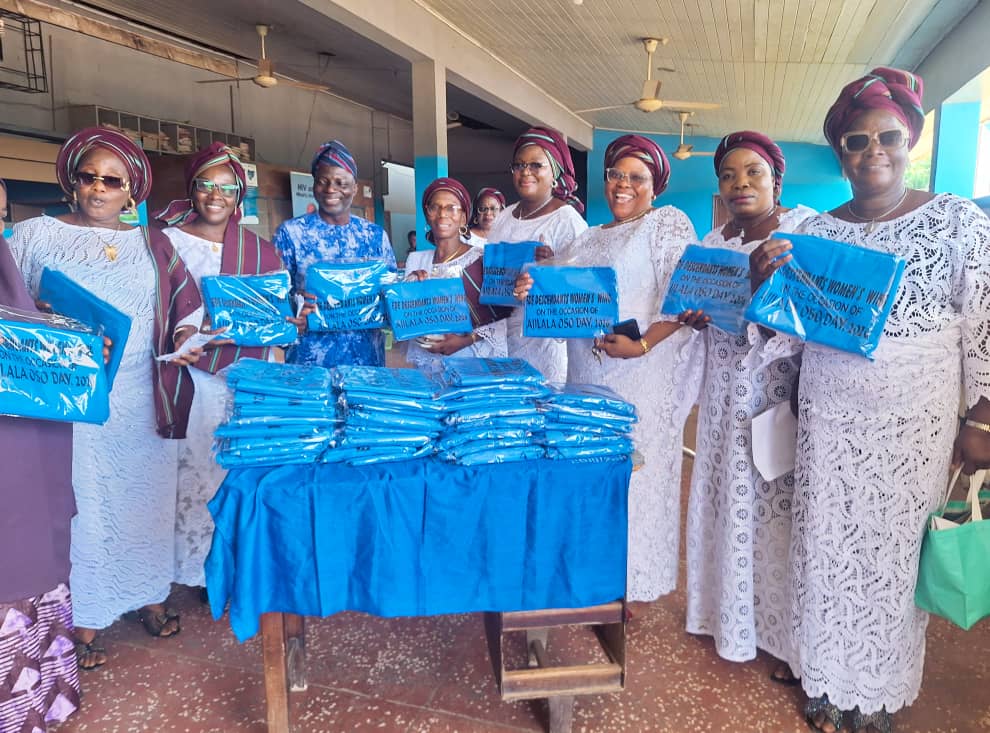
AjilalaOso Day 2026: Women Union Make Donations To Hospital
The women wing of the Ede Descendants Union has donated 42 bedsheets and 44 pillow cases to Cottage Hospital, Ede, in Osun State, as part of activities marking preparations for AjilalaOso Day 2026.
The donation was aimed at supporting healthcare services at the hospital while also demonstrating the union’s commitment to community development and humanitarian service.
Members of the union said the gesture formed part of efforts to give back to society and contribute meaningfully to the wellbeing of patients receiving treatment at the health facility.
Speaking during the presentation, the leader of the women wing, Mrs Silifat Shittu, described the initiative as a reflection of the values of compassion, unity and service which AjilalaOso Day represents.
She noted that the annual cultural celebration is not only about showcasing the rich heritage of Ede but also about promoting development-oriented projects capable of impacting lives positively.
The group further urged individuals, organisations and stakeholders in Edeland to continue supporting community-based initiatives aimed at improving the welfare of residents.
Speaking on behalf of the hospital management, the Chief Medical Officer, Dr Isiaka Alade, appreciated the women group for the donation, describing the items as timely and beneficial to patients and the hospital environment.
Chairman of the AjilalaOso Day 2026 Planning Committee, Prince Adewale Laoye while addressing the gathering appealed to other well-meaning individuals and organisations to extend similar gestures to the hospital, noting that some roofing sections of the facility require urgent repairs.
He also commended the women wing of the union for the initiative and support shown to Cottage Hospital.
Prince Laoye, who spoke extensively on the objectives of the AjilalaOso festival, explained that the annual celebration would not only be about funfair and merriment but would also focus on touching the lives of the needy through impactful community projects.
According to him,“We also want associations to have a project executed in Ede every year, such as what the women wing of EDU has done today.”


- Strengthening Zambia’s Readiness for Health Emergencies: From Surveillance to Pandemic Preparedness May 21, 2026
- Economic Community of West African States (ECOWAS) Strengthens Regional Integration Through Cross-Border Cooperation Stakeholders’ Meeting in Abuja, Nigeria May 21, 2026
- Senegal Retains Title as Overall Champion at ECOWAS African Wrestling Tournament (TOLAC 14) May 21, 2026
- Eritrea: Diaspora Nationals Celebrate Independence Day Anniversary May 21, 2026
- Seychelles: President Herminie Visits District Administration Office and Library on La Digue May 21, 2026
- Egypt: President El-Sisi Meets Tunisian Minister Mohamed Ali Nafti May 21, 2026
- Joint statement welcoming the Republic of Togo’s announcement on Visa facilitation for African nationals May 21, 2026
- Advancing Regional Political Commitment and Cross Border Coordination for Ebola Preparedness and Response May 21, 2026
- Morocco: African Development Bank commits €200 Million to boost employability and develop future skills May 21, 2026
- Société Nationale des Pétroles du Congo (SNPC) Targets Global Operator Status as African Energy Chamber (AEC) Engagement Reinforces Congo’s Energy Ambitions May 21, 2026
- Strengthening Zambia’s Readiness for Health Emergencies: From Surveillance to Pandemic Preparedness May 21, 2026
- Economic Community of West African States (ECOWAS) Strengthens Regional Integration Through Cross-Border Cooperation Stakeholders’ Meeting in Abuja, Nigeria May 21, 2026
- Senegal Retains Title as Overall Champion at ECOWAS African Wrestling Tournament (TOLAC 14) May 21, 2026
- Eritrea: Diaspora Nationals Celebrate Independence Day Anniversary May 21, 2026
- Seychelles: President Herminie Visits District Administration Office and Library on La Digue May 21, 2026
- Egypt: President El-Sisi Meets Tunisian Minister Mohamed Ali Nafti May 21, 2026
- Joint statement welcoming the Republic of Togo’s announcement on Visa facilitation for African nationals May 21, 2026
-

 news5 months ago
WHO REALLY OWNS MONIEPOINT? The $290 Million Deal That Sold Nigeria’s Top Fintech to Foreign Interests
-

 society3 weeks ago
SOCIAL MEDIA IS NOT A BATTLEFIELD COMMAND – WHY THE NIGERIAN ARMY’S ACTION AGAINST JUSTICE CRACK IS A NATIONAL SECURITY IMPERATIVE
-

 celebrity radar - gossips4 months ago
Dr. Chris Okafor Returns with Power and Fire of the Spirit -Mounts Grace Nation Altar with Fresh Anointing and Restoration Grace on February 1, 2026
-

 celebrity radar - gossips5 months ago
Prophet Kingsley Aitafo Releases 2026 Prophecy: ‘Nigeria Will Rise, but the World Must Prepare for Turbulence’