
Business
I Started as a Camera man.. passed through thick and thin to get to this stage – Planet TV Owner,Wale Akinlabi


Planet TV is a musical channel on GOTV transmitting to the world from south Africa, a couple of weeks ago an affiliation kicked off in Nigeria transmitting from onward building in oregun, ikeja Lagos. The president of the planet image communications both in south Africa and Nigeria is a young Nigerian that has traveled far wide and especially through every nook and cranny of African continent promoting both Africa and Nigeria culture through selling our musical contents. Sahara weekly had the honor of speaking one on one with Mr Wale Akinlabi a man of vision and focus on how it all began and how it has been so far. Enjoy….
Sw: can we meet you sir?
Wale Akinlabi: my name is wale akinlabi the president of planet image communications,the owner of planet TV on GoTV channel 37 and good morning africa on africa magic
Sw: kindly tell us your background
WA:I hail from oyo alafin in oyo state and happens to be the first child in a family of seven. I studied theater arts from lagos state university,bachelor of arts(BA)visual & performing arts, I’m married with 2 beautiful kids from the most beautiful woman(smiles)
Sw: Recently you unveiled planet T.V a music channel on cable network in nigeria apart from the planet TV in south Africa,kindly tell us how and when planet TV started?
WA: Planet TV actually originated from Nigeria. I started the company in 1990 but as a one man business there was not much to write home about . So in year 2000 after resigning my appointment from where I was working I went into full operation.
Sw: As at that time were you still in Nigeria?
WA: I relocated to south africa in 2004,the beginning in south Africa was also not rosy. I was just there with nothing but just hoping for the best,in 2008 things started improving and I got planet image registered
Sw: earlier you talked about resigning your appointment to fully concentrating on planet TV from which company did you resign?
WA: I was working with Audio visual first( AVF) who actually owns this facility before resigning in year 2000
Sw: For you to set up planet TV in south Africa you must have recorded a huge success?
WA: (smiles) we still can not deny the fact that planet TV has come of age inspite of the fact that we still target the sky as our limit
SW: what makes planet TV different from the others ?
WA: we strive to stand ahead of others in our programming, we target both the youth and the matured audience and try to balance the two. As for our picture quality, we broadcast with HD and also transmit with the most powerful and effective transmitting machine from South Africa which is the latest technology in terms ot transmission, we are only the only one using it in Nigeria while all others make do with satellite dish which is not always reliable, when it rains the signal becomes unstable.
Sw: that is quite wonderful!!!
WA: that is not all,we are the first cable TV channel with live interaction,so we could feel the pulse of our viewers and give it instant attention,they tell us what music to play and we put it on their screen immediately …
SW: what prompted the decision to have a live interactions while others are not so inclined….
WA: like every other youth, everybody has a vision but the way we actualise our dreams is what brings about the difference, it depends on how individual go by it. Another point of note is the fact that we all have dreams but not all are given the grace to actualise our dreams. All in all I give glory to God for making my dreams come to life.
SW: life is not always a bed of roses, along the line the road must have been rough and bumpy, what are the challenges?
WA: it has not been an easy journey all through. I passed through thick and thin to get to this stage . Like I told you earlier,1990 till 2000 when I resigned at my working place to fully concentrate on my own project,I was not getting anything but only sacrificing time, energy and capital,the situation continued till we left Nigeria’s shore in 2004
SW: once in south Africa,things turned around for good?
WA: Not immediately ,the first few years in south Africa was full of unrewarding efforts making it the same old story, it was self determination coupled with patience and lot of sacrifice that saw us through and we had an upturn in the business. My brother the challenges were tough and discouraging but above all I give all the glory to God for where we are today..
Sw: let’s get on how you found your self in the media world,was it a dream or somehow accidental?
WA: I actually started from the scratch. Its a long story but I’ll take time to tell you to the barest details
SW: Go on,I’m all ear sir?
WA: (sigh) I passed through all aspects of production
,Started as a cameraman, I later moved to Galaxy TV owned by Steeve OJO, I was working as an editor,I was one of the first set of people that built and developed galaxy tv in ibadan, I trained virtually all the editors and also doing the broadcast. One thing I can say about steeve ojo is the fact that he would not tolerate half measure . He made me work hard and every body said he was using me but the fact remains that I was building myself morally,physically and technically. He employed me as an editor but made me understand professional camera handling. We rotate different departments,it was him that turned me into an animator, my dexterity on it with time made all my friends call me animation,it became my nick name .
SW: so you moved from minor camera operation to editing and from there to animation?
WA: you are right,it was when I moved to AVF that I became content producer
Sw: Hmmm Jack of all trades- (cuts in)
WA: master of all (General laughter) so imagine you going through all these processes,knowing almost everything in all facets of it. Setting up your own company will no doubt be an easy thing.
Sw: so in one word experience has really worked positively for you ?
WA: exactly after knowing all the rudiments of each departments nothing should stop one from reaching the sky. When I started the planet TV because I could do everything I made myself the capital. I would do the capital work and later edit the stuff, after editing I would send the content to where I want it to go . It was really a humble beginning.
SW: Planet TV having been on GoTV for couple of years what positive impact have you made on Africa magic?
WA: I myself have made positive impact that would linger on for quite a long time. Good morning africa which is totally one of the best breakfast show in the continent of africa is my brain child ,it started in 2009 in south africa . After watching africa magic for a long time,I conceptualized the program and started selling the content for africa magic…
SW: ok ,that was when you started selling content for them ?
WA: Nooo…I started selling content for them in 2004,before the good morning africa, I was commission to get contents for them so I started producing small small contents like the ”star zone featuring Nigerian stars on their channel, growing time, weekend plus,home trend,chillers,design & life style , design & automobile and so on …
SW: that is quite a lot sir but before I go, to every hard working and commitment there must be one or two benefits or let me say reward, have you ever been awarded before ?
WA: we give all Glory to God!to God be the glory I have been awarded the following accolades!!(1) Best television producer with the most african content 2012 by african achievers award at kings college united kingdom, (2)media excellence 2011by leaders voice magazine south africa,(3)entrepreneur of the year 2011 by Applause magazine united kingdom,(4) Heritage award 2014, excellence media practice & profound commitment to success 2014 by supreme magazine. And by the grace Of God more are still coming our ways…
SW: Whao!!! what an achievement! So at this juncture sir what would you tell those who aspire to become a TV channel owner like you?
WA: patience,endurance and sacrifice because it can never be an instant success,it takes a whole lot of time. But with God All things are possible
SW: thank you very much sir for your quality time….




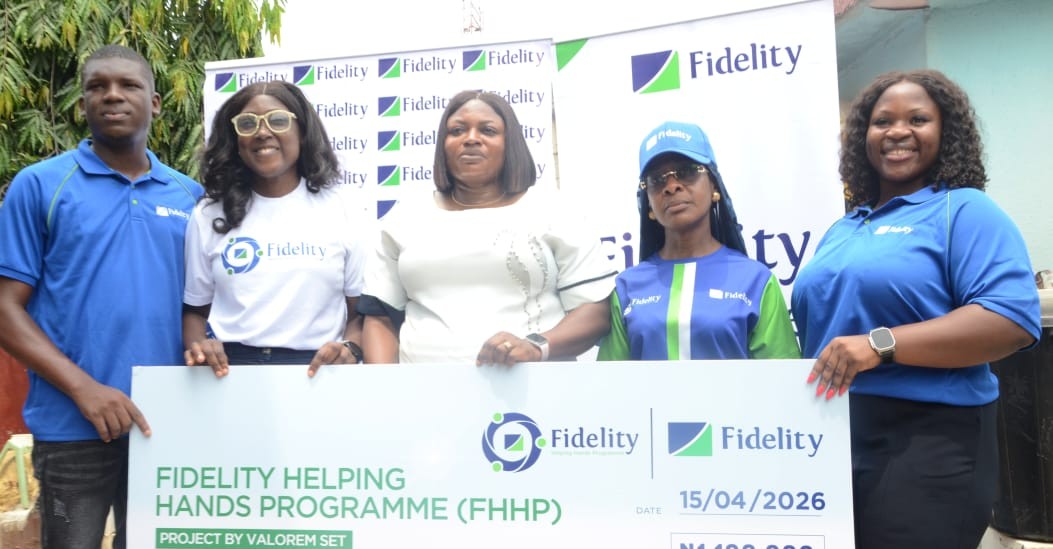
Fidelity Bank Provides Critical Funding Support to Abuja Special Needs Orphanage
Leading financial institution, Fidelity Bank Plc, through the Fidelity Helping Hands Programme (FHHP), has funded critical support for the JKS Special Needs Academy in Abuja to ensure continued shelter and care for vulnerable children.
The intervention was facilitated by a group of the bank’s newly recruited employees known as Team Valorem, as part of their induction activities. Through the FHHP, employees are empowered to actively contribute to social development by dedicating their time, resources and skills to impactful projects. Projects executed under the initiative are employee-driven, with teams encouraged to identify causes, contribute fifty percent of the project funding, while the bank matches the contribution.
Speaking during the outreach, Divisional Head, Brand and Communications Division, Fidelity Bank Plc, Dr Meksley Nwagboh, highlighted that the initiative aligns with the Bank’s CSR pillars focused on health & social welfare, and youth empowerment.
“This intervention reflects our belief that building a better society is a shared responsibility. Through the Fidelity Helping Hands Programme, we empower our employees to actively contribute to meaningful social causes. The funding provided will secure the orphanage’s accommodation for an additional year, ensuring a stable and safe environment for the children. This support guarantees that these children continue to have a place they can call home,” Nwagboh remarked.
He also commended caregivers at the facility for their dedication and called for increased focus on empowerment and skill development for children with special needs.
“Beyond providing basic needs, we must provide these children with opportunities to develop skills and become self-reliant. Everyone, regardless of their physical or socio-economic status, has a role to play in the society,” he said.
In her response, Director of JKS Special Needs Academy, Mrs. Nifemi Ajileye, expressed deep appreciation to Fidelity Bank and its staff for the timely intervention.
“We are truly grateful to Fidelity Bank for this support. It will significantly improve the welfare of the children under our care and help us sustain our operations,” she said.
Ajileye highlighted the high cost of caring for children with disabilities, stating that, “Many of the children require continuous medical attention and therapy, which are quite expensive. Support like this helps us bridge critical gaps and continue delivering quality care. This support from Fidelity Bank is timely and it means the world to us and to these children. It will help us continue our work and secure a better future for them,” she added, while calling for sustained support from other organisations.
As an institution with a heart for people, Fidelity Bank continues to demonstrate its commitment to social responsibility by driving inclusive growth and social impact through initiatives that empower communities and improve lives across Nigeria.
Ranked among the best banks in Nigeria, Fidelity Bank Plc is a full-fledged Commercial Deposit Money Bank serving over 10 million customers through digital banking channels, its 255 business offices in Nigeria and United Kingdom subsidiary, FidBank UK.
The Bank is a recipient of multiple local and international Awards, including the 2024 Excellence in Digital Transformation & MSME Banking Award by BusinessDay Banks and Financial Institutions (BAFI) Awards; the 2024 Most Innovative Mobile Banking Application award for its Fidelity Mobile App by Global Business Outlook, and the 2024 Most Innovative Investment Banking Service Provider award by Global Brands Magazine. Additionally, the Bank was recognized as the Best Bank for SMEs in Nigeria by the Euromoney Awards for Excellence and as the Export Financing Bank of the Year by the BusinessDay Banks and Financial Institutions (BAFI) Awards.
Business
Official waste of government resources and national wealth, group slams NNPCL GMD over MOU with Chinese firm to revive dead refineries*
*Official waste of government resources and national wealth, group slams NNPCL GMD over MOU with Chinese firm to revive dead refineries*
*…demands accountability into past investment of $1 billion into the refineries*
A coalition of oil sector reform advocates has criticised the latest agreement by the Nigerian National Petroleum Company (NNPC) Limited with Chinese firms to revive Nigeria’s refineries, describing the move as a wasteful recycling of failed strategies and a troubling signal of weak accountability in the management of public resources.
The group, the Centre for Energy Sector Transparency (CEST), made its position known in a statement issued on Wednesday and signed by its executive director, Dr Oghenetega Edafe, following the announcement of a new memorandum of understanding between NNPC Ltd and two Chinese companies for a proposed technical equity partnership.
The agreement is aimed at completing rehabilitation work and restarting operations at the Port Harcourt and Warri refineries, assets that have remained largely dormant despite multiple rounds of government-funded turnaround maintenance.
Edafe said the development raises serious questions about fiscal discipline, policy coherence, and the absence of accountability for previous investments running into billions of dollars.
“What Nigerians are witnessing is a troubling pattern of policy repetition without reflection. The same refineries that have gulped enormous public funds over the years are once again at the centre of a fresh round of agreements, yet there has been no transparent accounting of what has already been spent or why those investments failed to deliver results,” he said.
The group specifically referenced earlier government approvals of over $1 billion for refinery rehabilitation projects, warning that proceeding with new partnerships without a public audit of past expenditures undermines trust in the system.
“It is unacceptable that after committing over one billion dollars to refinery rehabilitation, the nation is being asked to embrace yet another agreement without a clear and verifiable audit of previous interventions. This is not just about policy failure; it is about the potential erosion of public trust in how national wealth is managed,” Edafe said.
He argued that while the introduction of a technical equity model may appear innovative, it does not absolve the government and NNPC Ltd of responsibility for past inefficiencies and possible mismanagement.
“The idea of bringing in technical partners with equity stakes is not inherently flawed. However, it becomes deeply problematic when it is introduced as a substitute for accountability. Before we speak of new partnerships, Nigerians deserve a full disclosure of how past funds were utilised, who was responsible for project delivery, and why the expected outcomes were not achieved,” he said.
The group also warned that without institutional reforms, the proposed collaboration risks becoming another cycle of investment without sustainable results.
“What is being presented as a strategic shift may, in reality, become another expensive experiment if the underlying governance issues are not addressed. Technical expertise alone cannot fix a system that lacks transparency, oversight, and consequences for failure,” Edafe said.
The Centre called on the National Assembly and relevant anti-corruption agencies to initiate a comprehensive probe of refinery rehabilitation projects over the past decade, including contract awards, disbursements, and project execution timelines.
“This moment demands more than optimism; it demands scrutiny. We call on oversight institutions like the National Assembly, Economic and Financial Crimes Commission (EFCC) and others to undertake a forensic examination of all funds committed to refinery rehabilitation, including the recent billion-dollar interventions. Nigerians must know what has been done with their resources and why the country is still dependent on fuel imports despite repeated promises of self-sufficiency,” he said.
The Centre added that restoring confidence in Nigeria’s oil sector would require not just new agreements, but a demonstrable commitment to transparency, accountability, and institutional integrity.
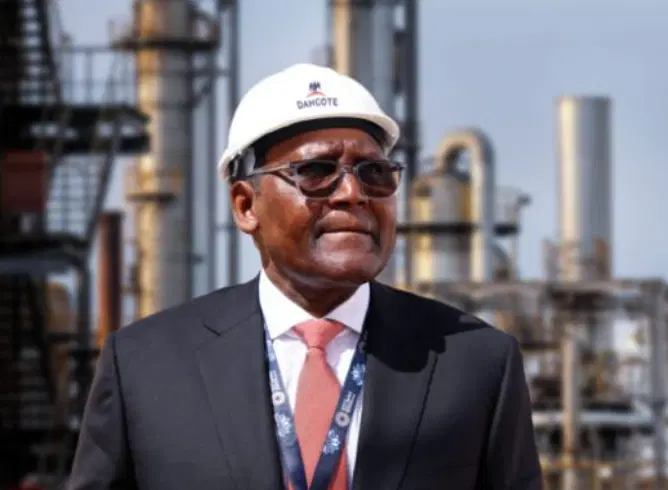
FUEL PRICE INCREASE: Dangote Refinery says ex‑depot price remains unchanged


- Rhino Resources Joins African Energy Week (AEW) as Gold Sponsor as Southern African Exploration Expands May 8, 2026
- Levene Energy Joins African Energy Week (AEW) as Gold Sponsor Amid Regional Expansion and Market Diversification May 8, 2026
- Gas Supply in the Age of Artificial Intelligence (AI): Can Africa’s Natural Gas Power the Continent’s Digital Future? May 8, 2026
- Merck Foundation and African First Ladies are Making History in Africa by Training the First Oncologists and Cancer Care teams in their Countries May 8, 2026
- Seychelles participates in United Nations Educational, Scientific and Cultural Organization (UNESCO) forum marking the International Day for Small Island Developing States May 8, 2026
- African Petroleum Producers Organization (APPO) Secretary General Ghezali to Address African Energy Week (AEW) 2026 as African Energy Bank Nears Launch May 8, 2026
- Petralon Energy Scales Dawes Island Output, Joins African Energy Week (AEW) 2026 as Diamond Sponsor May 8, 2026
- Giving Thanks for a Year of Petrine Service: Message to His Holiness Pope Leo XIV May 8, 2026
- Targeting 250,000 bpd by 2030, First Exploration & Petroleum Development Company (First E&P) Joins African Energy Week (AEW) 2026 as Diamond Sponsor May 8, 2026
- From Artificial Intelligence (AI) to project profiles: ESI Africa has the stories to balance opinions May 8, 2026
- Rhino Resources Joins African Energy Week (AEW) as Gold Sponsor as Southern African Exploration Expands May 8, 2026
- Levene Energy Joins African Energy Week (AEW) as Gold Sponsor Amid Regional Expansion and Market Diversification May 8, 2026
- Gas Supply in the Age of Artificial Intelligence (AI): Can Africa’s Natural Gas Power the Continent’s Digital Future? May 8, 2026
- Merck Foundation and African First Ladies are Making History in Africa by Training the First Oncologists and Cancer Care teams in their Countries May 8, 2026
- Seychelles participates in United Nations Educational, Scientific and Cultural Organization (UNESCO) forum marking the International Day for Small Island Developing States May 8, 2026
- African Petroleum Producers Organization (APPO) Secretary General Ghezali to Address African Energy Week (AEW) 2026 as African Energy Bank Nears Launch May 8, 2026
- Petralon Energy Scales Dawes Island Output, Joins African Energy Week (AEW) 2026 as Diamond Sponsor May 8, 2026
-

 news5 months ago
WHO REALLY OWNS MONIEPOINT? The $290 Million Deal That Sold Nigeria’s Top Fintech to Foreign Interests
-

 society5 days ago
SOCIAL MEDIA IS NOT A BATTLEFIELD COMMAND – WHY THE NIGERIAN ARMY’S ACTION AGAINST JUSTICE CRACK IS A NATIONAL SECURITY IMPERATIVE
-

 celebrity radar - gossips3 months ago
Dr. Chris Okafor Returns with Power and Fire of the Spirit -Mounts Grace Nation Altar with Fresh Anointing and Restoration Grace on February 1, 2026
-

 celebrity radar - gossips5 months ago
Prophet Kingsley Aitafo Releases 2026 Prophecy: ‘Nigeria Will Rise, but the World Must Prepare for Turbulence’
You must be logged in to post a comment Login
You must log in to post a comment.