
society
Insecurity in the Northwest: Tinubu’s Visit Raises More Questions Than Answers Written and Compiled


Insecurity in the Northwest: Tinubu’s Visit Raises More Questions Than Answers
Written and Compiled by George Omagbemi Sylvester | Sahara Weekly Nigeria
Context: Northwest Insecurity Landscape
Banditry crisis scale: Northwest Nigeria, especially Katsina, has been battered by bandits for over a decade. By late 2022, the conflict displaced more than 1.08 million people in rural areas of the region
Human toll: In Tinubu’s first two years (May 2023–May 2025), Amnesty International estimates over 10,200 civilians were killed across Nigeria in attacks by gunmen, including bandits
Continued carnage: Between April 2025 alone, rural violence in northern states claimed more than 150 lives, with thousands displaced and some of these attacks directly tied to bandit gangs
Bandit strength: There are believed to be around 30,000 bandits, operating in groups of tens to hundreds, using AK rifles and motorbikes for mass kidnappings, raids, terror tactics
1. Silence and Insensitivity
My question: What is President Tinubu doing in Katsina without a minute of silence, prayer or empathy for the bandit victims?
Reality check:
Tinubu attended a high-profile wedding in Katsina without any public act of mourning or memorial service for victims, a glaring oversight in a state still grieving mass abductions and killings.
Even Katsina’s traditional forums, such as elders from July 2024, publicly demanded more visible empathy and action, urging the President to re‑jig his cabinet and mount “Jungle Battalions” to defend the region
Takeaway: The optics of visiting in celebration while ignoring public mourning smack of a tone-deaf approach to widespread trauma, indicative of misplaced priorities.
2. Troops & Weaponry Deployment
My question: If not empty words of assurance, how many troops and weapons has Tinubu newly deployed?
Official statements and reality on the ground
In October 2024, Tinubu directed an intensified military push in Zamfara and the Northwest under Operation Fansan Yamma, urging the Defence Minister to “eradicate insecurity”
Recent military press claims include neutralizing notorious local kingpins like Kamilu Buzar, intensifying patrols in Katsina and rescuing kidnapped victims
Through 2024, the military reported killing 65 militia leaders, nearly 1,937 militants, arresting 2,782 suspects, and rescuing 1,854 hostages
Defence Chief Gen. Christopher Musa publicly proposed border fencing on June 3, 2025, but this remains a suggestion not an on‑the‑ground deployment
The gaps:
Tinubu has not published exact figures on how many new troops or weapons have been sent specifically to Katsina.
Security incidents (mass abductions, killings, displacement) continue unabated as of May 2025
Takeaway: Though military claims exist, no transparent data show a significant increase in boots or arms specifically pledged or delivered to Katsina.
3. Governor’s Pleas for Victims
My question: Has Katsina’s governor informed Tinubu about the plight of displaced victims; the loss of homes, farmlands, communities?
What we know
Katsina elders raised alarms in July 2024, urging Tinubu to prioritize food security and community roots which many victims have lost farmland and cannot afford meals
Tinubu’s May 2, 2025 visit featured agricultural mechanization projects (500 tractors and solar irrigation) aimed at boosting productivity
However, farmers publicly condemned this as “Bandits still control farmlands. No project succeeds without safety first.”
There is no record or public transcript showing the governor formally pleading for displaced victims, nor any federal response tied to those specific grievances.
Takeaway: While agricultural aid was discussed, no concrete federal plan to restore victims’ lives has been shared, leaving conversations confined to lofty speeches.
4. Why Only Katsina?
My question: Why did Tinubu visit only Katsina, rather than the entire Northwest region also besieged?
Focus and optics
Katsina is Tinubu’s home state, giving it symbolic and political weight and thus it became the only stop in the multi-state Northwest.
Victims and analysts argue this political calculation overshadowed other crisis zones like Zamfara, Sokoto and Kaduna.
On regional approach
In October 2024, the federal government ordered troops across the Northwest, including in Zamfara
Yet as of spring 2025 there was no evidence of Tinubu undertaking a coordinated regional tour to assess and address insecurity across the West-North zone.
Takeaway: The trip seems calibrate for political symbolism not an honest, regional intervention to map needs or coordinate cross-border operations.
5. Plans for the Northwest
My question: What are Tinubu’s actual plans for the Northwest region?
Public policies vs. implementation
Military offensives & intelligence reforms:
Bagged “Operation Fansan Yamma” and tighter coordination among defense and security agencies at the President’s behest
Measures include new military leadership and deploying resources to known hotspots, with claims of disrupting leadership of terror networks.
Border fencing proposal:
In June 2025, defence chiefs called for fencing Nigeria’s northern frontiers to stop infiltrations
However, no budget or timeframe is attached.
Agricultural revival:
The Katsina mechanization rollout is part of Tinubu’s larger emergency food security plan to stabilize food production, but these focus on crop yield, not security-for-food.
Security task force deployment:
Across 2024–25, Nigeria posted enhanced Joint Task Force activities, with claims of hundreds killed, criminals arrested and hostages freed.
Reality vs. rhetoric
Despite claimed gains, insecurity persists as evidenced by high death tolls in April 2025.
Reports of military collusion, such as soldiers allegedly aiding bandits in Katsina, surfaced on local media and social platforms just weeks ago, casting doubts on effectiveness.
Experts argue that military reinforcement alone is insufficient; reforms must include grazing policies, community policing, local intelligence reforms and socio-economic revival.
Takeaway: Tinubu’s approach skews toward military-first, highly centralized tactics, with no transparent blueprint for comprehensive socio-economic and local-focused anti-instability strategy.
📌 Summary Table
Question Reality & Analysis
1. Public empathy during visit? No signs of mourning or condolences; criticised by elders.
2. Troops & weapon deployment? General, unquantified deployment; claims of some success, but lacking clarity on new reinforcements specific to Katsina.
3. Governor’s pleas for victims? While state officials asked for more, no documented federal interventions for victims’ restitution.
4. Why only visit Katsina? Politically symbolic, neglecting crisis-wide coordination.
5. Northwest-wide plans? Military operations ongoing; border fencing still proposal; socioeconomic tactics disconnected from public security needs.
🔥 Implications & Strengthening the Argument
Tinubu prioritizes optics over accountability.
A celebration in a region still traumatized showcases shallow political gesture, empathy is missing from messaging.
Security claims lack transparency.
We hear troop-neutral count, not troop deployment. Without numbers or independent verification, it’s impossible to evaluate effectiveness.
Holistic policy absent.
Despite increased budgets and rhetoric, insecurity is growing, a sign that military solutions alone do not tackle root causes like displacement, livelihood collapse and weak governance.
Victims sidelined.
There’s no federal program to rehabilitate victims, rebuild infrastructure or return victims to their ancestral farmlands even though displacement continues at mass levels
Calls for reform ignored.
Voices from Katsina elders and analysts recommend JCM battalions, grazing reserves, intelligence reform and border security. Tinubu hasn’t adopted these in policy or budget.
🏛️ Final Analysis: Empty Promises?
In somber truth, President Tinubu’s trip to Katsina, replete with mechanization announcements but absent public grief, comes across as barely more than political theater. The mounting death toll, unabated kidnappings and economic dislocation are wildly out of sync with Tinubu’s upbeat claims of “improvement.”
What the people of Katsina (and indeed the wider Northwest) need is not glossy hometown visits or tractor fanfare.
They need:
Real troop numbers, logistics and weapons, verifiable on the ground.
A victim-restoration program like housing, farmland rehabilitation, compensation.
Community-engaged security architecture: local policing, grazing policies, intelligence sharing.
A regional strategy, not disjointed state visits, ensuring patterns of violence are addressed across borders and states.
Until these are visible, Tinubu’s hope‑offering words to grieving families remain, regrettably, wishful thinking.





society
GEN CHRISTOPHER GWABIN MUSA SUPPORT INITIATIVE EXTENDS WARM BIRTHDAY FELICITATIONS TO PRESIDENT TINUBU ON 74TH BIRTHDAY
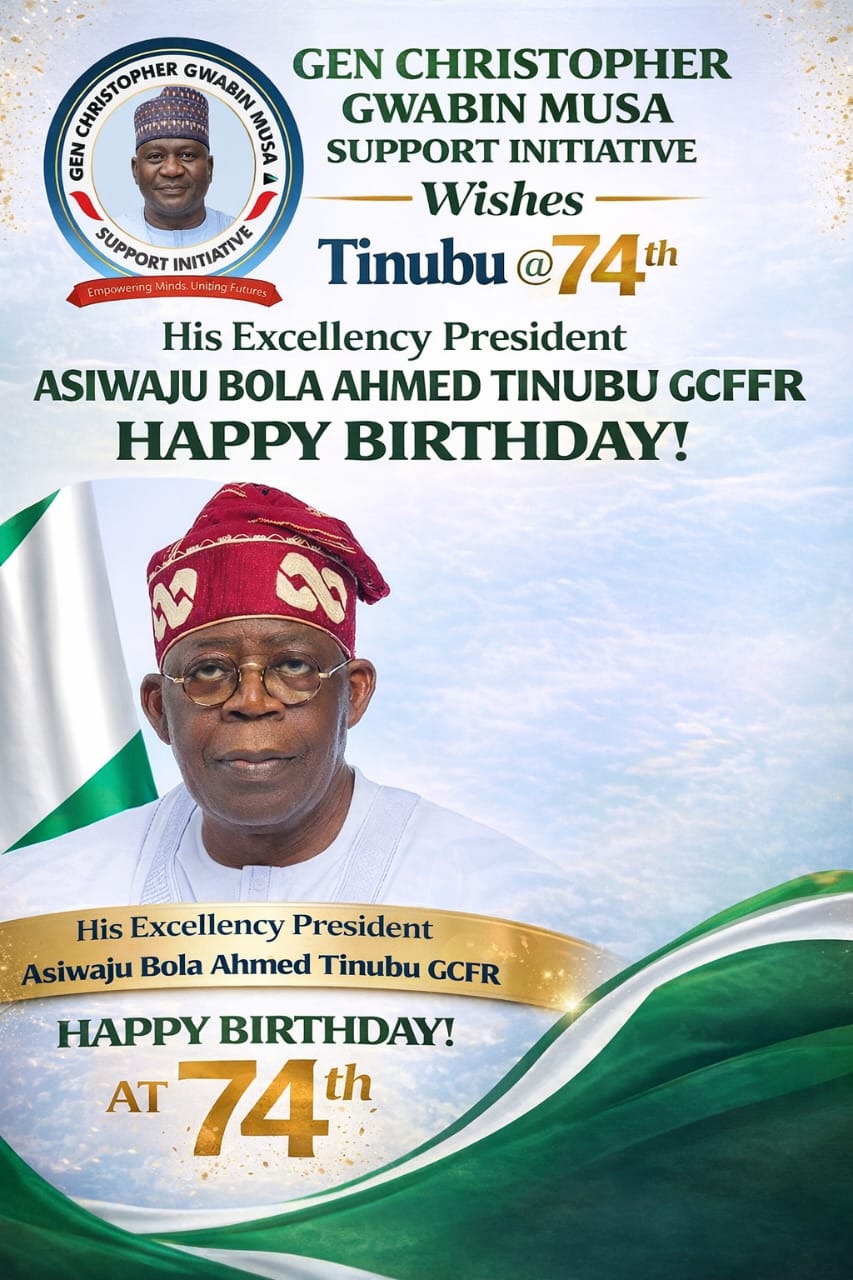
GEN CHRISTOPHER GWABIN MUSA SUPPORT INITIATIVE EXTENDS WARM BIRTHDAY FELICITATIONS TO PRESIDENT TINUBU ON 74TH BIRTHDAY
The Gen Christopher Gwabin Musa Support Initiative has extended heartfelt congratulations to His Excellency President Asiwaju Bola Ahmed Tinubu, GCFR, on the occasion of his 74th birthday.
In a statement released to the press, the Initiative conveyed warm wishes for the President’s personal well-being and for his continued leadership of the nation. The statement, signed by the Convener, Ibrahim Dahiru Danfulani, Sadaukin Garkuwan Keffi/Betara Biu, expressed hope that the coming year would bring the President “renewed strength and more wisdom in guiding the nation.”
The statement further noted that the Grand Patron of the Initiative, His Excellency Gen Christopher Gwabin Musa, OFR, Minister of Defence of the Federal Republic of Nigeria, joined in celebrating the milestone. It added, “Wishing Your Excellency continued good health, vitality, and determination as you lead the country towards greater unity and progress.”
The message underscores support for President Tinubu’s administration and its national objectives, marking the birthday as an occasion to reaffirm commitment to the nation’s unity and advancement under his stewardship.
society
Dominion City to Host Global Camp Meeting, “2 Nights of Glory” 2026 in Lagos, Enugu …Calls for Moral Renewal
*Dominion City to Host Global Camp Meeting, “2 Nights of Glory” 2026 in Lagos, Enugu
…Calls for Moral Renewal
Lagos – Dominion City has announced plans to host its annual Global Camp Meeting alongside a special “2 Nights of Glory” gathering in April 2026, with events scheduled to be held simultaneously in Lagos and Enugu.
The week-long programme is expected to draw tens of thousands of participants onsite and millions of virtual attendees from across the globe.
The Global Camp Meeting will run from Wednesday, April 1 to Monday, April 6, featuring daily sessions at 8:00 a.m. and 5:00 p.m. The “2 Nights of Glory” is slated for Friday, April 3 and Saturday, April 4 at the Golden Heart Place, Km 22 Lekki-Epe Expressway, beside Lagos Business School, Ajah, Lagos.
Organised by Dominion City, a global church focused on raising transformational leaders, the conference will centre on revival, spiritual renewal, and practical teachings. This year’s theme, “Redigging the Wells of Our Fathers,” underscores a call to return to foundational values and principles.
Speaking ahead of the event, Nobbert Onaga, President, Golden Heart Foundation and Senior Pastor, DC Lagos & Europe, emphasised the need for moral reawakening as a pathway to national transformation. He described the Church as “the pillar and foundation of truth,” noting that the conference aims to confront moral decline and restore core values within society.
“We are going back to foundational truths that established the Church. These truths will help repair societal damage and reposition the Church as a source of hope and light,” Onaga said.
Also speaking, Shola Olapade, Senior Pastor of Dominion City Headquarters, highlighted the Church’s role in addressing ethical and cultural challenges, particularly among young people. He added that the programme would go beyond spiritual teachings to include sessions on artificial intelligence, innovation, business, media, arts, and career development.
“We are equipping people not just spiritually, but with relevant 21st-century skills to thrive in today’s world,” Olapade noted.
The conference will feature teachings and ministrations from a lineup of international ministers, including Dr. David Ogbueli, Dr. Charles Ndifon, Andres Bisonni, Pastor Randy Mitchell, Apostle Ikechukwu Peter Nnajiofor, Dr. Ferdinand Nweke, Apostle Ben Hanyani Ndobe, Evangelist Dan Scott, and Dr. Chiefo Ejiofobiri.
Music ministrations will also be led by notable gospel artists such as Grace Idowu, Rhema Onuoha, Once More Six, David Nkennor, Anthony Kani, and GUC.
Organisers disclosed that over 30,000 participants are expected to attend in person, with free transportation provided from designated locations across Lagos to ease access. In addition, free medical services will be offered daily, building on previous outreaches that benefited over 1,700 people.
To ensure safety and order, more than 200 traffic marshals will be deployed in collaboration with relevant authorities.
Beyond its spiritual impact, organisers project that the event will stimulate local economic activity across hospitality, transportation, and retail sectors.
The Global Camp Meeting remains a key platform for spiritual impartation, leadership development, and societal transformation, aligning with Dominion City’s mission to equip believers to influence their communities positively.
Participation is open to the public, with registration available online for both physical and virtual attendance. //END.//
*PHOTO CAPTIONS:*
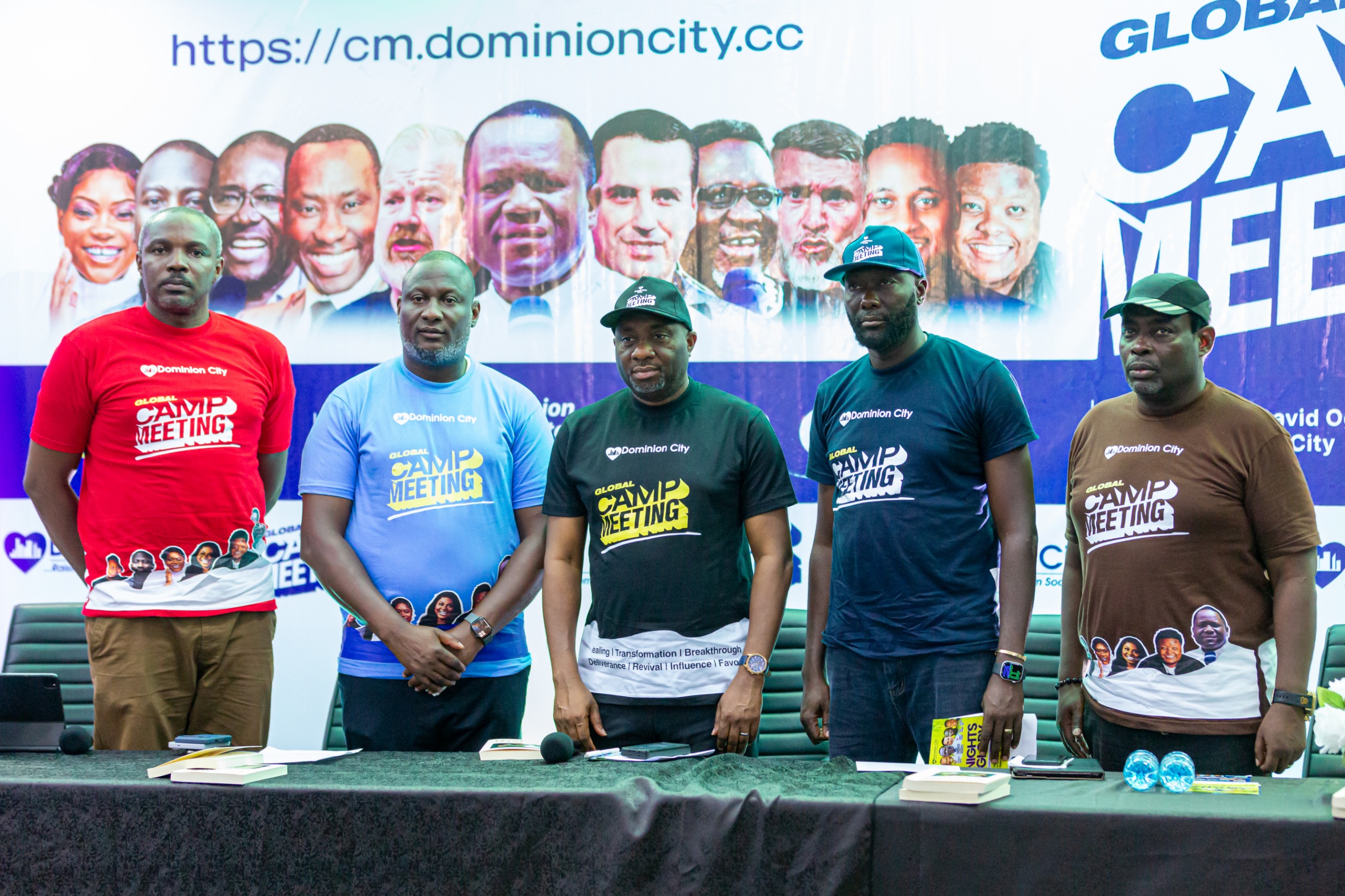
L-R: Dr. Godwin Efobi, Head, Medical Team, Dominion City Headquarters (DCHQ); Pastor Shola Olapade, Senior Pastor, DCHQ; Pastor Nobbert Onaga, President, Golden Heart Foundation and Senior Pastor, DC Lagos & Europe; Pastor Chuks Anochie, Head of Security and Traffic Control, Dominion City Headquarters (DCHQ), Camp Meeting 2026; Pastor Josh Tim Vaduchi, Head of Event & Programmes, DCHQ, during the press briefing of the forthcoming Global Camp Meeting, held the weekend of 2026 at the Dominion City Headquarters (DCHQ), Lagos.
L-R: Pastor Chuks Anochie, Head of Security and Traffic Control, Dominion City Headquarters (DCHQ), Camp Meeting 2026; Pastor Shola Olapade, Senior Pastor, DCHQ; Pastor Nobbert Onaga, President, Golden Heart Foundation and Senior Pastor, DC Lagos & Europe; Dr. Godwin Efobi, Head, Medical Team, DCHQ; and Pastor Josh Tim Vaduchi, Head of Event & Programmes, during the press briefing of the forthcoming Global Camp Meeting, held over the weekend in 2026 at the Dominion City Headquarters (DCHQ), Lagos.
society
Oloworo of Oworosoki Kingdom, Oba Babatunde Saliu, Felicitates President Bola Ahmed Tinubu at 74
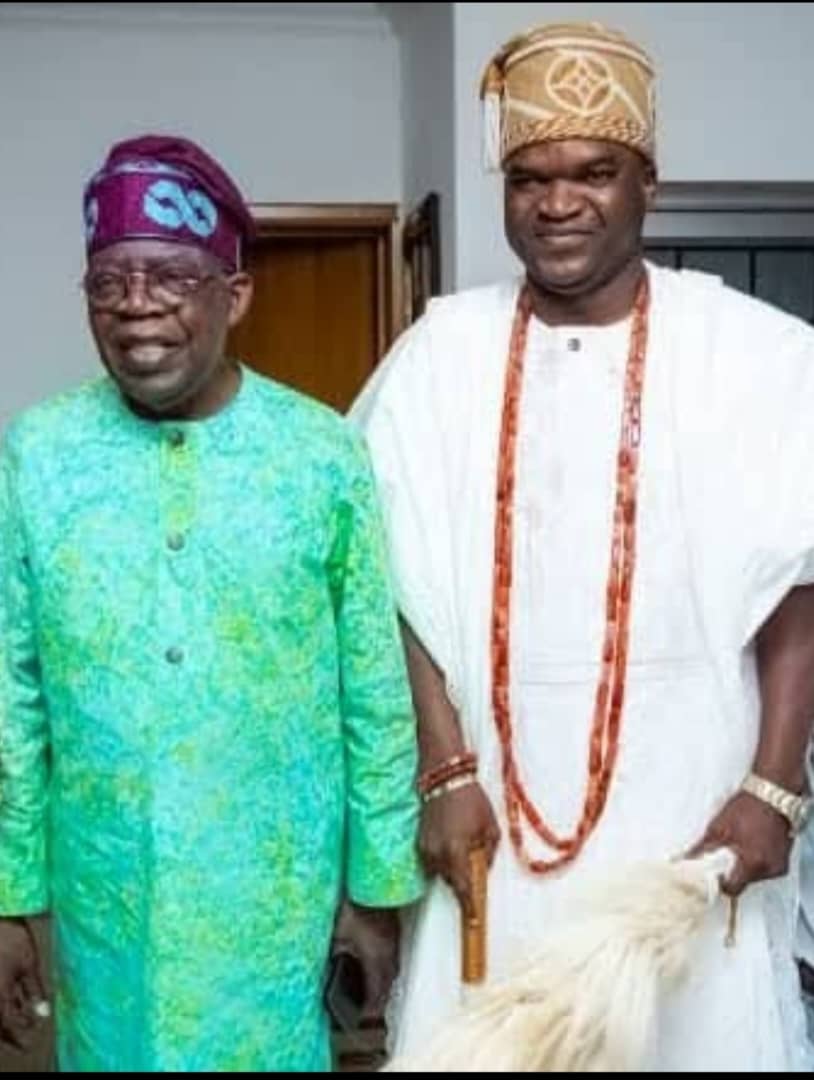
Oloworo of Oworosoki Kingdom, Oba Babatunde Saliu, Felicitates President Bola Ahmed Tinubu at 74
By Adeyemi Obadimu
The Oloworo of Oworosoki Kingdom, His Royal Majesty, Oba Babatunde Saliu, Elebo II, has extended warm felicitations to the President of the Federal Republic of Nigeria, Bola Ahmed Tinubu, GCFR, on the occasion of his 74th birthday.
In a goodwill message issued from his palace, the revered monarch described President Tinubu as a visionary statesman, a courageous reformer, and an indefatigable democrat whose lifelong commitment to nation-building continues to shape Nigeria’s progress.
Oba Babatunde Saliu praised the President’s unwavering dedication to public service, noting that his leadership has ushered in a new phase of economic reform, infrastructural renewal, and institutional strengthening across the country.
According to the monarch, the President’s Renewed Hope Agenda has begun yielding tangible relief and renewed confidence among citizens, reflecting his determination to reposition Nigeria for sustainable growth and prosperity.
“President Bola Ahmed Tinubu has demonstrated exceptional resilience, strategic foresight, and a deep love for Nigeria. His administration’s bold initiatives are laying the foundation for long-term national transformation. At 74, he remains steadfast in his resolve to build a stronger, more united, and economically vibrant nation,” the monarch stated.
Oba Babatunde further commended the President’s legacy of leadership, describing him as a bridge-builder, a mentor to many leaders, and a symbol of democratic stability. He acknowledged the President’s decades of sacrifice and contribution to the advancement of democracy in Nigeria.
On behalf of the Oworosoki Kingdom, the royal father prayed for divine wisdom, sound health, and renewed strength for the President to successfully complete the noble reforms and developmental strides he has embarked upon for the benefit of all Nigerians.
“As Your Excellency marks 74 remarkable years, we pray that Almighty God grants you long life, continued wisdom, and the fortitude to steer our great nation toward greater heights. May your days be filled with strength and grace as you continue to serve Nigeria with distinction,” Oba Babatunde Saliu added.
President Bola Ahmed Tinubu clocks 74 as a leader whose enduring influence, bold reforms, and steadfast patriotism remain central to Nigeria’s ongoing journey of national renewal.


-

 society6 months ago
Religion: Africa’s Oldest Weapon of Enslavement and the Forgotten Truth
-

 news4 months ago
WHO REALLY OWNS MONIEPOINT? The $290 Million Deal That Sold Nigeria’s Top Fintech to Foreign Interests
-

 society6 months ago
“You Are Never Without Help” – Pastor Gebhardt Berndt Inspires Hope Through Empower Church (Video)
-

 celebrity radar - gossips2 months ago
Dr. Chris Okafor Returns with Power and Fire of the Spirit -Mounts Grace Nation Altar with Fresh Anointing and Restoration Grace on February 1, 2026