
celebrity radar - gossips
“Having Knowledge of The Bible Alone Doesn’t Make A Pastor” …Grace Christian Church’s Pastor Kunle Yusuf


Pastor Kunle Yusuf is the chief executive officer and lead consultant, Above Productions Company, a registered company that deals in event management, radio and television productions, sports marketing and public relations consultancy. A media and public relations practitioner of over eighteen years standing covering both print and electronic media, Pastor Kunle, in this interview, shares his life experience including his career and how he was called by God to spread the gospel. Excerpts…
You are a career person. Are you moving away from your job to run a full ministry?
The answer is quite simple. I am combining my career with ministry assignment. My desire had always been serving God and humanity. But it was difficult combining all this together in another man’s calling. You knew before now that I was serving as a Pastor in the Redeemed Christian Church of God, but not at optimum level. As a trained PR and media practitioner, it turned out somehow challenging combining both roles together. So, I started praying, asking God for directions. And answer finally came last year; hence my decision to start my full time ministry without cluttering my career path. After all, both are services to God and humanity.
What gifts and skills do one need to serve effectively as pastor and how well prepared are you?
The calling of God is without repentance. You must be sure of the calling of God before venturing into it. Part of the issues plaguing Christendom today was that too many people were ambitious but not really sensed the call of God before venturing out. And this is serious! You must attend medical school before calling you Doctor; attend Law school before being called a Barrister. Not exactly the same when we talk about spiritual issues. While your bible knowledge must be above average, that itself does not guarantee a successful calling as Pastor, Prophet, Bishop or any other ministerial callings. While not playing down the knowledge of the bible which is key; that itself is never enough. Talking about gifts and skills you must possess, I will say, maturity is very vital. You must be a mature Christian inside out. You must not be materialistic. You must ignore filthy lucre. Gift of oratory is never enough. You must be word-driven.
The calling is never a meal ticket.
When you received the calling, was there a specific area that God asked you to serve in?
The spirit of the Lord God is upon me; because the Lord has anointed me to preach good tidings unto the meek; he has sent me to bind up the broken-hearted, to proclaim liberty to the captives, and the opening of the prison to them that are bound. That is the mandate. To proclaim the acceptable year of the Lord, and the day of vengeance of our God; to comfort all that mourn. That is the mandate. To appoint unto them that mourn in Nigeria and abroad, to give unto them beauty for ashes; the oil of joy for mourning, the garment of praise for the spirit of heaviness; the planting of the Lord, that He might be glorified. That is the mandate.
Tell us some of your past experiences in the church that prepared you in leading your own ministry?
This would probably occupy a whole book. Though from a Muslim background, the deaths of my parents changed my outlook to life. That we are alive only is by the grace of God. I started out as a Cell leader; later youth pastor and after marriage, Pastor in the Redeemed Christian Church of God. I had met and dealt with Pastors with different characters. Some were good; some to the extreme. Few experiences hurt more than learning that someone you trust has lied to you. If you are devout, the effect could be profound, as it was for me in the beginning.
Your congregation is interested more in your leadership capabilities; how much are you prepared in winning your members’ confidence?
I think the most important confidence they would need from you is to exemplify Christ. When I started out as a church goer several years back, guess I was eighteen (18) years at the time, I was angry seeing the way things were. I felt I had been tricked, that my hopes and goals turned out to be futile. But I have learnt a great deal. You must look unto Jesus: the author and finisher of our faith. This way, you would never be shocked or surprised at your leaders’ character flaws, while not giving excuses to the ways of Pastors and church leaders, who frittered away the goodwill of their members. Truth is, focusing on Jesus, the head of the church is the way out.
What is your understanding of faith?
Faith is never a feeling. It is viewed in many ways, and thus discussion of one’s faith may be difficult without first pinning down which meaning we are talking about. Faith could mean allegiance to duty or person. It could mean firm belief in something for which there is no proof. For me, understanding faith, I always put it in terms of a relationship. When we speak about biblical faith, that I am disposed to, we are speaking in terms of having faith, trusting, based upon relationship with God through His son, Jesus. With that in mind, Hebrews 11:1-2 do come in. Faith believes even when it makes no sense to believe, not because of the proof before you , but because of the trust you placed in the object of your faith. Biblical faith is in a person, the person of God, ( God the father, son and Holy Spirit) they are one. Faith is never in me or my abilities but on God and His abilities.
What is your honest position on tithing and what is it that you are going to do differently that will stand you out as a church leader?
Like every good deed, Satan, through the enemies of the gospel, is waging war against tithing. The bible says, ‘I will build my church, and the enemies will never prevail against it’. What this means therefore is there is quarrelling or struggling with the church, but the enemies will never have the final say. That is they will never prevail against it. The truth is: tithing predates Jesus Christ. Despite the fact that many people used the word ‘tithe’ synonymously with any church-related giving. The word tithe literally means “tenth”. Tithe was an obligatory offering from Mosaic law requiring 10 percent of an Israelite’s first fruits. However, a note of caution must be observed: only pay up tithe where you are getting blessed and you are sure the place is a fertile soil.
Share with us your journalism years and academic achievements.
I was a senior correspondent and entertainment writer with Nigerian Tribune from where I later functioned as contributing editor at Society Post, a weekly magazine. Between 2011 and 2012, I worked as the marketing consultant at Unique FM, Ilesa, Osun State. I was the general manager of Breakthrough Television Services Limited, where I produced highly successful programmes such as ‘Check It Out’, a live TV programme on Galaxy TV; ‘Weekend Delight’ on NTA Port Harcourt, Rivers State Television (RSTV); ‘Sports Circuit’ on LTV 8, Lagos, and several others. I was once an associate producer of ‘Child & Society’ on Nigerian Television Authority, NTA 2 Channel 5. Currently, I work as the editor, ‘Straight Times’ magazine, based in Ibadan. For my academic, I hold a National Diploma in Mass Communication; Bsc. Degree in Public Administration and Masters Degree (Distinction) in Communication Studies from the Lagos State University. I obtained post graduate Diploma in Theology from the Redeemed Christian Bible College, Main Campus. I’m a member of the Nigerian Institute of Public Relations (NIPR), where I serve as part time lecturer while I’m the former secretary general of the Entertainment Writers Association Of Nigeria, Oyo State Chapter.
Tell us about your business outfit and how far you have spread.
Above Productions Company is a registered company with Corporate Affairs Commission. We are event managers, radio and television producers, sports marketers and public relations consultants. We produce ‘Entertainment Plus’, a highly successful programme on several television stations in Nigeria. We have extensive experience on event activation and public relations consultancy. We also produce ‘Family Line’, a radio programme on Premier FM, Ibadan, and other stations. We enjoy, by the grace of God, patronage from Nigerian Breweries PLC, Universal Mccan, MindShare Lagos, Unilever PLC, and Insight Communications, etc.
Tell us about your family and how is your new vocation going to impact them?
I’m a young man with budding passion to serve the Lord. I am happily married to Pastor (Mrs.) Motunrayo Olakunle. For now, we are blessed with three wonderful and God-fearing boys; David, Daniel and Samuel. Like their parents, they don’t joke with their faith. I’m a voracious reader and this, they pick from me. My wife is a trained teacher with first Degree in Economics Education. Telling them about my faith posed no problem as my wife was a minister in the church before we met. She did give birth to our children as a Pastor’s wife.
The church’s relationship with the state, how should it be?
Jesus commands to ‘render unto Caesar what is Caesar’s, and unto God the things that are God’s. The relationship must be mutual. Note that religious organizations helped many countries to draft their new constitutions. In countries like Benin, Congo, Togo and DRC, religious leaders were asked to be speakers of parliament. In Togo for example, a Bishop acted as a speaker of parliament for two years and in Congo, a Bishop acted in the same capacity for almost four years. In Liberia, during the war, the head of the Lutheran church was asked to be the Vice President of the country while people were looking for ways to end the civil war. In Nigeria, the same is playing out as we do have as Vice President a Pastor. The church’s relationship with the state must be cordial so as to guarantee peaceful co-existence of citizens in the state.


celebrity radar - gossips
Adron Homes Celebrates Visionary Chairman, Aare Adetola Emmanuel King, at 51
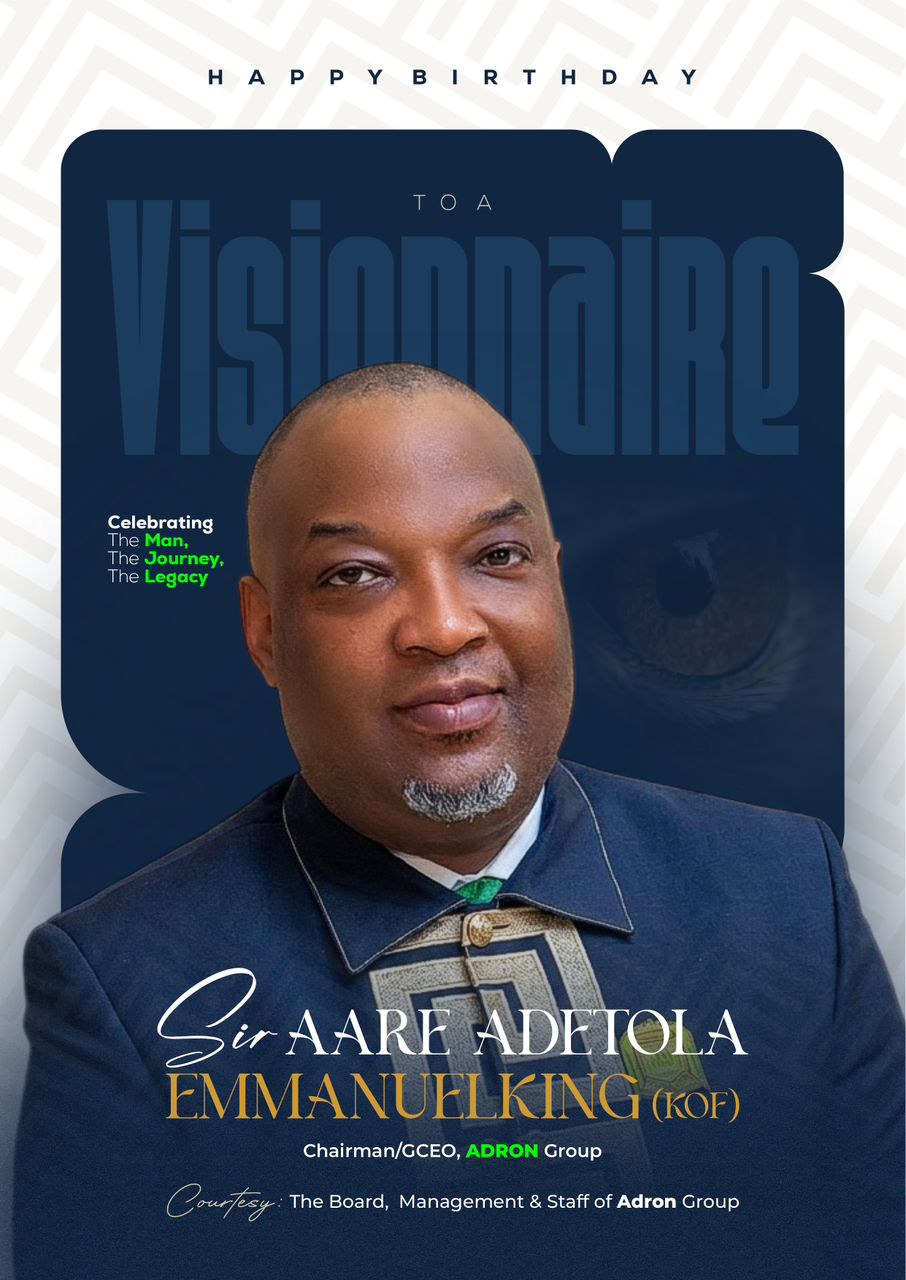
Adron Homes Celebrates Visionary Chairman, Aare Adetola Emmanuel King, at 51
The management and staff of Adron Homes and Properties Limited have joined family, friends, associates, and well-wishers across the globe to celebrate their Chairman and Chief Executive Officer, Aare Adetola EmmanuelKing, as he marks his 51st birthday.

In a statement released by the company, the milestone was described as a celebration of an exceptional leader whose vision, resilience, and entrepreneurial brilliance have not only transformed Adron Homes into a household name in Nigeria’s real estate sector but have also redefined affordable housing across the country.
Under his dynamic leadership, Adron Homes has continued to expand its footprint, delivering value-driven residential solutions while empowering thousands of Nigerians with opportunities for home ownership. His commitment to excellence, innovation, and customer satisfaction has remained the driving force behind the company’s sustained growth and industry leadership.
The statement further highlighted Aare EmmanuelKing’s passion for nation-building and community development, noting his significant contributions to job creation, youth empowerment, and the promotion of socio-economic development through real estate investments.
“As a leader, mentor, and visionary, Aare Adetola EmmanuelKing has consistently inspired a culture of excellence, integrity, and dedication within the organization. His ability to turn bold ideas into reality continues to position Adron Homes as a trailblazer in the industry,” the statement read.
The company expressed profound gratitude for his steadfast leadership and prayed for continued wisdom, strength, and sound health as he embarks on another year of impactful achievements.
As he celebrates his 51st birthday, the entire Adron Homes family proudly honours a man whose legacy continues to shape the future of real estate in Nigeria.
Happy 51st Birthday, Aare Adetola EmmanuelKing!

Oba Ara Releases Emotional Tribute to Late Taiwo Adegbodu
Taofik Afolabi
The gospel music community continues to grieve the painful loss of Taiwo Adegbodu, a beloved figure whose sudden departure left a deep void among fans, colleagues, and loved ones. In response to this loss, renowned gospel minister Rotimi Onimole, popularly known as Oba Ara, has released a moving tribute song that captures both the sorrow of the moment and the enduring legacy of the late singer.
Oba Ara, a proud son of Isale Eko, channels raw emotion throughout the song, using heartfelt lyrics and soul-stirring melodies to reflect on his personal connection with Taiwo Adegbodu. In the tribute, he openly expresses how deeply the news of Adegbodu’s passing shook him, describing it as a painful and unexpected loss that is difficult to come to terms with.
The song goes beyond mourning, it celebrates the life, ministry, and impact of Taiwo Adegbodu. Oba Ara highlights the late artist’s dedication to spreading the gospel through music, his inspiring voice, and the spiritual influence he had on many within and beyond Nigeria. Through powerful verses, he paints a picture of a man who lived for God and touched countless lives through his ministry.
Listeners have described the tribute as both comforting and deeply emotional, as it resonates with the collective grief of the gospel music community. It serves as a reminder that although Taiwo Adegbodu is no longer physically present, his music, message, and legacy will continue to live on.
In honoring his late colleague, Oba Ara not only pays his respects but also offers a source of healing for fans and fellow ministers, using music as a tool to process grief and celebrate a life well lived.
celebrity radar - gossips
Buratai, Fagbemi , Shagaya, Olofa, Others Eulogise Olowu Kuta’s Olori On 60th Birthday, Foundation Launch

Buratai, Fagbemi , Shagaya, Olofa, Others Eulogise Olowu Kuta’s Olori On 60th Birthday, Foundation Launch
Eminent personalities across the Nigeria stormed the TFK Event Centre, Bala Mohammed Way, Guzape, Abuja, to celebrate the 60th birthday of Olowu Kuta’s Olori, Queen Jumai Amoke and her Foundation Launch on Saturday 28, March 2026.

From former Chief of Army Staff, Lt Gen TY Buratai rtd, to the Minister of Justice and Attorney-General of the Federation, Prince Lateef Fagbemi; Olofa of Offa, HRM Oba Mufutau Gbadamosi. Even top businesswoman and socialite, Chief (Mrs) Bola Shagaya, was in attendance.


Other dignitaries were newly promoted Deputy Inspector-General of Police and former AIG Zone 2 , Lagos , Adegoke Fayoade, Major General Abdumalik, Major General Samuel Adebayo rtd (Fmr CDI);
Major General Anthony Omozoje rtd (Fmr Copp);
Alhaji Tajudeen Owoyemi (Asiwaju of Offa and CEO Radisson Hotel Nigeria;
Dr Waheed Olagunju, former managing director of Bank of Industry, Oniba of Iba, Lagos State, HRM Oba Dr Suleiman Raji ;
Justice Falola, Olu of Ile-Ogbo , Oba Adetoyese amongst many traditional rulers and captains of industry too numerous to mention.
Speaking at the occasion, the Chief Host, Olowu of Kuta, HRM Oba Dr Adekunle Oyelude Makama, CON , Tegbosun iii, who is also the husband of the celebrant commended Queen Jumai for ‘ her slender arms full of kindness’ to establish such humanitarian Foundation, ‘Amoke Children and mother in Need Foundation’ at a time Nigerians are going through economic crisis occassioned by the global meltdown.
Olowu also commended her steadfastness and love for the less privileged and downtrodden.
The monarch refrenced the task before his wife’s humanitarian gesture said her best is yet to come.
” Olori Amoke Jumai, I celebrate you. You will celebrate 70, 80, 90 and continue to shine as you continue to put a smile on people’s faces. I love you, “Olowu Kuta added.
To Lt Gen Buratai, a former army chief and former Nigerian Ambassador to Benin Republic, the reward of hard work is more work.
Buratai, who also doubles as Balogun Agba of Owu Kuta, a chieftaincy title reserved for a generalismo congratulated Queen Jumai for attaining the age of 60 in good health.
The retired army General said he’s not surprised by the turn out of eminent personalities across the country to celebrate the Olowu Kuta’s Olori because she merited it through her hospitality to all, adding that Allah the most merciful, most beneficial would accept all her act of ibadah.
The minister of Justice, Prince Fagbemi, was full of praises for Queen Jumai for deeming it fit to have a place in her heart to accommodate the needy and less privileged in ‘our society.’
Prince Fagbemi urged the guests to contribute generously to support the Foundation in order to continue to alleviate poverty and put a smile on the faces of the people.
” I congratulate you on your 60th birthday and Foundation Launch. I wish you many happy returns of the day and many more fruitful services to the country and motherland”, Prince Fagbemi added.
The celebrant, Queen Jumai who was grining from ear to ear thankfully said she was excited by the turn out and the response of the people to her foundation.
Queen Jumai, however, promised to continue to use her resources and donations received for the good of the needy and less privileged in the society.
” I want to appreciate my own Kabiesi Olofa of Offa , for his presence and im I’m using him as a point of contact to all other Kabiesis present here, the minister of justice and Attorney-General, you’re welcome, sir; Mrs Bola Shagaya, I salute your enterprise, Lt Gen Buratai, I’m grateful, sir; DIG Fayoade, Justice Falola and other dignitaries too numerous to mention, I thank you, all. To my darling husband, Kabiesi Olowu , I thank you immensely for your support. And to my family and friends, I thank you , all. E se pupo!”, she said.


-

 society6 months ago
Religion: Africa’s Oldest Weapon of Enslavement and the Forgotten Truth
-

 news4 months ago
WHO REALLY OWNS MONIEPOINT? The $290 Million Deal That Sold Nigeria’s Top Fintech to Foreign Interests
-

 society6 months ago
“You Are Never Without Help” – Pastor Gebhardt Berndt Inspires Hope Through Empower Church (Video)
-

 celebrity radar - gossips2 months ago
Dr. Chris Okafor Returns with Power and Fire of the Spirit -Mounts Grace Nation Altar with Fresh Anointing and Restoration Grace on February 1, 2026
You must be logged in to post a comment Login
You must log in to post a comment.