
society
KOMOLAFE’S ENDURING LEGACIES IN GLOBAL OIL REFORMS


*KOMOLAFE’S ENDURING LEGACIES IN GLOBAL OIL REFORMS
By Charles Matthew
The name Engineer Gbenga Komolafe keeps resonating with technical precision, depth of influence, and administrative innovation in the growing narrative of Africa’s quest for sustainable development and global relevance within the petroleum ecosystem. As the Chief Executive of the Nigerian Upstream Petroleum Regulatory Commission (NUPRC), his emergence as a central figure in today’s global energy reforms stems from dedicated years of institutional knowledge, regulatory rectitude, and unassailable patriotism.
It is no surprise that the Nigeria of today has repositioned itself prominently on the global energy map under the Renewed Hope Agenda of President Tinubu.
The recognition the Pan-African Parliament bestowed upon him in a recent session was not an act of vain appraisal, but the formal acknowledgment of a man who has become an intellectual lighthouse guiding the continent through a complex energy transition era.
When AFRIPERF identified him as a competent individual sufficiently equipped both in moral stature and technical acumen to pilot Africa’s unified policy direction for sustainable energy frameworks, it was a welcoming announcement greeted by ovation in consensus across academic and diplomatic circles.
When he strode through the grand halls of the House of Lords in London, within the Palace of Westminster in the United Kingdom, to receive the Global Sustainable Leadership Award at the 2025 Global Sustainable Education and Leadership (G-SEL) Conference and a professional doctorate in Leadership (Energy Law) from the International Business School of Scandinavia, the ovation of his recognition was for Nigeria as a whole.
The world was recognizing a reform-driven and technically grounded confident Nigerian voice.
This is happening at a time when some voices in the international space attempt to distort Nigeria’s true narrative by amplifying negative perceptions while ignoring the quiet but powerful work of reformers who are reconstructing governance institutions.
While the media is flooded with President Trump’s broad and dismissive remarks about Nigeria, Komolafe’s strides and those of several distinguished Nigerians demonstrate a different reality that speaks volumes of economic recalibration, international cooperation, and building investor confidence.
This emerging truth is evident: Nigeria is not defined by how loud the voice of criticism is, but by the constructive labour of its united visionaries. In this regard, Komolafe’s leadership in NUPRC stands as the clearest manifestation of true leadership.
The appreciation of Komolafe’s legacy can be drawn from his magnanimous contributions in the broader context of Nigeria’s tumultuous history with the petroleum sector. To better understand this, it is important to note that Nigeria’s oil sector has been marred by decades of community conflicts, vandalism, rent-seeking behavior, and regulatory ambiguity.
Both local and multinational operators were handicapped by bureaucratic contradictions. Despite the bulk contributions of communities in oil-producing regions to the nation’s primary revenue, they lived in anger and deprivation, and Nigeria suffered numerous policy reversals that created an unpredictable atmosphere stunting investments for decades.
To address all these, the Petroleum Industry Act (PIA) of 2021 came to the rescue, marking a legislative watershed moment. The need for a competent hand to translate such a profound law into a functioning system brought the appointment of Engineer Gbenga Komolafe, one that came at a critical inflection point.
His task was monumental and clearly defined: rebuild confidence, restore order, deepen transparency, and reinvigorate Nigeria’s upstream sector in line with global best practices. On this note, he went to work immediately with a structured strategy anchored on three priorities—transparency, competitiveness, and sustainability—with an emphasis on maximising the value of Nigeria’s hydrocarbon resources while advancing the energy transition.
The results: an empirical reality. Under Komolafe’s leadership, Nigeria’s active rig counts increased from 8 in 2021 to over 40 rigs, and presently stand at a total of 69 rigs as of October 2025. This shows that the petroleum sector is active, undergoing a healing phase, and now reviving investor confidence.
In addition, the revenue figures are verified. The NUPRC did not just meet government targets in revenue performance; it surpassed them consistently, with the Commission achieving surpluses of 18.3 per cent in 2022, 14.6 per cent in 2023, and an unprecedented milestone of 84.2 per cent in 2024.
The PIA introduced the Host Community Development Trust (HCDT) as a framework for restoring peace to the oil-producing communities of Nigeria that have historically experienced consistent cycles of exploitation, environmental neglect, and conflict. It further served as a mechanism for structured development funding and local empowerment.
Today, it is on record that the Host Community Development Trust has risen to over ₦350 billion, part of which has been used in implementing lofty projects like funding schools, healthcare facilities, road rehabilitation, water supply systems, security patrols, and youth empowerment schemes, which have contributed to the restoration of peace in hitherto volatile communities.
The most profound legacy here is “restored dignity.” Where previously, oil-bearing communities negotiated development as charity, now they operate within a codified framework of statutory entitlement.
Right now, the world is shifting away from hydrocarbons and gradually transitioning to renewable energy sources. Even though this global movement is uneven at the moment, it calls for nations to balance environmental obligations with economic realities. Komolafe’s leadership has also proven indispensable in this aspect.
At international forums, he has emphasized a rational transition, but not abrupt abandonment. He argues for energy justice, which insists that African nations, still developing, must not be coerced into sacrificing development in the name of a transition engineered and financed by countries whose own industrialization was built on fossil fuels.
This clarity has elevated Nigeria’s voice from the periphery of global climate conversations to the negotiating table of strategic policy formulation. The philosophy of President Tinubu’s administration is often summarized in one governance phrase: “A Practical Reform for Sustainable National Revival.”
Komolafe has translated this meaningful philosophy from mere vision into real outcomes in the petroleum sector. Undoubtedly, the NUPRC under Komolafe has delivered a powerful governance success with remarkable clarity.
This is why his recent international recognition is not merely a personal milestone but a validation of the Renewed Hope Agenda as a functional governance blueprint.
It is clear that Komolafe has not only managed the upstream sector; he has reforged its professional work ethics and economic yield.
As the world continues to celebrate him for his redefined integrity, reinforced national dignity, and championed continental voice, the applause that echoed from London to Addis Ababa, from Abuja to Johannesburg, and across multilateral energy circles are results that were well deserved, sustained, and justified.
His legacy is not frozen in plaques, certificates, and award speeches. It is active, dynamic, and continually expanding. At a time when some would define Nigeria by pessimism, Komolafe stands as living testimony that Nigeria is rising structurally, methodically, and irreversibly. Engineer Gbenga Komolafe is building legacies and shaping history.
Matthew writes from Abuja




society
Liberian Leaders, Citizens Bear Witness as Apostle Suleman Hosts Two-Day Power-Packed Crusade
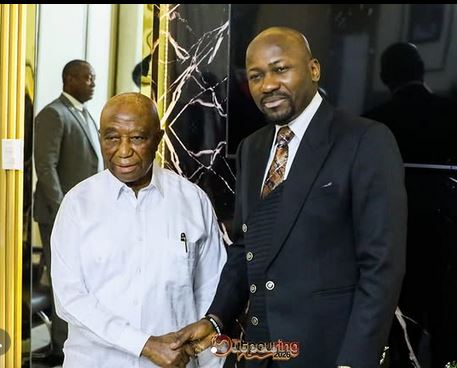
Liberian Leaders, Citizens Bear Witness as Apostle Suleman Hosts Two-Day Power-Packed Crusade
It was testimonies galore on Tuesday, March 31, the first day of the famous servant of God and founder of the Omega Fire Ministries (OFM) worldwide, Apostle Johnson Suleman’s power-packed two-day crusade. The event documented impactful moments with the Gospel and miracles, emphasizing the power of faith and the tangible confirmation of God’s Word through signs and wonders. It was equally an atmosphere of miraculous healing, restoration of lives, and the strengthening of faith.
At the crusade, which was held at the SKD Sports Stadium in Paynesville City, and themed, “Liberia Outpouring Crusade” witnessed testimonies of impact and miracles with participants experiencing instant healing of various kinds of challenges.
Apostle Suleman’s first port of call was Paynesville, the office of Liberian government’s president, Mr. Joseph Nyuma Boakai, who received him in an audience with his junior ministers. Apostle Suleman, who also met with the vice-president, Mr. Jeremiah Kpan Koung, was welcomed by the Liberian leader’s office as part of the president’s ongoing engagements with religious leaders aimed at fostering spiritual support for national development.
The president expressed profound appreciation to Apostle Suleman for the visit and continued prayers and intercessions by men and women of God on behalf of Liberia, emphasizing his firm belief that sustained spiritual guidance and prayer remain vital to the transformation and progress of the nation.
During the visit, Apostle Suleman offered prayers for President Boakai, his cabinet and the Liberian nation, invoking divine alignment, wisdom, and insight in Liberia’s path toward growth and stability. He prayed that the Almighty God would position Liberia for relevance and fulfillment of its national destiny.
Apostle Johnson Suleman, an evangelist who knows no bounds of where preaching the gospel comes to a stop, visited Liberia prepared with the message, compelling power of the Gospel and the work of the Holy Spirit, and bringing people to a point of decision where they surrendered their lives to Christ.
Aside from being prophetic and timely, OFM sources disclosed that the servant of God’s visit underscores the importance of faith-based partnerships in supporting governance and national renewal efforts.
society
Middle Belt Forum Hails Tinubu’s Jos Visit, Calls for United Civil-Military Effort to Restore Lasting Peace
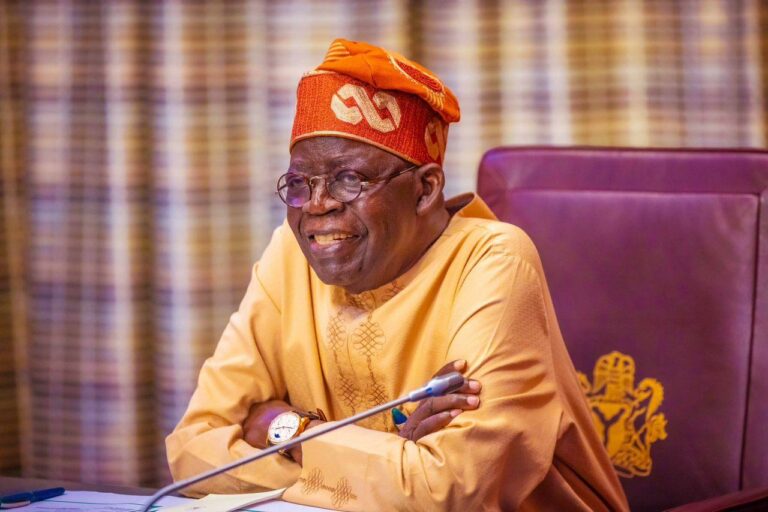
*Middle Belt Forum Hails Tinubu’s Jos Visit, Calls for United Civil-Military Effort to Restore Lasting Peace
The Middle Belt Peace Forum (MBPF) has commended President Bola Ahmed Tinubu for his profound demonstration of empathy and responsive leadership following his decision to postpone an official engagement in Iperu in order to visit victims of the recent attacks in Jos.
In a statement signed by its National Coordinator, Pastor Bulus Garba, in Jos on Friday, the Forum said the President’s decision to personally identify with grieving communities sends a powerful message of solidarity and reinforces public confidence in the commitment of the Federal Government to the protection of lives and property.
“The Middle Belt Peace Forum warmly commends President Bola Ahmed Tinubu for prioritising compassion over ceremony. At a time of deep sorrow for the people of Plateau State, his decision to visit Jos stands as a mark of true leadership—one that listens, responds, and stands with the people in their moment of pain,” the statement read.
The Forum described the perpetrators of the recent attacks as “cowards who prey on innocent and defenceless citizens,” stressing that such acts of violence are not only inhumane but also a direct assault on the unity and peace of the nation.
“We condemn in the strongest terms the actions of these cowardly attackers whose only aim is to instil fear and destabilise peaceful communities. Their actions must be met with firm and decisive resistance from all arms of the state,” Pastor Garba said.
The MBPF further used the opportunity to salute the courage, gallantry, and sacrifices of the Armed Forces of Nigeria under the leadership of the Chief of Defence Staff, General Olufemi Oluyede, noting that their continued efforts remain central to restoring stability across troubled parts of the country.
According to the Forum, the Armed Forces have demonstrated resilience and professionalism in the face of complex security challenges, often operating under difficult conditions to safeguard communities and defend Nigeria’s territorial integrity.
“We salute the Armed Forces of Nigeria for their unwavering commitment and sacrifices. Their gallantry in confronting criminal elements and reclaiming territories is a testament to their dedication to national service. We recognise that the path to peace is demanding, and we honour those who stand daily in defence of our nation,” the statement added.
The Forum pledged its full support to ongoing military operations and called for strengthened collaboration between security agencies and local communities as a critical factor in achieving lasting peace.
It also urged citizens across the Middle Belt to cooperate with security forces by providing timely information and fostering unity within their communities.
The MBPF, however, expressed concern over the need for greater synergy among security agencies, particularly the role of the Nigeria Police in consolidating gains made by the military.
“We call on the Nigeria Police Force to rise fully to its constitutional responsibility by effectively supporting the Armed Forces in stabilising and securing areas that have been cleared of criminal elements. Holding and policing such territories is essential to preventing a resurgence of violence,” Pastor Garba stated.
The Forum emphasised that sustainable peace requires a coordinated approach in which the military clears and secures areas, while the police maintain law and order to enable displaced communities to return and rebuild their lives.
The MBPF concluded by reiterating its commitment to peacebuilding efforts across the Middle Belt and expressed optimism that with sustained leadership, coordinated security efforts, and active citizen participation, lasting peace can be achieved.
“Together, through unity, vigilance, and collective resolve, we can overcome these challenges and build a safer and more peaceful Middle Belt,” the statement added.
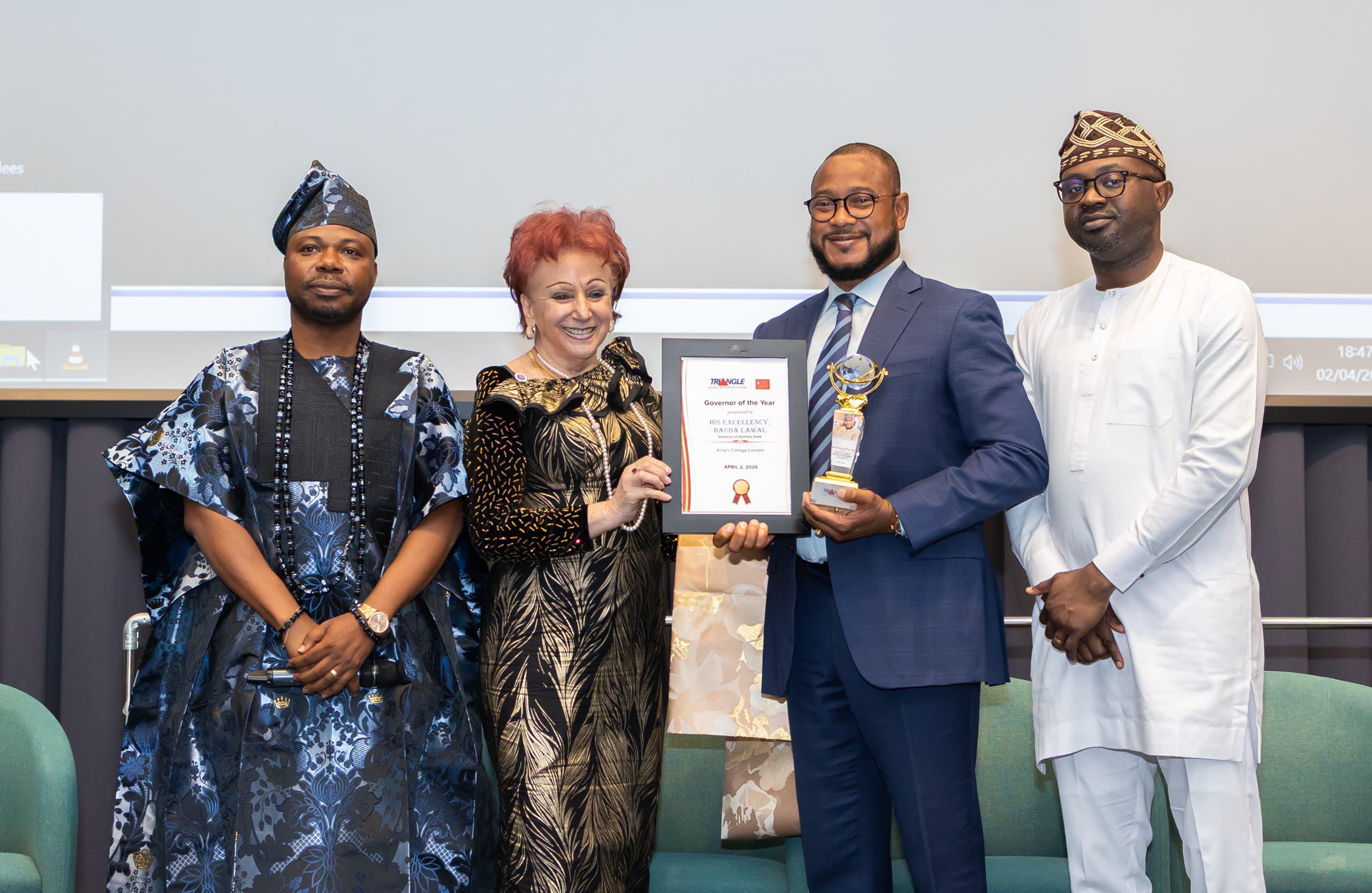
Governor Dauda Lawal Wins Face of Africa Governor of the Year Award in London
Governor Dauda Lawal has been honored with the Outstanding Governor of the Year award by Triangle Media International Magazine.
The award was presented during the magazine’s 10th annual lecture and award ceremony, held on Thursday at the Grand Hall of King’s College, London, United Kingdom.
According to a statement by the governor’s spokesperson, Sulaiman Bala Idris, the awards recognize public and private sector leaders whose leadership positively impacts governance and service delivery.
He added that the lecture, themed “Harnessing the Roles of Nigerians in Diaspora for National Development,” brought together stakeholders from both the public and private sectors.
The statement read in part: “Yesterday, in London, Governor Dauda Lawal received the 2026 Face of Africa Leadership Award for Outstanding Governor of the Year.
“The 2026 edition coincides with the 10th anniversary of Triangle International Magazine, which has over the years celebrated notable Africans across diverse fields.
“The award recognizes the Zamfara State Government under Governor Lawal’s leadership for achieving remarkable milestones in service delivery since his inauguration on 29 May 2023.
“The board of Triangle International noted that, despite inheriting an empty treasury, Governor Dauda Lawal has remained true to the Rescue Agenda’s campaign promise: to rescue and rebuild Zamfara.
“The award also reflects the state government’s innovative approach to indirectly curbing insecurity through educational advancement, demonstrated by the declaration of a state of emergency in the education sector.
“This includes the state government’s swift payment of the outstanding N3.4 billion for WAEC and NECO examinations, as well as the reconstruction and rehabilitation of schools across all 14 Local Government Areas of Zamfara State.
“The international magazine finds these initiatives to be strategic interventions toward long-term efforts to make Zamfara State better.”
The colourful event was attended by the Minister of Interior, Olubunmi Tunji-Ojo, and Sahara Group’s Group Managing Director, Kola Adesina, among others.


-

 society7 months ago
Religion: Africa’s Oldest Weapon of Enslavement and the Forgotten Truth
-

 news4 months ago
WHO REALLY OWNS MONIEPOINT? The $290 Million Deal That Sold Nigeria’s Top Fintech to Foreign Interests
-

 society6 months ago
“You Are Never Without Help” – Pastor Gebhardt Berndt Inspires Hope Through Empower Church (Video)
-

 celebrity radar - gossips2 months ago
Dr. Chris Okafor Returns with Power and Fire of the Spirit -Mounts Grace Nation Altar with Fresh Anointing and Restoration Grace on February 1, 2026