
society
Lawmaker Noheem Adams and his winning ways

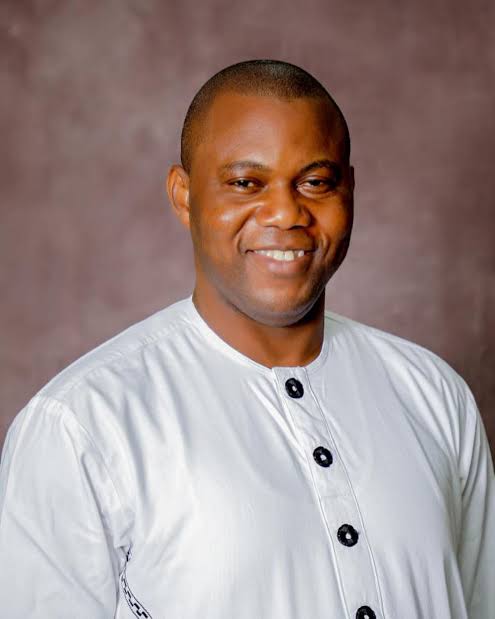
Lawmaker Noheem Adams and his winning ways
By Johnbosco Afolabi
In a country where true service to humanity has become almost impossible, it has thus become our tasks to praise those who find it in their hearts and principles to shift from what has ordinarily become their norm to touch as much lives as they find possible. This is why when a governor in Nigeria is successfully able to complete the construction of a road, which should ordinarily be one of his duties to the people, we go beyond mere commendations. We wear Aso-ebi. We invite musicians. We gather ourselves and merry.
You don’t have to blame the people. Over the years, we have lived far less than third-class citizens in our communities, states and country. Those who we queue in the rain and sun to elect have often done the opposite of what we anticipate. The promises they oil our ears with before the elections often become far more than the axiomatic ‘rocket science’. Excuses take control.
On two occasions within December last year, I stumbled on two different videos on social media where irate constituents pounced on their representatives for abandoning them after the election. In one of the videos, the constituents claimed that the representative disappeared after the 2023 general election where he won a seat at the House of Representatives. As usual, the election season is fast approaching and the lawmaker sensed the need to return to base and bamboozle the electorate with some sweet-coated promises. The result is what he never anticipated.
As I watched that video, my mind kept drifting to Noheem Babatunde Adams, a member of the Lagos State House of Assembly, who came in years ago through a supplementary election for a constituency that hitherto loathed the idea of an elected politician retaining his office after one term. Though, the unwritten traditional one term changed with his predecessor, Noheem has not only constantly won hearts. He has kept the tempo sustained.
Eti-Osa is one of the most-politically sophisticated area of Lagos and for someone to retain a position in such a place, it shows simply how deeply ingrained such a person is, It further shows how successfully the person has handled the mandate handed him by his people. In November, 2025, during the opening of a new housing scheme in Abraham Adesanya area of Eti-Osa, Governor Babajide Sanwo-Olu called Noheem “The Son In The Soil.” That sobriquet sank deservedly. It was a perfect description of a lawmaker whose passion and commitment has seen him going out of his core duties to bring smiles to the faces of his constituents. During the townhall meeting held simultaneously across Lagos by the House of Assembly in the last months of 2025, Noheem was one of the only two lawmakers who empowered 250 constituents with at least ₦25 million. That was unprecedented. Little wonder the free endorsements he continues to receive among leaders in the constituency.
The attention of my team was first drawn to his mode of operation in 2022 culminating in the political campaigns in 2023. Noheem was in every corner of his constituency, either sitting with the people, checking up on them, especially the aged, having deliberations and understanding their plights. Unassuming, he would always smile while listening. Then, for challenges he could handle, he did privately. For others he could not, he made promises to draw the attention of the government. And this he did both in letters, conversations with officials of the executive arm of government and in his positions on the floor of the House where he champions his people’s yearnings irrespective of whose ox is gored.
A close associate of the Majority Leader once told me that the lawmaker is not the average Nigerian politician. Why? He said Noheem was too sincere to be called one. He has these principles of treating everyone equally. He believes that everyone has specific grace and should never be handled less. “Bros, that man thrives better in challenging situations. His intuitions are very sharp. He pre-empts and solves a problem before it becomes obvious. He lives in the midst of his people and feels their pains. And he knows how to warm himself into the minds of the people with his smiles. His life revolves around his people and what he can do for them at every point. He has empowered people so much so that we do ask him what he has left for himself.”
At the Lagos Assembly, Noheem remains one of the most brilliant lawmaker handling his office with great mastery. Aside multiple motions, he is known to have single-handedly sponsored the Railway Corporation Bill in 2025. The bill that aims to systematically structure rail transportation in the state is currently in its final stage for passage.
He is not my representative, but he continues to earn my respect since I started monitoring him closely. Yes, he has. And Eti-Osa Constituency 1 got this one right. Think. Can you speak this way about the person who represents you?
Johnbosco, a media, political and social analyst, writes from Maryland, Lagos.





US-Based Society Lady, Fehintola-Brat Extends Eid-El-Kabir Greetings To Muslims
United States based fahionista of class, Chief (Mrs) Ayoola Fehintola-Brat has extended a warm greetings to Muslim faithful all over the world on the occasion of the 2026 Eid-El-Kabir celebration.
Fehintola-Brat who is the Balogun Egbe Obaneye Obinrin Akile Ijebu, and the Yeye Asofin of Idenaland in her message to Journalists urged Muslim to continually uphold the enduring values of sacrifice, obedience, faith, and compassion, which are central to the significance of Eid-El-Kabir festival.
A quiet philantropist whose humanitarian services has won her several laurels urged Muslims to use the spiritual occasion to pray for the peace co-existence of Nigerians regardless of religious, social and political leanings stressing that the oneness of the country should not be underplay.
In a related development, she expressed her felicitations to all sons and daughters of Ijebuland on the forthcoming Ojude Oba 2026 celebration, tasking age-groups otherwise known as Regbregbe to be more proactive in giving back to their immediate communities.
According to her, the beauty of the age-groups in Ijebuland is the need to contribute immensely to the development of the land in no small means. “This we will continue to achieve with God on our side”, she concluded.
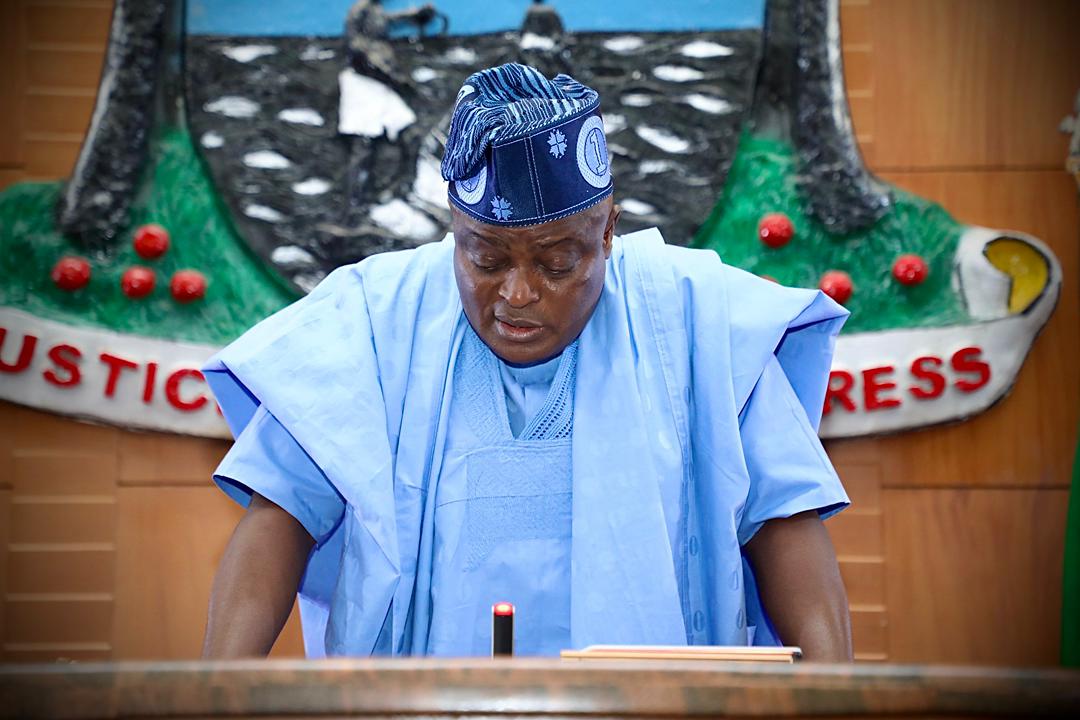
Sallah: Obasa Felicitates Muslim Ummah, Commends Nigerians for APC Primaries Turnout
The Speaker of the Lagos State House of Assembly, Rt. Hon. Mudashiru Obasa has extended warm felicitations to Muslims in Lagos State and across Nigeria on the occasion of Eid al-Adha.
In a statement released by his Chief Press Secretary, Mr. Dave Agboola, Obasa described the festival as a season of sacrifice, reflection, and gratitude, urging the faithful to continue to uphold the values of peace, unity, and love that strengthen the nation.
He noted that the celebration of Eid al-Adha is not only a spiritual milestone but also a reminder of the importance of togetherness and collective responsibility in building a stronger society.
He, likewise, emphasized that the festival provides an opportunity for Nigerians to renew their commitment to national progress and to support leadership that prioritizes development and prosperity.
Obasa, however, commended Nigerians, particularly members of the All Progressives Congress (APC), for their massive turnout during the recently concluded party primaries. He described the participation as a clear demonstration of the people’s confidence in the government of President Bola Ahmed Tinubu and their belief in the administration’s vision for a greater Nigeria.
“The APC primaries have shown the resilience of our democracy and the confidence Nigerians have in the leadership of President Bola Ahmed Tinubu and the Renewed Hope Agenda. This is a strong message that our people are ready to continue supporting policies that will drive growth and prosperity,” Obasa stated.
The Speaker further encouraged Muslims to celebrate responsibly, stressing that the joy of Eid should be accompanied by prayers for the continued peace and progress of Lagos State and Nigeria.
“As you celebrate with family and loved ones, may this season bring joy, peace, and prosperity to your homes. Let us remain united in our resolve to build a stronger nation,” he added.
On behalf of the Lagos State House of Assembly, Obasa wished all Muslims a happy and fulfilling Eid al-Adha celebration.

ABEOKUTA FILM FESTIVAL AT ILEYA
Kayshow Multimedia a filmmaking and Media organization this year 2026 holds its annual Abeokuta film festival at the Ake Palace in Abeokuta.
Alake of Egba land, Ọba Michael Adedotun Arẹmu Gbadebo has graciously endorsed the Free Training of Egba Youths on Film and Arts and the Entertainment of the the People with a FREE FILM SHOW at the AKE PAVILION. as part of the ABEOKUTA FILM FESTIVAL 2.0.
The Convener of the Film Festival Honorable Kehinde Soaga says this year’s event promises to be more exciting as distinguished personalities are sure to attend.
This includes the honorable Minister for Art Culture and Creative Economy in Nigeria, Barr. Hannatu Musa Musawa, Ààrẹ Lai Labode, Sen. Ibikunle Amosun and other special guests.
The event will feature Film, Cultural Dance Cultural foods and Award Ceremony.
The general public is hereby invited to the Free film show at the Abeokuta film festival at the Alake Palace Pavilion on Thursday 28th of May 2026 by 4:00 p.m.
Only well dressed is the Entry. The Abeokuta Film Festival is an annual event taking place in the capital city of Ogun State state.


- Qrent says delaying Information Technology (IT) refresh cycles may be increasing operational risk for businesses in Africa May 27, 2026
- Dentons’ Iyunola Adekanye Appointed to African Mining Week (AMW) Advisory Board May 27, 2026
- United Nations (UN) Women Liberia and Partners Convene for Spotlight Initiative 2.0 Women’s Economic Empowerment Inception Meeting May 27, 2026
- African Mining Week (AMW) to Host Central Bank Governors Roundtable as Monetary Authorities Deepen Role in Mining Sector Growth May 27, 2026
- Eritrea: Diaspora Nationals Celebrate Independence Day Anniversary May 27, 2026
- Africa Unveils Landmark Humanitarian Coordination Platform to Strengthen aligned Response to Humanitarian Crises May 27, 2026
- Seychelles: President Herminie Engages with Police and Fire Services on Praslin May 27, 2026
- Issue 3 of Mining Review Africa now available for free download May 27, 2026
- NOV Joins African Energy Week (AEW) 2026 as Gold Sponsor Amid Africa’s Offshore Expansion Push May 26, 2026
- African Union of Broadcasting (AUB) and United Nations University Institute for Water, Environment and Health (UNU-INWEH) Launch Landmark Webinar Series on Africa’s Water Crisis, Starting June 2, 2026 May 26, 2026
- Qrent says delaying Information Technology (IT) refresh cycles may be increasing operational risk for businesses in Africa May 27, 2026
- Dentons’ Iyunola Adekanye Appointed to African Mining Week (AMW) Advisory Board May 27, 2026
- United Nations (UN) Women Liberia and Partners Convene for Spotlight Initiative 2.0 Women’s Economic Empowerment Inception Meeting May 27, 2026
- African Mining Week (AMW) to Host Central Bank Governors Roundtable as Monetary Authorities Deepen Role in Mining Sector Growth May 27, 2026
- Eritrea: Diaspora Nationals Celebrate Independence Day Anniversary May 27, 2026
- Africa Unveils Landmark Humanitarian Coordination Platform to Strengthen aligned Response to Humanitarian Crises May 27, 2026
- Seychelles: President Herminie Engages with Police and Fire Services on Praslin May 27, 2026
-

 news5 months ago
WHO REALLY OWNS MONIEPOINT? The $290 Million Deal That Sold Nigeria’s Top Fintech to Foreign Interests
-

 society3 weeks ago
SOCIAL MEDIA IS NOT A BATTLEFIELD COMMAND – WHY THE NIGERIAN ARMY’S ACTION AGAINST JUSTICE CRACK IS A NATIONAL SECURITY IMPERATIVE
-

 celebrity radar - gossips4 months ago
Dr. Chris Okafor Returns with Power and Fire of the Spirit -Mounts Grace Nation Altar with Fresh Anointing and Restoration Grace on February 1, 2026
-

 celebrity radar - gossips6 months ago
Prophet Kingsley Aitafo Releases 2026 Prophecy: ‘Nigeria Will Rise, but the World Must Prepare for Turbulence’