
society
Maduro on Trial: Defiant, Unbowed and Still Claiming the Presidency


Maduro on Trial: Defiant, Unbowed and Still Claiming the Presidency.
By George Omagbemi Sylvester | Published by saharaweeklyng.com
“Inside the U.S. Courtroom Drama That Shook Global Politics. A Legal Maelstrom, a Sovereignty Crisis and the Battle for Venezuela’s Soul.”
In a legal and diplomatic showdown without recent parallel, Venezuelan President Nicolás Maduro stood before a U.S. federal judge in Manhattan on January 5, 2026, to enter a formal not guilty plea to a sweeping indictment that accuses him of narcotics trafficking, narco-terrorism and related violent crimes. Yet in a defiant and extraordinary twist, Maduro did not merely traverse the routine procedures of an arraignment, he seized the moment to declare, in unequivocal terms, that he remains the legitimate President of Venezuela, lambasting his removal and detention as unlawful and a violation of international law.

This courtroom appearance (held in the Southern District of New York) was the culmination of a dramatic military operation in Caracas just days earlier, when U.S. forces seized Maduro and his wife, First Lady Cilia Flores, from their residence and transported them to the United States to face federal prosecution. The proceedings have shattered norms of modern geopolitics and sparked fierce debate among legal scholars, international relations experts and world leaders.
A Defiant Stand in the Courtroom.
Appearing before U.S. District Judge Alvin Hellerstein, Maduro, 63, spoke through an interpreter and delivered a message that was as political as it was legal. In clear Spanish he declared:
“I am innocent. I am not guilty. I am a decent man. I am still president of my country.”
Maduro’s defence team, led by prominent attorney Barry J. Pollack, signalled that they intend to challenge not only the substance of the charges but also the legality of Maduro’s capture and also including asserting his entitlement to sovereign immunity as a head of state. Such claims are seldom entertained in U.S. courts and invite complex questions about international law and diplomatic norms.
His wife, Cilia Flores, also formally entered a not guilty plea, asserting through her counsel that she is innocent of all charges and deserves fair legal treatment.
The Charges: A Legal Storm.
The indictment, spanning multiple counts, accuses Maduro and key aides of orchestrating a decades-long criminal enterprise:
Narco-terrorism conspiracy
Cocaine importation conspiracy into the United States
Possession of machine guns and destructive devices in connection with drug trafficking
These charges carry potential life sentences, making it one of the most consequential criminal cases ever brought against a foreign head of state in the U.S. judicial system.
Military.com
Prosecutors allege that Maduro’s regime facilitated the transportation of large quantities of cocaine into the United States and collaborated with violent cartels and rebel groups across Latin America. While Maduro has vehemently denied all accusations, U.S. officials maintain that the evidence justifies the charges.
“I Was Captured”: A President or a Prisoner of War?
In one of the most striking moments of his brief court appearance, Maduro claimed he had been “captured” at his home in Caracas and likened his situation to that of a prisoner of war or a rhetorical choice intended to frame the U.S. action as not merely law enforcement but as political and militaristic aggression.
This characterisation was echoed by his supporters outside the courthouse and by several international governments. Russia, for instance, angrily condemned the U.S. operation and demanded Maduro’s immediate release, calling the action a breach of Venezuelan sovereignty.
Legal scholars, too, have weighed in. Harold Koh, former legal adviser to the U.S. State Department, warned that the case places the U.S. judiciary at the crossroads of criminal law and foreign policy, asserting:
“This prosecution will test the boundaries of sovereign immunity and set precedents about how far a domestic court can reach into international affairs.”
Whether Maduro’s dramatic narratives will hold any legal water remains to be seen, but they unquestionably shape the political context of the proceedings.
Global Reverberations and International Law.
The Maduro case has triggered heated debates in the United Nations Security Council, where some member states voiced grave concern that the U.S. violated international norms by apprehending a sitting head of state on foreign soil. Critics argue that such unilateral action undermines the principle of sovereignty and a cornerstone of international law enshrined in the U.N. Charter.
In response, U.S. representatives emphasised that the mission was a lawful law enforcement effort, not a war or occupation. They insist Maduro’s indictment relates to longstanding criminal allegations and not any desire to occupy or govern Venezuela.
Nevertheless, the clash between legal justifications and geopolitical pushback highlights the fragile balance between transnational justice and sovereign autonomy, an issue that will continue to resonate in global diplomatic circles.
The Human Toll and Venezuelan Context.
The Maduro saga cannot be disentangled from Venezuela’s decade-long political and economic crisis. Citizens have endured hyperinflation, shortages of basic goods, mass migration and widespread reports of political repression. Many Venezuelans outside the courthouse voiced intense emotions and some calling Maduro a tyrant who must answer for his actions, others denouncing the U.S. role as imperialistic interference.
As Professor Francisco Toro, a respected Venezuelan political analyst, observed:
“Maduro’s government was marred by corruption and repression, but the manner in which he was seized raises dangerous questions about external intervention and the future of self-determination for the Venezuelan people.”
The domestic fallout was immediate. Hours after the court appearance, Delcy Rodríguez, Venezuela’s Vice President, was sworn in by the National Assembly as interim president, pledging to safeguard national sovereignty and support Maduro’s legal battle.
ThisDayLive
What Lies Ahead: A March Showdown and Beyond.
Both Maduro and Flores are set to return to court on March 17, 2026, marking the next stage in what is expected to be a long, complex and politically charged legal process. Defence attorneys are anticipated to file robust motions challenging jurisdiction, sovereign immunity claims, and the legality of the U.S. capture operation.
Meanwhile, global attention remains riveted. Some observers argue that if Maduro were to be convicted, the consequences could reshape international criminal law, especially where heads of state are concerned. Others fear the case could exacerbate tensions between great powers and undermine diplomatic resolution.
Final Words: A Trial at the Crossroads of Law and Geopolitics.
Nicolás Maduro’s not guilty plea in a U.S. court transcends ordinary criminal litigation. It is a geopolitical earthquake, blending legal drama with questions of sovereignty, justice, and power. Whether history will remember this moment as a triumph of accountability or a perilous overreach remains uncertain. What is clear, however, is that no stone has been left unturned in this unprecedented clash between a head of state and a foreign nation’s legal system.
As respected international law expert Dr. Mary Ellen O’Connell put it:
“When law and power collide on the global stage, the jurisprudence of tomorrow is written in the actions taken today.”
Maduro’s words (“I am still President”) may echo far beyond the courtroom walls, shaping international relations and legal norms for years to come.






US-Based Society Lady, Fehintola-Brat Extends Eid-El-Kabir Greetings To Muslims
United States based fahionista of class, Chief (Mrs) Ayoola Fehintola-Brat has extended a warm greetings to Muslim faithful all over the world on the occasion of the 2026 Eid-El-Kabir celebration.
Fehintola-Brat who is the Balogun Egbe Obaneye Obinrin Akile Ijebu, and the Yeye Asofin of Idenaland in her message to Journalists urged Muslim to continually uphold the enduring values of sacrifice, obedience, faith, and compassion, which are central to the significance of Eid-El-Kabir festival.
A quiet philantropist whose humanitarian services has won her several laurels urged Muslims to use the spiritual occasion to pray for the peace co-existence of Nigerians regardless of religious, social and political leanings stressing that the oneness of the country should not be underplay.
In a related development, she expressed her felicitations to all sons and daughters of Ijebuland on the forthcoming Ojude Oba 2026 celebration, tasking age-groups otherwise known as Regbregbe to be more proactive in giving back to their immediate communities.
According to her, the beauty of the age-groups in Ijebuland is the need to contribute immensely to the development of the land in no small means. “This we will continue to achieve with God on our side”, she concluded.
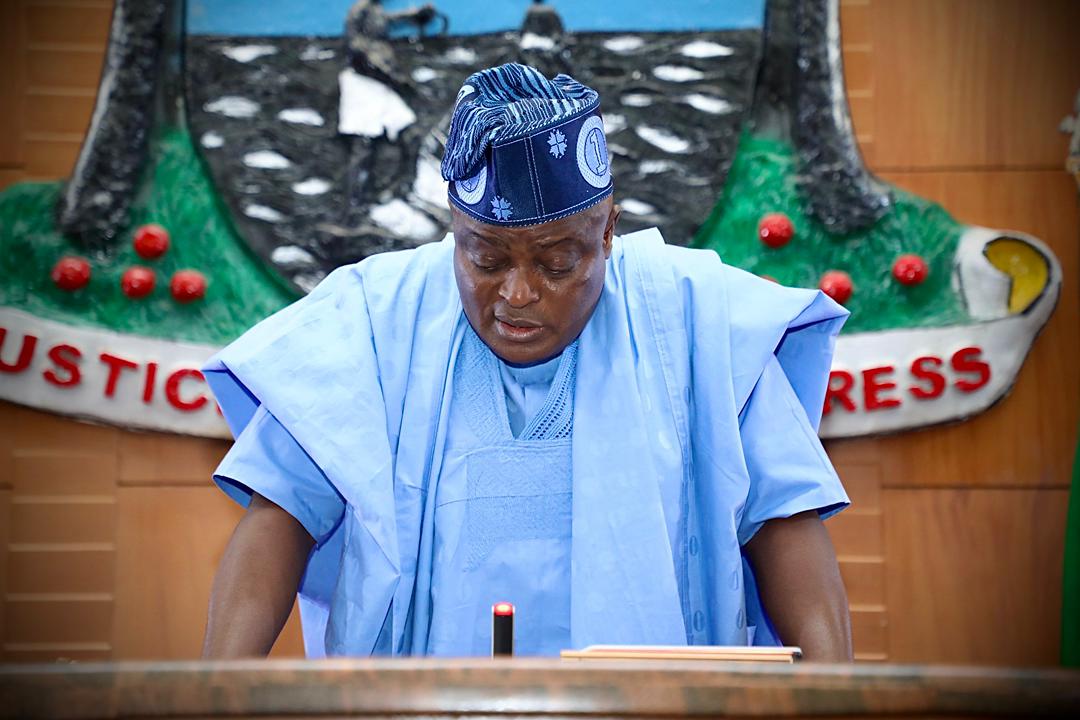
Sallah: Obasa Felicitates Muslim Ummah, Commends Nigerians for APC Primaries Turnout
The Speaker of the Lagos State House of Assembly, Rt. Hon. Mudashiru Obasa has extended warm felicitations to Muslims in Lagos State and across Nigeria on the occasion of Eid al-Adha.
In a statement released by his Chief Press Secretary, Mr. Dave Agboola, Obasa described the festival as a season of sacrifice, reflection, and gratitude, urging the faithful to continue to uphold the values of peace, unity, and love that strengthen the nation.
He noted that the celebration of Eid al-Adha is not only a spiritual milestone but also a reminder of the importance of togetherness and collective responsibility in building a stronger society.
He, likewise, emphasized that the festival provides an opportunity for Nigerians to renew their commitment to national progress and to support leadership that prioritizes development and prosperity.
Obasa, however, commended Nigerians, particularly members of the All Progressives Congress (APC), for their massive turnout during the recently concluded party primaries. He described the participation as a clear demonstration of the people’s confidence in the government of President Bola Ahmed Tinubu and their belief in the administration’s vision for a greater Nigeria.
“The APC primaries have shown the resilience of our democracy and the confidence Nigerians have in the leadership of President Bola Ahmed Tinubu and the Renewed Hope Agenda. This is a strong message that our people are ready to continue supporting policies that will drive growth and prosperity,” Obasa stated.
The Speaker further encouraged Muslims to celebrate responsibly, stressing that the joy of Eid should be accompanied by prayers for the continued peace and progress of Lagos State and Nigeria.
“As you celebrate with family and loved ones, may this season bring joy, peace, and prosperity to your homes. Let us remain united in our resolve to build a stronger nation,” he added.
On behalf of the Lagos State House of Assembly, Obasa wished all Muslims a happy and fulfilling Eid al-Adha celebration.

ABEOKUTA FILM FESTIVAL AT ILEYA
Kayshow Multimedia a filmmaking and Media organization this year 2026 holds its annual Abeokuta film festival at the Ake Palace in Abeokuta.
Alake of Egba land, Ọba Michael Adedotun Arẹmu Gbadebo has graciously endorsed the Free Training of Egba Youths on Film and Arts and the Entertainment of the the People with a FREE FILM SHOW at the AKE PAVILION. as part of the ABEOKUTA FILM FESTIVAL 2.0.
The Convener of the Film Festival Honorable Kehinde Soaga says this year’s event promises to be more exciting as distinguished personalities are sure to attend.
This includes the honorable Minister for Art Culture and Creative Economy in Nigeria, Barr. Hannatu Musa Musawa, Ààrẹ Lai Labode, Sen. Ibikunle Amosun and other special guests.
The event will feature Film, Cultural Dance Cultural foods and Award Ceremony.
The general public is hereby invited to the Free film show at the Abeokuta film festival at the Alake Palace Pavilion on Thursday 28th of May 2026 by 4:00 p.m.
Only well dressed is the Entry. The Abeokuta Film Festival is an annual event taking place in the capital city of Ogun State state.


- Qrent says delaying Information Technology (IT) refresh cycles may be increasing operational risk for businesses in Africa May 27, 2026
- Dentons’ Iyunola Adekanye Appointed to African Mining Week (AMW) Advisory Board May 27, 2026
- United Nations (UN) Women Liberia and Partners Convene for Spotlight Initiative 2.0 Women’s Economic Empowerment Inception Meeting May 27, 2026
- African Mining Week (AMW) to Host Central Bank Governors Roundtable as Monetary Authorities Deepen Role in Mining Sector Growth May 27, 2026
- Eritrea: Diaspora Nationals Celebrate Independence Day Anniversary May 27, 2026
- Africa Unveils Landmark Humanitarian Coordination Platform to Strengthen aligned Response to Humanitarian Crises May 27, 2026
- Seychelles: President Herminie Engages with Police and Fire Services on Praslin May 27, 2026
- Issue 3 of Mining Review Africa now available for free download May 27, 2026
- NOV Joins African Energy Week (AEW) 2026 as Gold Sponsor Amid Africa’s Offshore Expansion Push May 26, 2026
- African Union of Broadcasting (AUB) and United Nations University Institute for Water, Environment and Health (UNU-INWEH) Launch Landmark Webinar Series on Africa’s Water Crisis, Starting June 2, 2026 May 26, 2026
- Qrent says delaying Information Technology (IT) refresh cycles may be increasing operational risk for businesses in Africa May 27, 2026
- Dentons’ Iyunola Adekanye Appointed to African Mining Week (AMW) Advisory Board May 27, 2026
- United Nations (UN) Women Liberia and Partners Convene for Spotlight Initiative 2.0 Women’s Economic Empowerment Inception Meeting May 27, 2026
- African Mining Week (AMW) to Host Central Bank Governors Roundtable as Monetary Authorities Deepen Role in Mining Sector Growth May 27, 2026
- Eritrea: Diaspora Nationals Celebrate Independence Day Anniversary May 27, 2026
- Africa Unveils Landmark Humanitarian Coordination Platform to Strengthen aligned Response to Humanitarian Crises May 27, 2026
- Seychelles: President Herminie Engages with Police and Fire Services on Praslin May 27, 2026
-

 news5 months ago
WHO REALLY OWNS MONIEPOINT? The $290 Million Deal That Sold Nigeria’s Top Fintech to Foreign Interests
-

 society3 weeks ago
SOCIAL MEDIA IS NOT A BATTLEFIELD COMMAND – WHY THE NIGERIAN ARMY’S ACTION AGAINST JUSTICE CRACK IS A NATIONAL SECURITY IMPERATIVE
-

 celebrity radar - gossips4 months ago
Dr. Chris Okafor Returns with Power and Fire of the Spirit -Mounts Grace Nation Altar with Fresh Anointing and Restoration Grace on February 1, 2026
-

 celebrity radar - gossips6 months ago
Prophet Kingsley Aitafo Releases 2026 Prophecy: ‘Nigeria Will Rise, but the World Must Prepare for Turbulence’