
Business
Legacy debts account for $3bn of $5.5bn foreign borrowing – Adeosun



…Says Nigeria’s debt to GDP ratio is within a reasonable threshold
The Honourable Minister of Finance, Mrs. Kemi Adeosun, on Wednesday, revealed that the Federal Government would apply the sum of US$3 billion in refinancing the legacy debts of the immediate past government.
The outlay is part of the US$5.5 billion foreign loan being sourced from the International Financial Markets.
The Minister, who appeared on Arise TV’s News Programme, said the proposed $5.5 billion loan was made up of two components – refinancing of heritage debts to the tune of $3billion and new borrowing of $2.5 billion for the 2017 Budget.
She said, “Let me explain the $5.5 billion borrowing because there have been some misrepresentations in the media in the last few weeks. The first component of $2.5 billion, represents new external borrowing provided for in the 2017 Appropriation Act to part finance the deficit in that Budget.
“The borrowing will enable the country to bridge the gap in the 2017 budget currently facing liquidity problem to finance some capital projects.
“For the second component, we are refinancing existing domestic debt with the US$3 billion external borrowing. This is purely a portfolio restructuring activity that will not result in any increase in the public debt,” she disclosed.
Adeosun further noted that the country’s debt puzzlingly rose from N7.9 trillion in June 2013 to N12.1 trillion in June 2015, despite the fact that only 10 per cent of the budget was allocated to capital expenditure when oil price exceeded $120 per barrel.
She emphasized the President Muhammadu Buhari-led Administration was investing in critical infrastructural projects such as roads, rails and power in order to deliver a fundamental structural change to the economy that would reduce the nation’s exposure to crude oil.
“Under this dispensation, we are not borrowing to pay salaries. If all we do is to pay salaries, we cannot grow the economy. This Administration is also assiduously working to return Nigeria to a stable economic footing. In light of this, the Government adopted an expansionary fiscal policy with an enlarged budget that will be funded in the short term, by borrowing,” Adeosun stated.
She reassured that the US$5.5 billion foreign borrowing was consistent with Nigeria’s Debt Management Strategy, whose main objective was to increase external financing with a view to rebalancing the public debt portfolio in favour of long-term external financing.
“Nigeria’s debt to Gross Domestic Product (GDP) currently stands at 17.76% and compares favourably to all its peers. The debt to GDP ratio for Ghana is 67.5%, Egypt is 92.3%, South Africa (52%), Germany (68.3%) and United Kingdom (89.3%).
“Nigeria’s debt to GDP ratio is still within a reasonable threshold. This Administration will continue to pursue a prudent debt strategy that is tied to gross capital formation. This will be attained by driving capital expenditure in our ailing infrastructure which will in turn, unlock productivity and create the much-needed jobs and growth,” the Minister added.
//


Business
Alpha Morgan Bank Reinforces Commitment to Education at Redeemer’s University Business School Commissioning
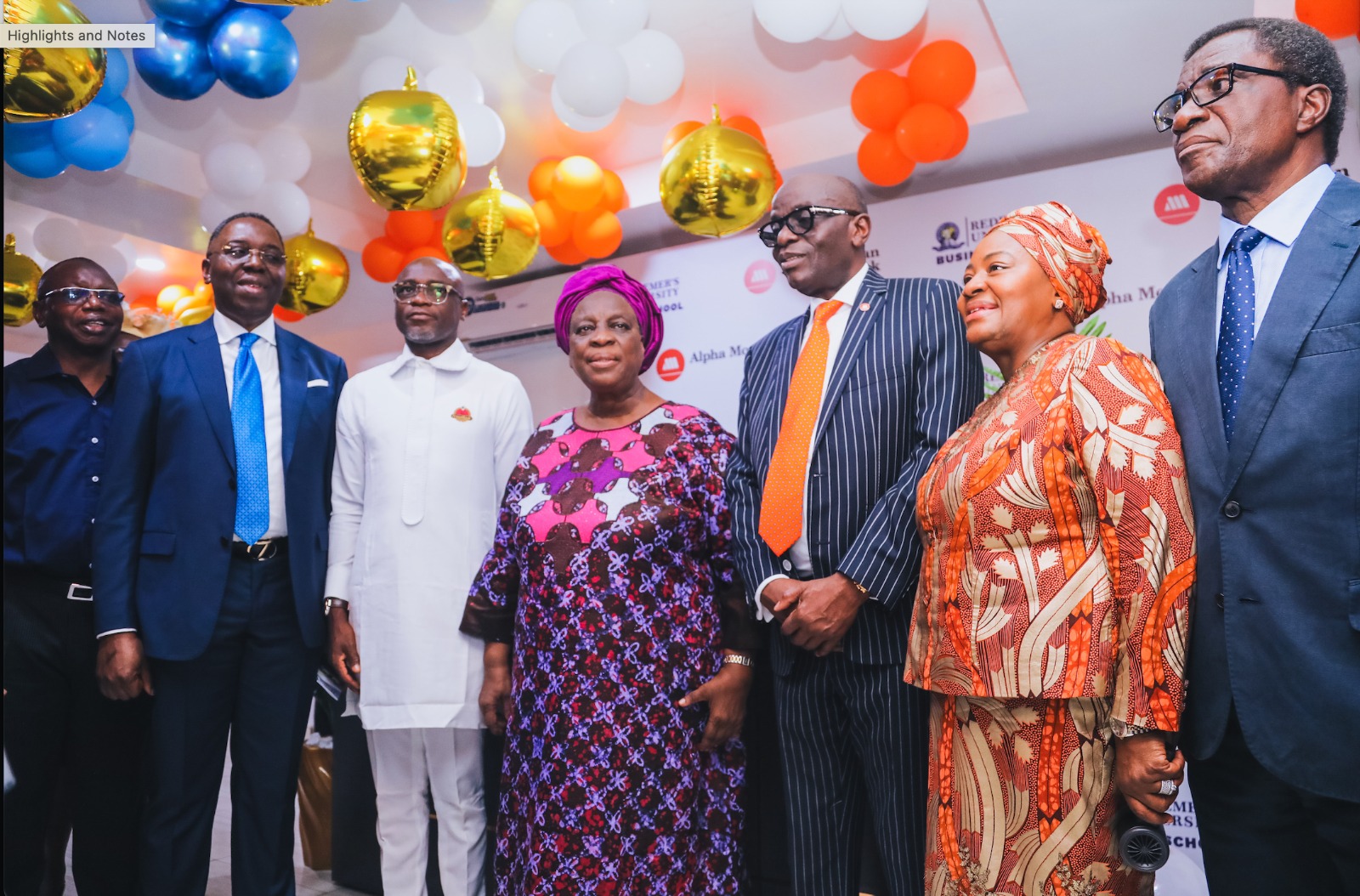
Alpha Morgan Bank Reinforces Commitment to Education at Redeemer’s University Business School Commissioning
Alpha Morgan Bank has reaffirmed its commitment to education and institutional development through its support for the commissioning of the Redeemer’s University Business School.
The Business School was officially inaugurated by Pastor (Mrs.) Folu Adeboye, at the commissioning ceremony attended by distinguished guests including Her Excellency, Mrs. Bola Obasanjo; the Pro-Chancellor and Chairman, Governing Council of Redeemers University, Professor Oluwatoyin Ogundipe; the Vice Chancellor, Professor Shadrach Olufemi Akindele; and other notable dignitaries.
Speaking at the event, the Managing Director of Alpha Morgan Bank reiterated the Bank’s commitment to supporting institutions that drive intellectual growth and national development.
As part of its broader focus on knowledge sharing and thought leadership, Alpha Morgan Bank will host its Economic Review Webinar in May 2026, bringing together experts to share insights on key economic trends and opportunities.
The Bank’s involvement reflects its continued dedication to empowering institutions and shaping the future of business and leadership in Nigeria.
Read more about Alpha Morgan Bank on www.alphamorganbank.com
PHOTO
L-R: Prof. Shadrach Olufemi Akindele, Vice Chancellor, Redeemers University, Engr. Eloka Eje, Dr Perez Araka, Pastor (Mrs) Folu Adeboye, Mother-In-Israel, The Redeemed Christian Church of God, Mr Ade Buraimo, MD/CEO Alpha Morgan Bank, Dr (Mrs) Oluwatomi Somefun, Dr. Simeon Ifere, at the inauguration of the Redeemer’s University Business School, Redemption City, Ogun State on Thursday 2nd April, 2026

Tinubu Aide Rebuts Rufai Oseni Over ₦3.3tn Power Debt Deal
Business
Aare Adetola Emmanuelking Welcomes President Tinubu to Gateway International Airport Commissioning in Iperu-Remo

Aare Adetola Emmanuelking Welcomes President Tinubu to Gateway International Airport Commissioning in Iperu-Remo
In a momentous occasion that underscores the rapid infrastructural advancement of Ogun State, renowned real estate mogul and philanthropist, Aare Adetola Emmanuelking, warmly received the President of the Federal Republic of Nigeria, Bola Ahmed Tinubu, at the official commissioning of the Gateway International Airport, located in Iperu-Remo.
The landmark event, held under the visionary leadership of the Ogun State Governor, Dapo Abiodun, marks a significant stride in the state’s economic transformation agenda, positioning Ogun as a key hub for aviation, commerce, and investment in Nigeria.
Aare Emmanuelking, who is also the Chairman/CEO of Adron Homes and Properties, commended the Ogun State Government for its foresight and commitment to infrastructural excellence. He described the airport project as a “game-changer” that will not only boost connectivity but also stimulate real estate growth, tourism, and industrial expansion across the region.
Speaking during the commissioning, President Tinubu lauded Governor Abiodun’s administration for delivering a world-class facility that aligns with the Federal Government’s Renewed Hope Agenda, emphasizing the importance of strategic infrastructure in driving national development.
The Gateway International Airport is expected to serve as a critical gateway for investors and travelers, further enhancing Ogun State’s reputation as one of Nigeria’s most business-friendly environments.
The presence of top dignitaries, industry leaders, and stakeholders at the event underscores the project’s significance and its anticipated impact on the state’s socio-economic landscape and beyond.


- ABB’s Application Configurator brings speed and precision to grid-feeding protection system design April 7, 2026
- Can Equatorial Guinea Reposition as West Africa’s Gas Hub? April 7, 2026
- Afreximbank Partners with African Energy Week 2026 to Drive Africa-Led Energy Deals April 7, 2026
- Merck Foundation Marks ‘World Health Day’ 2026 – Transforming Patient Care in Africa and Beyond through 2600+ Scholarships for Healthcare Providers From 52 Countries April 7, 2026
- Morocco Gas Plan Reset Could Open Door to New Investment Models April 7, 2026
- African Petroleum Producers Organization (APPO) Secretary General Joins Angola Oil & Gas (AOG) 2026 as African Energy Bank Eyes June 2026 Debut April 7, 2026
- Ghanaian Biomedical Specialist Receives International Award April 7, 2026
- Grey Connects the Africa-Canada Money Corridor With Instant Transfers via Interac April 7, 2026
- Nigeria’s Oil Revival in Focus as Petroleum Minister Lokpobiri Joins Paris Energy Forum April 7, 2026
- CLG Expands into Libya and Central Africa, Named Official Legal Partner for African Energy Week (AEW) 2026 April 7, 2026
- ABB’s Application Configurator brings speed and precision to grid-feeding protection system design April 7, 2026
- Can Equatorial Guinea Reposition as West Africa’s Gas Hub? April 7, 2026
- Afreximbank Partners with African Energy Week 2026 to Drive Africa-Led Energy Deals April 7, 2026
- Merck Foundation Marks ‘World Health Day’ 2026 – Transforming Patient Care in Africa and Beyond through 2600+ Scholarships for Healthcare Providers From 52 Countries April 7, 2026
- Morocco Gas Plan Reset Could Open Door to New Investment Models April 7, 2026
- African Petroleum Producers Organization (APPO) Secretary General Joins Angola Oil & Gas (AOG) 2026 as African Energy Bank Eyes June 2026 Debut April 7, 2026
- Ghanaian Biomedical Specialist Receives International Award April 7, 2026
-

 society7 months ago
Religion: Africa’s Oldest Weapon of Enslavement and the Forgotten Truth
-

 news4 months ago
WHO REALLY OWNS MONIEPOINT? The $290 Million Deal That Sold Nigeria’s Top Fintech to Foreign Interests
-

 society7 months ago
“You Are Never Without Help” – Pastor Gebhardt Berndt Inspires Hope Through Empower Church (Video)
-

 celebrity radar - gossips2 months ago
Dr. Chris Okafor Returns with Power and Fire of the Spirit -Mounts Grace Nation Altar with Fresh Anointing and Restoration Grace on February 1, 2026
You must be logged in to post a comment Login
You must log in to post a comment.