
Business
MUST READ!!! WHAT IS WRONG WITH PASEDA? By Michael-Azeez Ogunsiji

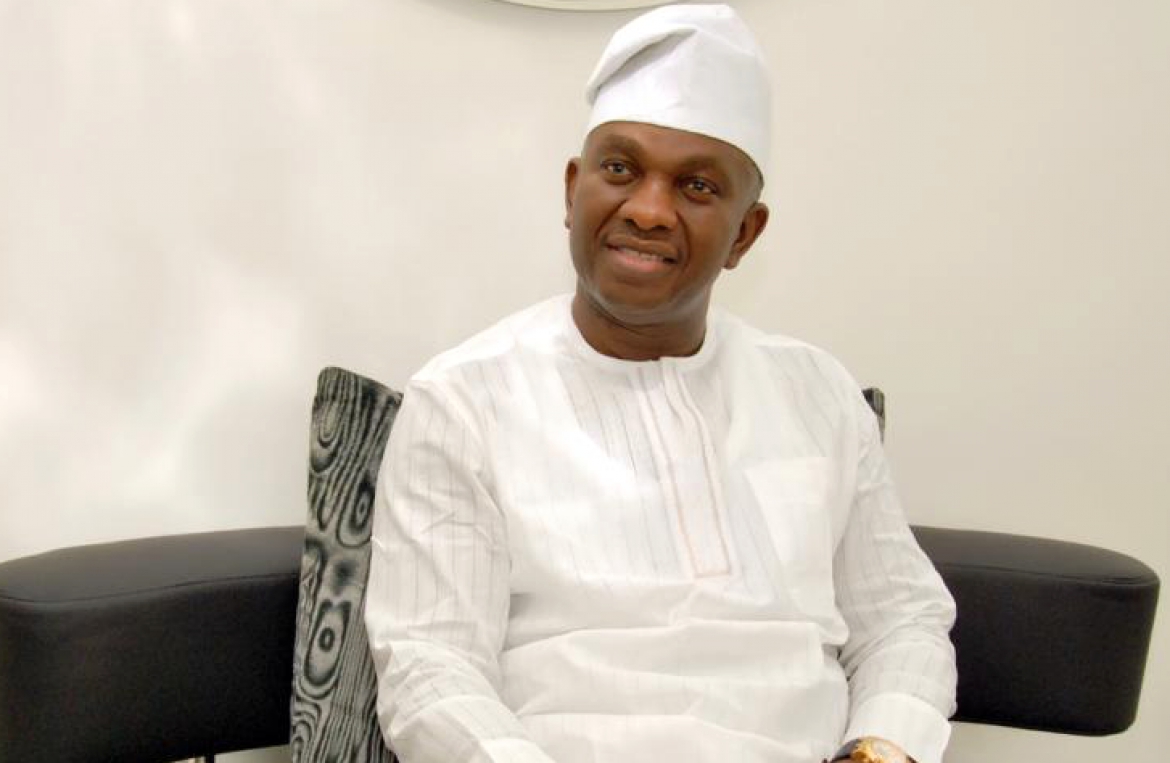

Politics according to Merriam Webster Dictionary is “the art or science of government or the art or science concerned with guiding or influencing governmental policy.
The grammarian also define politics as the art or science concerned with winning and holding control over a government.
Empirically, politics can be said to be activities that relate to influencing actions and policies of a government or getting and keeping power in a government.
It is the work or job of people (such as elected officials) who are part of a government.
Just as I searched and observed with keen interest the calibre and credibility of Nigerian politicians, I discovered that nothing is inseparable from each other.
In Ogun State, a retrospect look at the dozier of past and present leaders of the state create a burning desire to give self assessment with unbias pass mark for those that performed credibly well, which invariably serves as benchmark for successive administrations.
OSOBA: ONE DISAPPOINTMENT, TOO MANY
Since 1999 we attained the fourth republic, Chief Olusegun Osoba who steer the affairs of the State under the political platform of Alliance for Democracy (AD) governed the state with the limited resources available at his disposal despite being an opposition party with Baba Obasanjo PDP at the federal government.
Aremo Osoba provided the needed dividends of democracy for his people and took governance to the door step of the masses especially the rural dwellers through town hall meetings, consultation and provision of social amenities in the rural areas.
Aremo Osoba between 1999-2003 remarkably touched every sector of the state economy to include ; agriculture, education, housing, rural/urban renewal, construction of roads, rural electrification project, donation of transformers to the urban centres, training and empowerment for artisans, provision of drinkable water system, prompt payment of workers salary, non-deduction of workers pension allowance, construction of market centres, empowerment through his wife, Beere Derinsola Osoba where the aged, widows/widowers, youth, artisans, unemployed graduates were assisted among others.
During Osoba’s tenure, the standard of Education in the state was maintained, while tuition fees across the state owned higher institution of learning was invariably minimal and affordable for prospective students and parents, not to mention good standard of living with adequate security.
DANIEL’S TRIUMPHANT ENTRY INTO THE FRAY
But alas, 2003 born the advent of new political era in Ogun State with the arrival and introduction of Otunba Gbenga Daniel into Ogun politics.
Like the Biblical ‘wonder’ Daniel, Otunba Justus Olugbenga Daniel came like a wild in the burning fire, caught the fancies of both young and old with so many creative concept that upshot him into the minds of the people.
The popular TV advert with the chorus “Ee lo so f’araye peee, Daniel mbo, Ee lo so f’araye pee, Daniel ti de o, Eyin Omo Ogun, ise ma tiya”…..this and many other lofty creativity couple with signages that arrest the thinking faculty of Ogun indigenes both home and abroad, still linger on for those that followed the trend.
OGD as fondly called, came with so much believe and aspiration that with him at the helms of the state affairs, Ogun would become Eldorado within a year.
Infact, such propaganda and gimmicks made people to condemned and rubbished Aremo Segun Osoba’s four year term as fruitless. Even, OGD and his ‘propagandists’ or strategists as the case maybe, whichever way made us believed that, we have been held under bondage and wilderness by Osoba, that within a twinkle of an eye, those O2T (Osoba for 2nd Term) Apostles found it compelling and competitive with enough reasons to switched allegiance to OGD. Bravo!
OGD emergence as the Executive Governor of the Gateway State brought new revolution and dimension to the politics and governance of the state, a standard that became a template for interested occupier/s of Oke-Mosan.
Daniel’s style of leadership and governance could be liken to that of Thai Model of governance whereby the immediate needs of the people were prioritized based on the demand and yearning of the people.
OGD’s administration witnessed tremendous achievements in terms of infrastructure, health, education, judiciary, Sports, economic vibe, massive job creation /employment, etc. That is not my obligation here, let his image makers continue from here.
Lo and behold, in spite of the adulation that greeted such lofty and credible ideas of Otunba Daniel with good implementation; corruption, thuggery, uncivil and overzealousness of few of his aides and unjust killing of innocent citizens of the state rubbished the eight years tenure and public demand for change in Governance.
…AND AMOSUN’S CONSOLIDATED VICTORY
This development however, gave Senator Ibikunle Amosun public sympathy and support after a failed attempt to become Governor in 2007.
Amosun became the State Governor in 2011 after a keenly contested election with Gbenga Daniel’s anointed candidate, Prince Gboyega Nasir Isiaka under People’s Party of Nigeria (PPN). Despite the mouth watering amount spent by the then incumbent (Daniel), the people of the state stood their ground against any imposition and intimidation from the PDP government.
Infact, another interesting scenario of the whole political saga was, inspite of the money distributed by Daniel and his cronies to convince the people to support his candidate, GNI, the people still continue to chant a particular slogan “Pin pin lowo Nasir” PPN (meaning Nasir money is for shared) which became a national anthem in the state.
Amosun emerged with so much expectation that, normalcy would return to the state and livelihood of the people would improve under the new government and party. But today, reversed was the case.
I may not be able to start analysing the events that unfold during the first term in office of Governor Ibikunle Amosun, except for the massive road construction and unnecessary overdo flyover bridges (we all know what is behind it, anyway) at the detriment of other sectors, but let’s give it to him on that, albeit we want to play politics here. In terms of road construction in the State Capital, Abeokuta, Amosun should be scored high, while many road projects in other zones {Yewa and Ijebu) were until now, abandoned. And I also believe that our memories is still very fresh to remember the odds that characterized the first year in office of his second term.
WHERE DID PASEDA GOT IT WRONG?
According to Africa proverb, caution should be taken when a dog that whine its tale to the owner, suddenly started barking, signifies a bad omen. The 2015 general elections in Ogun State created a new aura in the anal of political history of the state. The fact that, Senator Amosun was declared winner of the governorship election was not the focal point, but the hopes and courage for a better tomorrow with the introduction of a charitable and grassroot candidate, the man of the people who has been tagged as the Awolowo of this new dispensation in the person of Otunba Olatunde Rotimi Paseda gave the good people of the state a sigh of relieve that the future is secured and reason to believe in our democracy once again.
Otunba Olatunde Rotimi Paseda, a seasoned administrator and an Engineer by profession, a man with an impeccable character who is God fearing declared his intention to serve the good people of Ogun State in less than six months to the 2015 elections under the platform of Unity Party of Nigeria (UPN), but came third behind PDP’s governorship candidate, Prince Gboyega Nasir Isiaka.
Immediately after the announcement of the election results, Paseda told who care to listen that, Project 2019 would be another opportunity to save his people from the hardship and inhuman policies the APC government brought upon the state, since then, Otunba Rotimi Paseda became the beautiful bride in Ogun politics that every political Party want to toast.
What then was his sin? Immediately he showed interest in running for 2019 project to change the dwindling fortune of Ogun State with the tagged of ancient state to eldorado of sort, all sort grandeur and mystery started connecting with his name.
The discrepancy between the legend and the reality proved immensely disappointing to those who wanted to believe in their Messiah. Suddenly, Paseda became a household name and the new beautiful bride in Ogun politics.
Ogun State is privileged to have one of the very few leaders with a mind of rendering selfless services to the people of the state. Olatunde Rotimi Paseda is one of the very few with Pa Awolowo’s legacy. ORP has fondly called, so much believe in giving back to the society that produced him. Olatunde Rotimi Paseda is the heir of Late Chief Jeremiah Obafemi Awolowo, the son of Efunyeloye.
Olatunde Rotimi Paseda is the Moses that has eluded Ogun State and the South-West in times of yore.
Despite the fact that, 2019 is three years away, already the political heat is on and some have started throwing pebbles /dynamite to destroy the personality of Otunba Paseda.
Judging from the ongoing political onslaught, it is crystal clear that, the name Paseda signaled threat and intimidation to the opposition camps. If not, one begin to wonder why the sudden attack on the philanthropist and youth liberator.
The recent facebook political witch-hunt by one political jobber to truncate the chances of Paseda on the order of his pay masters was another decoy to test his popularity, but whether day like it or not, Paseda has come to stay and a household name in Ogun politics today.
The question that came to mind, was that, is their perception about Paseda the standard Ogun state people would use to measure Paseda?
No matter what, Paseda has become a household name in Ogun, a feat which has been enhanced by his recent move to assist the challenged underprivileged people in the state.
Otunba Rotimi Paseda is a born servant leader who exhibits the characteristics that only exceptional people possesses in politics. His humble life is a tapestry of success and accomplishment in all human endeavors. His excellence services in the service of the Lord, humanity and our community have placed him in the league of the few emerging leaders to look forward to lead our people to the promised land come
2019.
Prince Olatunde Rotimi Paseda may not have held any political office in the past, but, his humanitarian gesture cannot be compare with any politicians who live large with government and tax payers money. I stand to be corrected.
Among many other humanitarian services Otunba Paseda rendered through his foundation, Paseda Legacy Foundation include but not limited to, scholarship to 20 Future Promise College Students, provision of six electrical transformers to the neglected Omu – Ijebu community, payment of medical bill of an amputated patient at Federal Medical Centre, Abeokuta, flying abroad of kidney transplant of 9year-old Oluwatobi Solanke , payment of tuition fees a final year law student of Olabisi Obasanjo University, payment of tuition fee of students of Moshood Abiola Polytechnic, Abeokuta, Federal University of Agriculture, Abeokuta, employment of two best mass communication graduates at his foundation, creation of skill acquisition programme for youths, among many others.
When the hues about his experience originated, I was quick to ask, if OGD had any political inclination before he ventured into politics and governed the state in 2003?
Unfortunately for these Facebook jobbers, Paseda has gone beyond the “Ali goes to school” politics and Pull Him Down antics, he is now being woo by the northerners to be their presidential candidate come 2019, a notion he dismissed instantly. Little wonder, they were quick to bestowed on him, a chieftaincy title of Garkuwan Hausawan of Ogun State to hijack him from the campaign of calumny.
His recent visit to the North-west region of the country, liken him to one of the foremost Nigeria politicians and the acclaimed winner of June 12, 1993 Presidential election, late Chief MKO Abiola, who was more celebrated abroad than home.
While he is being treated fairly at home by the power brokers, he became a toast of both old and young in the Hausa speaking states.
Today, Paseda, the son of a village teacher and Store-keeper now rules the world with his chain of businesses spread across Europe and America where over 2,500 workers were on his payroll monthly, not minding the over bearing cost, Paseda recently recruited additional 3,000 staff to his companies in Nigeria to reduce the high rate of unemployment in the country.
What else needed to be done by this great, but intelligent politician to serve Ogun State and his people? Is it because he had failed to join the array of political manslaughters that made him unqualified?
Is it because he doesn’t have political godfathers who would dictate his mind and rig elections for him?
Those condemnation holds no water, any way, as the persecutors failed to realize that, “One in God, is more than a million”.
According to the prophecy of the late Sage, Obafemi Awolowo wherein he said, “a time is coming where the left and right will come together and form a centralized government”, already such testimony is beginning to manifest in Otunba Olatunde Rotimi Paseda as he is being taunted as the (central) only chain that will connect the powers that be together to form a formidable government that will move Ogun State to greater height irrespective of their political affiliation.
MICHAEL-AZEEZ, is the Director on Communication,
Paseda Legacy Foundation
Ogun Sate.





Fidelity Bank grows gross earnings by 38% to N434.95b in Q1
Fidelity Bank Plc recorded 37.9 per cent growth in gross earnings to N434.95 billion in first quarter 2026 as the international commercial bank continued to expand its core banking market share.
Interim report and accounts of Fidelity Bank for the three months ended March 31, 2026 released at the Nigerian Exchange (NGX) showed that gross earnings rose from N315.42 billion in first quarter 20025 to N434.95 billion in first quarter 2026, representing an increase of 37.9 per cent.
The top-line performance was driven by impressive growth in the bank’s core business operations with interest incomes rising by 22.8 per cent to N314.48 billion in first quarter 2026 as against N256.10 billion in first quarter 2025.
With net interest income at N180.97 billion, the bank closed the period with profit before tax of N92.48 billion. After taxes, net profit stood at N74.47 billion for the three-month period. Earnings per share remained high at N5.69, underlining the capacity of the bank to reward its shareholders.
The balance sheet of the bank also emerged stronger. Total assets crossed the N11 trillion mark to N11.35 trillion by March 2026 compared with N10.46 trillion recorded in December 2025. Customers’ deposits increased from N6.89 trillion to N7.38 trillion. Total equity rode on the back of earnings growth to a 27.5 per cent increase from N1.09 trillion in December 2025 to N1.39 trillion by March 2026.
The first quarter 2026 results further consolidated the strong earnings outlook of the bank, which had successfully completed its recapitalisation amidst impressive earnings performance in 2025.
Fidelity Bank had recorded double-digit growths in interest and non-interest incomes as well as key balance sheet items during the year ended December 31, 2025.
The audited report showed that gross earnings rose from N1.04 trillion in 2024 to N1.52 trillion in 2025, an increase of 45.6 per cent. Interest and similar incomes had grown by 38.7 per cent from N803.1 billion in 2024 to N1.11 trillion in 2025. Fees and commission incomes also rose by 44.7 per cent from N78.4 billion to N113.4 billion. The bank recorded net profit after tax of N242.4 billion in 2025.
The bank’s balance sheet emerged stronger with total assets rising by 18.6 per cent to N10.46 trillion in 2025 as against N8.82 trillion in 2024. Customer deposits increased by 16.1 per cent from N5.94 trillion to N6.89 trillion, reflecting continued franchise strength and an improved funding profile. Net loans and advances meanwhile declined by 2.4 per cent to N4.28 trillion in 2025 as against N4.39 trillion in 2024, attributable to customers paying down on their mature obligations.
The bank had in 2025 strengthened its capital position, with eligible capital rising to N561 billion, above the regulatory minimum of N500 billion for banks with international authorisation. In addition, capital adequacy had remained robust, with Capital Adequacy Ratio of 30.94 per cent by December 2025 as against 23.47 per cent by December 2024.
Managing Director, Fidelity Bank Plc, Dr. Nneka Onyeali-Ikpe, said the first quarter 2026 results reinforced the bank’s strong and resilient business model.
She noted that with the remarkable success of its recapitalisation programme and continuing expansion, Fidelity Bank has entered a new era of growth and impressive returns.
“We are on a stronger footing and confident that we will set new growth records that are reflective of our legacy and the future we are working on,” Onyeali-Ikpe said.
Business
Dangote Refinery Ends Nigeria’s Era of Fuel Import Dependence, Boosts GDP, FX Earnings — EIU
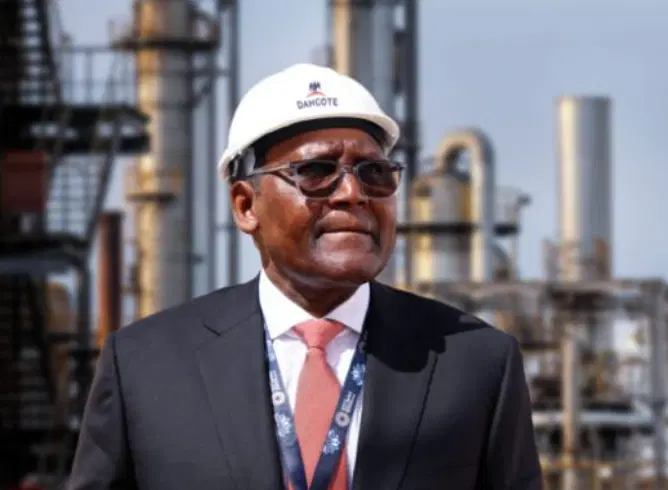
Dangote Refinery Ends Nigeria’s Era of Fuel Import Dependence, Boosts GDP, FX Earnings — EIU
The operational ramp up of the 650,000 barrels per day Dangote Petroleum Refinery & Petrochemicals is fundamentally reshaping Nigeria’s downstream oil sector, significantly reducing the country’s dependence on imported refined petroleum products and strengthening its external position, according to the Economist Intelligence Unit (EIU).
In its latest assessment on Nigeria’s fuel market and regulatory environment, the EIU said the refinery has already transformed a sector that was previously characterised by heavy reliance on imported fuel despite Nigeria being Africa’s largest crude oil producer. The report noted that the refinery met nearly 80 per cent of domestic petrol demand in April and produced enough volumes to satisfy local consumption requirements as operations approached full capacity.
The EIU described Nigeria’s downstream petroleum sector before the refinery as “long dysfunctional”, noting that the country had remained almost entirely dependent on costly imported fuel while producing nearly 1.5 million barrels of crude oil daily.
According to the report, the emergence of the refinery has reduced import dependence, improved domestic fuel availability and strengthened Nigeria’s balance of payments position through lower import demand and rising exports of refined petroleum products.
“The gradual ramp up of the 650,000 barrel/day Dangote refinery since May 2023 has transformed Nigeria’s long dysfunctional downstream sector,” the report stated. “The country’s main refineries, all state owned, had been inoperative for years and Nigeria was almost entirely reliant on costly imported fuel.”
The research and analysis division of The Economist Group, London added that the refinery’s attainment of full operational capacity and its planned expansion would further support Nigeria’s economic growth and foreign exchange earnings over the medium term.
“Meanwhile, the attainment of full capacity at, and an increase in exports from, the Dangote refinery will support real GDP growth and foreign exchange earnings in 2026 and 2027 and beyond, as a planned doubling of the plant’s output comes on stream around the end of the decade,” it added.
Industry analysts said the refinery is increasingly positioning Nigeria as an emerging refining and export hub, altering energy trade flows across Africa and reducing the vulnerability associated with fuel import dependence.
The EIU noted that the refinery’s expansion has coincided with major reforms in Nigeria’s downstream sector, including the removal of fuel subsidies and the introduction of market driven pricing mechanisms.
The report, however, said the transition from a state dominated fuel import structure to large scale domestic refining has triggered resistance from interests linked to the old import regime.
The latest tensions emerged following the decision by the Nigerian Midstream and Downstream Petroleum Regulatory Authority to relax restrictions on petrol imports despite the refinery’s growing capacity to meet domestic demand.
Dangote Industries subsequently initiated legal action, arguing that continued import approvals undermine domestic refining investments and conflict with the objectives of the Petroleum Industry Act, which seeks to encourage local refining capacity and reduce import dependence.
Analysts noted that the availability of large-scale domestic refining capacity has improved Nigeria’s energy security and reduced exposure to external supply shocks and foreign exchange volatility.
The Centre for the Promotion of Private Enterprise also cautioned against unrestrained importation of petroleum products, warning that such a policy could weaken Nigeria’s industrialisation drive and discourage investments in domestic refining.
Chief Executive Officer of CPPE, Muda Yusuf, said continued dependence on imported fuel had historically contributed to pressure on foreign reserves, exchange rate instability and fiscal leakages.
The refinery’s growing impact is also being reflected in Nigeria’s broader macroeconomic indicators. Earlier this month, S&P Global Ratings cited increased domestic refining capacity and rising hydrocarbon exports among the major factors supporting Nigeria’s sovereign credit rating upgrade – the first in 14 years.
Beyond Nigeria, analysts said the refinery is increasingly being viewed as a strategic industrial asset for Africa, where many countries remain heavily dependent on imported fuel despite rising demand for transportation, manufacturing, and power generation.
Business
BREAKING: Court Dismisses $19.6 Million Claim Against NNPCL — Rules Contract Scope Cannot Be Changed Orally
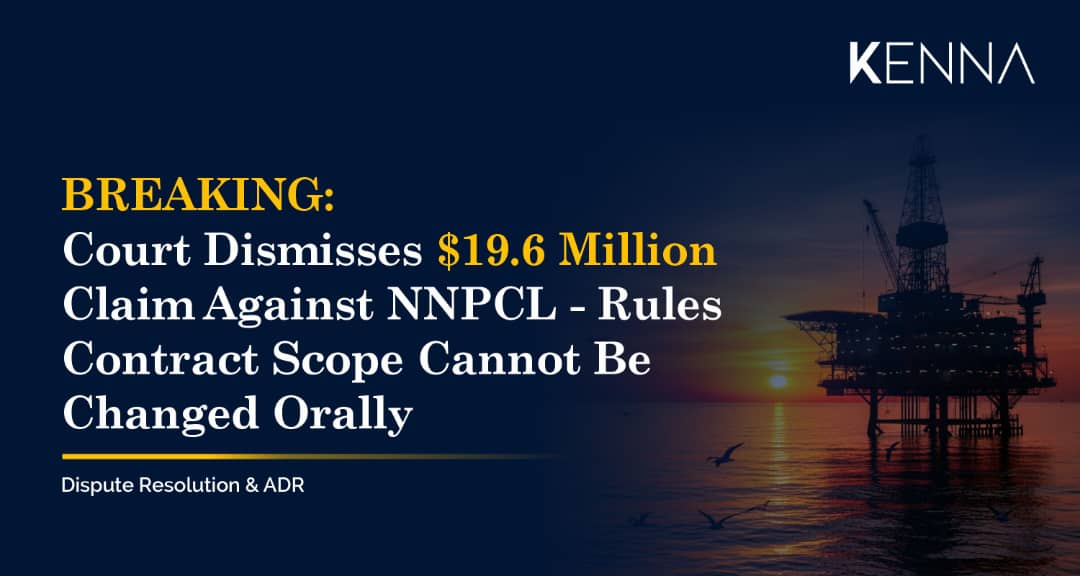
BREAKING: Court Dismisses $19.6 Million Claim Against NNPCL — Rules Contract Scope Cannot Be Changed Orally
In a landmark ruling on Friday, May 22, 2026, the Federal Capital Territory High Court in Abuja threw out a $19.6 million lawsuit filed by Alternate Dimensions Ventures Ltd against the Nigerian National Petroleum Company Limited (NNPCL), affirming a key legal principle: a written contract cannot be expanded through oral agreements or conduct.
Alternate Dimensions had sought $19,600,000 in professional fees, claiming the scope of its Direct Sale, Direct Purchase (DSDP e-pro) contract with NNPCL was orally expanded. Represented by counsel Patrick Peter, the firm argued it was entitled to the revised sum for services rendered under the alleged new terms.
But NNPCL, through its lawyer Ituah Imhanze of KENNA LP, pushed back sharply, arguing that parties are bound exclusively by the clear terms of their written agreement. Imhanze contended that without any written amendment, the claim was legally unsound, and the court agreed.
Delivering judgment, Justice Hamza Mu’azu upheld NNPCL’s defense, stating that the contract was unambiguous and that no evidence was adduced during the trial, which supported the alleged scope expansion. The court further found that NNPCL fully complied with all contractual terms and committed no breach.
Dismissing the suit as meritless, Justice Mu’azu reinforced the doctrine of sanctity of contract: any amendment to a written agreement must be express, unequivocal, and documented, not implied or verbal.
The ruling spares NNPCL from the S19.6 million claim and also a floodgate of similar potential liabilities.


- Deputy (Dep.) Finance Minister Courts Investors to Transform Ghana’s rice Economy June 4, 2026
- Mobile health services in Kenya reduce the risk of stillbirths June 4, 2026
- JustMarkets Research Highlights Global Growth Divergence as a Key Market Driver June 4, 2026
- African Development Bank Group approves $125 million investment in African Trade and Investment Development Insurance (ATIDI) to expand risk insurance capacity in Africa June 4, 2026
- Congo Energy & Investment Forum 2027 to Position Brazzaville as a Hub for Global Energy Deal-Making June 4, 2026
- Africa Skills Hub (ASH) Transitions to ASH Africa as it Marks 10 Years of Impact June 4, 2026
- When women farm better, Eswatini eats better June 3, 2026
- Togo Hosts the 8th Annual Forum of National Volunteer Agencies in the Economic Community of West African States (ECOWAS) Region June 3, 2026
- Indigenous Peoples gravely vulnerable to Ebola epidemic, warn United Nations (UN) independent experts June 3, 2026
- Meeting between Parliamentary Vice-Minister ONISHI and His Excellency (H.E.) Mr. Cosgrow, Principal Minister and Minister for Agriculture, Fisheries and Blue Economy of Seychelles June 3, 2026
- Deputy (Dep.) Finance Minister Courts Investors to Transform Ghana’s rice Economy June 4, 2026
- Mobile health services in Kenya reduce the risk of stillbirths June 4, 2026
- JustMarkets Research Highlights Global Growth Divergence as a Key Market Driver June 4, 2026
- African Development Bank Group approves $125 million investment in African Trade and Investment Development Insurance (ATIDI) to expand risk insurance capacity in Africa June 4, 2026
- Congo Energy & Investment Forum 2027 to Position Brazzaville as a Hub for Global Energy Deal-Making June 4, 2026
- Africa Skills Hub (ASH) Transitions to ASH Africa as it Marks 10 Years of Impact June 4, 2026
- When women farm better, Eswatini eats better June 3, 2026
-

 news6 months ago
WHO REALLY OWNS MONIEPOINT? The $290 Million Deal That Sold Nigeria’s Top Fintech to Foreign Interests
-

 society1 month ago
SOCIAL MEDIA IS NOT A BATTLEFIELD COMMAND – WHY THE NIGERIAN ARMY’S ACTION AGAINST JUSTICE CRACK IS A NATIONAL SECURITY IMPERATIVE
-

 celebrity radar - gossips4 months ago
Dr. Chris Okafor Returns with Power and Fire of the Spirit -Mounts Grace Nation Altar with Fresh Anointing and Restoration Grace on February 1, 2026
-

 celebrity radar - gossips6 months ago
Prophet Kingsley Aitafo Releases 2026 Prophecy: ‘Nigeria Will Rise, but the World Must Prepare for Turbulence’
You must be logged in to post a comment Login
You must log in to post a comment.