
society
Nwobi Political Dynasty Pays Condolence Visit to Udeogu Family in Awgu

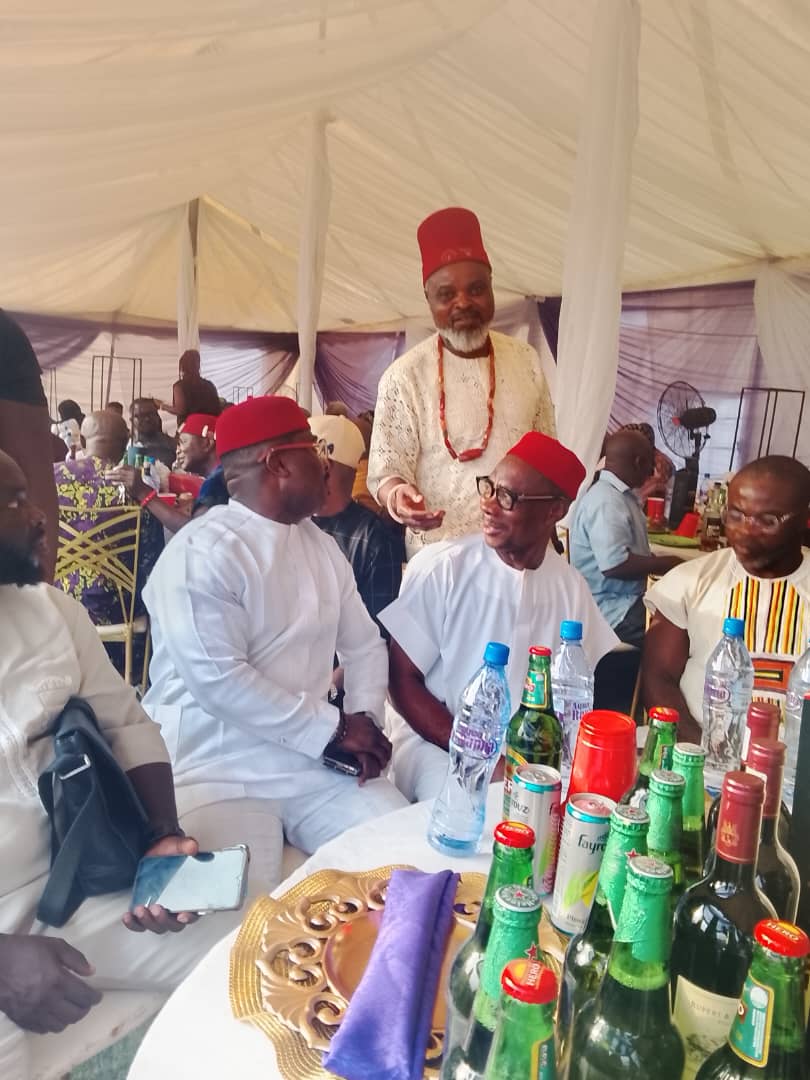
Nwobi Political Dynasty Pays Condolence Visit to Udeogu Family in Awgu.
By George O. Sylvester
In a powerful demonstration of empathy, unity, and responsible leadership, the Nwobi Political Dynasty, led by eminent industrialist, philanthropist, and political leader, High Chief Francis Osy Nwobi, CEO and Managing Director of Fontana Group of Companies, has paid a condolence visit to the family of Late Mrs. Maria Ihunanya Nwigwe Udeogu of Mgbowo, Awgu Local Government Area of Enugu State.
The visit, which took place in an atmosphere of solemn reflection and communal solidarity, was aimed at commiserating with the bereaved family and standing with them during one of the most difficult moments in human existence amid the loss of a loved one. The late Mrs. Udeogu was remembered as a devoted mother, community pillar and woman of dignity whose life left an indelible mark on her family and the wider Mgbowo community.

Speaking during the visit, High Chief Francis Osy Nwobi expressed deep sorrow over the passing of Mrs. Udeogu, describing her death as a significant loss not only to her immediate family but also to the entire Awgu axis. He noted that death, though inevitable, always leaves behind pain and emptiness, especially when it takes individuals whose lives were defined by kindness, resilience and service to others.
High Chief Nwobi urged the family to draw strength from the worthy legacy the deceased left behind, stressing that a fulfilled life is not measured by length of years alone, but by the positive impact made on people and society. He offered prayers for the peaceful repose of the soul of Mrs. Udeogu and asked God Almighty to grant the family the grace, strength and comfort needed to bear the irreparable loss.

The condolence visit was further dignified by the presence of a distinguished entourage, reflecting the depth of respect and solidarity extended by the Nwobi Political Dynasty. Among those present were Chief Gilbert Destiny Onuoha, CEO/Managing Director of Blessed Destiny Energy Ltd; Prince Smart I. Nwobi, CEO Smart (N) Attorney’s INC & the President of the Nigeria Union South Africa (NUSA); Hon. Friday Okolie, former Senior Special Assistant to the Governor; Engr. Simon Igwe, CEO of Bling Furniture and His Royal Highness, Igwe Dr. Godwin Okosisi Nwobi, Ugwundu II of Ugwuleshi Awgu, alongside other notable leaders, professionals and stakeholders.
Their collective presence was widely seen as a strong statement of unity across political, traditional, businessand diaspora leadership structures, underscoring the importance of shared humanity and communal responsibility beyond partisan or economic interests.

Observers noted that the condolence visit aligns with the long-standing tradition of the Nwobi Political Dynasty in promoting people-centered leadership, community cohesion and moral responsibility. Over the years, the dynasty has earned respect across Enugu State and beyond for consistently identifying with grassroots communities during moments of joy and sorrow alike.
For the people of Mgbowo and Awgu at large, the visit served as a reminder that true leadership is not only demonstrated during times of political campaigns or economic prosperity, but also in moments of grief, when compassion, presence and genuine concern matter most.
Members of the Udeogu family, visibly moved by the show of love and solidarity, expressed profound gratitude to High Chief Nwobi and his delegation. They described the visit as deeply comforting and reassuring, noting that such gestures strengthen communal bonds and help families navigate the emotional weight of bereavement.
They further prayed for God’s continued guidance and strength upon the Nwobi Political Dynasty, acknowledging the delegation’s prayers, kind words and moral support as a testament to enduring friendship and leadership rooted in humanity.

As the family prepares to bid their final farewell to Mrs. Maria Ihunanya Nwigwe Udeogu, many in the community continue to celebrate her life, values, and contributions. Her legacy, they say, will live on through the lives she touched and the principles she embodied.
The condolence visit once again reinforces the belief that compassion remains one of the strongest pillars of leadership and community development with an ideal the Nwobi Political Dynasty continues to uphold with consistency and dignity.






Viral Hantavirus Reports Spark Fresh Anxiety as Prophet Aitafo’s 2025 Warning Resurfaces
Kingsley Aitafo’s widely shared prophecy about a coming “deadly disease” has resurfaced online amid growing concern over reports of a new Hantavirus outbreak in parts of Europe, particularly France.
In a viral video from his “2025 Prophecy” message, the cleric warned of a disease outbreak he described as potentially “more brutal than COVID-19,” urging followers to engage in fervent prayers against a looming global health emergency.
“We should pray against a deadly disease that is more brutal than COVID-19. It is coming on the earth. I cannot specify when, but we should pray against it,” the prophet declared in the footage.
The resurfaced prophecy has triggered intense debate across social media platforms, with many followers drawing parallels between the warning and recent international reports surrounding Hantavirus infections.
Rising Concern Over Hantavirus
Hantavirus is a rare but potentially severe viral infection commonly transmitted through exposure to infected rodent urine, droppings, or saliva. Some strains can lead to serious respiratory complications or hemorrhagic fever.
Although health authorities have not declared a global emergency, reports of increasing infections have heightened public concern, especially given lingering memories of the COVID-19 pandemic.

Medical experts continue to caution against panic, stressing that surveillance systems and international response mechanisms are now far more prepared than they were during the early stages of COVID-19.
Health Precautions Advised
Health authorities and medical professionals recommend the following precautionary measures:
Avoid contact with rodents, their droppings, urine, or nesting areas.
Properly disinfect potentially contaminated environments.
Maintain strict hygiene practices.
Seek urgent medical care if symptoms such as sudden fever, muscle pain, fatigue, or breathing difficulties develop.
As of press time, Nigerian authorities have not issued any formal travel advisory linked to the reported outbreak in Europe, though monitoring measures at international entry points are believed to have been strengthened.
*From Visa Bans to Value Chains: Why Europe must structure sovereign mobility for growth*
By Babatunde Aduloju
The recent visa restrictions introduced by the United Kingdom government on nationals connected to Saint Lucia’s Citizenship by Investment (CBI) program have triggered an important policy moment, not just for the UK, but for the broader European Union.
At first glance, this may appear to be a routine tightening of immigration controls. It signals something deeper: a growing discomfort within Europe about how to manage the intersection of global mobility, private capital, and economic sovereignty.
But the current response, restrictions, fragmentation, and reactive regulation, misses the bigger opportunity.
Global mobility is no longer just about movement. It is about capital, consumption, and economic influence.
And right now, Europe is under-leveraging one of the most powerful drivers of modern economic growth: the Sovereign Mobility Investor.
*The Economic Reality Europe Cannot Ignore*
Globally mobile investors are not passive travelers. They are active economic participants who inject capital across multiple sectors simultaneously.
To understand the scale:
• Global tourism receipts reached approximately $1.5 trillion annually, with Europe capturing nearly 50% of international tourist arrivals.
• High-net-worth individuals (HNWIs) account for a disproportionate share of premium travel and luxury consumption, often spending 5–10x more per trip than average travelers.
• The global luxury tourism and hospitality market is projected to exceed $1 trillion in the next decade, driven significantly by cross-border wealth mobility.
• International real estate investment linked to mobility programs contributes hundreds of billions of euros annually, particularly in gateway cities and emerging tourism destinations.
But these figures only scratch the surface.
A single Sovereign Mobility Investor family typically contributes across five interconnected economic layers:


-. Travel & Aviation
• First- and business-class international flights
• Private aviation and charter services
• Frequent cross-border movement generating recurring airline revenues
-. Hospitality & Tourism
• Luxury hotels, extended stays, branded residences
• High-value tourism experiences (medical tourism, cultural tourism, leisure travel)
• Destination spending across restaurants, entertainment, and services
-. Real Estate & Infrastructure
• Acquisition of residential and commercial property
• Participation in resort and mixed-use developments
• Investment in urban regeneration and tourism infrastructure
-. Financial Services & Capital Markets
• Banking relationships across jurisdictions
• Portfolio diversification into European assets
• Participation in private equity, venture capital, and structured investment vehicles
-. Lifestyle & Consumption Economies
• Luxury retail (fashion, automotive, art, jewelry)
• Education (private schools, universities)
• Healthcare systems (private care, specialized treatment)
This is not migration. This is an integrated economic ecosystem.
*The Rise of the Sovereign Mobility Investor*
Over the last decade, a structural shift has taken place.
High-net-worth individuals from Africa, Asia, and the Middle East, particularly from countries like Nigeria, India, South Africa, and Lebanon, have increasingly turned to second citizenship and residency programs as tools for:
• global market access,
• risk diversification,
• family security,
• business scalability,
• and participation in international economies.
In Africa alone, outbound investment migration has grown significantly, with Nigerians consistently ranking among the top participants in global mobility programs.
Contrary to outdated narratives, these individuals are not fleeing instability, they are strategically positioning themselves within global value chains.
They are:
• founding companies in multiple jurisdictions,
• investing in global startups,
• participating in cross-border trade,
• and contributing to international tax and consumption systems.
They are, in effect, informal ambassadors of transnational economic integration.
*Europe’s Policy Challenge: Fragmentation vs. Strategy*
Despite benefiting from global capital flows, Europe’s approach to sovereign mobility remains inconsistent.
Across the European Union:
• Some countries have scaled back or eliminated investor visa programs (e.g., golden visa reforms).
• Others maintain independent frameworks with varying standards.
• Regulatory bodies emphasize risk, compliance, and reputational concerns, often without unified economic strategy.
The result is a fragmented system that:
• discourages high-quality investors,
• creates policy uncertainty,
• and weakens Europe’s global competitiveness relative to regions like the Middle East and Asia, where mobility-linked investment is aggressively structured and incentivized.
The UK’s decision regarding Saint Lucia reflects this tension: a necessary concern for oversight, but an incomplete solution for economic engagement.
*The Strategic Opportunity: A Tiered Sovereign Mobility Framework*
Europe has an opportunity to lead, not by restricting mobility, but by structuring it.
At HOC Capital Club, we propose a Three-Tier Sovereign Mobility Engagement Framework:
Tier 1: Compliance, Governance & Trust Infrastructure
Establish a unified European baseline for mobility-linked engagement:
• Cross-border AML and KYC integration
• Shared intelligence platforms between EU and partner jurisdictions
• Standardized due diligence for CBI and residency-linked investors
• Digital identity verification systems
• Policy alignment between immigration, finance, and security agencies
Objective: Remove opacity and build trust.
Tier 2: Economic Participation & Sector Alignment
Link mobility access directly to economic contribution:
• Minimum investment thresholds tied to priority sectors
• Structured investment pathways in:
o tourism and hospitality,
o green energy,
o healthcare infrastructure,
o digital economy and fintech,
o logistics and supply chain ecosystems
• Regional development incentives for underinvested EU zones
Objective: Convert mobility into measurable economic output.
Tier 3: Strategic Sovereign Mobility Partnerships
Integrate investors into Europe’s long-term economic vision:
• Co-investment platforms with governments and development banks
• Public-private partnerships for infrastructure and tourism
• Innovation ecosystem participation (tech hubs, venture ecosystems)
• Policy dialogue platforms connecting investors and regulators
Objective: Transform investors into long-term economic partners.
*The Financial Multiplier Effect*
What Europe must recognize is the compounding nature of sovereign mobility capital.
A €2 million investment does not remain €2 million.
It triggers:
• construction jobs,
• tourism revenue,
• local business growth,
• tax contributions,
• secondary investments,
• and long-term economic activity.
For example:
• A luxury resort backed by mobility-linked capital can generate tens of millions annually in tourism revenue.
• A single high-net-worth investor relocating partially to Europe can contribute €200,000–€500,000 annually in direct consumption.
• Portfolio investments in startups and SMEs can unlock innovation-driven growth across sectors.
When aggregated across thousands of investors, the impact becomes systemic.
*Why Europe Is at Risk of Losing This Opportunity*
Other regions are moving faster.
• The Middle East is aggressively positioning itself as a hub for global mobility capital.
• Asia is integrating investment migration with innovative ecosystems.
• Caribbean nations continue to refine their CBI frameworks as economic tools.
If Europe continues to approach sovereign mobility primarily through restriction:
• capital will be redirected,
• investors will seek alternative jurisdictions,
• and Europe’s influence over global mobility standards will decline.
*The Role of HOC Capital Club*
This is where HOC Capital Club becomes critical.
We are building a platform that connects:
• policymakers,
• sovereign mobility investors,
• institutional capital,
• and global economic ecosystems.
Through our Sovereign Mobility Investor Program, we provide:
• structured investor engagement frameworks,
• policy advisory for governments and institutions,
• curated investment pipelines aligned with national priorities,
• and governance-driven platforms for cross-border collaboration.
We position sovereign mobility not as a loophole, but as a lever for structured economic growth.
*A Call to Action for Europe*
The decision by the United Kingdom government on Saint Lucia should not end the conversation.
It should begin a new one.
Europe must decide:
Will it remain reactive, closing doors and managing risk?
Or will it lead, designing the frameworks that define the future of global mobility?
Because the reality is clear:
• Capital is mobile.
• Talent is mobile.
• Opportunity is mobile.
The regions that succeed will not be those that stop movement.
They will be those that structure it, govern it, and align it with growth.
*Conclusion: Building Economies Without Borders*
Sovereign mobility is not a threat to Europe.
It is an opportunity, if properly structured.
The future global economy will not be defined by static borders, but by connected systems of capital, policy, and people.
Europe has the regulatory strength, institutional depth, and economic scale to lead this transformation.
But leadership requires a shift in mindset:
-From restriction to strategy.
-From fragmentation to coordination.
-From control to structured collaboration.
At HOC Capital Club, we stand ready to partner with Europe in building that future.
Because the next era of global growth will not be built within borders.
It will be built across them.
Aduloju is the Director, Policy & Strategic Development, HOC Capital Club
society
AWARENESS WALK LOOMS AS CONCERNED FGC ALUMNI REFUSE TO BACK, VOWS TO CONTINUE PEACE WALK AND LAWSUIT DESPITE MINISTER’S APPEAL

AWARENESS WALK LOOMS AS CONCERNED FGC ALUMNI REFUSE TO BACK, VOWS TO CONTINUE PEACE WALK AND LAWSUIT DESPITE MINISTER’S APPEAL
A protracted meeting between the Federal Ministry of Education and old students’ associations ended in a stalemate on Thursday, as the President of the FGC Kano Old Students Association (FGCKOSA) flatly rejected the Minister’s plea to suspend planned protests and legal action over a controversial land concession deal.
The high-tension session, which lasted over four hours on May 7, 2026, brought together the Honourable Minister of Education, Dr. Morufu Olatunji Alausa, the Minister of State for Education, Prof. Suwaiba Said Ahmad, and the leadership of the Unity Schools Old Students Association (USOSA) alongside FGCKOSA.
While the Ministry sought to de-escalate the growing crisis, the alumni dug in their heels, insisting that the proposed land swap and concession arrangement at Federal Government College Kano represents an existential threat to the institution.
“We Will Not Be Silenced” – FGCKOSA President
In a dramatic turn during the meeting, the National President of FGCKOSA, Shoyinka Shodunke, told the Ministers in clear terms that the association’s planned awareness rally for May 9, 2026, would proceed as scheduled. He also confirmed that the legal action already filed by the alumni would not be withdrawn.
“The process has excluded us from the beginning. We have lost confidence in this concession plan,” Shodunke stated. “The awareness rally will hold, and our litigation continues. We are matching the commercial enterprise’s proposal dollar-for-dollar to preserve our land, but we will not be intimidated into silence.”
Shodunke formally reiterated the alumni’s offer to match the reported infrastructure proposal from the commercial bidder, insisting that school land must be preserved for future generations of students.
USOSA Demands Suspension, Backs Kano Alumni
USOSA, led by President General Michael Magaji, backed FGCKOSA’s hardline position, raising strong concerns over the commercialization of Unity School assets, lack of stakeholder consultation, and threats to the legacy and security of the schools.
USOSA demanded the immediate and unconditional suspension of the concession plan, emphasizing that alumni associations have independently delivered projects worth hundreds of millions of naira across Unity Schools without selling off an inch of school land.
Minister Acknowledges Concerns but Appeals for Calm
In response, Dr. Alausa acknowledged the developmental role USOSA has played in bridging infrastructure gaps caused by low funding over the past 20 years. He thanked the alumni for their contributions but maintained his support for the concession as part of the Ministry’s infrastructure renewal strategy.
The Minister appealed directly to FGCKOSA to call off the May 9 rally and withdraw the lawsuit, warning that confrontation could harm the very institutions the alumni seek to protect. He promised to work with USOSA on future Public-Private Partnership (PPP) initiatives, starting with Kings College, Lagos, where alumni have expressed interest in taking over management. That proposal is expected to be submitted to the Federal Executive Council in the coming weeks.
The Minister also handed USOSA a copy of the Ministry’s PPP guidelines, inviting them to develop a value proposition for PPP opportunities across Unity Schools nationwide.
No Resolution in Sight
Despite the Minister’s outreach, the meeting ended inconclusively, with both sides unwilling to yield on the core issue of FGC Kano’s land. USOSA and FGCKOSA have pledged to continue constructive engagement with the Ministry in principle, but with the rally and legal action still firmly on the table, tensions remain dangerously high.
As the May 9 deadline approaches, all eyes are now on Kano to see whether the government will act to stop the rally or allow the dispute to spill into the streets and the courts.
— Signed by the Secretary General, FGCKOSA


- Rhino Resources Joins African Energy Week (AEW) as Gold Sponsor as Southern African Exploration Expands May 8, 2026
- Levene Energy Joins African Energy Week (AEW) as Gold Sponsor Amid Regional Expansion and Market Diversification May 8, 2026
- Gas Supply in the Age of Artificial Intelligence (AI): Can Africa’s Natural Gas Power the Continent’s Digital Future? May 8, 2026
- Merck Foundation and African First Ladies are Making History in Africa by Training the First Oncologists and Cancer Care teams in their Countries May 8, 2026
- Seychelles participates in United Nations Educational, Scientific and Cultural Organization (UNESCO) forum marking the International Day for Small Island Developing States May 8, 2026
- African Petroleum Producers Organization (APPO) Secretary General Ghezali to Address African Energy Week (AEW) 2026 as African Energy Bank Nears Launch May 8, 2026
- Petralon Energy Scales Dawes Island Output, Joins African Energy Week (AEW) 2026 as Diamond Sponsor May 8, 2026
- Giving Thanks for a Year of Petrine Service: Message to His Holiness Pope Leo XIV May 8, 2026
- Targeting 250,000 bpd by 2030, First Exploration & Petroleum Development Company (First E&P) Joins African Energy Week (AEW) 2026 as Diamond Sponsor May 8, 2026
- From Artificial Intelligence (AI) to project profiles: ESI Africa has the stories to balance opinions May 8, 2026
- Rhino Resources Joins African Energy Week (AEW) as Gold Sponsor as Southern African Exploration Expands May 8, 2026
- Levene Energy Joins African Energy Week (AEW) as Gold Sponsor Amid Regional Expansion and Market Diversification May 8, 2026
- Gas Supply in the Age of Artificial Intelligence (AI): Can Africa’s Natural Gas Power the Continent’s Digital Future? May 8, 2026
- Merck Foundation and African First Ladies are Making History in Africa by Training the First Oncologists and Cancer Care teams in their Countries May 8, 2026
- Seychelles participates in United Nations Educational, Scientific and Cultural Organization (UNESCO) forum marking the International Day for Small Island Developing States May 8, 2026
- African Petroleum Producers Organization (APPO) Secretary General Ghezali to Address African Energy Week (AEW) 2026 as African Energy Bank Nears Launch May 8, 2026
- Petralon Energy Scales Dawes Island Output, Joins African Energy Week (AEW) 2026 as Diamond Sponsor May 8, 2026
-

 news5 months ago
WHO REALLY OWNS MONIEPOINT? The $290 Million Deal That Sold Nigeria’s Top Fintech to Foreign Interests
-

 society5 days ago
SOCIAL MEDIA IS NOT A BATTLEFIELD COMMAND – WHY THE NIGERIAN ARMY’S ACTION AGAINST JUSTICE CRACK IS A NATIONAL SECURITY IMPERATIVE
-

 celebrity radar - gossips3 months ago
Dr. Chris Okafor Returns with Power and Fire of the Spirit -Mounts Grace Nation Altar with Fresh Anointing and Restoration Grace on February 1, 2026
-

 celebrity radar - gossips5 months ago
Prophet Kingsley Aitafo Releases 2026 Prophecy: ‘Nigeria Will Rise, but the World Must Prepare for Turbulence’