
celebrity radar - gossips
Obaship: Ifa rejects MC Oluomo (1) By Tunde Odesola

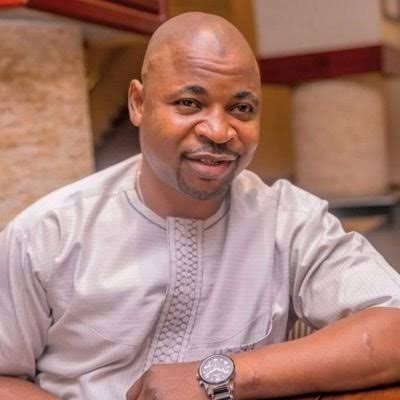
Obaship: Ifa rejects MC Oluomo (1) By Tunde Odesola
MC Oluomo- They wear the nation’s green-white-green flag as uniform. They have their own army, arms and ammunition. Their constitution is superior to the laws of the land. They’re state-backed bandits. They’re a clan of killers. They’re the National Union of Road Transport Workers.

Though Lagos is the centripetal force in this discourse, it’s no breaking news that killings and violence by NURTW members have a nationwide centrifugal spread. From Oyo to Kwara, Sokoto, Kano, Borno, Benue, Anambra, Delta, Rivers etc imprints of blood have marked the steps of the NURTW ountrywide since its creation in 1978.
Lagos is a unique city. After berthing at the ancient Benin Kingdom, it was on Lagos soil that Portuguese colonialists subsequently stepped their feet in the 15th Century, foraging hinterlands, years after, to amalgamate peoples of different languages, religions and cultures into what is today known as the unworkable contraption called Nigeria.

The indigenous name of Lagos is Eko. Eko, which was occupied then by the Awori, was renamed Lago de Curamo by Portuguese explorer, Rui de Sequeira, – after the healing lakes of Portugal.
The panegyrics of Lagos, ‘Eko a r’omi sa legbe legbe’ and ‘Eko akete, ilu ogbon’, define the aquatic splendour and grit of a territory founded on commerce long before the days of European invasion that made Badagry the first slave port in the country.

On its official website, the Lagos State Government says, “Lagos Gross Domestic Product (GDP) accounted for 26.7% of Nigeria’s total GDP and more than 50% of Nigeria’s non-oil GDP. It (Lagos) accounts for over 80% of the country’s foreign trade flows, and generates over 50% of Nigeria’s port revenues…
“Lagos economy, with an estimated population of 24 million, is larger than any other economy in the ECOWAS sub-region despite the rebasing of Ghana’s GDP.
“Lagos population is growing 10 times faster than that of New York and Los Angeles, and more than the population of 32 African nations combined, the state’s population is expected to hit the 35 million mark in 2020.”
The above-quoted self-description by Lagos State suggests that the government knows the important role Lagos should play in the socio-cultural and economic rebirth of the South-West, in particular, and that of Nigeria, in general.
Not to recognise the weight of history and grace of providence on Lagos’ shoulders is for Governor Babajide Sanwo-Olu to string corn cobs and tie it across the waist in the congregation of chickens.
Sadly, an abomination against the gods is about to be committed in the illustrious land of Lagos. The gods are not to blame if Lagos seas overflow their banks consequently.
That the Chairman, National Union of Road Transport Workers, Lagos State chapter, Musiliu Akinsanya aka MC Oluomo, is eyeing the vacant post of the Baale of Oshodi, is no secret.
But it’s highly distressing to observe that Lagos State, for potfuls of questionable electoral votes from the NURTW, appears more than primed to negate Yoruba culture and tradition by enthroning MC Oluomo as the next traditional ruler of Oshodi.
There’s no smoke without fire, goes a popular saying. Although MC Oluomo hasn’t publicly declared interest in the vacant post of Baale of Oshodi, recent activities, especially in the music industry, strengthen the belief MC Oluomo might be hand in glove with the Lagos State government over the Oshodi obaship stool.
Many musicians, especially those of the Fuji genre, have been singing the praises of MC Oluomo, recently calling him the next king of Oshodi. Chief among these musicians is the Toast, no, I mean Toad of Fujii, who has been calling MC Oluomo king of Oshodi – in his croaky voice.
If MC Oluomo had a jot of blue blood coursing through his veins, musicians would’ve been assaulting listeners’ eardrums with Oluomo’s kingly panegyrics in the last 15 years, at least.
Before and after his rise to notoriety, not a single musician, living or dead, has ever called MC Oluomo a prince. Is it possible for a limelight-loving gangster not to disclose his royal pedigree and ‘spray’ money while his princehood is being sung? The answer is a capital NO! How much of the over N123bn accruing annually to the Lagos NURTW would MC Oluomo spend for musicians to call him the king of kings and lord of lords?
I beseech Governor Sanwo-Olu not to break the calabash of Yoruba culture by enthroning MC Oluomo, a man found unworthy by Ifa for kingship.
World renowned Ifa scholar, Chief Ifayemi Elebuibon, says, “Someone with physical challenges or who is a thug must not be made king, according to the body of Ifa knowledge. Ifa won’t choose such a person.”
MC Oluomo limps badly with a swag.
Supporting his assertion with Ifa verses, Elebuibon recalls, “Once upon a time, the frog, which the Yoruba call akere, was forewarned to beware of immoderate exuberance.
“One day, the frog went to his farm. As he was tilling the ground, his hoe hit a pot in the ground. He dug out the pot and found destiny-changing sum of money in it.
“As he was contemplating his newfound wealth, word came that his wife had given birth; his joy grew in leaps and bounds. He didn’t wait to get home, he sent word to all and sundry to come to his farm and partake in marathon celebrations with him right from the farm.
“He sent for all the drummers, palm wine tappers and bushmeat sellers in the land. It was a great occasion. In the merrymaking, word came from the kingmakers that the frog had been selected as the next king of the land; he went overboard with joy – dancing, jumping, sweating and prancing from one end of town to the other.
“As he jumped up for the umpteenth time, he landed wrongly, and krahah! He broke his thighs. The frog limped in pain to the kingmakers, saying he was ready to be crowned. Alas, he was told a physically challenged individual cannot be king. That was how the frog missed being crowned king.”
Aside from physical disability, Elebuibon also describes violence as a vice that can disqualify an aspirant from being made king. A 2010 documentary by British-American journalist, broadcaster and author, Louis Theroux, confirms MC Oluomo’s violent nature, completely ruling him out of the race for Oshodi baale stool.
To buttress the density of killings and violence around MC Oluomo and his NURTW, his confidant and aide, Kunle Mamowora, who conducted Theroux round Lagos during the documentary, was shot dead few houses to his father’s residence on Mosaku Street, Oshodi, in October 2015.
In January 2008, the Lagos State Chairman, NURTW, Alhaji Saka Saula, was shot dead in his Iyana Ipaja home, Lagos. In May 2017, MC Oluomo was accused of masterminding the killing of Rasaq Bello, aka Hamburger, in the Sogunle area, near Oshodi, during the local council primaries of the All Progressives Congress. Hamburger was the state treasurer of the tricycle operators association, a branch of the NURTW. MC Oluomo vehemently denied the allegation. But a leader of the NURTW in the Oshodi area, Taoreed Adedigba, aka Talo Skibo, who was a Peoples Democratic Party supporter, and his pro-PDP faction, accused MC, a staunch APC member, of being behind the killing. In 2019, Talo Skibo himself was arrested and accused of killing Mamok.
Also, a popular member of the NURTW in Oshodi, Olayemi Eniola, popularly known as Esi Oluwo, was killed in April 2015, when a clash broke out during an APC rally in Oshodi. Esi Oluwo was a staunch member of the PDP before he defected to the APC shortly after meeting with a national leader of the APC who lives in Ikoyi.
In the documentary, Law and Disorder in Lagos, Theroux, who was born in Singapore on May 20, 1970, to an English mother, Anne, and an American father, Paul, explores the marriage between governance and gangsterism, wondering why thugs are above the law.
To be continued.
Email: [email protected]
Facebook: @tunde odesola
Twitter: @tunde_odesola




celebrity radar - gossips
Adron Homes Celebrates Visionary Chairman, Aare Adetola Emmanuel King, at 51
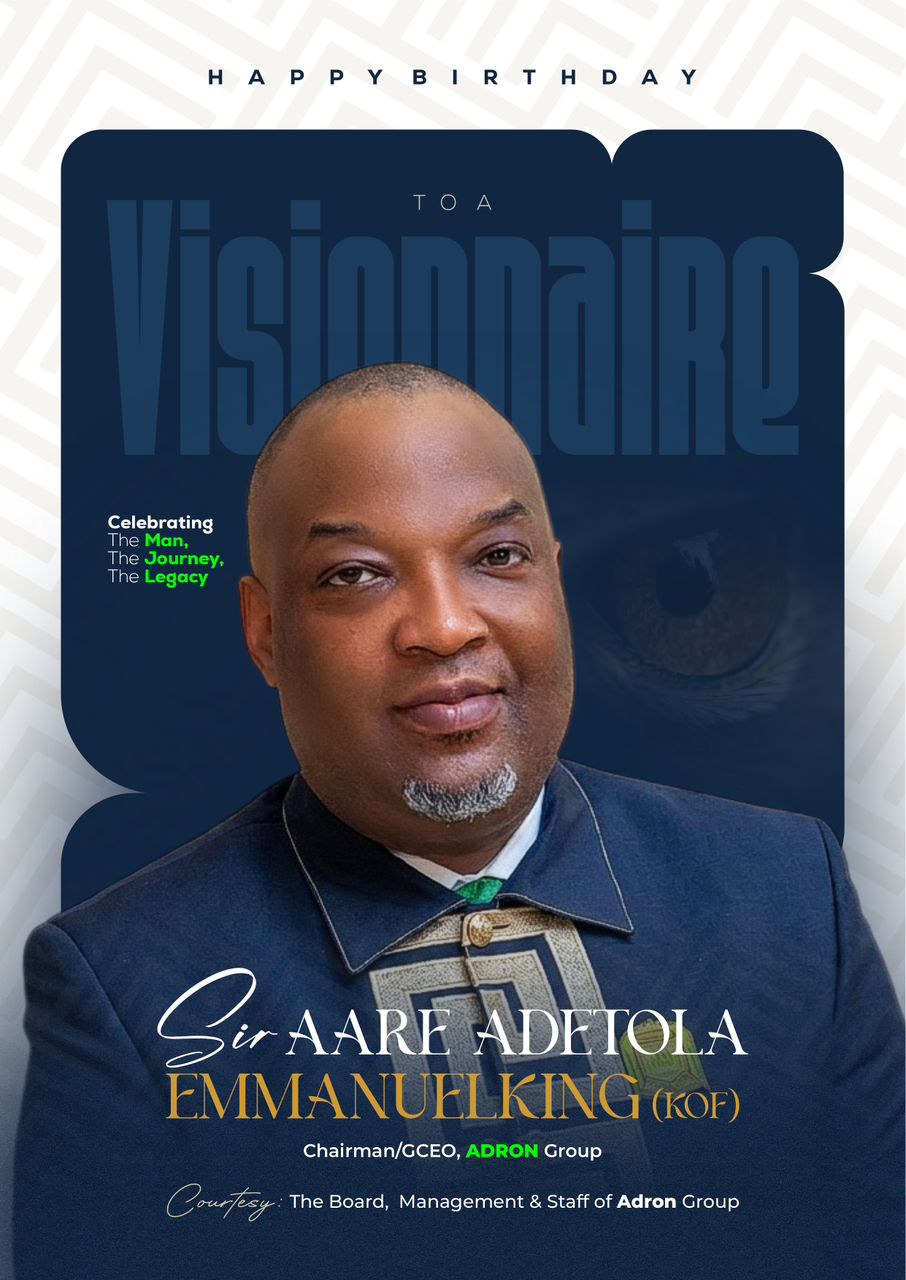
Adron Homes Celebrates Visionary Chairman, Aare Adetola Emmanuel King, at 51
The management and staff of Adron Homes and Properties Limited have joined family, friends, associates, and well-wishers across the globe to celebrate their Chairman and Chief Executive Officer, Aare Adetola EmmanuelKing, as he marks his 51st birthday.

In a statement released by the company, the milestone was described as a celebration of an exceptional leader whose vision, resilience, and entrepreneurial brilliance have not only transformed Adron Homes into a household name in Nigeria’s real estate sector but have also redefined affordable housing across the country.
Under his dynamic leadership, Adron Homes has continued to expand its footprint, delivering value-driven residential solutions while empowering thousands of Nigerians with opportunities for home ownership. His commitment to excellence, innovation, and customer satisfaction has remained the driving force behind the company’s sustained growth and industry leadership.
The statement further highlighted Aare EmmanuelKing’s passion for nation-building and community development, noting his significant contributions to job creation, youth empowerment, and the promotion of socio-economic development through real estate investments.
“As a leader, mentor, and visionary, Aare Adetola EmmanuelKing has consistently inspired a culture of excellence, integrity, and dedication within the organization. His ability to turn bold ideas into reality continues to position Adron Homes as a trailblazer in the industry,” the statement read.
The company expressed profound gratitude for his steadfast leadership and prayed for continued wisdom, strength, and sound health as he embarks on another year of impactful achievements.
As he celebrates his 51st birthday, the entire Adron Homes family proudly honours a man whose legacy continues to shape the future of real estate in Nigeria.
Happy 51st Birthday, Aare Adetola EmmanuelKing!
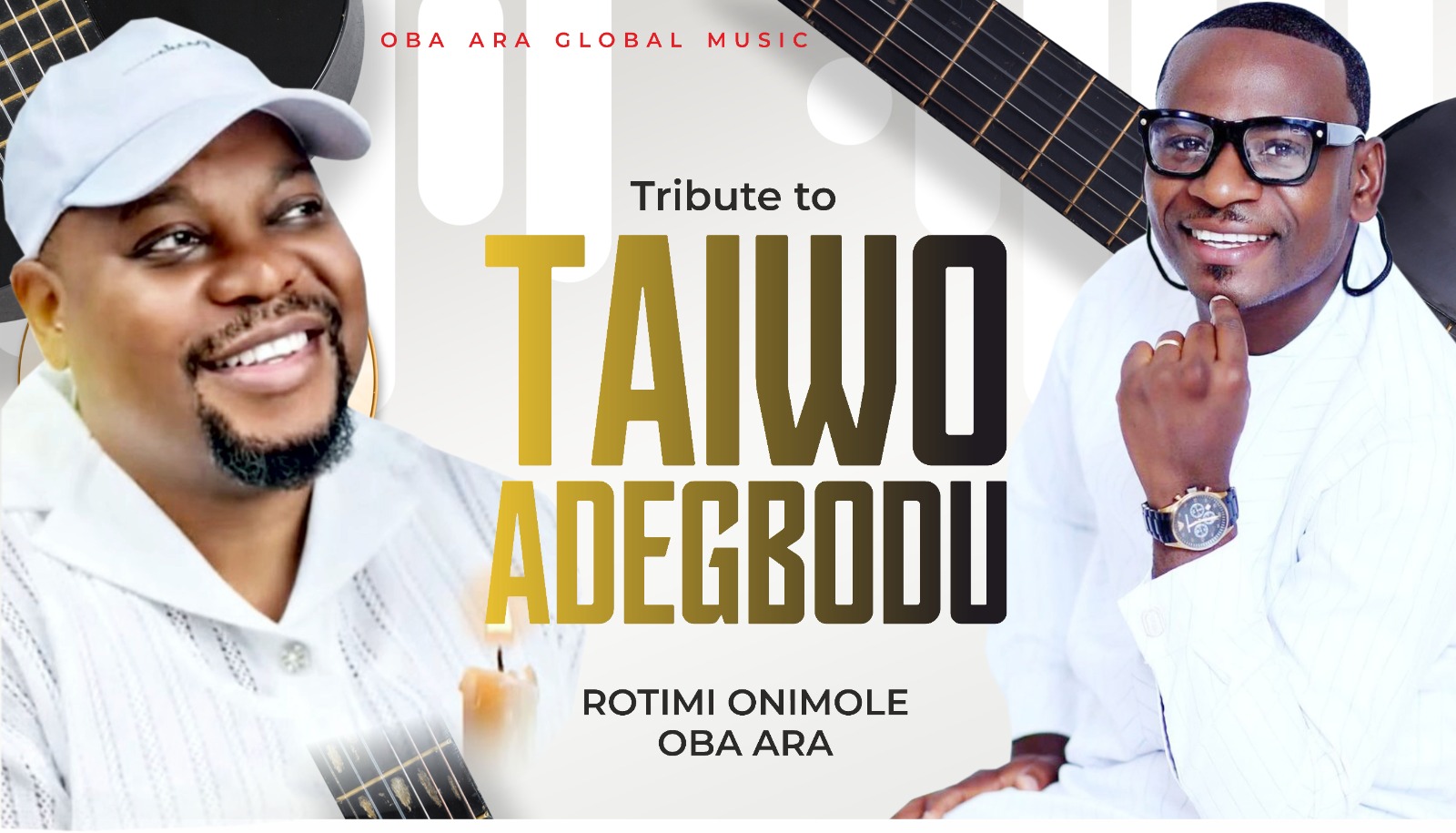
Oba Ara Releases Emotional Tribute to Late Taiwo Adegbodu
Taofik Afolabi
The gospel music community continues to grieve the painful loss of Taiwo Adegbodu, a beloved figure whose sudden departure left a deep void among fans, colleagues, and loved ones. In response to this loss, renowned gospel minister Rotimi Onimole, popularly known as Oba Ara, has released a moving tribute song that captures both the sorrow of the moment and the enduring legacy of the late singer.
Oba Ara, a proud son of Isale Eko, channels raw emotion throughout the song, using heartfelt lyrics and soul-stirring melodies to reflect on his personal connection with Taiwo Adegbodu. In the tribute, he openly expresses how deeply the news of Adegbodu’s passing shook him, describing it as a painful and unexpected loss that is difficult to come to terms with.
The song goes beyond mourning, it celebrates the life, ministry, and impact of Taiwo Adegbodu. Oba Ara highlights the late artist’s dedication to spreading the gospel through music, his inspiring voice, and the spiritual influence he had on many within and beyond Nigeria. Through powerful verses, he paints a picture of a man who lived for God and touched countless lives through his ministry.
Listeners have described the tribute as both comforting and deeply emotional, as it resonates with the collective grief of the gospel music community. It serves as a reminder that although Taiwo Adegbodu is no longer physically present, his music, message, and legacy will continue to live on.
In honoring his late colleague, Oba Ara not only pays his respects but also offers a source of healing for fans and fellow ministers, using music as a tool to process grief and celebrate a life well lived.
celebrity radar - gossips
Buratai, Fagbemi , Shagaya, Olofa, Others Eulogise Olowu Kuta’s Olori On 60th Birthday, Foundation Launch

Buratai, Fagbemi , Shagaya, Olofa, Others Eulogise Olowu Kuta’s Olori On 60th Birthday, Foundation Launch
Eminent personalities across the Nigeria stormed the TFK Event Centre, Bala Mohammed Way, Guzape, Abuja, to celebrate the 60th birthday of Olowu Kuta’s Olori, Queen Jumai Amoke and her Foundation Launch on Saturday 28, March 2026.

From former Chief of Army Staff, Lt Gen TY Buratai rtd, to the Minister of Justice and Attorney-General of the Federation, Prince Lateef Fagbemi; Olofa of Offa, HRM Oba Mufutau Gbadamosi. Even top businesswoman and socialite, Chief (Mrs) Bola Shagaya, was in attendance.


Other dignitaries were newly promoted Deputy Inspector-General of Police and former AIG Zone 2 , Lagos , Adegoke Fayoade, Major General Abdumalik, Major General Samuel Adebayo rtd (Fmr CDI);
Major General Anthony Omozoje rtd (Fmr Copp);
Alhaji Tajudeen Owoyemi (Asiwaju of Offa and CEO Radisson Hotel Nigeria;
Dr Waheed Olagunju, former managing director of Bank of Industry, Oniba of Iba, Lagos State, HRM Oba Dr Suleiman Raji ;
Justice Falola, Olu of Ile-Ogbo , Oba Adetoyese amongst many traditional rulers and captains of industry too numerous to mention.
Speaking at the occasion, the Chief Host, Olowu of Kuta, HRM Oba Dr Adekunle Oyelude Makama, CON , Tegbosun iii, who is also the husband of the celebrant commended Queen Jumai for ‘ her slender arms full of kindness’ to establish such humanitarian Foundation, ‘Amoke Children and mother in Need Foundation’ at a time Nigerians are going through economic crisis occassioned by the global meltdown.
Olowu also commended her steadfastness and love for the less privileged and downtrodden.
The monarch refrenced the task before his wife’s humanitarian gesture said her best is yet to come.
” Olori Amoke Jumai, I celebrate you. You will celebrate 70, 80, 90 and continue to shine as you continue to put a smile on people’s faces. I love you, “Olowu Kuta added.
To Lt Gen Buratai, a former army chief and former Nigerian Ambassador to Benin Republic, the reward of hard work is more work.
Buratai, who also doubles as Balogun Agba of Owu Kuta, a chieftaincy title reserved for a generalismo congratulated Queen Jumai for attaining the age of 60 in good health.
The retired army General said he’s not surprised by the turn out of eminent personalities across the country to celebrate the Olowu Kuta’s Olori because she merited it through her hospitality to all, adding that Allah the most merciful, most beneficial would accept all her act of ibadah.
The minister of Justice, Prince Fagbemi, was full of praises for Queen Jumai for deeming it fit to have a place in her heart to accommodate the needy and less privileged in ‘our society.’
Prince Fagbemi urged the guests to contribute generously to support the Foundation in order to continue to alleviate poverty and put a smile on the faces of the people.
” I congratulate you on your 60th birthday and Foundation Launch. I wish you many happy returns of the day and many more fruitful services to the country and motherland”, Prince Fagbemi added.
The celebrant, Queen Jumai who was grining from ear to ear thankfully said she was excited by the turn out and the response of the people to her foundation.
Queen Jumai, however, promised to continue to use her resources and donations received for the good of the needy and less privileged in the society.
” I want to appreciate my own Kabiesi Olofa of Offa , for his presence and im I’m using him as a point of contact to all other Kabiesis present here, the minister of justice and Attorney-General, you’re welcome, sir; Mrs Bola Shagaya, I salute your enterprise, Lt Gen Buratai, I’m grateful, sir; DIG Fayoade, Justice Falola and other dignitaries too numerous to mention, I thank you, all. To my darling husband, Kabiesi Olowu , I thank you immensely for your support. And to my family and friends, I thank you , all. E se pupo!”, she said.


-

 society6 months ago
Religion: Africa’s Oldest Weapon of Enslavement and the Forgotten Truth
-

 news4 months ago
WHO REALLY OWNS MONIEPOINT? The $290 Million Deal That Sold Nigeria’s Top Fintech to Foreign Interests
-

 society6 months ago
“You Are Never Without Help” – Pastor Gebhardt Berndt Inspires Hope Through Empower Church (Video)
-

 celebrity radar - gossips2 months ago
Dr. Chris Okafor Returns with Power and Fire of the Spirit -Mounts Grace Nation Altar with Fresh Anointing and Restoration Grace on February 1, 2026