
celebrity radar - gossips
Obi Cubana and the drug pushers

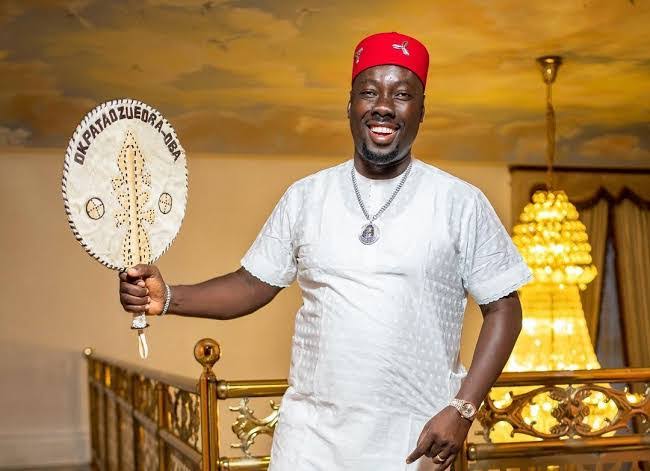
Obi Cubana and the drug pushers By Tunde Odesola
OBI CUBANA– Globally, crime is the fugitive that lurks behind every insane quest for money, power and drugs. In most underdeveloped countries, Nigeria inclusive, crime walks unashamedly naked, bigger than the aforementioned threesome, bending the arms of the law over backwards like a twisted branch of a tree. In developed countries, however, crime – silent and unobtrusive – works hand in glove with money, power and drugs, wreaking havoc like cancer.

Let’s talk about numbers. For certain, three is a very powerful number in the physical and metaphysical realms. The integrality of three is universally seen in the body, spirit and soul composition of man, and in the three elements that make up the world – heaven, earth and water, as well as the division of day into morning, afternoon and night. When something happens three times, it’s neither a mistake nor a coincidence.
In Christian orthodoxy, the oneness of God the Father, the Son, and the holy spirit in a blessed threeness summarises the sojourn of man, his fall, and salvation. The horn-headed Lucifer tempted Christ thrice. Jesus rose from the dead on the third day.
Trinity as a symbol has 
universal significance. Traditional religion worshippers offer sacrifices to the gods at junctions where three footpaths meet. Every tribe has their own worldview about the perfection of number three. The Yoruba would say, “aro meta kii d’obe nu,” in agreement with the perfection in trinity.

Even the late British naval intelligence officer, journalist and writer, Ian Fleming, renowned for his James Bond 007 series of spy novels, buttressed the unignorable importance of three as a number, saying, “Once is happenstance. Twice is coincidence. Three times is enemy action.”
Last week, the National Drug Law Enforcement Agency quizzed 46-year-old internet celebrity, Obinna Iyiegbu, aka Obi Cubana, over the payment of THREE different tranches of money by drug pushers convicted in New Delhi, India; Kuala Lumpur, Malaysia; and Lagos, Nigeria, into his various bank accounts.
Cubana inherited no fortune from his parents, just like his trusted 40-year-old second-in-command, Pascal Chibuike Okechukwu, aka Cubana Chief Priest, who was a shoemaker in Aba, Abia State, with his father, a few years ago.
Cubana graduated with a B.A in Political Science from the University of Nigeria, Nsukka in 1998, served in the National Youth Service Corps in 1999, and barely six years later, he had become a multi-billionaire in Nigerian currency, founding Ibiza Nightclub in Abuja.
From my findings over the weekend, Cubana came under the radar of security agencies when foreign intelligence services, in partnership with their Nigerian counterparts, established that THREE drug convicts separately paid various sums of money into his accounts.
A highly placed security source disclosed to me, “He (Cubana) has been under secret investigations for months based on what our foreign partners shared with us concerning the details of payments into his accounts by convicted drug pushers.
“Coincidentally, the NDLEA was the agency that arrested one of the drug pushers at the Murtala Muhammed International Airport, Lagos, in 2016, securing conviction against the drug pusher in 2017.
“Apart from the NDLEA case against him, the Economic and Financial Crimes Commission is also looking into money laundering allegations against him. That was the reason why the EFCC also invited him.”
Eehhh! Mba! Mba! Mba! Cubana isn’t guilty of dealing drugs yet. He remains innocent until found guilty by a law court. The money paid into his accounts by the three drug convicts could be money for lifetime accommodations in any of his hotels in Lagos, Abuja, Owerri, Enugu and Port Harcourt.
Cubana is street-wise. He defended himself in an Instagram interview with On-Air Personality, Daddy Freeze, on Saturday. But his defence was the most devious sleight of the tongue.
Cubana said, “I was in detention for four days and three nights. I didn’t feel bad because I knew the agency would do a thorough job and if I am cleared, I’d be let go (sic). There was no witch-hunt, nobody was after me. But to link me to drugs? I’ve never felt so low. To me, it’s repulsive.”
He continued, “I was never accused. I was never linked to anything but they said somebody paid money into my account, and I believe that the agency in question is a very responsible one. I know that at the end of the day, they would make their findings public.”
For me, there goes the stupidest defence since wanted-for-crime Deputy Commissioner of Police, Abba Kyari, alleged witch-hunt after collecting $20,600 from internet bandit, Abbas Ramon, alias Hushpuppi, to silence a smaller internet robber, Chibuzo Kelly Vincent, who threatened to expose a $1.1m fraud Hushpuppi was set to commit against a Qatari businessman. Kyari had hushed Vincent into silence by putting him behind bars and instilling fear in him, thus clearing the way for Hushpuppi to go ahead and defraud the Qatari.
For a celebrity role model with 2.5 million Instagram and 1.9 million Facebook fans to admit in an interview that he was linked to drugs, and to say in the same interview he was never accused, never linked to anything, was a dirty slap on the faces of his fans who he’s taking for idiots.
What Cubana probably wants his fans to believe is that he spent four days and three nights in NDLEA detention teaching the chairman of the agency, Brigadier-General Buba Marwa (retd.) how to slaughter 500 cows for suya, juggle wads of naira notes with the feet, and stone friends with bales of foreign currencies.
In the Instagram interview, Cubana was careful not to condemn the NDLEA that detained him (an innocent man) for four days. I had expected Cubana not to be vague, and to disclose what he sold to or brought from the three drug convicts that warranted them paying monies into his accounts.
If the NDLEA detains a small me for ONE day and the EFCC quizzes me on allegations of drug and money laundering, I’ll demand unreserved apologies from both agencies, and head to court if they fail to apologise.
For someone in the hospitality business, drug and money laundering allegations would hurt Cubana’s brand as millions of rich Nigerian customers who stream into his hotels daily are likely not to want to associate with a patron alleged to have links with drugs and money laundering.
The crazy way millions of Nigerian youths idolise get-rich-quick celebrities has fuelled crimes such as Yahoo-Yahoo, ritualism, kidnapping, drug peddling, armed robbery etc. Poverty, unemployment and lack of life-changing opportunities occasioned by bad governance have imperilled Nigeria’s youths, exposing them to crime.
Unfortunately, instead of laying good example by sending fugitive Kyari to the US as requested by the FBI, the retired Major General Muhammadu Buhari-led regime has continued to shield the Kanuri police officer while another Nigerian wanted by the US for drug-related offences, the late Senator Buruji Kashamu, was commendably holed up in his Lagos residence for many days and almost sent to the US by the Buhari government.
The craze for living large is pervasive among Nigerian youths. The son of President Buhari, Yusuf, has many multi-million naira motorbikes that his job of being a first son cannot support. The son of Vice President Yemi Osinbajo was seen in a viral video, clutching a bag of foreign currencies, and uproariously doling out dollars in a country whose National Bureau of Statistics says 83 million Nigerians live below the poverty line.
This is the same country, where two bullion vans ferried an undisclosed amount of money into Asiwaju Bola Tinubu’s Bourdillon residence during the 2019 national elections. Another Nigerian, Obinwanne Okeke alias Invictus Obi, is currently serving time in US prison over multi-million dollar fraud. How this type of country would raise credible youths for critical nation-building responsibilities is beyond me.
I know Cubana is innocent and has nothing to hide because, in the dark world of drugs, power and money, three things cannot be long hidden: they’re the sun, the moon, and the truth.
Email: [email protected]
Facebook: @tunde odesola
Twitter: @tunde_odesola




celebrity radar - gossips
Adron Homes Celebrates Visionary Chairman, Aare Adetola Emmanuel King, at 51
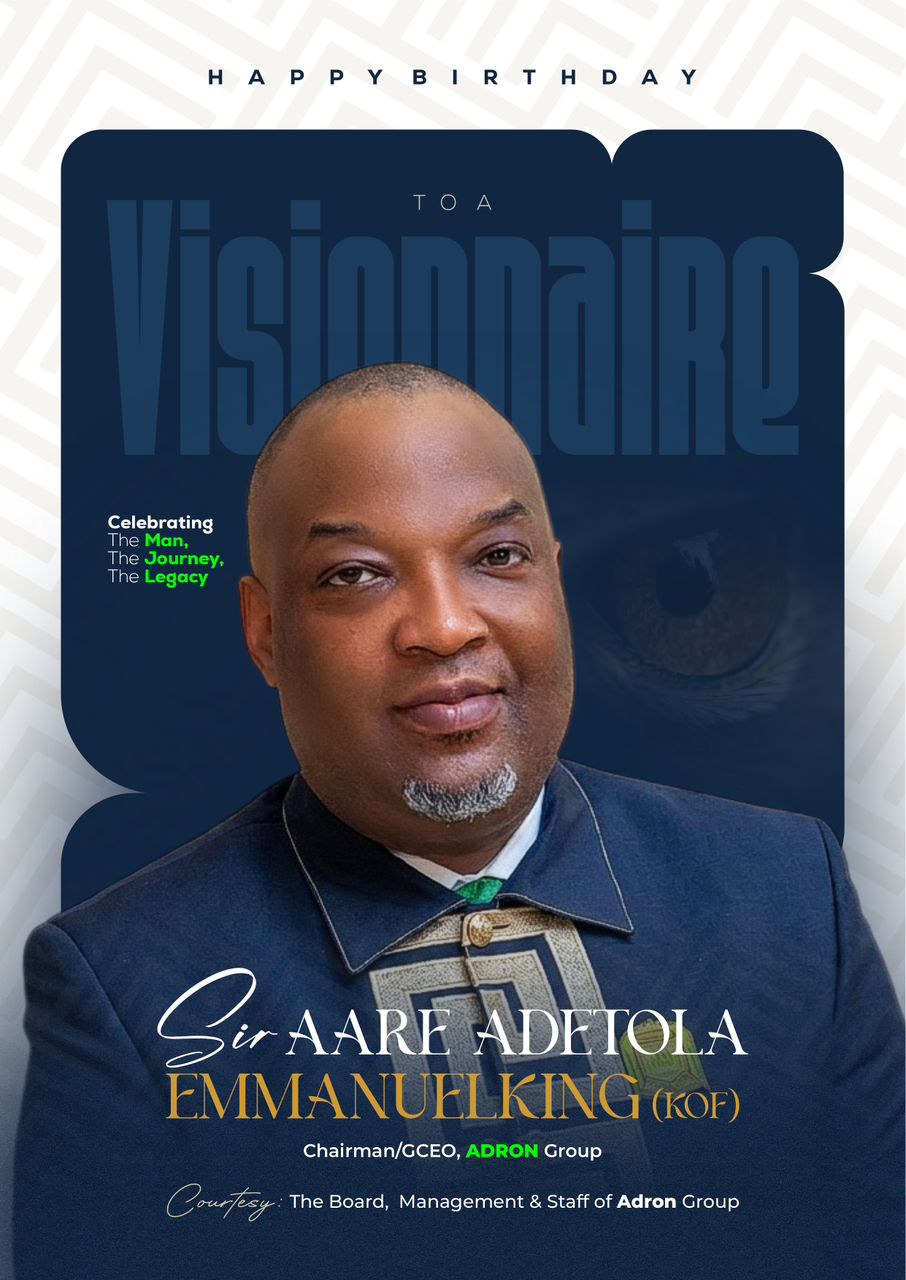
Adron Homes Celebrates Visionary Chairman, Aare Adetola Emmanuel King, at 51
The management and staff of Adron Homes and Properties Limited have joined family, friends, associates, and well-wishers across the globe to celebrate their Chairman and Chief Executive Officer, Aare Adetola EmmanuelKing, as he marks his 51st birthday.

In a statement released by the company, the milestone was described as a celebration of an exceptional leader whose vision, resilience, and entrepreneurial brilliance have not only transformed Adron Homes into a household name in Nigeria’s real estate sector but have also redefined affordable housing across the country.
Under his dynamic leadership, Adron Homes has continued to expand its footprint, delivering value-driven residential solutions while empowering thousands of Nigerians with opportunities for home ownership. His commitment to excellence, innovation, and customer satisfaction has remained the driving force behind the company’s sustained growth and industry leadership.
The statement further highlighted Aare EmmanuelKing’s passion for nation-building and community development, noting his significant contributions to job creation, youth empowerment, and the promotion of socio-economic development through real estate investments.
“As a leader, mentor, and visionary, Aare Adetola EmmanuelKing has consistently inspired a culture of excellence, integrity, and dedication within the organization. His ability to turn bold ideas into reality continues to position Adron Homes as a trailblazer in the industry,” the statement read.
The company expressed profound gratitude for his steadfast leadership and prayed for continued wisdom, strength, and sound health as he embarks on another year of impactful achievements.
As he celebrates his 51st birthday, the entire Adron Homes family proudly honours a man whose legacy continues to shape the future of real estate in Nigeria.
Happy 51st Birthday, Aare Adetola EmmanuelKing!
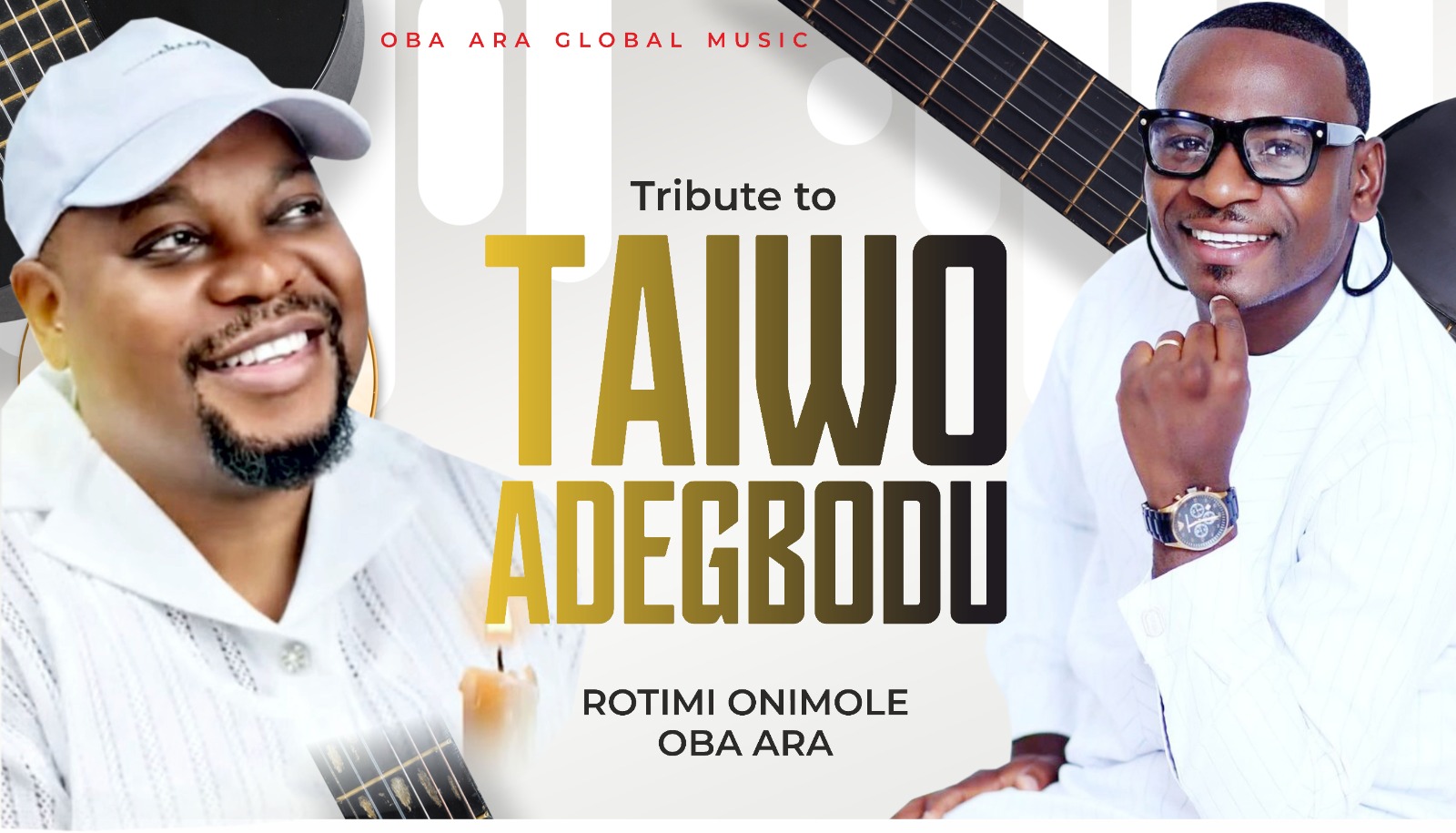
Oba Ara Releases Emotional Tribute to Late Taiwo Adegbodu
Taofik Afolabi
The gospel music community continues to grieve the painful loss of Taiwo Adegbodu, a beloved figure whose sudden departure left a deep void among fans, colleagues, and loved ones. In response to this loss, renowned gospel minister Rotimi Onimole, popularly known as Oba Ara, has released a moving tribute song that captures both the sorrow of the moment and the enduring legacy of the late singer.
Oba Ara, a proud son of Isale Eko, channels raw emotion throughout the song, using heartfelt lyrics and soul-stirring melodies to reflect on his personal connection with Taiwo Adegbodu. In the tribute, he openly expresses how deeply the news of Adegbodu’s passing shook him, describing it as a painful and unexpected loss that is difficult to come to terms with.
The song goes beyond mourning, it celebrates the life, ministry, and impact of Taiwo Adegbodu. Oba Ara highlights the late artist’s dedication to spreading the gospel through music, his inspiring voice, and the spiritual influence he had on many within and beyond Nigeria. Through powerful verses, he paints a picture of a man who lived for God and touched countless lives through his ministry.
Listeners have described the tribute as both comforting and deeply emotional, as it resonates with the collective grief of the gospel music community. It serves as a reminder that although Taiwo Adegbodu is no longer physically present, his music, message, and legacy will continue to live on.
In honoring his late colleague, Oba Ara not only pays his respects but also offers a source of healing for fans and fellow ministers, using music as a tool to process grief and celebrate a life well lived.
celebrity radar - gossips
Buratai, Fagbemi , Shagaya, Olofa, Others Eulogise Olowu Kuta’s Olori On 60th Birthday, Foundation Launch

Buratai, Fagbemi , Shagaya, Olofa, Others Eulogise Olowu Kuta’s Olori On 60th Birthday, Foundation Launch
Eminent personalities across the Nigeria stormed the TFK Event Centre, Bala Mohammed Way, Guzape, Abuja, to celebrate the 60th birthday of Olowu Kuta’s Olori, Queen Jumai Amoke and her Foundation Launch on Saturday 28, March 2026.

From former Chief of Army Staff, Lt Gen TY Buratai rtd, to the Minister of Justice and Attorney-General of the Federation, Prince Lateef Fagbemi; Olofa of Offa, HRM Oba Mufutau Gbadamosi. Even top businesswoman and socialite, Chief (Mrs) Bola Shagaya, was in attendance.


Other dignitaries were newly promoted Deputy Inspector-General of Police and former AIG Zone 2 , Lagos , Adegoke Fayoade, Major General Abdumalik, Major General Samuel Adebayo rtd (Fmr CDI);
Major General Anthony Omozoje rtd (Fmr Copp);
Alhaji Tajudeen Owoyemi (Asiwaju of Offa and CEO Radisson Hotel Nigeria;
Dr Waheed Olagunju, former managing director of Bank of Industry, Oniba of Iba, Lagos State, HRM Oba Dr Suleiman Raji ;
Justice Falola, Olu of Ile-Ogbo , Oba Adetoyese amongst many traditional rulers and captains of industry too numerous to mention.
Speaking at the occasion, the Chief Host, Olowu of Kuta, HRM Oba Dr Adekunle Oyelude Makama, CON , Tegbosun iii, who is also the husband of the celebrant commended Queen Jumai for ‘ her slender arms full of kindness’ to establish such humanitarian Foundation, ‘Amoke Children and mother in Need Foundation’ at a time Nigerians are going through economic crisis occassioned by the global meltdown.
Olowu also commended her steadfastness and love for the less privileged and downtrodden.
The monarch refrenced the task before his wife’s humanitarian gesture said her best is yet to come.
” Olori Amoke Jumai, I celebrate you. You will celebrate 70, 80, 90 and continue to shine as you continue to put a smile on people’s faces. I love you, “Olowu Kuta added.
To Lt Gen Buratai, a former army chief and former Nigerian Ambassador to Benin Republic, the reward of hard work is more work.
Buratai, who also doubles as Balogun Agba of Owu Kuta, a chieftaincy title reserved for a generalismo congratulated Queen Jumai for attaining the age of 60 in good health.
The retired army General said he’s not surprised by the turn out of eminent personalities across the country to celebrate the Olowu Kuta’s Olori because she merited it through her hospitality to all, adding that Allah the most merciful, most beneficial would accept all her act of ibadah.
The minister of Justice, Prince Fagbemi, was full of praises for Queen Jumai for deeming it fit to have a place in her heart to accommodate the needy and less privileged in ‘our society.’
Prince Fagbemi urged the guests to contribute generously to support the Foundation in order to continue to alleviate poverty and put a smile on the faces of the people.
” I congratulate you on your 60th birthday and Foundation Launch. I wish you many happy returns of the day and many more fruitful services to the country and motherland”, Prince Fagbemi added.
The celebrant, Queen Jumai who was grining from ear to ear thankfully said she was excited by the turn out and the response of the people to her foundation.
Queen Jumai, however, promised to continue to use her resources and donations received for the good of the needy and less privileged in the society.
” I want to appreciate my own Kabiesi Olofa of Offa , for his presence and im I’m using him as a point of contact to all other Kabiesis present here, the minister of justice and Attorney-General, you’re welcome, sir; Mrs Bola Shagaya, I salute your enterprise, Lt Gen Buratai, I’m grateful, sir; DIG Fayoade, Justice Falola and other dignitaries too numerous to mention, I thank you, all. To my darling husband, Kabiesi Olowu , I thank you immensely for your support. And to my family and friends, I thank you , all. E se pupo!”, she said.


-

 society7 months ago
Religion: Africa’s Oldest Weapon of Enslavement and the Forgotten Truth
-

 news4 months ago
WHO REALLY OWNS MONIEPOINT? The $290 Million Deal That Sold Nigeria’s Top Fintech to Foreign Interests
-

 society6 months ago
“You Are Never Without Help” – Pastor Gebhardt Berndt Inspires Hope Through Empower Church (Video)
-

 celebrity radar - gossips2 months ago
Dr. Chris Okafor Returns with Power and Fire of the Spirit -Mounts Grace Nation Altar with Fresh Anointing and Restoration Grace on February 1, 2026