
society
Oko Opo Foundation Takes Off With Food items, Cash Gifts To Over 100 Widows In Ogun

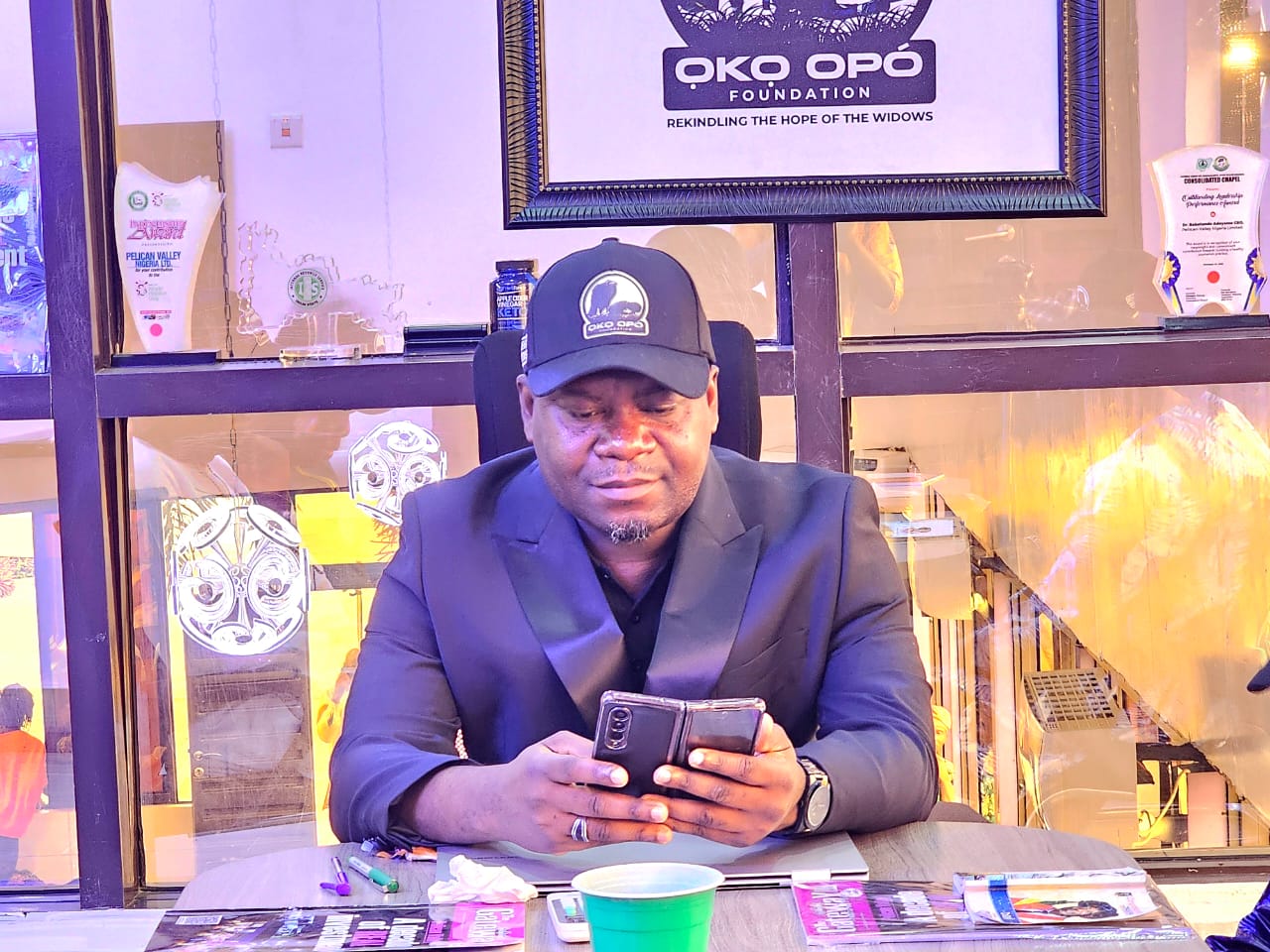
Oko Opo Foundation Takes Off With Food items, Cash Gifts To Over 100 Widows In Ogun
… Urges wealthy Nigerians to support less privileged
Ernest Nwokolo, Abeokuta
Excitement and joy suffused the faces of over 100 widows from across 18 communities in Ogun State on Boxing Day, Tuesday, December 26 as Oko Opo Foundation took off formally with food items and cash distributed to alleviate their plights and cushion the effects of widowhood and the current economic situation of the country.
The widows which had a free ride to and fro the venue of the launch at the Pelican Valley Estate Laderin, Abeokuta also benefited from health awareness and sensitization talk from experts on age related health condition as well as the appropriate response tips they needed to adopt in order to cope effectively.
An octogenarian widow, and the mother of the chief promoter of Oko Opo Foundation, Iya Adinni of Ginti Community Central Mosque Ikorodu, Alhaja Sidikat Adeyemo, also shared her useful experience to encourage her colleagues, advising them to be closer to God and fight off lack, boredom and despair by engaging in productive ventures and being people – oriented.
Similarly, a veteran broadcast journalist, Chief Eddy Aina urged the widows to pay more attention to their age, diet and health to prolong their lifespan, advising that with some of them having reached the age of 40 years and above, they should henceforth eat more of vegetables, fruits, unripe plantain, fish or crayfish and less of beef, salt, rice, gari, amala, yam and other sugary products because of their high sugar contents.
According to him, with old age setting in and the body system also losing its vigour and vitality in respect to food metabolism, high sugary food could spike blood glucose level, compound an existing diabetic condition or trigger one in someone.
Aina who noted that there is an estimated 15million widows in Nigeria, lamented the inhuman conditions some of them were being subjected to in parts of the country, especially in the South – East geopolitical zone of Nigeria, appealing to the governments and wealthy Nigerians to emulate Oko Opo Foundation and the Chief Promoter, Ambassador (Dr) Babatunde Adeyemo, by him joining hands with him to alleviate the suffering of Nigerian widows.
In the same vein, Mr. Lekan Jaji, an author and publisher, also spoke on “Acceptability” – a way of empowering the widows to accept the reality that their departed loved husbands had gone and would not physically return anymore.
He noted that getting into this phase of acceptability would the widow to move on with life and forge a new frontier instead of dwelling on illusion that leads to frustration and incapacitation of the will to function productively.
The event was preceded by a 45 – minute long Live Executive Media chat with executive members of the foundation – Dr. Babatunde Adeyemo, Mr Adeyemo Ibrahim; Secretary of the foundation and Mrs Titilayo Babs Adeyemo, Director and Mr Olukayode Olasehinde, the Brand Ambassador of Oko Opo Foundation.
The media chat was anchored by three of Chief Eddy Aina, Public Relations expert; Mr Tope Adaramola and Ernest Nwokolo of The Nation newspaper.
Speaking on the event, Dr. Adeyemo who remains highly impressed with the huge success the Oko Opo Foundation formal launch recorded, especially the sight of the overjoyed widows, said the passion to make things happen positively in this country and change the narratives informed the reason for the establishment.
The philanthropist who also doubles as the Chief Executive Officer of Pelican Valley Nigeria Limited, a foremost Nigerian real estate firm behind Pelican Valley Estate Laderin where unusual home happens, Pelican’s Brief Estate, Pelican Ecostay Apartments and Pelican’s Greenish Acre Farm Estate – all the three located at the Kobape – Masa corridor of Ogun State, revealed that the Foundation is a “covenant” between him and God.
He also revealed that he has expended almost N150million planning the project since the idea was conceived about 10 years ago, in addition to donating two acres of land towards providing housing in the future to the most vulnerable widows among them.
He said, “The motivation is simply the passion to make things happen in this country and to also change the narratives. I came from a very humble beginning, a very humble background where we suffered a lot. My father was a philanthropist, he was a senior civil servant, he spent almost 27 years in service but my Dad didn’t build a house of his own. He was busy using all his money to empower people. From my home town he empowered them, sent them to school. Unfortunately, he was retired suddenly and we moved from there into uncompleted building. We stayed in an unknown persons uncompleted building without electricity, doors and windows for about a decade.
“So, I was privileged to see a bush, a thick forest turning into a town. So, any thick forest that I see now, I don’t actually see the forest in there, I see the town in there. So, that actually motivated me towards establishing Pelican Valley Nigeria Limited. And something I learnt from my father as well is that there is no amount of money you have that can secure your future or secure the future of your children.
The only way you can secure your future is to invest in institution, invest in people. Those are the things that will stand the test of time. And here I’m today, I’m not a multi billionaire but I’m contented with what I have and I see reason for me to touch the heart of people positively.
“We still have people that have billions but could not do what we are doing. It is in the blood. It is hereditary. For example, most of my staff, apart from given them their salary, I give them daily stipends because I can’t afford to work with somebody that is hungry. So, the same integrity we have brought into real estate. We are one of the best in Ogun State right now. We are the Omoluabi in the real estate business. We have been into this business for almost 14 years without a single court case and I have four lawyers under my retainership. We have 100% positive reviews and we are still pushing on on this.
“So, I want to bring those integrity and goodwill to help the widows and I’m doing this to live by example. I have committed over N150million of hard earned funds into this project. This building that is called The Podium where the programme is being formally unveiled was purposely built for the foundation. We spent almost N150million to put this place together. It was long term project, I conceptualised this project in the last 10 years and I have been systematically working to achieve it.
On What Others Should Do?
“We are just using this opportunity and avenue to call on people of like minds to join us, to join this crusade. This is not about somebody looking for what to eat. Like the Pelican bird, the spirit of Pelican is, ‘ working together to empower ourselves. We are building this to work together to empower the less privileged in the society. This is not a short time affairs. In the long time projection, I have donated about two acres of land that we are going to use to build houses, one bedroom short let apartment for the most vulnerable widows who don’t have roof over their heads among other plans we have for the widows.
Why Are Some Wealthy People Not Helping ?
Actually, poverty is a thing of the mind. That is why you see people that are rich still stealing and looting the treasury. It is a thing of the mind. I believe we need to change the narrative, we need to open our heart, we need to open our mind. We are too comfortable in Nigeria and God is not even challenging us, we don’t have that challenge. For example, take a look at our weather. Our weather is so friendly that it is not challenging. I was in UK about few weeks ago , I couldn’t come out because of the harsh weather. I was just wondering if electricity is not a necessity there? You can’t live without having a warmer in your house. Imagine we have that kind of weather in Nigeria, we don’t have any choice than to fix our electricity. It shows that it is actually by choice we are not having electricity. If we want it to happen when it becomes very important for us to have it, we will have it. The same thing happens to the issues of giving alms. It is a thing of the mind. For example, there was a time when I started the Pelican, I had huge amount in my account. I was then left with either gallivanting about and buy G – Wagon with that huge amount or investing it for people to have value for what they had paid for, do electrification for them. I had to choose one. I don’t want to play with my integrity, I don’t want to get myself involved something I won’t be able to point my finger and say, this is what I’m doing. I spent all the money on electrification project and infrastructure development. Presently, our estates are the only ones that have government approved layout in the first four years of the presentadministrationinOgun State. I have spent double of what my clients have contributed as development levies on our Estates infrastructures. I have spent over N350million on infrastructure at Pelican Valley Estate alone. Those are long term projects and investments I believe it will bring lots of funds into our pockets in the nearest future.
Concerning Our Leaders
Average Nigerian or leader in Nigeria should have that kind of disposition. There is no amount of money that you can keep in your account that will secure your future. It is only by investing in institution and people that you can secure your future. If most of our leaders can think in that perspectives, the future of Nigeria will be bright.
Why Using Boxing Day To Empower Widows?
I’m just been directed by God and by my spirit. I just thought over it and felt I should do it on Boxing Day. I’m a muslim and a liberal one but I believe in the teachings of all the Prophets of God and as it is instructed in the Holy Quran that we should obey God and the Prophets.
Jesus Christ is a Prophet as recorded in the Quran, we just have to emulate the gestures of the Prophets. Oko Opo Foundation is not coming by accident, it is an ambition we have been nursing for about 10 years now, meticulously preparing for it. It took me almost eight years to put The Podium we are using for the foundation. We are trying to live by example.
“It is not all about politicking, I’m not interested in politicking and I don’t want to do anything like politics, I just want to do something that directly touches the life of people positively. That is the rational behind the setting up of Oko Opo Foundation.
Most of the widows normally have two major health problems. One of them is acceptability. Once they lose their loved ones, to accept the fact that that person is gone is always very difficult for them. They always live in the past and if you are living in the past, it will be difficult to move forward or forge ahead.
So, once you help them accept the situation they are in now, it becomes easier for them to cope and do the necessary adjustment. And that is why we are brought experts to guide them. Once you fail to accept, it throws up other health challenges. We want them to know all those health challenges, most of them are elderly people, we want to know about momentary forgetfulness(amnesia) due to old age. This is even necessary for their caregivers so that if any is developing or manifesting such symptom, people will not label the person a witch or wizard. That is what we are trying to do.
We are calling on every wealthy Nigerians, excluding the politicians, to add value to what we are doing because I don’t want what we are doing to be an instrument of politicking. I’m not interested in politics. I want to try as much as possible to make a mark with this Foundation and I’m ready to donate major part of my resources towards alleviating the suffering of the widows.
“It is unfortunate that we find ourselves in this kind of situation. We are just being over joyous in Nigeria. We are damn too comfortable. Nature puts us in this kind of situation. I was in London few weeks ago and I realised that electricity is a necessity in London.





society
Grace Nation: Harvest of Babies 2026 Records Miracle Birth and Dedication of Twins as Conference Concludes
“Guard your fruitfulness—identify and avoid distractions.”
The 2026 edition of Harvest of Babies, the flagship family liberation conference of Grace Nation Global, concluded with remarkable testimonies, including the reported safe delivery of a baby boy during the programme and the dedication of multiple “miracle babies.”
Miracle Delivery and Baby Dedications
One of the standout testimonies involved a woman whose pregnancy had gone beyond term and was reportedly scheduled for surgery. According to accounts shared during the conference, she was prayed for after being identified during one of the sessions. She later delivered a healthy baby boy without complications during the course of the event.
The conference also witnessed the dedication of several children described as long-awaited blessings, including twins after 15 years, a baby boy after 9 years, and a baby girl after 7 years. The dedications formed a major highlight of the closing moments of the programme, reinforcing the conference’s focus on fruitfulness and restoration.
Teaching on Fruitfulness
Continuing his teaching series on “Fruitfulness,” the Generational Prophet of God and Senior Pastor of Grace Nation Worldwide, Dr Chris Okafor, emphasized the importance of addressing the root causes of life’s challenges.
“If the cause of a battle is not confronted, the cycle may continue,” he said, adding that spiritual discipline—particularly prayer—remains a key tool in overcoming limitations such as barrenness, whether physical, financial, or generational.
He described prayer as a necessary channel for divine intervention, stressing that understanding one’s spiritual foundation is essential to overcoming recurring challenges.
Guarding Your Fruitfulness
Dr. Okafor also warned about distractions that may hinder progress, urging believers to remain focused on principles that sustain growth and fulfillment.
“Every kingdom operates by principles,” he noted. “If you allow distractions around you to take your focus away from those principles, you may delay your manifestation.”
He encouraged participants to be intentional about their environment, relationships, and spiritual discipline in order to maintain their breakthroughs.
What Hinders Fruitfulness?
The cleric identified curses and ignorance as major obstacles to fruitfulness. According to him, some challenges may stem from longstanding family patterns, but these can be broken through spiritual understanding and alignment.
He reiterated that blessings—particularly those pronounced through spiritual authority—have the capacity to reverse negative cycles and establish fruitfulness.
“Ignorance allows problems to persist,” he said. “But when you gain understanding and follow divine instruction, transformation begins.”
Looking Ahead
Although the 2026 Harvest of Babies conference has ended, organizers say the testimonies and experiences from the event will have a lasting impact. Many participants expressed faith that by this time next year, they will return with their own testimonies of fruitfulness.
The conference closed on a note of expectation, with attendees looking forward to future editions and continued manifestations of what they described as divine intervention. By Sunday Adeyemi [email protected]


society
GEN CHRISTOPHER GWABIN MUSA SUPPORT INITIATIVE EXTENDS WARM BIRTHDAY FELICITATIONS TO PRESIDENT TINUBU ON 74TH BIRTHDAY
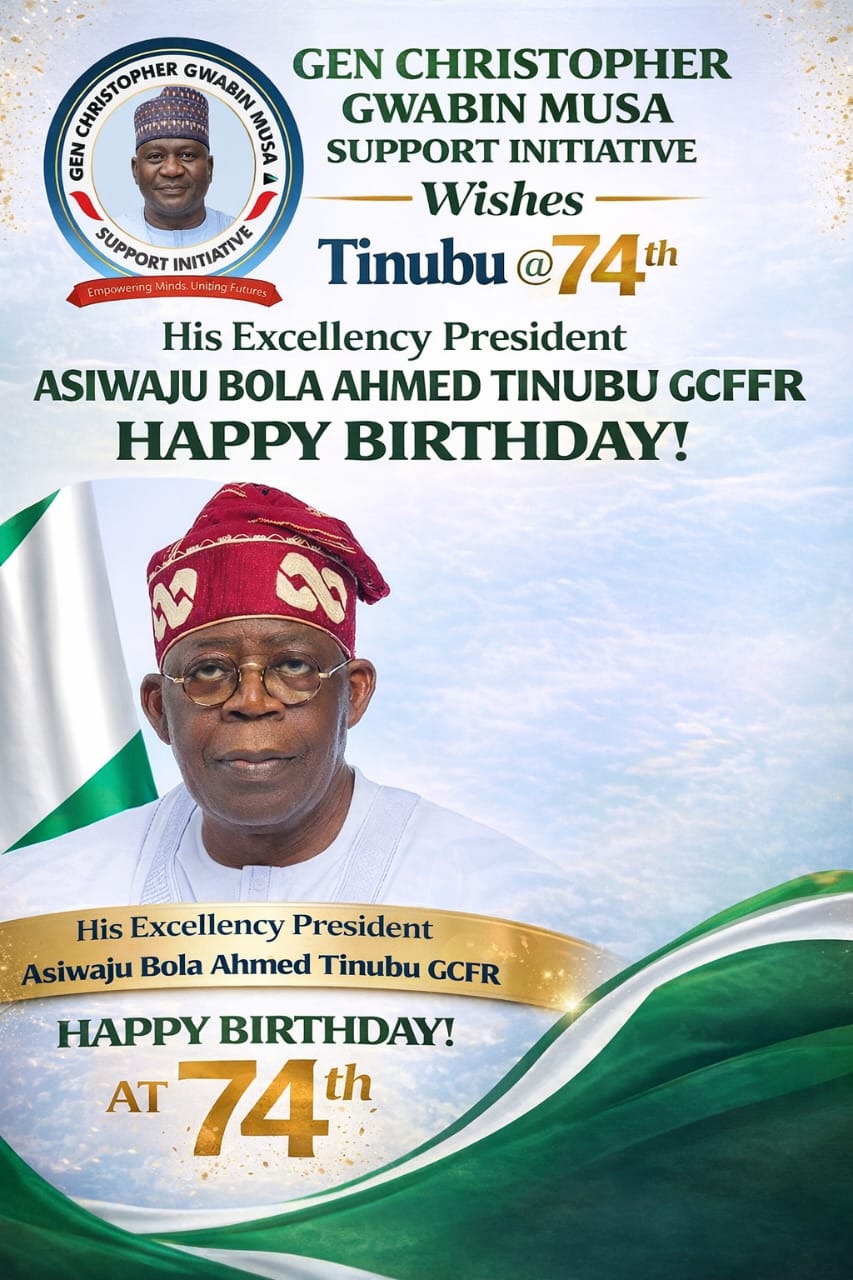
GEN CHRISTOPHER GWABIN MUSA SUPPORT INITIATIVE EXTENDS WARM BIRTHDAY FELICITATIONS TO PRESIDENT TINUBU ON 74TH BIRTHDAY
The Gen Christopher Gwabin Musa Support Initiative has extended heartfelt congratulations to His Excellency President Asiwaju Bola Ahmed Tinubu, GCFR, on the occasion of his 74th birthday.
In a statement released to the press, the Initiative conveyed warm wishes for the President’s personal well-being and for his continued leadership of the nation. The statement, signed by the Convener, Ibrahim Dahiru Danfulani, Sadaukin Garkuwan Keffi/Betara Biu, expressed hope that the coming year would bring the President “renewed strength and more wisdom in guiding the nation.”
The statement further noted that the Grand Patron of the Initiative, His Excellency Gen Christopher Gwabin Musa, OFR, Minister of Defence of the Federal Republic of Nigeria, joined in celebrating the milestone. It added, “Wishing Your Excellency continued good health, vitality, and determination as you lead the country towards greater unity and progress.”
The message underscores support for President Tinubu’s administration and its national objectives, marking the birthday as an occasion to reaffirm commitment to the nation’s unity and advancement under his stewardship.
society
Dominion City to Host Global Camp Meeting, “2 Nights of Glory” 2026 in Lagos, Enugu …Calls for Moral Renewal
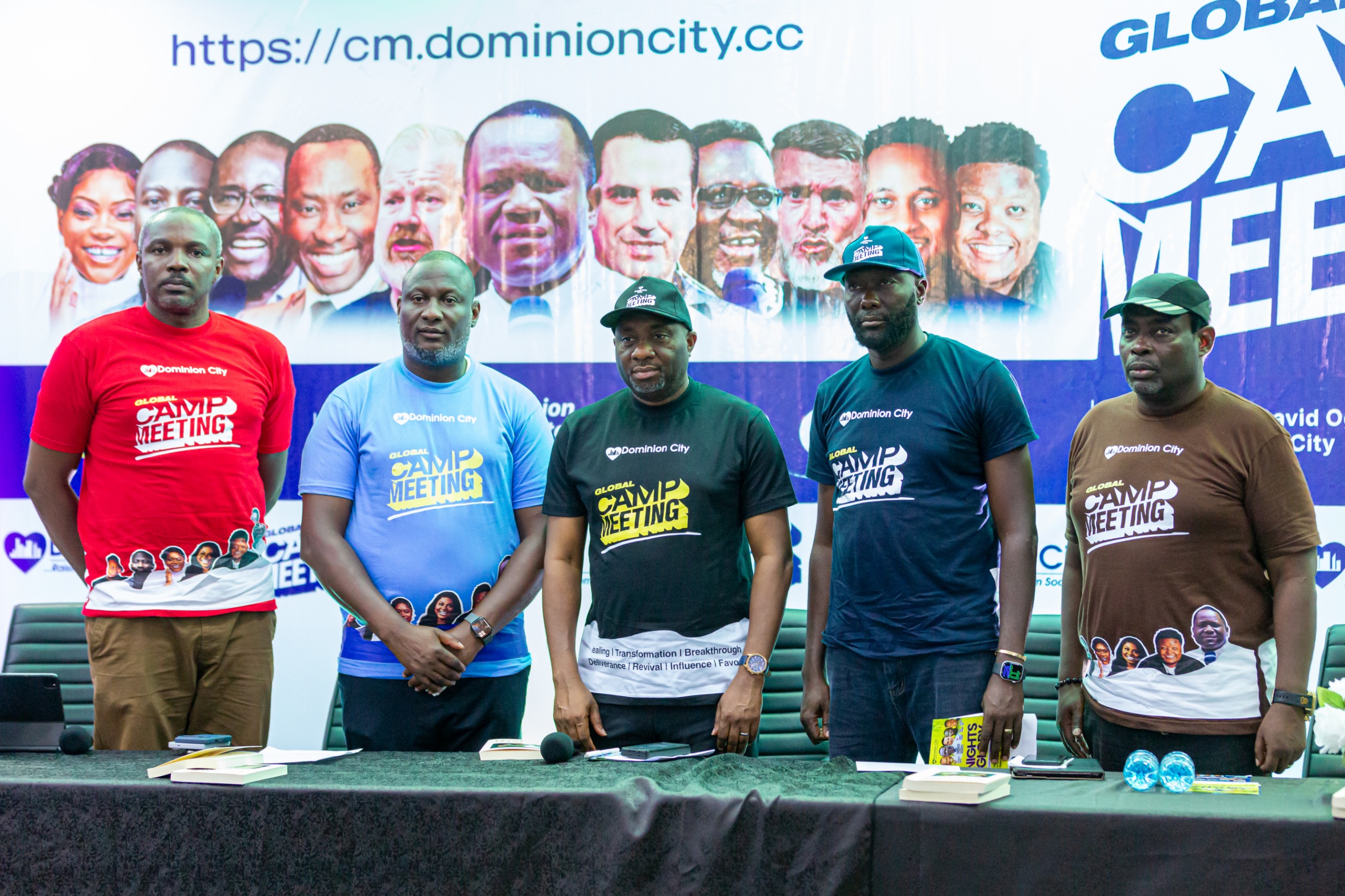
*Dominion City to Host Global Camp Meeting, “2 Nights of Glory” 2026 in Lagos, Enugu
…Calls for Moral Renewal
Lagos – Dominion City has announced plans to host its annual Global Camp Meeting alongside a special “2 Nights of Glory” gathering in April 2026, with events scheduled to be held simultaneously in Lagos and Enugu.
The week-long programme is expected to draw tens of thousands of participants onsite and millions of virtual attendees from across the globe.
The Global Camp Meeting will run from Wednesday, April 1 to Monday, April 6, featuring daily sessions at 8:00 a.m. and 5:00 p.m. The “2 Nights of Glory” is slated for Friday, April 3 and Saturday, April 4 at the Golden Heart Place, Km 22 Lekki-Epe Expressway, beside Lagos Business School, Ajah, Lagos.
Organised by Dominion City, a global church focused on raising transformational leaders, the conference will centre on revival, spiritual renewal, and practical teachings. This year’s theme, “Redigging the Wells of Our Fathers,” underscores a call to return to foundational values and principles.
Speaking ahead of the event, Nobbert Onaga, President, Golden Heart Foundation and Senior Pastor, DC Lagos & Europe, emphasised the need for moral reawakening as a pathway to national transformation. He described the Church as “the pillar and foundation of truth,” noting that the conference aims to confront moral decline and restore core values within society.
“We are going back to foundational truths that established the Church. These truths will help repair societal damage and reposition the Church as a source of hope and light,” Onaga said.
Also speaking, Shola Olapade, Senior Pastor of Dominion City Headquarters, highlighted the Church’s role in addressing ethical and cultural challenges, particularly among young people. He added that the programme would go beyond spiritual teachings to include sessions on artificial intelligence, innovation, business, media, arts, and career development.
“We are equipping people not just spiritually, but with relevant 21st-century skills to thrive in today’s world,” Olapade noted.
The conference will feature teachings and ministrations from a lineup of international ministers, including Dr. David Ogbueli, Dr. Charles Ndifon, Andres Bisonni, Pastor Randy Mitchell, Apostle Ikechukwu Peter Nnajiofor, Dr. Ferdinand Nweke, Apostle Ben Hanyani Ndobe, Evangelist Dan Scott, and Dr. Chiefo Ejiofobiri.
Music ministrations will also be led by notable gospel artists such as Grace Idowu, Rhema Onuoha, Once More Six, David Nkennor, Anthony Kani, and GUC.
Organisers disclosed that over 30,000 participants are expected to attend in person, with free transportation provided from designated locations across Lagos to ease access. In addition, free medical services will be offered daily, building on previous outreaches that benefited over 1,700 people.
To ensure safety and order, more than 200 traffic marshals will be deployed in collaboration with relevant authorities.
Beyond its spiritual impact, organisers project that the event will stimulate local economic activity across hospitality, transportation, and retail sectors.
The Global Camp Meeting remains a key platform for spiritual impartation, leadership development, and societal transformation, aligning with Dominion City’s mission to equip believers to influence their communities positively.
Participation is open to the public, with registration available online for both physical and virtual attendance. //END.//
*PHOTO CAPTIONS:*
L-R: Dr. Godwin Efobi, Head, Medical Team, Dominion City Headquarters (DCHQ); Pastor Shola Olapade, Senior Pastor, DCHQ; Pastor Nobbert Onaga, President, Golden Heart Foundation and Senior Pastor, DC Lagos & Europe; Pastor Chuks Anochie, Head of Security and Traffic Control, Dominion City Headquarters (DCHQ), Camp Meeting 2026; Pastor Josh Tim Vaduchi, Head of Event & Programmes, DCHQ, during the press briefing of the forthcoming Global Camp Meeting, held the weekend of 2026 at the Dominion City Headquarters (DCHQ), Lagos.
L-R: Pastor Chuks Anochie, Head of Security and Traffic Control, Dominion City Headquarters (DCHQ), Camp Meeting 2026; Pastor Shola Olapade, Senior Pastor, DCHQ; Pastor Nobbert Onaga, President, Golden Heart Foundation and Senior Pastor, DC Lagos & Europe; Dr. Godwin Efobi, Head, Medical Team, DCHQ; and Pastor Josh Tim Vaduchi, Head of Event & Programmes, during the press briefing of the forthcoming Global Camp Meeting, held over the weekend in 2026 at the Dominion City Headquarters (DCHQ), Lagos.


-

 society6 months ago
Religion: Africa’s Oldest Weapon of Enslavement and the Forgotten Truth
-

 news4 months ago
WHO REALLY OWNS MONIEPOINT? The $290 Million Deal That Sold Nigeria’s Top Fintech to Foreign Interests
-

 society6 months ago
“You Are Never Without Help” – Pastor Gebhardt Berndt Inspires Hope Through Empower Church (Video)
-

 celebrity radar - gossips2 months ago
Dr. Chris Okafor Returns with Power and Fire of the Spirit -Mounts Grace Nation Altar with Fresh Anointing and Restoration Grace on February 1, 2026